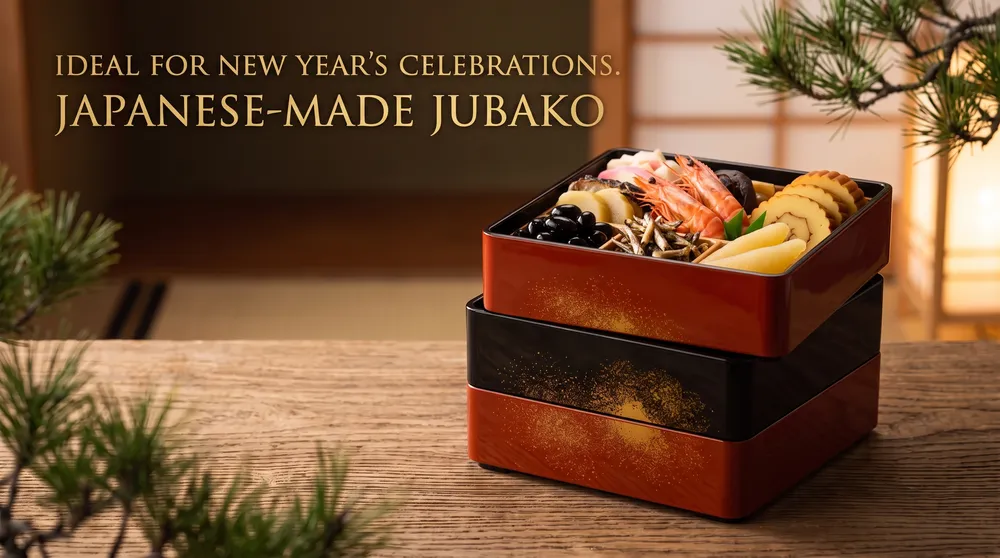
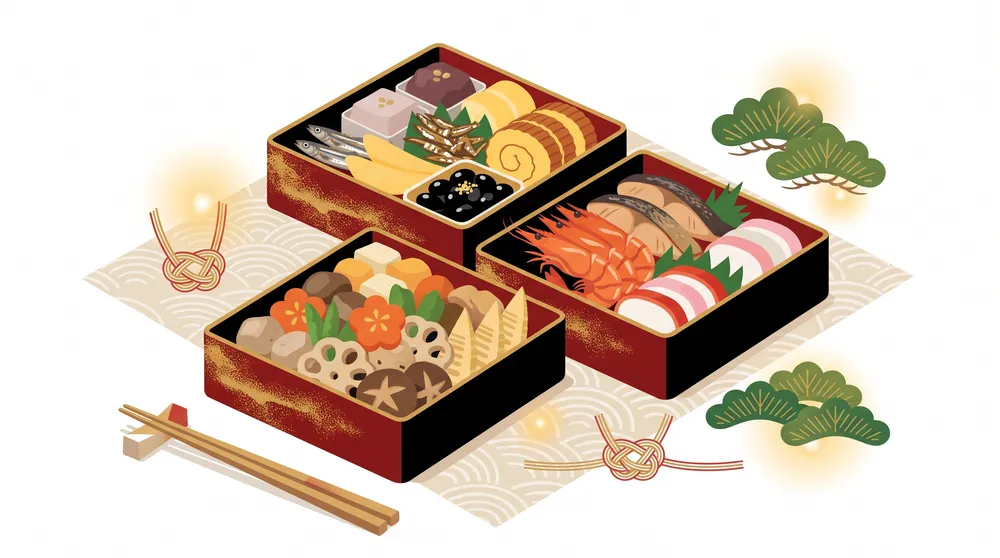
A three-tier jūbako is not three boxes of the same food. Each tier has
assigned contents, fixed by convention: appetisers on top, grilled and vinegared dishes in the
middle, simmered vegetables at the bottom.
The stack is a menu. That is why the formal count is three — not because three
holds the right amount, but because a New Year meal has three kinds of dish in it.
Which matters if you are not making osechi. Buy the formal three tiers for a meal
that does not have three parts and you have bought two empty boxes. Buy for what you
actually serve.
Quick Reference: What Goes in Each Tier
| Tier | Holds | Examples |
|---|---|---|
| First (top) | Celebratory appetisers | Black beans, herring roe, candied sardines |
| Second | Grilled and vinegared | Yellowtail, prawns, pickled vegetables |
| Third (bottom) | Simmered | Root vegetables braised in dashi |
| Sizing runs in sun. Six sun is about 18 cm across and feeds three or four people — the useful size for almost everyone outside a Japanese New Year. | ||
Why Three, and Why You Probably Want Two
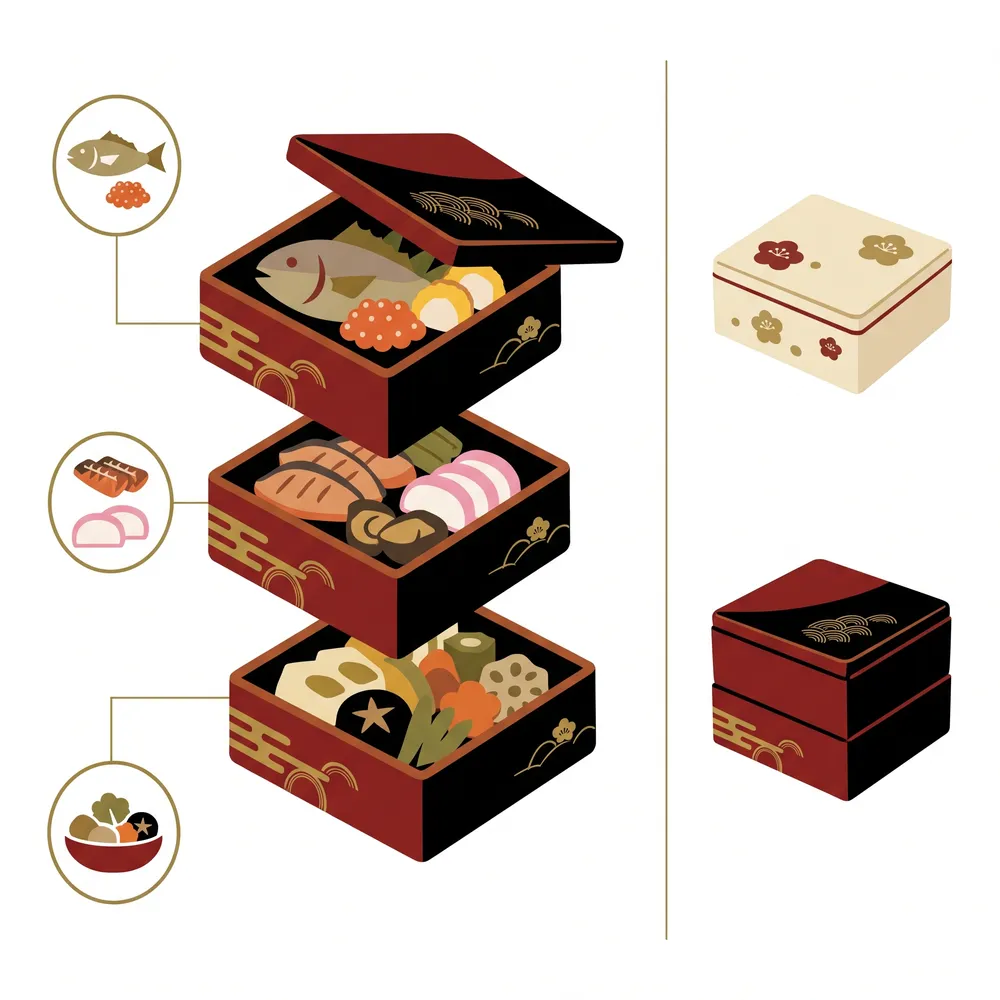
The tiers exist because osechi — the New Year meal — is composed of categories, and each category gets its own box.
That also keeps the food apart. Vinegared dishes do not leak into simmered ones, dry things stay dry, and the whole meal can sit at room temperature over several days, which is the original purpose: food prepared in advance so nobody has to cook during the New Year.
The formal number has varied by region and era, and three is the modern standard. One and two tiers are increasingly common in Japan too, simply because households are smaller than the convention assumes.
So here is the honest advice for a reader outside Japan.
If you are making osechi, buy three. The structure is the point and it will work
exactly as designed.
If you are not — and you are buying a beautiful box you like the look of — buy one or
two. A two-tier jubako gets used for picnics, for a party spread, for taking food to
somebody. A three-tier gets used once and then stored, which is a lot of lacquer to keep
in a cupboard.
Size: The Sun System
Jubako are sized in sun, a traditional unit of about 3 cm, and the number refers to the width of the square.
- 5 sun — about 15 cm. Two people, or one tier as a lunch box.
- 6 sun — about 18 cm (7 in). Three to four people. The size most people should buy.
- 6.5 to 8 sun — 20 to 24 cm. A family New Year, and large enough that a full three-tier stack is heavy.
Listings abroad usually give centimetres or inches, so you may never see the word — but if you do, that is what it means.
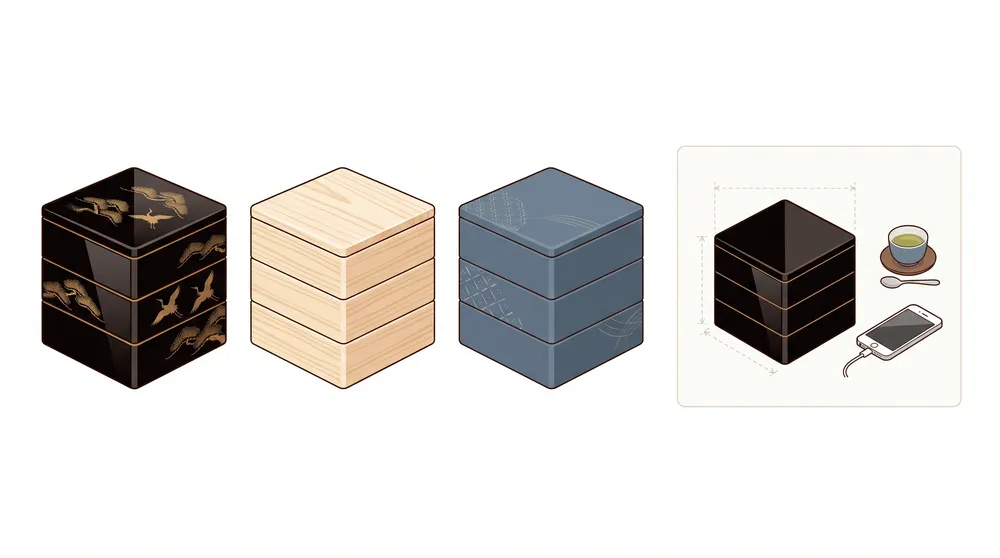
Err smaller than the guidance suggests. A jubako is filled densely and
deliberately — the food is packed in, not spooned in loosely — so a box holds
considerably more than its dimensions imply.
A half-empty tier also looks wrong in a way that a half-empty bowl does not,
because the whole aesthetic is a filled grid.
Why Japanese — and How Much Lacquer You Need
A jubako is a box that has to be airtight enough to keep food for days, light enough to carry stacked, and beautiful enough to be the table setting. Wood coated in urushi does all three, which is why the form settled on it centuries ago.
The properties of urushi, the differences between Wajima, Yamanaka and Aizu, and the detailed care rules are covered properly elsewhere on this site — this section is only about how much of it a jubako buyer actually needs.
Real lacquered wood is the beautiful and expensive answer, and it is genuinely
better to eat from and to look at. It is also the one with rules — no
dishwasher, no microwave, no soaking, no direct sun.
Lacquered resin is the honest middle: it looks close, costs a fraction, and can
be washed without thinking. Sellers who describe it accurately are doing you a
favour, and for a box used once a year it is not a foolish choice.
What to avoid is the one that does not say which it is.
What to Buy
Echizen lacquer — the proper one
Echizen in Fukui is one of Japan's major lacquer districts, and its
three-tier jubako are finished with maki-e — designs painted in lacquer and dusted
with gold — under a final clear coat and polish.
These are sized for two to three people, which for a Western household is
usually the right call even in three tiers.
- Origin
- Echizen, Fukui
- Finish
- Lacquer with gold maki-e
- Serves
- Two to three
- Care
- Hand wash, no microwave, no dishwasher
Lacquered three-tier, made in Japan, everyday price
A plain black or red three-tier box, made in Japan, at a price that does not make you
anxious about using it. No gold work, no decoration — which is arguably better if
you are going to fill it with things other than osechi.
The plain finish is also the more versatile one. A gourd-and-pine design
reads as New Year; a plain black box reads as a serving dish.
- Tiers
- Three, stacking
- Made
- Japan
- Colours
- Black or red
- Best for
- Using rather than displaying
There is also a lacquered-plastic version, made in Japan and sold as exactly that.
It costs very little, it goes in the dishwasher, and nobody at the table will inspect it.
For a box you will open once a year, that is a defensible choice — and a seller
who writes "plastic lacquered" on the listing rather than burying it deserves the sale.
The problem is never resin; it is resin sold as if it were not.
The Other Eleven Months
If you are outside Japan, this is probably the main use rather than the exception. A jubako is a stacking, lidded, rigid serving box — which is a genuinely useful object regardless of what day it is.
- Picnics and outdoor eating. Rigid sides mean nothing gets crushed, and the lid means you carry and serve from the same object.
- Taking food to somebody. Far better than foil trays, and you get the box back — which is a small social contract in itself.
- A party spread. Unstack the tiers and you have three matching serving trays; stack them again to put the leftovers in the fridge.
- Sushi and sashimi at home. The shallow depth suits laid-out food, and the black interior is a good background for fish.
- Cake, biscuits, or a mixed dessert board, which is what the compartmented Japanese aesthetic is really for.
The stacking is the underrated part. Three serving dishes take three shelves; three tiers of a jubako take one — and go from the fridge to the table without being transferred.
Care, Briefly
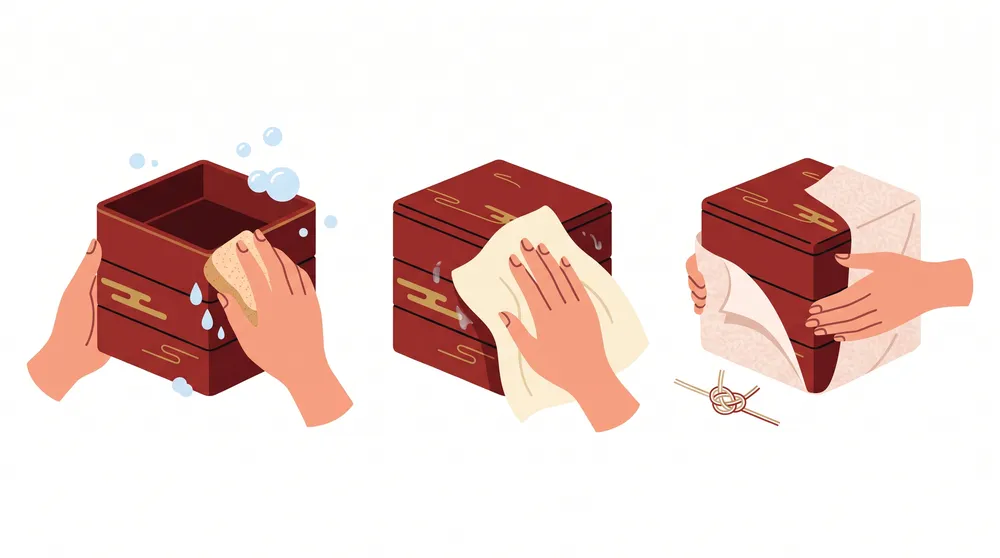
- Hand wash in warm water with a soft sponge. Mild detergent is fine; abrasives are not.
- Never the dishwasher or the microwave. Heat and the lacquer surface are incompatible.
- Do not soak it. Wash, rinse, dry immediately with a soft cloth.
- Keep it out of direct sunlight, in storage as well as in use — UV degrades lacquer.
- Store with paper between the tiers so the stacked surfaces do not rub, and somewhere that does not get very dry.
The detailed version of all this is in our lacquerware guides, which cover why these rules exist rather than just listing them.
Frequently Asked Questions
How many tiers should I buy?
Three if you are making osechi, because each tier holds a different category of
dish. Appetisers, then grilled and vinegared, then simmered.
One or two if you are not — a smaller box gets used through the year, and a
three-tier bought for its looks tends to live in a cupboard.
What size fits a small household?
Six sun, about 18 cm square, feeds three to four people. Five
sun (15 cm) suits two.
Err smaller — jubako are packed densely rather than filled loosely, so they
hold noticeably more than the dimensions suggest.
Lacquered wood or lacquered plastic?
Wood if you will use it often and enjoy looking after it; resin if it comes out once a
year. Resin washes in a machine and costs a fraction.
The only wrong answer is a listing that does not say which it is, since the
price difference between them is very large.
Can it go in the dishwasher or microwave?
Lacquered wood: neither, ever. Heat damages the lacquer film and the wood
beneath it, and the damage is not repairable at home.
Lacquered resin is usually fine in a dishwasher and will say so — check the
specific product rather than assuming.
Can I use it for things other than osechi?
Yes, and outside Japan that is the sensible plan. It is a stacking lidded
serving box: picnics, party food, taking a dish to someone, sushi at home.
Unstacked it gives you matching trays; stacked it goes into the fridge taking
one shelf instead of three.
Why does osechi keep for days at room temperature?
Because it is cooked to keep — heavily seasoned, sweetened, vinegared or
simmered down, all of which were preservation methods before refrigeration.
The point was that nobody had to cook over the New Year, and the box's separate
tiers keep the wet and dry dishes from ruining each other.
Final Thoughts: Buy for the Meal You Will Serve
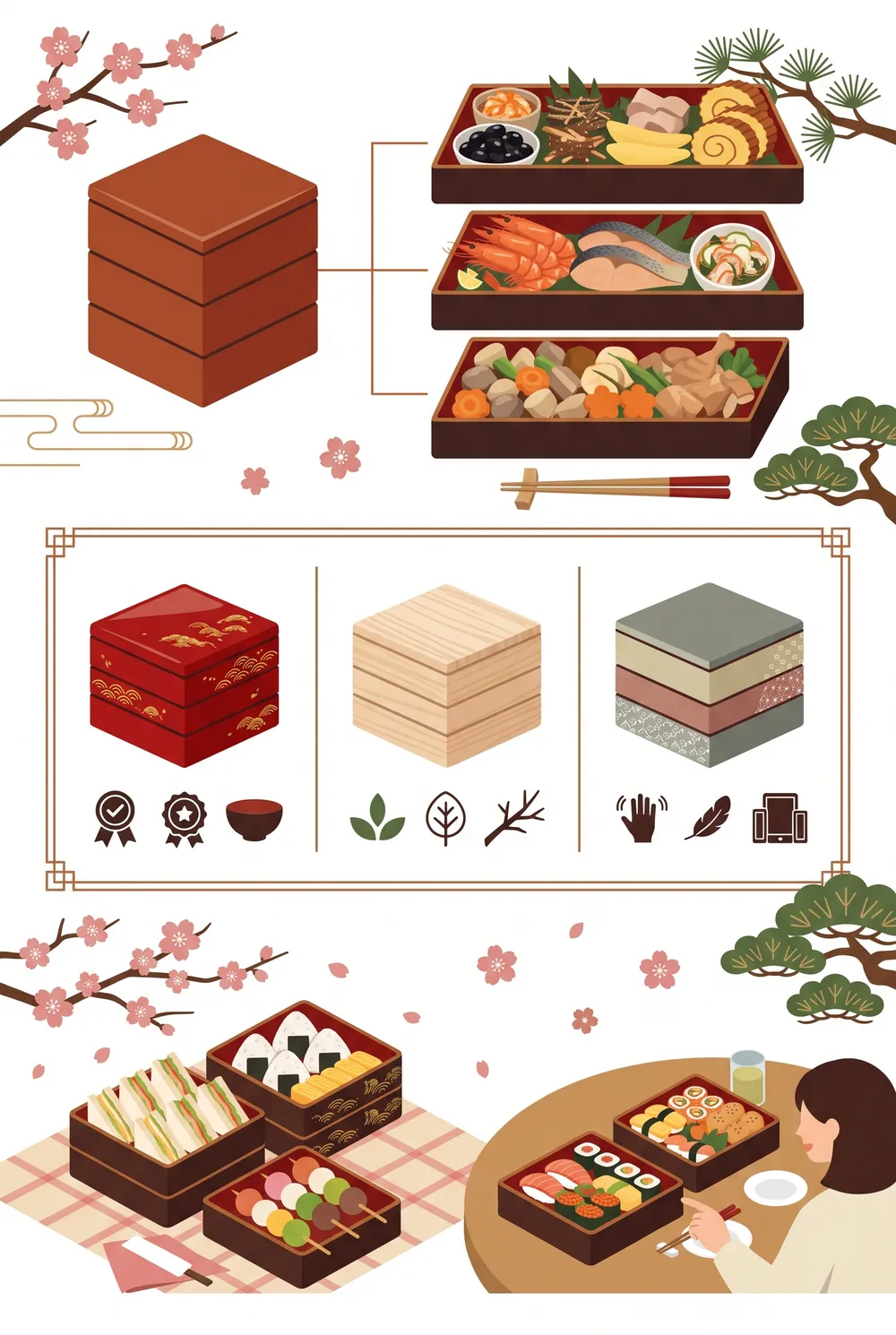
The three tiers are not a quantity, they are a structure — appetisers, grilled and vinegared, simmered — and that structure belongs to one specific meal eaten on one specific week of the year.
If that is not your meal, the structure is not doing anything for you. Buy two tiers at six sun, in plain lacquer, and use it for picnics and for taking food to people.
It is a rigid, stacking, lidded box that is beautiful enough to serve from. That is worth owning in any month.

Urushi: Japan's Natural Lacquer, Its Properties & Care Guide
Japanese Lacquerware: Wajima vs Yamanaka — Top 5 Urushi Brands