Japan produces about 6% of the honey it eats. The other 94% is imported.
Which makes "Japanese honey" one of the few cases where a country-of-origin label is a statement
about scarcity rather than marketing — and it explains the price before anyone has to defend
it.
There is also a genuinely different bee involved. The native Japanese honeybee is a separate
species from the one kept everywhere else, it produces a fraction as much honey, and it is
the one you have seen on television cooking hornets alive.
Quick Reference: What to Check on the Jar
| Check | What you want |
|---|---|
| Ingredients | Honey. One word, nothing else |
| Heat treatment | Raw / unheated — aroma survives |
| Flower source | Named, not just "blossom" |
| Bee species | Nihon mitsubachi if you want the rare one |
| Never give honey — of any kind — to a child under 12 months. Raw or pasteurised, imported or domestic. This is a botulism risk and it is not negotiable. | |
Six Per Cent, and Why That Is the Whole Story
Japan's honey self-sufficiency rate is around 6%. In 2024 the country imported roughly 45,000 tonnes, with China the largest supplier and further volume arriving from New Zealand, Canada, Argentina and Hungary.
So when a Japanese jar says kokusan — domestic — it is describing something that
makes up a twentieth of the market.
That is unusual. Most "made in Japan" claims are about how a thing was made.
This one is about how little of it there is, and it is why domestic honey costs
three to five times what a supermarket jar does.
The reason is land, not skill. Japan is mountainous and forested, farmland is fragmented, and there is simply not much of the continuous open flowering acreage that industrial-scale apiculture needs. Beekeeping there is a small-scale business by geography.
Which also tells you what to expect in the jar: small batches, named flower sources, a specific region — and none of the consistency that comes from blending thousands of tonnes. Two jars of the same product from different years will not taste identical. That is the trade you are making.
Why Japanese — A Different Species of Bee
Most of the world's honey comes from Apis mellifera, the Western honeybee. Japan keeps it too — most Japanese honey is from mellifera. But Japan also has a native species, Apis cerana japonica, the Japanese honeybee, and honey from it is a genuinely separate product.
It produces far less
Apis cerana yields roughly 5 to 25kg of honey per colony per year, well below what a Western honeybee colony gives. The colonies are smaller and they swarm more readily, which means a keeper loses bees more often.
So the scarcity is structural rather than manufactured. You cannot scale up a species that produces a fraction as much and leaves when it feels like it.
And it is the bee that cooks hornets
You have almost certainly seen this. When an Asian giant hornet approaches the nest, several hundred Japanese honeybees engulf it in a tight sphere and vibrate their flight muscles, raising the temperature at the centre of the ball to 46–47°C.
Hornets die between 44 and 46°C. The bees tolerate slightly more. Carbon dioxide
builds up inside the ball as well, and the hornet is dead within twenty to thirty minutes.
The Western honeybee has no equivalent defence at all and is largely helpless
against a mass hornet attack. It is a real biological difference between the two species — and it
happens to be the most memorable way to explain why the honey is not the same product.
Japanese honeybee honey is usually sold as hyakka — hundred-flower, or multifloral — because the bees forage widely from whatever is in bloom rather than being moved to a single crop. It tends to be darker, more complex and more acidic than single-source mellifera honey, and it is expensive even by domestic Japanese standards.
Raw or Heated, and What "Pure" Means
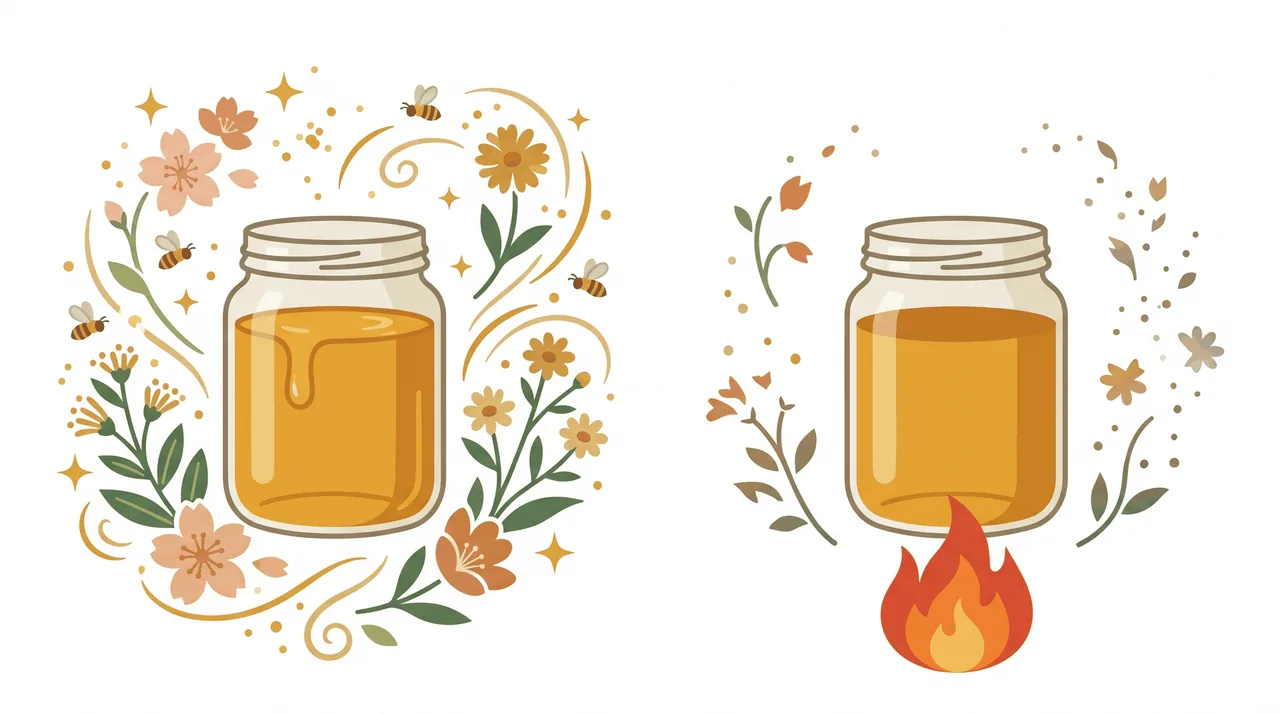
Most commercial honey is heated. Warming it makes it easier to filter and to
pour, delays crystallisation, and gives a product that looks the same in every jar.
What heat costs is aroma. Honey's volatile aromatic compounds are fragile, and
the enzymes the bees add are denatured by sustained warmth. Raw honey tastes more of the
flowers it came from — which is the entire reason to buy a single-source honey at all.
Look for "raw" or "unheated" on the label. A honey that has been warmed to the point of tasting generic has had the thing you were paying for removed.
"Pure honey" is a claim worth checking
Honey adulteration is a global problem, not a Japanese one — cheap glucose and rice syrups are close enough in composition to be difficult to detect. Japan operates an industry standard for the term junsui hachimitsu, "pure honey," which excludes added sugars and syrups.
The practical version of this rule is short: the ingredients list should say honey and
nothing else.
Watch for the words "with added glucose," "isomerised sugar," or "fructose-glucose
syrup." A jar carrying those is a honey-flavoured sweetener, and it is legal, cheap and
clearly labelled — which means the only thing standing between you and it is reading.
One more term: kanjuku, "fully ripened." Bees reduce nectar's water content in the hive before capping the comb. Harvesting early and evaporating the water off with machinery is faster, and it produces honey that is thinner in flavour. Producers who wait for the bees to finish tend to say so.
Acacia Honey Is Not Acacia
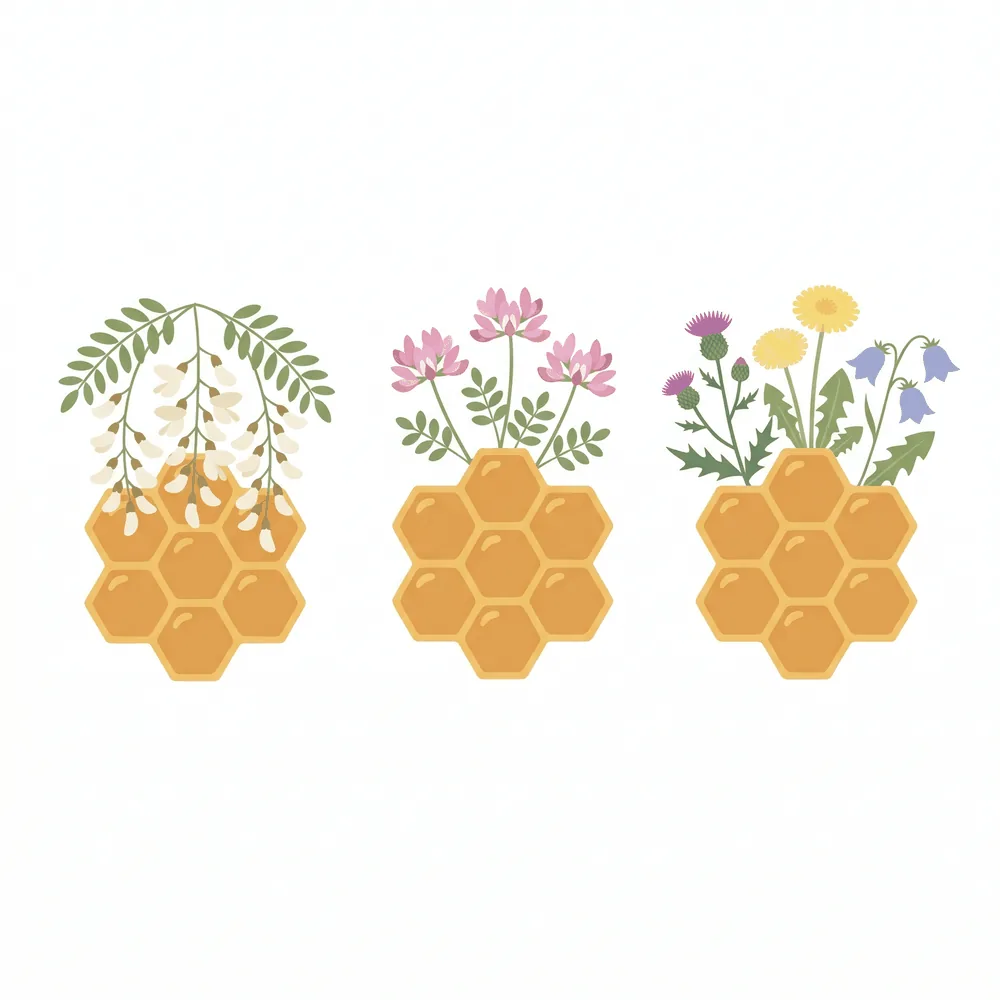
The honey sold everywhere as "acacia" comes from Robinia pseudoacacia —
the false acacia, or black locust, a North American tree. It is not in the genus
Acacia at all.
European producers call it acacia; American producers call the same honey black
locust. Japan uses the European name.
True Acacia is a genus of around 1,300 species, some 960 of them Australian. Almost none of the honey labelled "acacia" anywhere in the world has anything to do with them. The naming is a historical accident — black locust was once classified alongside true acacias, and the name stuck because it sells better.
None of which makes it a bad honey. Robinia honey is very pale, mild, floral, and unusually high in fructose — which matters practically, as the next section explains. In Japan it is the most popular single-source honey and the Tohoku region is known for it.
The sources worth knowing
- Acacia (Robinia) — pale, delicate, barely crystallises. The safe first choice, and the one that does not overpower tea.
- Renge (Chinese milk vetch) — the classic Japanese honey. Floral and rounded. Increasingly scarce as the crop is planted less.
- Hyakka (hundred-flower) — multifloral, whatever was blooming. Varies by apiary and by year, which is either the appeal or the problem.
- Chestnut, buckwheat, mikan — the assertive ones. Dark, mineral, sometimes bitter. Buy a small jar first.
The Crystallisation Test, and Its Limits
Honey going cloudy and solid in the jar is normal, and it is broadly a good sign. Glucose crystallising out is what real honey does; heavily processed and syrup-cut products often do not behave the same way.
But you cannot compare across flower types
How fast honey crystallises depends on its glucose-to-fructose ratio, which is set by the flowers.
Renge and multifloral honeys crystallise readily. Acacia honey barely crystallises
at all, because Robinia nectar is high in fructose.
So "it set solid, therefore it is real" only works within one flower source. An
acacia honey that stays liquid for a year is behaving correctly — and conversely,
an "acacia" honey that sets hard within a few months is worth a second look.
How to reverse it without ruining it
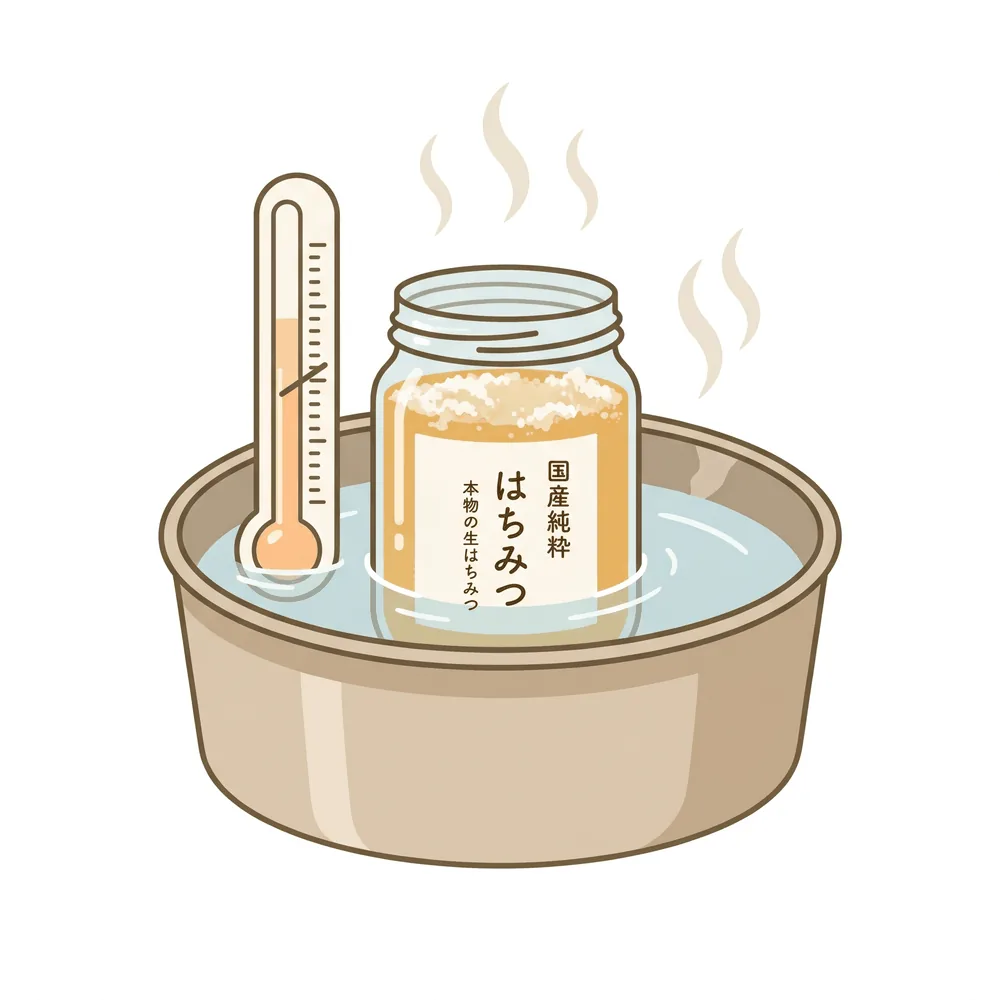
Stand the jar in warm water — around 40–50°C — and wait. Stir occasionally. It will take a while and that is fine.
Do not microwave it, and do not use boiling water. If you bought raw honey
specifically for its aroma and enzymes, cooking it to fix a texture issue undoes the entire
purchase.
Or simply eat it crystallised. Spread on toast it is arguably better that way,
and it is what a good deal of Japan does with it.
How to Buy It
An honest note: Japan's serious apiaries are small businesses selling domestically, and we could not confirm English-language direct sales for the producers we would otherwise recommend by name. So rather than list brands you cannot reach, here is what to check on any jar — which works whether you are buying in Tokyo, from an importer, or from a Japanese online store through a forwarding service.
The four checks, in order of importance
- 1. The ingredients list says honey and nothing else. This eliminates most of the market and costs you nothing. Added glucose or isomerised sugar is legal and clearly printed.
- 2. "Raw" or "unheated." If the aroma of a specific flower is what you are buying, heat is what removes it.
- 3. A named flower source and a named region. Not "blossom honey" — acacia from Tohoku, renge from a specific prefecture, hundred-flower from a named apiary. Vagueness on the label usually means blending.
- 4. The bee, if it matters to you. Nihon mitsubachi honey is the rare one and it is priced accordingly. Everything else is Western honeybee, which is not a criticism.
Where to actually look
- Japanese department store food halls, if you are visiting. This is the reliable route — single-apiary honey with the flower and region on the label, and often tasting.
- Japanese online stores via a forwarding service. Honey is shelf-stable, heavy for its price, and awkward to ship in glass — check the packing before ordering several jars.
- Comb honey (su-mitsu) is the most impressive gift and travels surprisingly well, since the comb holds everything in place.
Frequently Asked Questions
Why must honey never be given to babies?
Honey can contain Clostridium botulinum spores, and an infant gut cannot suppress
them. The result is infant botulism, which is serious.
No honey of any kind before 12 months — raw or pasteurised, cheap or expensive,
and including honey baked into food. Cooking does not reliably destroy the spores. After a year the
risk has passed.
Is Japanese honey actually worth the price?
It is genuinely scarce — Japan produces about 6% of what it consumes — so the
price reflects supply rather than positioning.
What you get for it is a specific flower and a specific place, unblended. If you
want honey by the kilo for cooking, imported honey is the sensible purchase and this article is not
about that.
My honey went solid. Has it gone off?
No — crystallisation is normal and generally a sign of unprocessed honey. Stand
the jar in warm water around 40–50°C and stir until it clears.
Do not microwave it or use boiling water, which destroys exactly the aroma and
enzymes you paid extra for. Eating it crystallised is also fine.
Does honey expire?
Effectively no. Its low water content and acidity make it inhospitable to
microbes, and sealed honey keeps for years past any printed date.
What does change is aroma and colour — it darkens and flavour flattens over time.
Keep it sealed, at room temperature, out of sunlight. Not in the fridge, which
accelerates crystallisation.
Is it true you should not use a metal spoon?
Practically, it makes no difference. The idea is that honey's acidity reacts with
metal, but a few seconds of contact with a stainless steel spoon changes nothing measurable.
What does matter is that the spoon is dry. Water introduced into the jar can allow
fermentation, which is the one way honey genuinely spoils.
Why is some honey dark and some pale?
The flower, not the quality. Acacia and renge are pale and mild;
chestnut and buckwheat are dark, mineral and assertive.
Darker honeys generally have more of everything — flavour, colour, minerals — and
are correspondingly harder to like. Start pale and work towards dark.
Final Thoughts: Read the Ingredients, Then the Flower
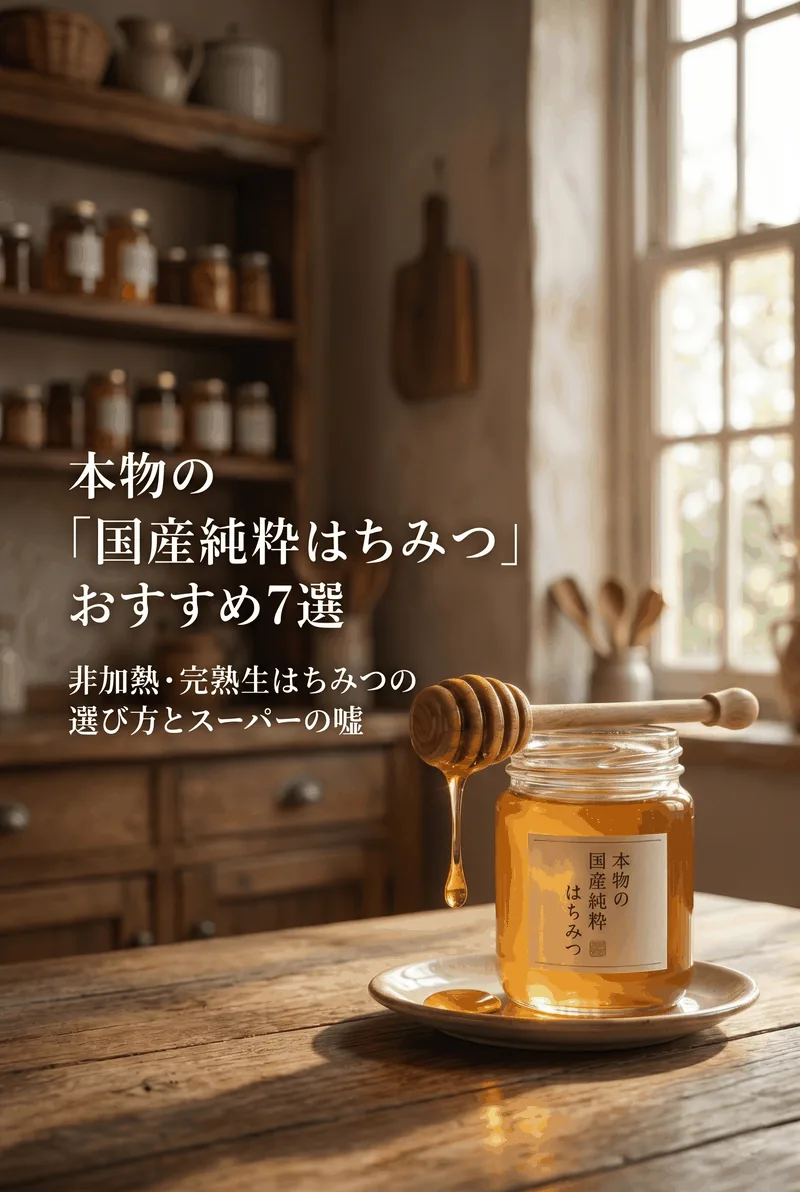
Honey is the one product where "made in Japan" is a supply statement rather than a craft one. Six per cent self-sufficiency in a mountainous country with fragmented farmland is not a marketing position — it is the reason the jars are small and expensive.
Buy on the ingredients list first — one word — then on the flower and the region. And know that "acacia" means black locust, and that acacia honey staying liquid is correct rather than suspicious.
If you want the genuinely unusual thing, look for nihon mitsubachi honey — from the native bee that yields a fraction as much, and that kills hornets by cooking them. It costs what it costs for reasons that are entirely biological.
Umeboshi: Salt, Time, and Nothing Else

Japanese Jam: Fruit Where the Sugar Is Restrained