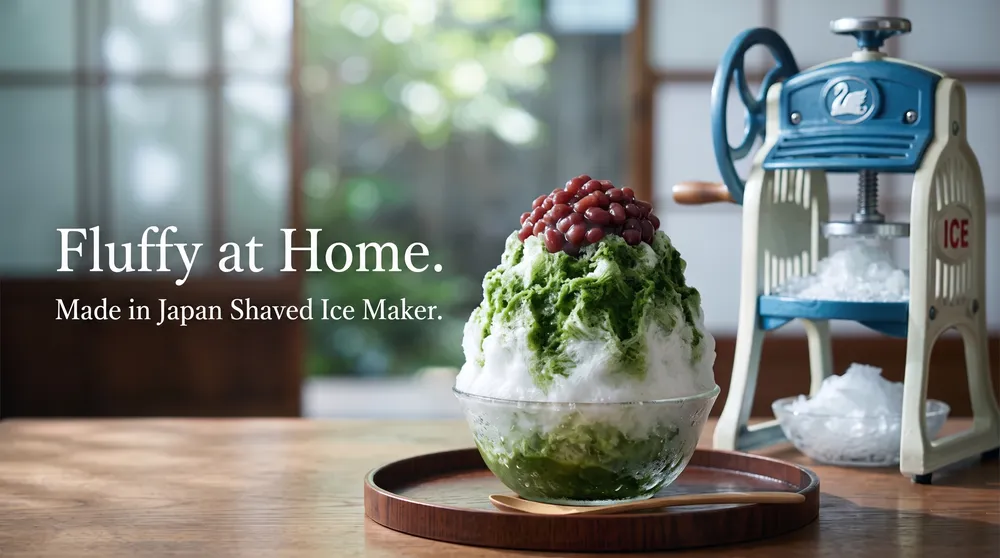
A snow cone machine and a kakigori machine look similar and do completely different things
to ice.
One crushes. The other shaves. A snow cone machine breaks ice into granules; a
Japanese machine holds a block against a blade and peels off ribbons so thin they collapse on your
tongue. That is the entire difference between crunchy ice with syrup on it and the snow-like
dessert you had in Japan.
Two useful things follow. The manual machines need no electricity at all, which
removes the usual Japanese-appliance voltage problem entirely — and
the ice you freeze matters more than the machine you buy. Most people who are
disappointed got the ice wrong, not the machine.
Quick Reference: Crushing vs Shaving
| Snow cone machine | Kakigori machine | |
|---|---|---|
| Mechanism | Breaks ice into granules | Peels ribbons off a block with a blade |
| Texture | Crunchy, granular, wet | Collapses on the tongue. Snow rather than ice |
| Ice it needs | Any cubes | A clear block, slowly frozen |
| Power | Electric | Manual models exist — no power at all |
| Cloudy ice-tray cubes will not work in either machine the way you want. Read the ice section before buying anything. | ||
Will One Work in Your Country?
Short answer — this is the easiest Japanese appliance on this site to bring home, because the best answer for most people has no plug.
| Type | Power | Outside Japan |
|---|---|---|
| Manual (hand crank) | None | No voltage question at all. Buy it and use it |
| Electric, domestic | 100V, motor only | A small step-down transformer is genuinely fine |
| Electric, commercial | 100V, larger motor | Larger transformer. Check the rating plate |
Why a transformer is acceptable here
An electric kakigori machine is a motor turning a blade — there is no heating
element. Motor-only appliances draw a fraction of what a rice cooker or hair dryer does,
so the transformer you need is small and cheap rather than large and absurd.
That is the same reasoning that makes transformers fine for fans and pointless for
kettles. Always check the rating plate rather than assuming — but for domestic models
this is a solved problem.
The plug still fits, and that is still worth saying. Japan and the US share the NEMA 1-15 Type A plug, so a 100V machine will run on 120V without any adapter — a motor tolerates this better than a heating element, but it runs hotter and the warranty is void.
Given the manual models are excellent and cost less, most readers should simply buy one.
⚠ A plug adapter is not a solution
A plug adapter changes the shape of the pins. It does nothing whatsoever to the voltage. This is the single most common and most expensive misunderstanding in this category, and the two regions get it wrong in opposite ways.
United States and Canada: nothing stops you
Japan and North America use the same Type A plug. A Japanese appliance fits a US socket with no adapter at all — it simply plugs in and turns on.
That is precisely the danger. There is no physical obstacle, no error message, and nothing that feels wrong. 120V into a 100V appliance is 1.2× the voltage, which is about 1.44× the power — so it runs hot, ages fast, and any thermostat inside it is now calibrated for conditions that no longer apply.
Europe, UK and Australia: an adapter alone destroys it
Here the plug shape is different, so you will go looking for an adapter — and travel shops
sell them by the till.
230V into a 100V appliance is 2.3× the voltage, which is roughly 5.3× the power.
That is not shortened life. That is immediate failure, and a genuine fire risk.
You need an adapter AND a transformer. The adapter makes it fit; the transformer
makes it safe. Neither one substitutes for the other.
⚠ And a "travel converter" is not a transformer
Cheap travel converters chop the AC waveform rather than transforming it, and are
meant only for simple resistive loads like a travel iron, for short periods.
They will damage anything with electronics, a thermostat or a motor.
Look for the word "transformer," and ideally "toroidal."
Sizing the transformer
| Appliance type | Transformer rating |
|---|---|
| No motor, no heating element | 1.5× the rated watts |
| Motor or heating element | 2–4× the rated watts — startup draw exceeds the printed figure |
A shaved ice machine is a small motor, so the 2–4× rule applies but the base figure is low. Check the plate and multiply.
A 500W unit covers most household models comfortably. Motors draw a surge at startup, so do not size this one to the nameplate exactly.
Why Japanese — the Blade, and Why It Is Adjustable
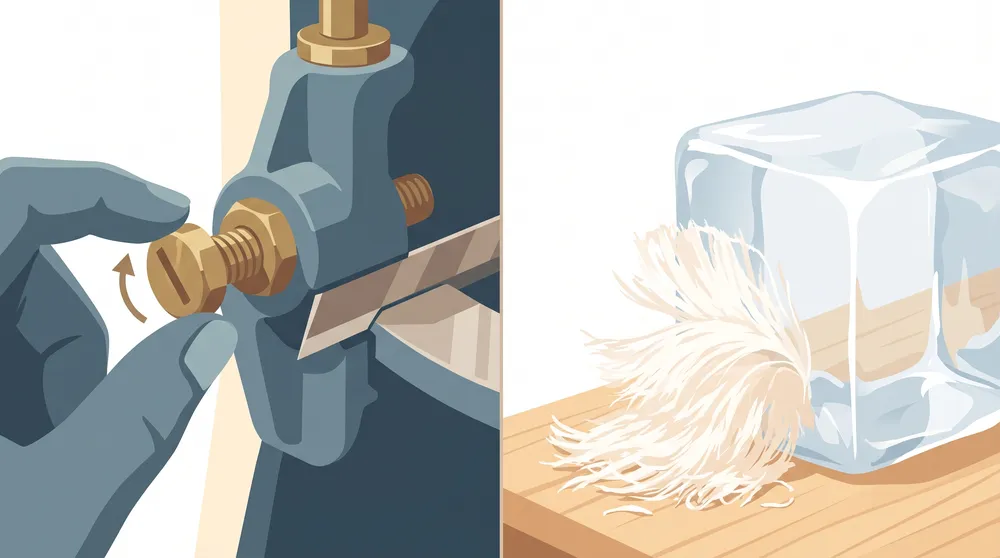
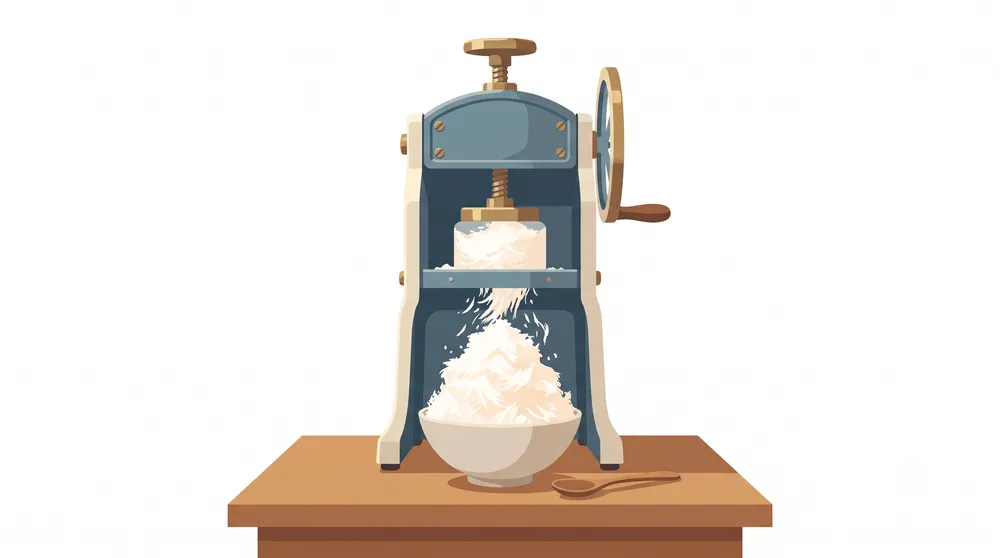
The mechanism is closer to a woodworking plane than to a blender. A block of ice is held against a fixed blade and rotated, and the blade peels a continuous sheet off the bottom face. How thick that sheet is depends on how far the blade protrudes above the plate — usually a fraction of a millimetre.
That protrusion is adjustable, and it is the whole craft. Set it too high and you get thick flakes that are wet and crunchy. Set it right and the ribbon is thin enough to be translucent, and it collapses in the mouth rather than being chewed.
Why cheap machines cannot do this
Inexpensive imported machines generally fix the blade at one setting and use a
stamped rather than ground edge. Neither can be corrected by the user.
Japanese machines from the established makers use a properly sharpened, replaceable
blade with micro-adjustment, which is why the same machine can produce coarse ice for
a syrup dessert and fine snow for the fluffy style — and why it is still working in twenty
years.
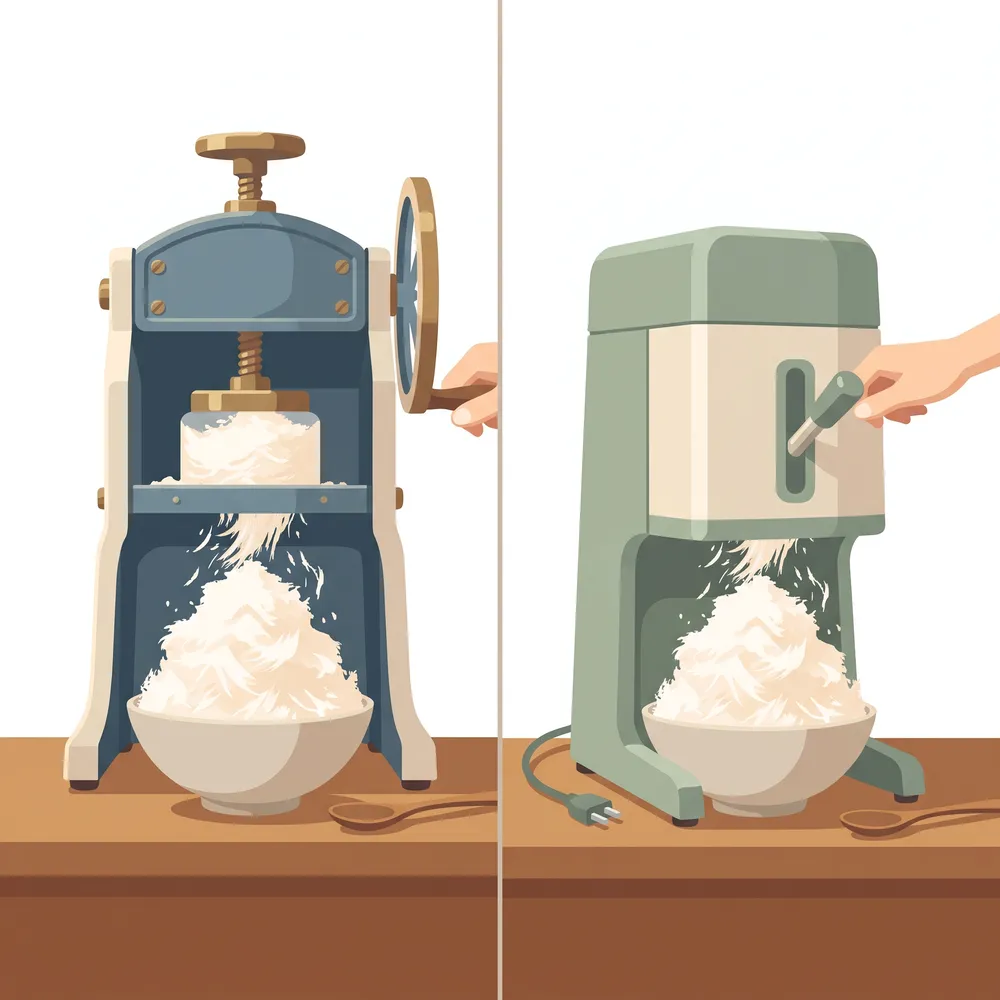
Manual or electric?
- Manual is the better home purchase. Cheaper, no power question, no motor to fail, and the crank gives you direct control over speed — which matters, because going too fast produces coarser ice.
- Electric earns its place at volume. If you are serving a party rather than a bowl, cranking gets old quickly.
- Commercial machines are heavy and loud and produce beautiful ice. They are for cafés, not kitchens.
Why it does not give you brain freeze
A commonly repeated claim about good kakigori is that you can eat it fast without the headache.
The mechanism is simple: ice shaved thin enough melts on contact, so what reaches
the roof of your mouth is cold liquid rather than a solid mass holding its temperature.
Granular crushed ice does the opposite — it sits there, still frozen, against your palate. This is
a genuine consequence of the texture rather than folklore.
The Ice Matters More Than the Machine
This is the section to read before you spend money. A good machine fed bad ice produces bad results, and almost everyone's first attempt uses bad ice.
Why your freezer ice is wrong
Ordinary ice-tray cubes freeze fast and from all sides at once. That traps dissolved air and impurities in the middle — which is exactly why they are cloudy white in the centre.
Those trapped bubbles are structural weaknesses. When the blade meets one, the ribbon breaks. Instead of a continuous sheet you get flakes and dust, and the result is closer to a snow cone than to kakigori. Cloudy ice cannot be shaved well by any machine.
Making clear ice at home
- Freeze slowly, from one direction. The standard trick is directional freezing: put water in an insulated container — a small cooler with the lid off works — inside the freezer. It freezes from the top down, pushing air and impurities ahead of the ice front.
- Discard the cloudy part. The last portion to freeze holds everything that got pushed there. Cut it off; the clear part above is what you shave.
- Use boiled and cooled water if you want to improve the odds further — boiling drives off dissolved gases.
- Temper the block before shaving. Ice straight from the freezer is too hard and brittle, and it shatters. Leave it out for 10–15 minutes until the surface just turns glassy. This one step transforms the result and almost nobody does it.
The shortcut
Buy a block of clear ice from a bar supply or ice company. The cocktail bar boom
means clear-ice suppliers now exist in most cities, and a block costs a few dollars.
If you are serious about this and not interested in freezer projects, that is the answer — and it
is what Japanese kakigori shops do, at scale, with ice frozen over several days.
What to Buy
Availability is the weak point. The Japanese makers sell into a domestic market and do not run international retail, so realistic routes are eBay sellers and proxy services.
A manual Japanese machine — the right answer for a kitchen
Hand-cranked, no power, an adjustable ground blade, and a clamp or suction
base to hold it to the worktop. The retro tabletop models are the ones people recognise, and
they are genuinely good tools rather than nostalgia objects.
The crank gives you speed control, which matters — turning slowly produces
finer ice than turning fast, and a motor cannot give you that judgement.
- Power
- None. No voltage question
- Blade
- Adjustable protrusion, replaceable, properly ground
- Ice
- Takes a purpose-frozen block or a large cylinder
- Availability
- eBay sellers in Japan; proxy services
- Price range
- $80–$200
Perfect for: Essentially every home user. Cheaper, simpler, no transformer, and better control.
Electric block-ice slicers — for volume
The machines Japanese cafés use: a motor drives the rotation while you set the blade and
apply pressure. Consistent, fast, and physically substantial.
These are 100V domestic machines, but the motor-only power draw means a small
transformer handles a home-scale unit. Check the rating plate before buying — commercial
models draw more.
- Power
- 100V, motor only. Transformer-friendly
- Best for
- Serving several people; cafés
- Downside
- Heavy, loud, and needs storage space
- Price range
- $250–$900+
Perfect for: Anyone making this for a crowd regularly. Overkill for a household of two.
The two Japanese names
Swan (made by Ikenaga Tekko) and Hatsuyuki are the two
manufacturers Japanese shops actually use, and between them they cover manual tabletop machines
through to commercial slicers. Neither runs international retail — they appear
abroad through resellers and proxy services rather than through their own channels.
When shopping, the specification that matters is an adjustable, replaceable blade.
A machine without that is a snow cone maker with different styling.
Blade Care and Rust
The blade is the product. Everything else is a frame to hold it at the right angle.
- Dry it immediately after use. A blade left wet will spot, and a rusted edge tears ice instead of shaving it.
- Wipe with a lightly oiled cloth before storing for the season. A food-safe oil is fine.
- Do not put the blade in a dishwasher, and do not scrub the edge. Rinse, wipe, dry.
- Blades are consumables and are sold separately. When the ice starts coming out coarse no matter how you set the adjustment, the edge has gone — this is normal, and it is why buying a machine with available spares matters.
- Adjust in tiny increments. The useful range of blade protrusion is a fraction of a millimetre; a quarter-turn of the screw is a large change.
If your ice suddenly turns coarse, check three things in this order: is the block tempered, is the blade sharp, is the protrusion set too high. It is almost always the first.
Frequently Asked Questions
How is this different from a snow cone machine?
A snow cone machine crushes ice into granules. A kakigori machine peels ribbons off a
block with a blade. The mechanisms are completely different and so are the results —
granular crunchy ice versus something that collapses on the tongue.
You cannot get kakigori texture from a crushing machine at any setting.
Can I use ice cubes from my freezer?
Not well. Tray cubes freeze fast from all sides, trapping air in the middle —
which is why they are cloudy. Those bubbles break the ribbon as the blade passes, so you get
flakes rather than sheets.
Freeze a clear block using directional freezing, or buy one from a bar-supply
company.
Do I need to worry about voltage?
Not if you buy a manual machine — there is no plug. That is the cleanest answer
for anyone outside Japan and it is also the better home machine.
Electric models are 100V but motor-only, so power draw is low and a small step-down
transformer is genuinely adequate — unlike a rice cooker or hair dryer.
Manual or electric for home use?
Manual. Cheaper, no power question, nothing to fail, and the crank gives you
speed control — turning slowly produces finer ice than a motor running at a fixed rate.
Electric earns its place when you are serving a group rather than a bowl.
Why did my ice come out coarse and wet?
Most likely the block was straight from the freezer. Ice that cold is brittle and
shatters instead of shaving — leave it out for 10–15 minutes until the surface
turns glassy.
After that, check the blade edge, then the blade protrusion. In that order.
Why do cheap machines not work as well?
Fixed blades and stamped edges. Inexpensive machines usually cannot adjust blade
protrusion and use an edge that was pressed rather than ground — neither of which the user can
correct.
Adjustable, replaceable, properly sharpened blade is the specification that
separates a kakigori machine from a snow cone maker with different styling.
Final Thoughts: Buy Manual, Freeze Properly
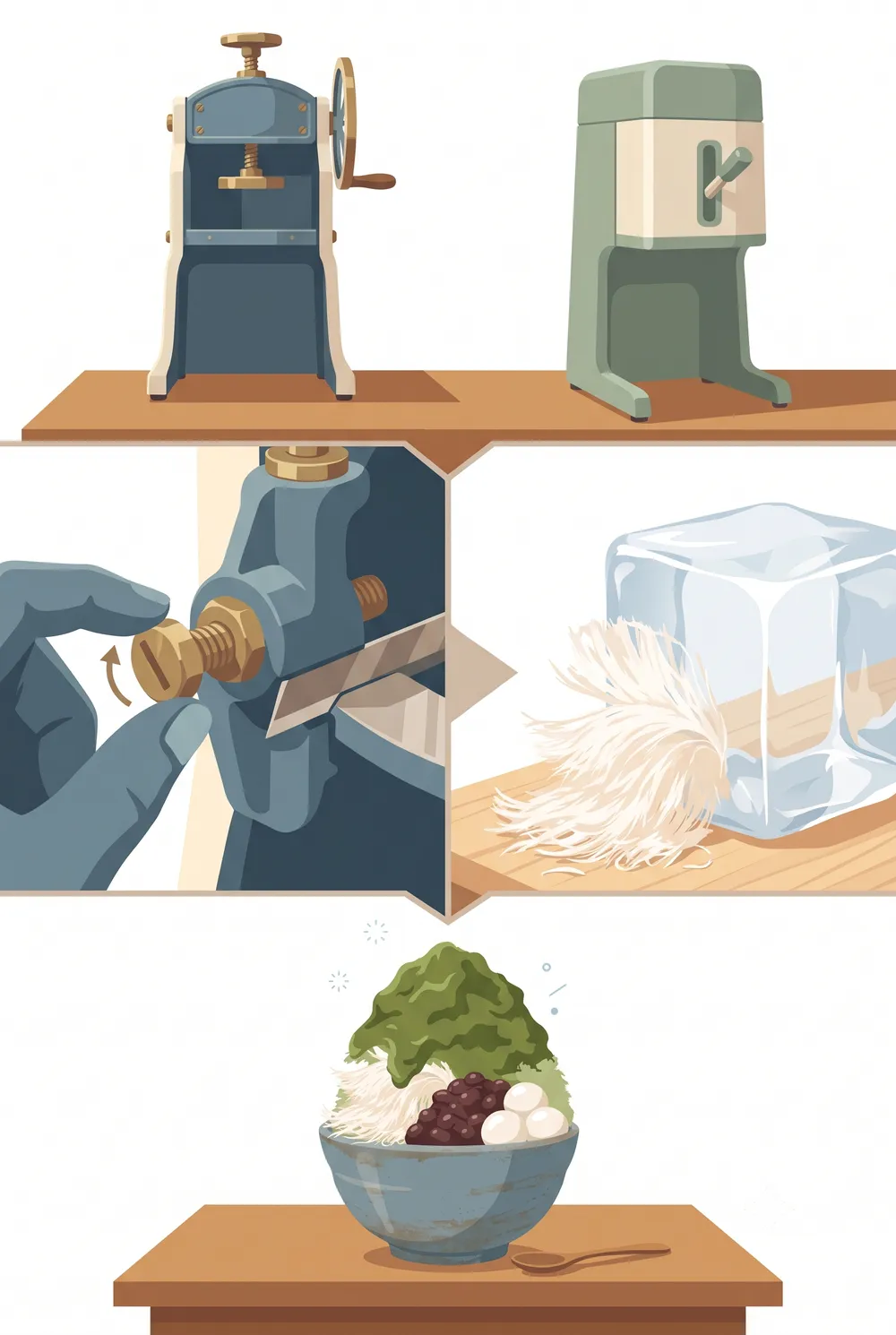
Buy a manual machine. It costs less, has no voltage problem, nothing to burn out, and gives you the speed control that actually determines how fine the ice comes out.
Then put the effort into the ice, because that is where the result lives. Clear block, frozen slowly from one direction — or bought from a cocktail-ice supplier — and left out for a quarter of an hour before it meets the blade.
Get those two right and a $100 machine produces something a $900 one cannot make from cloudy cubes. The machine is the easy part.
Japanese Matcha: Grades and What to Buy

Japanese Matcha Sweets Worth Ordering