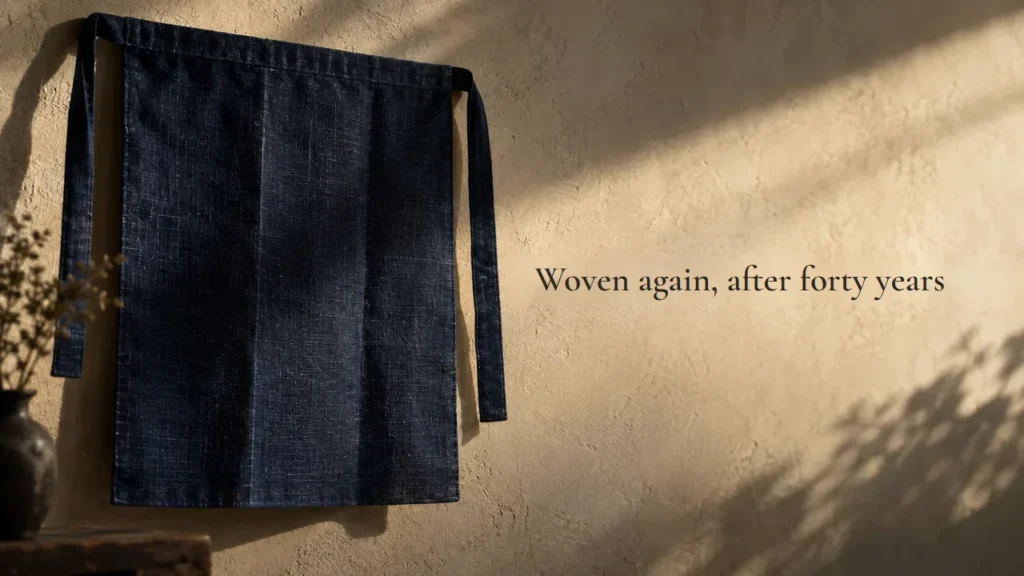
A maekake (前掛け) is the heavy cotton canvas apron that Japanese sake brewers, rice dealers and shopkeepers have long tied around their waists — a single panel of thick, densely woven cloth, wrapped twice and knotted at the front.
The thickest maekake fabric had quietly stopped being made. Then a Japanese maekake company teamed up with the weaver it calls its master, test-wove the cloth again, and in 2011 brought a fabric last made 40 years earlier back into production. It is woven in Toyohashi, in Aichi Prefecture, on shuttle looms that are 70 to 100 years old — including one of a type invented in 1914.
When you buy one, there are really only two decisions: the length (Japanese makers name lengths with letters and the old unit "sun") and whether you want a pocket. This guide covers the fabric, how to choose, how to tie it, and how to buy one from outside Japan.
Quick Reference: Maekake Lengths at a Glance
| Japanese name | Length | Reaches | Good for |
|---|---|---|---|
| AA-sun ▾ | about 34 cm (13.4 in) | Hips only | Work with a lot of crouching and standing |
| A-sun ("Short") ▾ | about 38 cm (15 in) | Just below the hips | The standard for standing work — bars, kitchens, counters |
| Chu-sun ("Medium") ▾ | about 56 cm (22 in) | Mid-thigh | Workshops, gardening, coffee roasting |
| Naga-sun ("Long") ▾ | about 70 cm (27.5 in) | Around the knees | Carrying loads, heavy or messy work |
| The other choice | Pocket or no pocket — the long length comes both ways, in the same color. Width stays about 46 cm (18 in) at every length. | ||
Lengths follow the "Toyohashi HoMaekake" series. On Amazon.com the same series is listed as Short, Medium and Long. Click a name to jump to that section.
1. Why Japanese: A Fabric That Was Made Again
A weaver they call "master"
Anything, a Japanese company that specializes in maekake, tells the story on its own site. Working with "Mr. Haga, our master in maekake," it revived a fabric from 40 years earlier.
By then, that heavy cloth was no longer being woven. What remained were old aprons and the person who had woven them. They test-wove it, checked it, and wove it again — and from October 2011 the fabric went back on sale.
That is what "made in Japan" means for a maekake. It is not a souvenir print on any apron. It is a working cloth whose weave was rebuilt by hand, in the town where it was woven.
"No. 1" means the thickest cloth
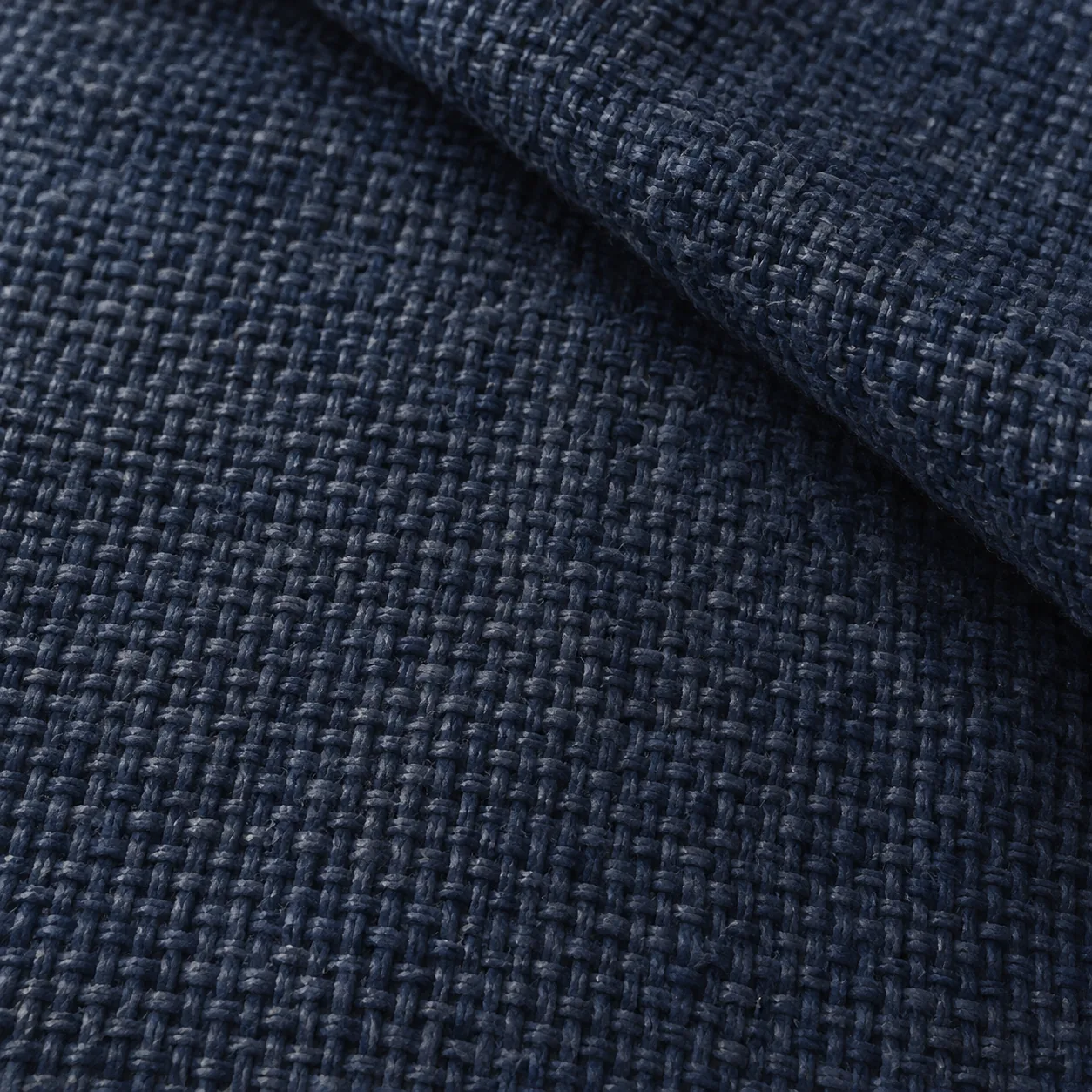
According to the same page, old order sheets used nicknames — "No. 1," "No. 2," "No. 3" — because there were several thicknesses, made by changing the thickness of the thread. No. 1 was the thickest. Today's fabric is woven with No. 4 count yarn. The thickness of the yarn is the thickness of the apron.
Anything — the maekake specialist behind the revival
Anything sells maekake in plain colors, with designs, and made to order. Its English store lists everyday aprons in the revived fabric and explains how to wear and wash them, and the company says its maekake are used in more than 60 countries.
Before you order: the store's shipping fee is listed for delivery within Japan. If you live abroad, contact the store before ordering, or buy the Toyohashi series below through Amazon.com.
2. Looms from 1914, Still Running in Toyohashi
Ten old shuttle looms, taken over
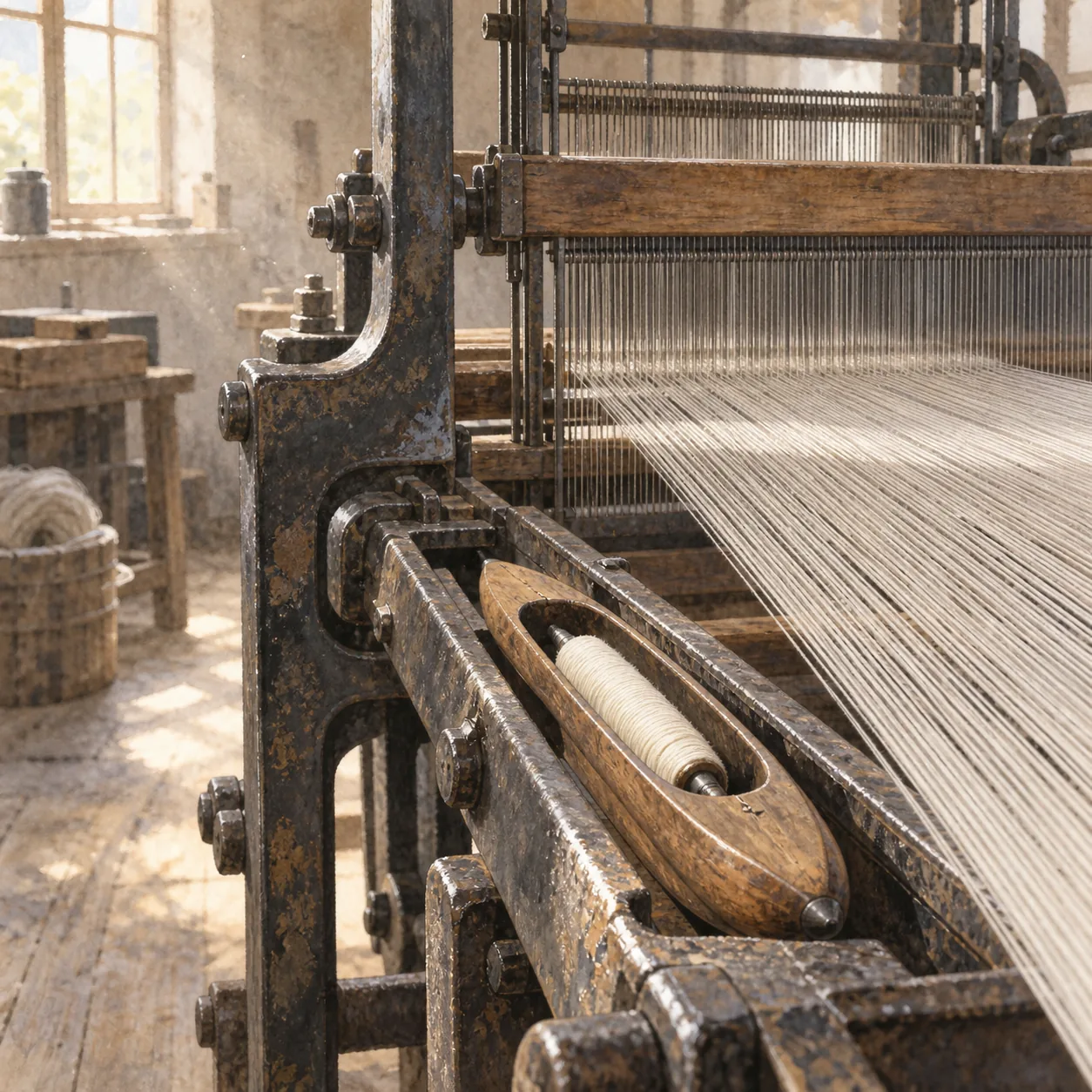
The fabric is woven in Toyohashi, Aichi Prefecture. The same official page says the company took over ten shuttle looms made 70 to 100 years ago — by Toyota, Suzuki and Enshu.
These are not new machines bought for the job. They are looms that were already running, kept running.
At the Toyohashi workshop, a Toyoda Automatic Loom "Type N" — a design invented in 1914, this one built in 1949 — is still in daily use. Shuttle looms like these weave narrow, dense cloth with natural selvedge edges, the same family of machines that denim fans seek out.
Woven in Toyohashi, dyed in Tokyo
The work does not happen in one place. The weaving is done in Toyohashi, and the dyeing is "mainly done in Tokyo."
The company adds that its dyeing "maintains a high rank in color-fastness-to-washing tests" — in other words, how well the color survives laundering is checked by testing.
This is cloth for working. It gets dirty, it gets washed, it goes back on. Color that holds is not just about looks; it is part of what makes it a tool.
3. Choosing the Length
From hip-length to the knees
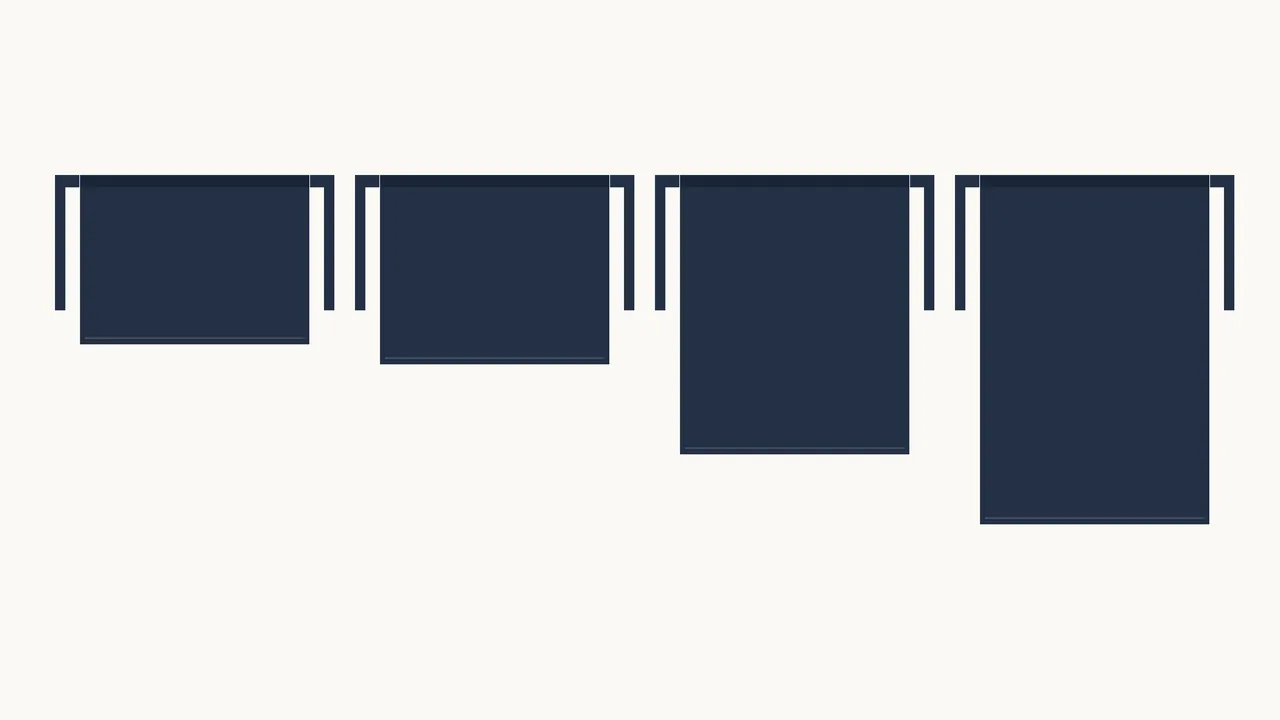
The first thing to decide is the length. Japanese makers use names rather than numbers: AA-sun, A-sun, chu-sun (medium) and naga-sun (long) — "sun" being an old Japanese unit of length.
In the Toyohashi series, AA-sun is about 34 cm (13.4 in), A-sun about 38 cm (15 in), chu-sun about 56 cm (22 in), and naga-sun about 70 cm (27.5 in). The longest is more than twice the shortest.
Shorter keeps your legs completely free; longer covers more. Neither is better — it depends on what you will be doing in it. A bartender or barista usually wants A-sun. Someone who kneels in a garden or carries sacks wants the long one.
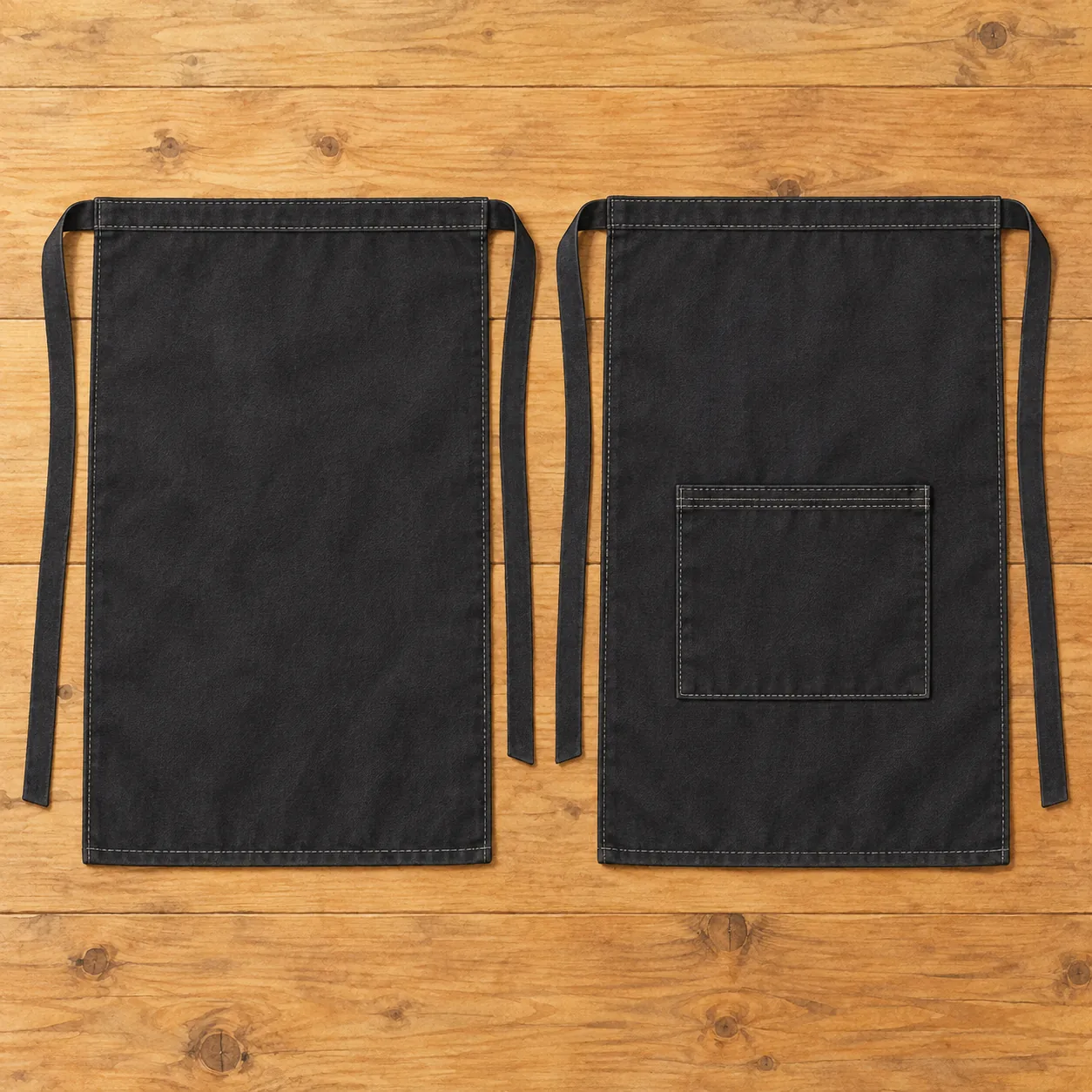
Toyohashi HoMaekake — Short (A-type), with two pockets
The standard length for standing work. It sits just below the hips and leaves your legs free. This version has two pockets.
The listing says it is handmade in Toyohashi, Japan — the same Toyohashi series used for the lengths in this guide.
Toyohashi HoMaekake Apron — Short (A-type, 2 pockets), Black
Loading product details…
Toyohashi HoMaekake — Medium, with pocket, in ecru
Mid-thigh length, in ecru — the color of the undyed cotton. It is the easiest color in which to see what the yarn and weave actually look like.
Dirt shows on ecru. But so does every mark of use, which some people prefer.
Toyohashi HoMaekake Apron — Medium (with pocket), Ecru
Loading product details…
4. Pocket or No Pocket
A pocket isn't always better
The long length is made both with and without a pocket, in the same color. That is the only difference.
A pocket holds tools, a cloth or a pen — handy when you are on your feet all day.
Plenty of people choose no pocket. Things fall out when you bend, and a pocket takes longer to dry. A single, flat panel is simply lighter to live with.
Toyohashi HoMaekake — Long, with pocket, in navy
Knee length, navy, with a pocket. Thick cloth sewn onto thick cloth makes a pocket that holds its shape.
Not sure? Decide what you would put in it. If nothing comes to mind, a plain panel is the lighter choice.
Toyohashi HoMaekake Apron — Long (with pocket), Navy
Loading product details…
Someno Yasubo MAEKAKE — Plain Navy, from Asakusa
A shorter, squarer maekake from Someno Yasubo, a dye house in Tokyo's Asakusa. It measures 20 × 20.5 inches (about 51 × 52 cm), in 100% cotton, and is listed as made in Japan.
The same maker also offers printed designs — Asakusa scenes, lucky cats, the Seven Lucky Gods — if you want something more decorative than a plain work apron.
Someno Yasubo MAEKAKE — Plain Navy (Asakusa)
Loading product details…
5. How to Tie a Maekake
Twice around, then tie
A maekake is not tied once around the body like a kitchen apron. The usual way is to wrap the ties around your waist twice, then knot them at the front.
With the thick cloth snug against your hips, your lower back feels supported — it works a little like a belt when you lift things. That is often given as one of the reasons the maekake survived as working clothes.
The ties can be replaced. Anything sells the waist tape on its own, in 65 mm-wide rolls, because the ties tend to wear out long before the apron does.
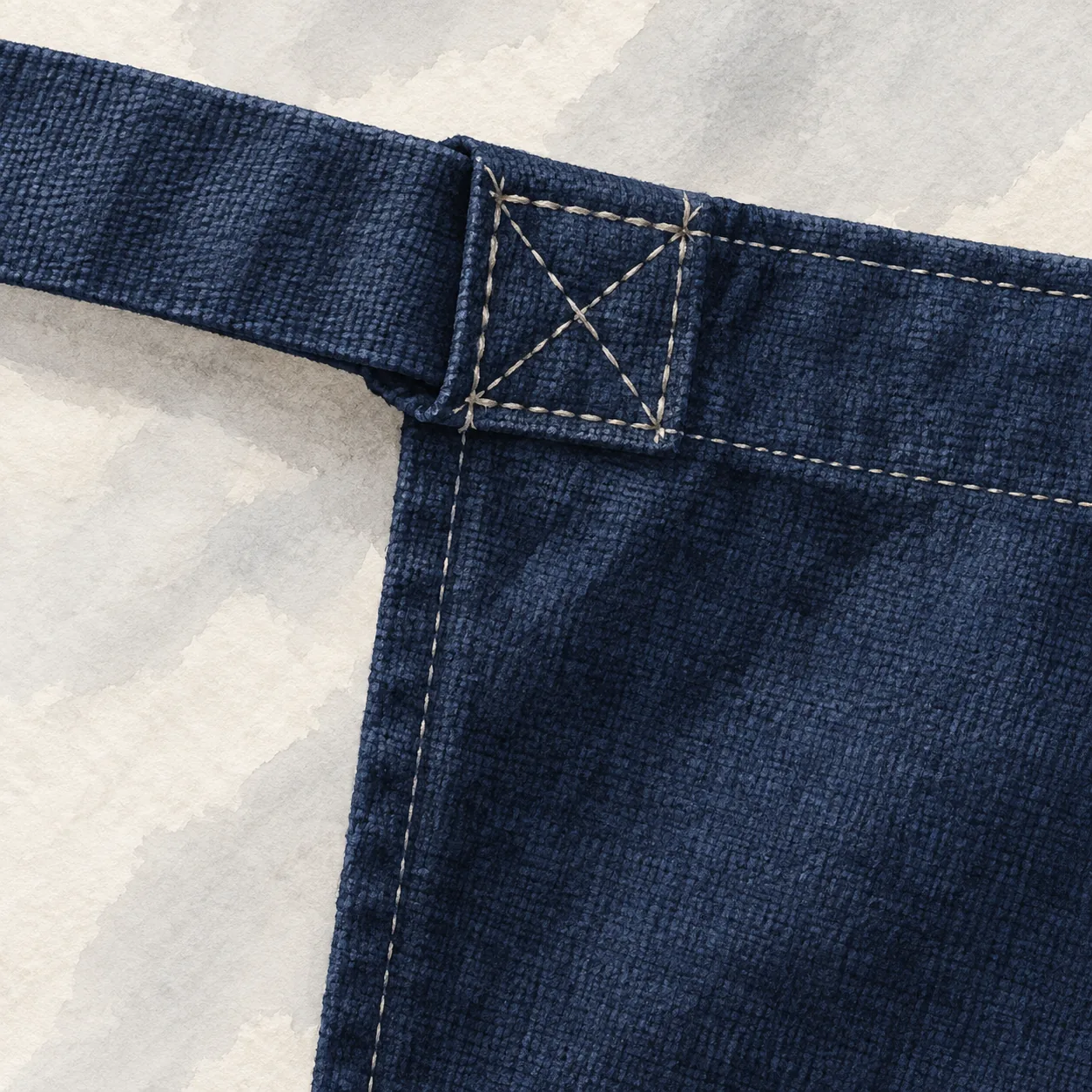
Some come with tassels
Some maekake have tassels (fusa) on the ends of the ties. Japanese listings say "fusa-tsuki" (with tassels) or "fusa-nashi" (without). They make no difference to how it works, but they change how the knot hangs.
6. Washing: It Softens to Your Shape
Stiff at first, softer with every wash
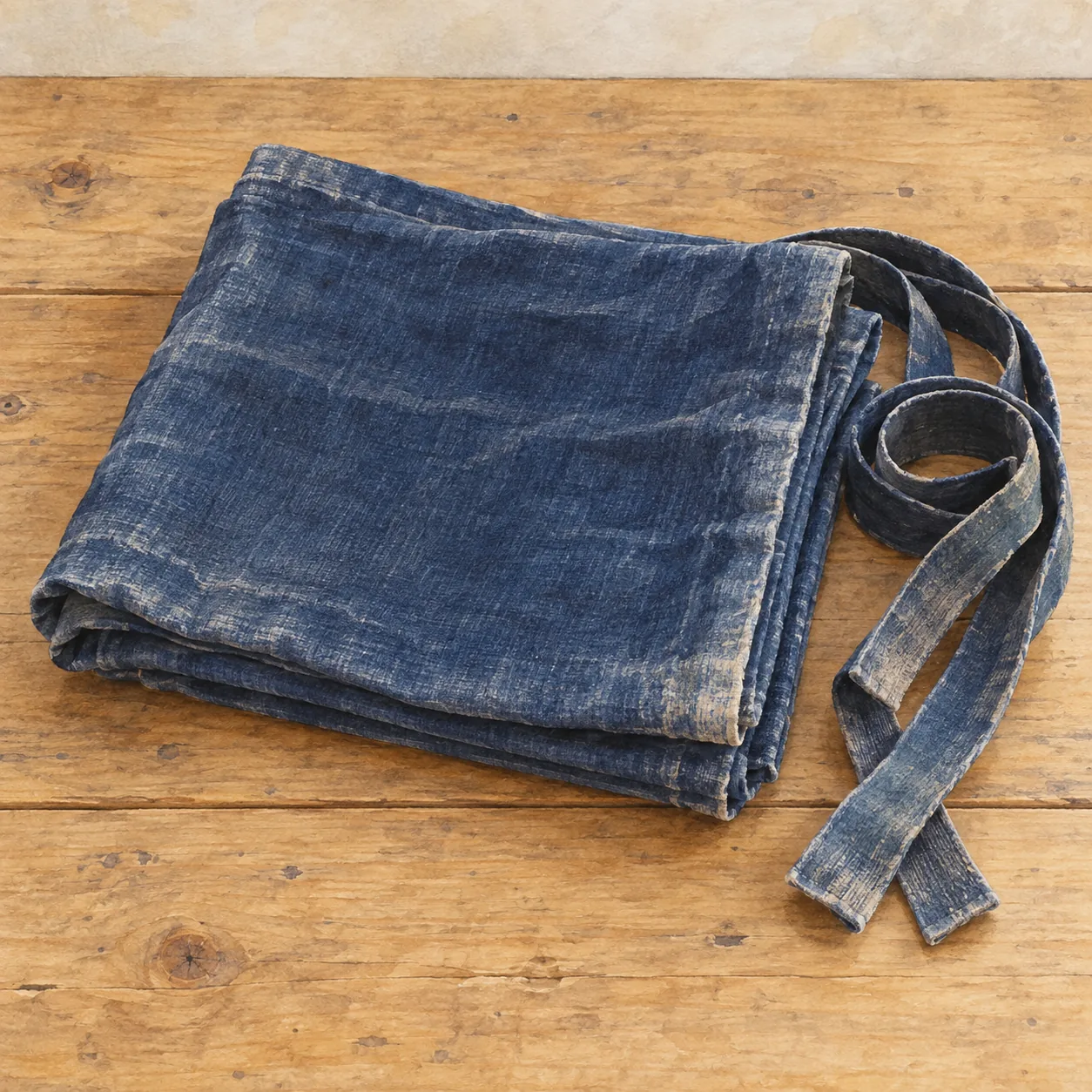
New, the canvas is stiff enough to stand up on its own. Tied on, it won't settle at first.
Wash it, dry it, wear it, repeat. It picks up folds and starts to follow your body — and where it bends is decided by where you wear it. The color fades too, slowly and over years rather than all at once.
Wash dark colors alone at first
Wash navy and black on their own for the first few times, and watch the color of the water before mixing them with other laundry.
It is thick, so it takes a while to dry. Hang it open; folded, the inside stays damp.
No need to iron. The creases settle with use, and on a work apron the creases are part of the look.
7. Buying From Outside Japan
The easiest route is Amazon.com. The Toyohashi HoMaekake series used for the lengths in this guide is listed there as "Handmade in Toyohashi, Japan," in Short, Medium and Long, with and without pockets, in several colors. Someno Yasubo's Asakusa maekake are listed as made in Japan too.
Anything's English store has the widest range, including made-to-order aprons, but its shipping information is for addresses in Japan. Ask the store about overseas delivery before ordering.
Check the label for "Japan." The word "maekake" is now used for printed aprons made in many countries. If what you want is the heavy Japanese canvas, look for a named maker or town — Toyohashi, Asakusa — and "made in Japan" on the listing.
8. Frequently Asked Questions
What is a maekake?
A traditional Japanese waist apron made from one panel of heavy cotton canvas. It was worn by people who worked in sake breweries, rice and liquor shops and other trades, and it is tied by wrapping the ties around the waist twice. Many carry a shop name or design printed on the front.
Which length should I choose?
It depends on the work. For a lot of crouching and standing, AA-sun or A-sun (Short). To cover your thighs, chu-sun (Medium). For carrying loads or messy work, naga-sun (Long). The width stays about 46 cm (18 in) at every length, so length is the only thing you are choosing.
How do you tie a maekake?
Wrap the ties around your waist twice, then tie them at the front. One wrap tends to loosen; two wraps hold the thick cloth snug against your hips. When the ties wear out, they can be replaced.
Is a maekake indigo-dyed?
Not necessarily. Navy is the most common color, but the maker of the revived fabric says only that dyeing is done mainly in Tokyo and tested for color fastness — it does not describe it as indigo. Check the listing if indigo matters to you.
Can I machine wash it?
Yes, but wash navy and black alone for the first few times. Hang it open to dry — it is thick, and folded it stays damp inside.
Is it only for shop work?
Not at all. It is worn today in kitchens, cafés, gardens, workshops and studios. It is just one thick panel of cotton, so you decide what it is for.
Final Thoughts: A Fabric That Came Back
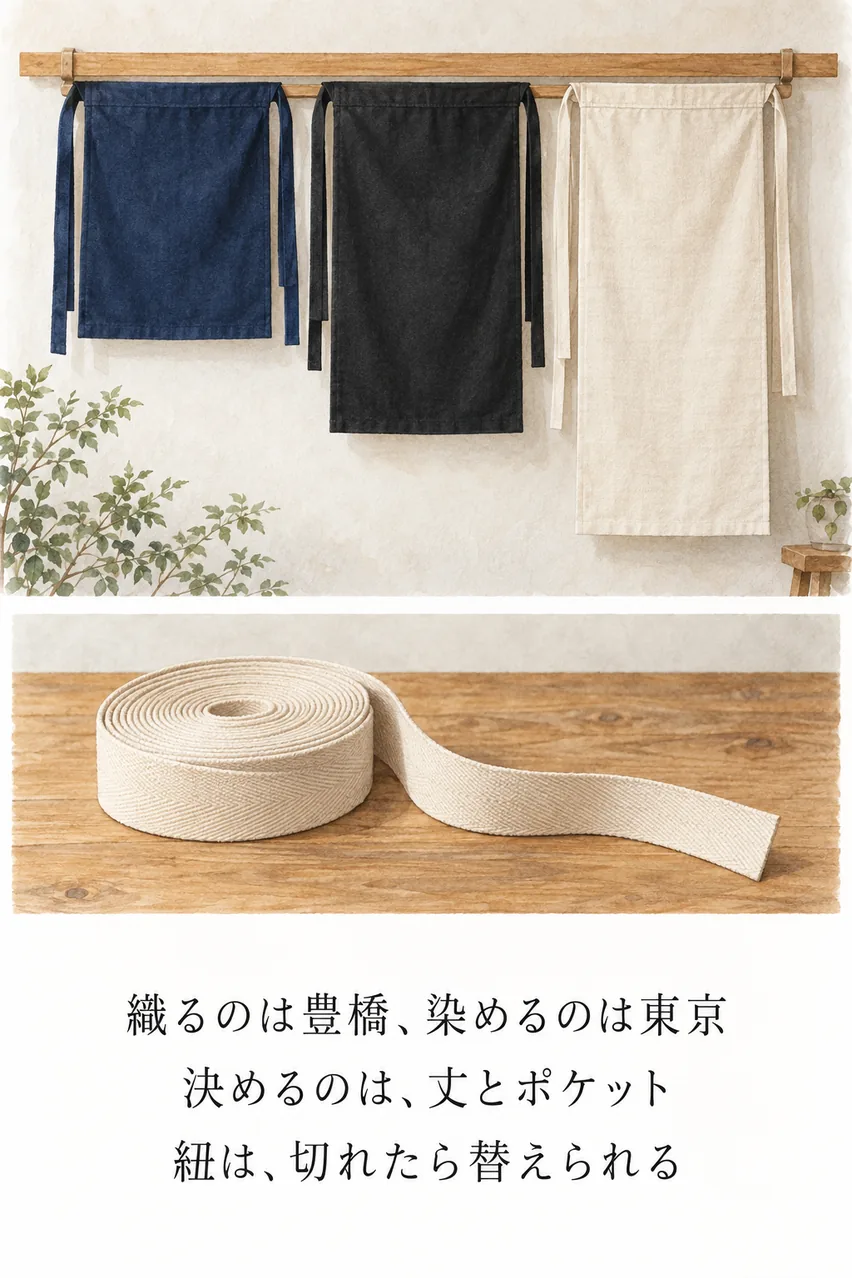
The thickest maekake fabric had stopped being made. A Japanese maekake company and the weaver it calls its master test-wove it again, and in 2011, after 40 years, it went back on sale.
It is woven in Toyohashi on shuttle looms that are 70 to 100 years old, one of them a type invented in 1914, and dyed mainly in Tokyo.
Choosing one comes down to two things: length and pocket. About 34, 38, 56 or 70 cm, all about 46 cm wide; with a pocket, or as a single flat panel.
Tie it twice around, and let it soften. Stiff at first, it learns your shape wash by wash — the fabric that came back, becoming yours.
Japanese Aprons: Why the Straps Cross at the Back
Jika-Tabi: The Companies Still Making Them in Japan