The Japanese humidifiers you can confirm as made in Japan come from two companies in Niigata: Dainichi and Corona. Both are best known in Japan for kerosene fan heaters — and that is no coincidence.
This guide compares four models by room size, how quiet they are at night and how easy they are to clean. It explains the two room sizes printed on every Japanese box ("wooden tatami room" and "prefab Western room"), what actually decides the electricity bill, and where to put a humidifier.
And because these are 100-volt Japanese appliances, it starts with the question readers outside Japan need answered first: will one work where you live?
Quick Reference: 4 Japanese Humidifiers at a Glance
| Model | Room size wooden / prefab |
Output standard / quiet |
Noise (max) standard / quiet |
Tank | Power (heater on) |
|---|---|---|---|---|---|
| Dainichi HD-C300H ▾ Bedroom |
5 / 8 tatami (8 / 14 m²) | 300 / 250 mL/h | 25 / 18 dB | 2.5 L | 161 W |
| Dainichi HD-RXC500C ▾ Living room |
8.5 / 14 tatami (14 / 23 m²) | 500 / 400 mL/h | 30 / 23 dB | 5.0 L | 163 W |
| Corona UF-H7226R ▾ Larger living room |
12 / 20 tatami (20 / 33 m²) | 720 mL/h | 40 / 29 dB | about 4.0 L | 345 W |
| Dainichi HD-LX1226 ▾ Open-plan LDK |
20 / 33 tatami (34 / 55 m²) | 1,200 / 800 mL/h | 34 / 27 dB | 7.0 L | 665–675 W |
All four are hybrid (warm-air evaporative) humidifiers. Figures are from Dainichi's and Corona's official spec sheets (Dainichi output measured at 20°C / 68°F and 30% humidity). Corona does not publish quiet-mode output. Click a model to jump to it.
1. Will a Japanese Humidifier Work in Your Country?
Short answer: in Japan, yes. In the US and Canada, only with a step-down transformer sized for the heater. In Europe, the UK and Australia, only with a 230–240V-to-100V transformer — and we found no overseas versions of these models.
| Where you live | Voltage | Does the plug fit? | What you need |
|---|---|---|---|
| Japan | 100V | — | Nothing |
| United States / Canada | 120V | Yes — same Type A plug | A step-down transformer (120V→100V). The plug fits, but the voltage is 20% too high |
| Europe / UK / Australia | 230–240V | No | A plug adapter and a 230–240V-to-100V transformer |
The danger is that the plug fits
In North America the plug goes straight into the wall, and the humidifier will run. That is the trap. These are hybrid humidifiers with a heater, and on 120V a heater runs hotter than it was designed to — the kind of slow damage you don't notice until something fails. Both Dainichi's spec sheets list values for 50 and 60 Hz, so frequency is not the issue; voltage is.
Use a transformer, not a travel "converter." Cheap converters chop the AC waveform and are meant for simple heating tools used for a few minutes — they can damage appliances with electronic controls, sensors and fans like these. Look for a step-down transformer, ideally a toroidal one.
How big a transformer?
Appliances with a heater or a motor draw a surge when they start, so the transformer should be rated at two to four times the appliance's power. With the heater on (standard mode), these models draw:
· Dainichi HD-C300H — 161 W; HD-RXC500C — 163 W → a 500 W transformer is the minimum.
· Corona UF-H7226R — 345 W → 1,000 W or more.
· Dainichi HD-LX1226 — 665–675 W → about 1,600 W or more.
Be honest with yourself about what that means: a properly sized transformer is a heavy box that lives permanently on the floor next to the humidifier. If you don't live in Japan, a humidifier built for your own voltage will usually be simpler and cheaper. A Japanese one makes the most sense if you live in Japan — or if you specifically want this design and accept the transformer.
120V to 100V 500 W Toroidal Step-Down Transformer
For the 300 and 500 mL/h Dainichi models (161–163 W with the heater on). A toroidal transformer for running Japanese 100V appliances in the US.
120V to 100V 500W Toroidal Step-Down Transformer
Loading product details…
120V to 100V 1,600 W Toroidal Step-Down Transformer
For the large Dainichi HD-LX1226 (665–675 W with the heater on), or the Corona UF-H7226R with room to spare.
120V to 100V 1,600 W Toroidal Step-Down Transformer
Loading product details…
2. Why Japanese: Made in Niigata, by Heater Makers
Dainichi — designed, assembled and inspected in Niigata
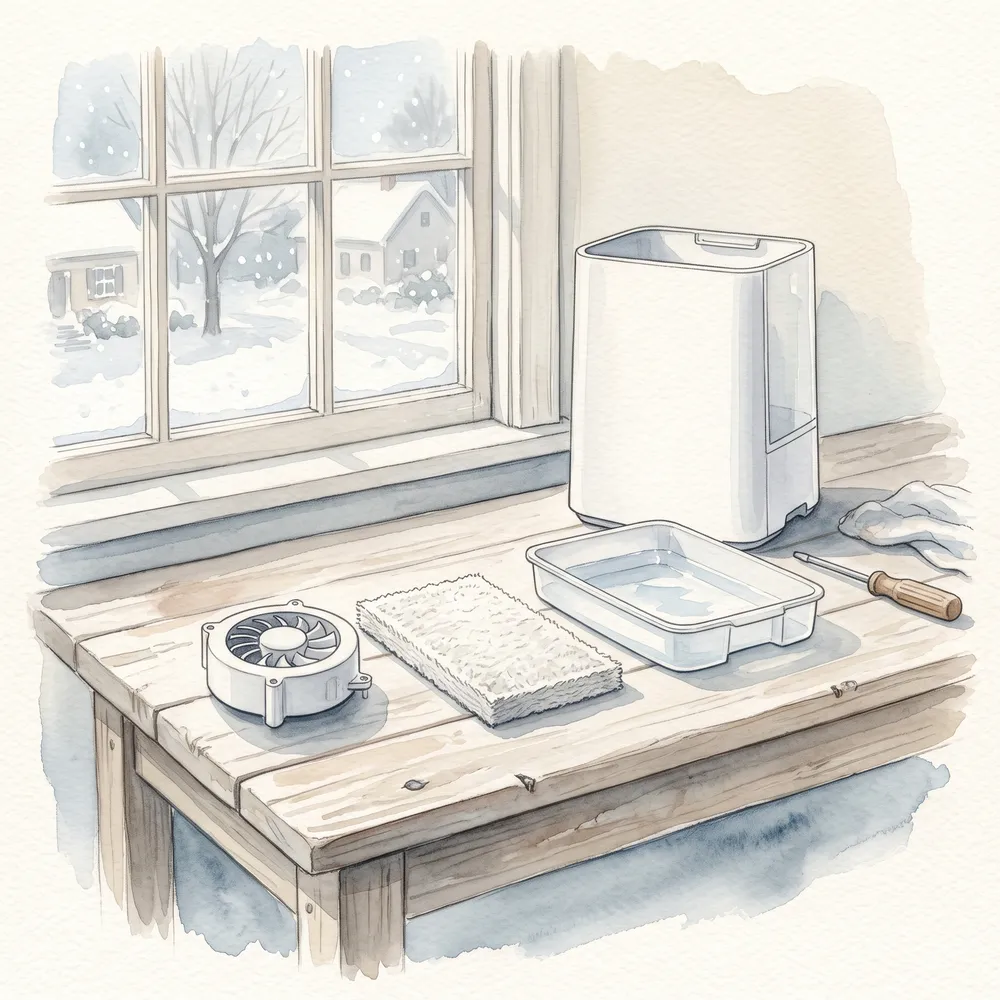
Dainichi Industry is based in Minami-ku, Niigata City. Founded in 1964, it has made humidifiers since 2003. Its official site says that "from product design to assembly and inspection, everything is produced in Japan at our factories in Niigata," and that "development, shipping and after-sales service are all done in Japan."
The humidifiers are made at its Nakanokuchi factory, which lists "environmental equipment (humidifiers, air purifiers, fuel-cell units)" alongside heaters. The same factory that makes heaters makes the humidifiers.
Corona — eight factories, all in Niigata
Corona is in Sanjo, Niigata. Founded in 1937 as a maker of kerosene cooking stoves, it now makes heating, air-conditioning and water-heating equipment. Its list of production sites names eight factories — and all of them are in Niigata Prefecture. The official product page for its UF-H humidifiers carries a "Made in Japan" mark.
These are the two companies whose official sites let us confirm Japanese production. Others may make humidifiers in Japan without saying so; if we confirm more, we'll add them.
Why heater companies make humidifiers
A kerosene fan heater vaporizes fuel and blows warm air; a hybrid humidifier vaporizes water and blows it out with fan and heat. The engineering is closely related, and both sell in the same season. Dainichi adds a neat detail: burning kerosene produces water, so "burning 1 liter of kerosene has the humidifying effect of 1 liter (1,000 mL) of water." A kerosene heater was already humidifying the room.
Corona UF-H7226R — a tank you can put your hand into
720 mL/h, for up to 12 tatami (wooden) or 20 tatami (prefab). Big enough for a larger living room.
Corona's selling point is the tank's opening: in its words, an "extra-wide 82 mm mouth, so you can put your hand in the tank to clean it." A narrow tank can't be scrubbed with a sponge; after five years, that difference shows. It is sold in Japan.
3. Electricity Depends on the Mode, Not the Size
What "hybrid" means
Japanese shops sell four types: steam (boils water — fast and clean, but power-hungry), evaporative (fan through a wet filter — cheap to run, slower in a cold room), ultrasonic (vibrates water into mist — small and inexpensive, but the tank water goes straight into the air, so it needs frequent changing) and hybrid. Both makers here make hybrids.
Dainichi describes its hybrid as switching between "warm-air evaporative" when the humidity is low, to raise it quickly, and plain "evaporative" once it reaches the set level, turning the heater off.
The heater is most of the bill
Dainichi publishes monthly running costs (8 hours a day for 30 days). By its figures, a 500 mL/h model costs about 14 times as much to run in standard mode as in eco mode. The 300 mL/h class in eco mode costs about the same as the 500 mL/h class in eco, and even the largest 1,200 mL/h class in eco mode costs about an eighth of a 500 mL/h model in standard mode.
Eco mode runs as a plain evaporative humidifier with no heater. The HD-RXC500C draws 163 W in standard mode and 12 W in eco. The trade-off is output: 500 mL/h drops to 370 mL/h. In practice: standard mode to raise the humidity when you get home, eco once it's there.
Dainichi also points out that a 960 mL/h model in eco mode (600 mL/h at 20 W) produces about the same moisture as a smaller model in standard mode while using 143 W less. Eco output drops in a cold room, but if you have the space and budget, one size up, run in eco, is worth considering.
Dainichi HD-RXC500C — the standard living-room size
500 mL/h, for up to 8.5 tatami (wooden) or 14 tatami (prefab), with a 5 L tank — the size that suits the most homes.
Dainichi says it designed for a noise level that "doesn't bother you while watching TV." The tank lifts out with one hand and the tray slides out from the front, so cleaning doesn't mean moving the unit. Sold in Japan.
4. Reading Japanese Room Sizes, and Choosing for a Bedroom
Two numbers on every box
Japanese humidifiers are rated in tatami mats (one tatami is about 1.6 m², or 17.5 sq ft), and every box gives two numbers — for example "wooden Japanese room 8.5 tatami / prefab Western room 14 tatami." Same machine, same output; the difference is the room.
A wooden house with tatami absorbs and leaks moisture through walls, floor and gaps, so the same humidifier covers less floor. An airtight modern apartment holds moisture, so it covers more. If you live in an older house or anything drafty, use the "wooden" number. If in doubt, use the "wooden" number — too much capacity is better than too little.
For a bedroom, compare quiet-mode numbers
A humidifier only works in the room it's in, so a bedroom usually needs its own. And at night it runs in quiet mode — so compare quiet-mode output and noise, not the standard figures.
The Dainichi HD-C300H runs at 250 mL/h and a maximum of 18 dB in quiet mode, and its 2.5 L tank lasts about 10 hours at that setting — through the night without refilling. The HD-RXC500C manages 400 mL/h at 23 dB. Corona's UF-H7226R peaks at 29 dB in quiet mode (Corona doesn't publish its quiet-mode output).
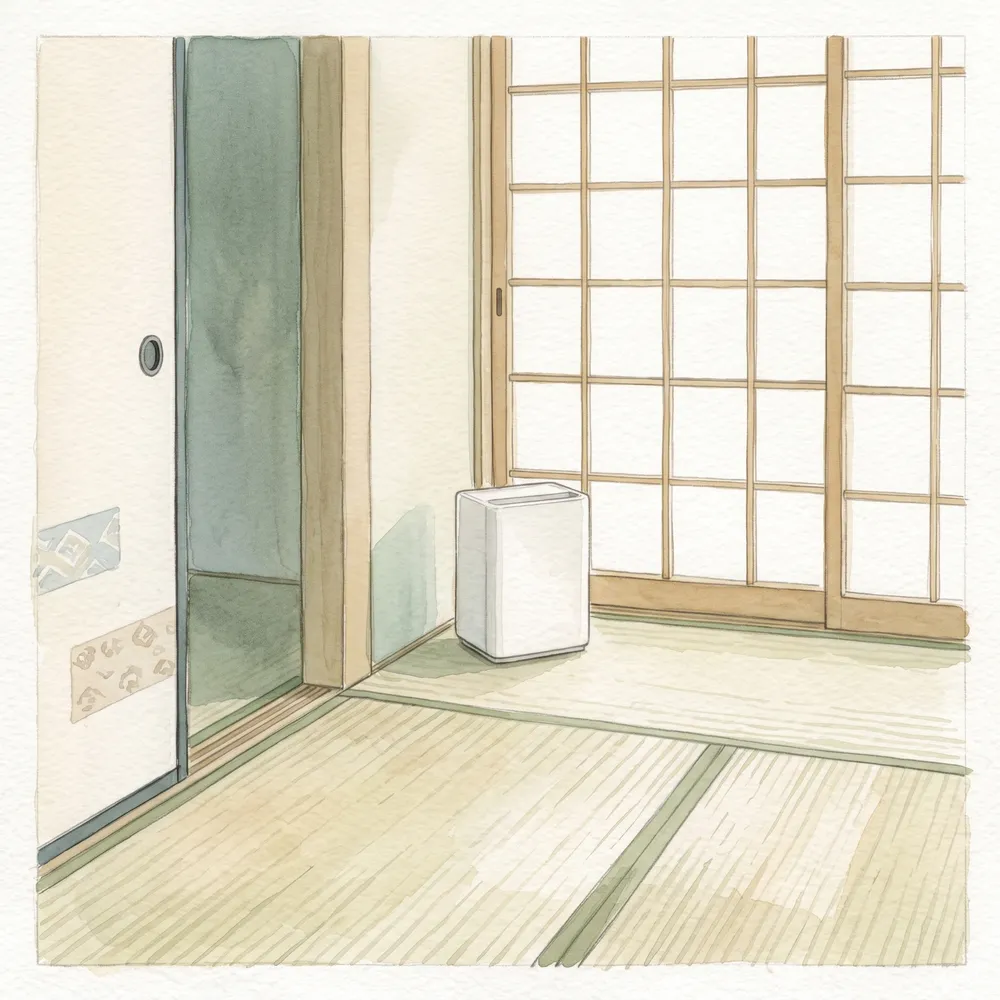
Dainichi HD-C300H — for a bedroom or study
300 mL/h, for up to 5 tatami (wooden) or 8 tatami (prefab), with a clear 2.5 L tank so you can see the water level.
Every Dainichi humidifier is a hybrid with a 3-year warranty in Japan — the smallest model included. Sold in Japan.
5. Where to Put It
Off the floor, away from the window
Dainichi's two placement rules: don't set it directly on the floor, and keep it away from windows. A window is the coldest spot in the room — cold air holds little moisture, the sensor misreads the room and the humidifier keeps running, and the result is condensation. Cold air also pools near the floor, so lift it onto a low stand.
Next, the air conditioner: the ideal spot is downwind of it, but not in its direct blast, so the warm air carries the moisture around the room without blowing on the sensor. And vacuum the air intake now and then — Dainichi notes that dust on the intake grille reduces output.
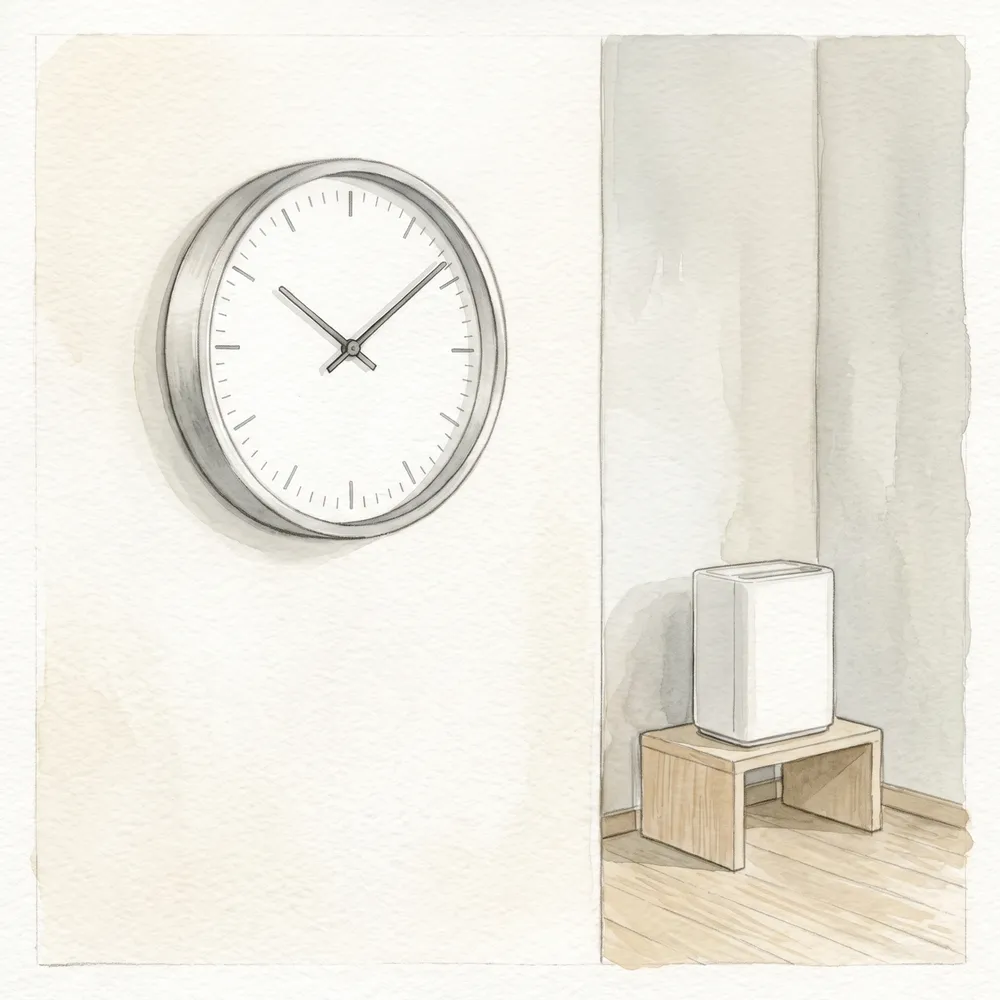
Check the room with a separate hygrometer
The display on a humidifier reads the air right around it. For a target, Japan's building hygiene law sets 40–70% relative humidity for large buildings such as offices — it doesn't apply to homes, but it is a reasonable reference. Go higher and you trade dryness for condensation and mold. A hygrometer on a wall away from the humidifier shows what the room is really doing.
6. Cleaning, Filters and the 3-Year Warranty
Daily, weekly, end of season
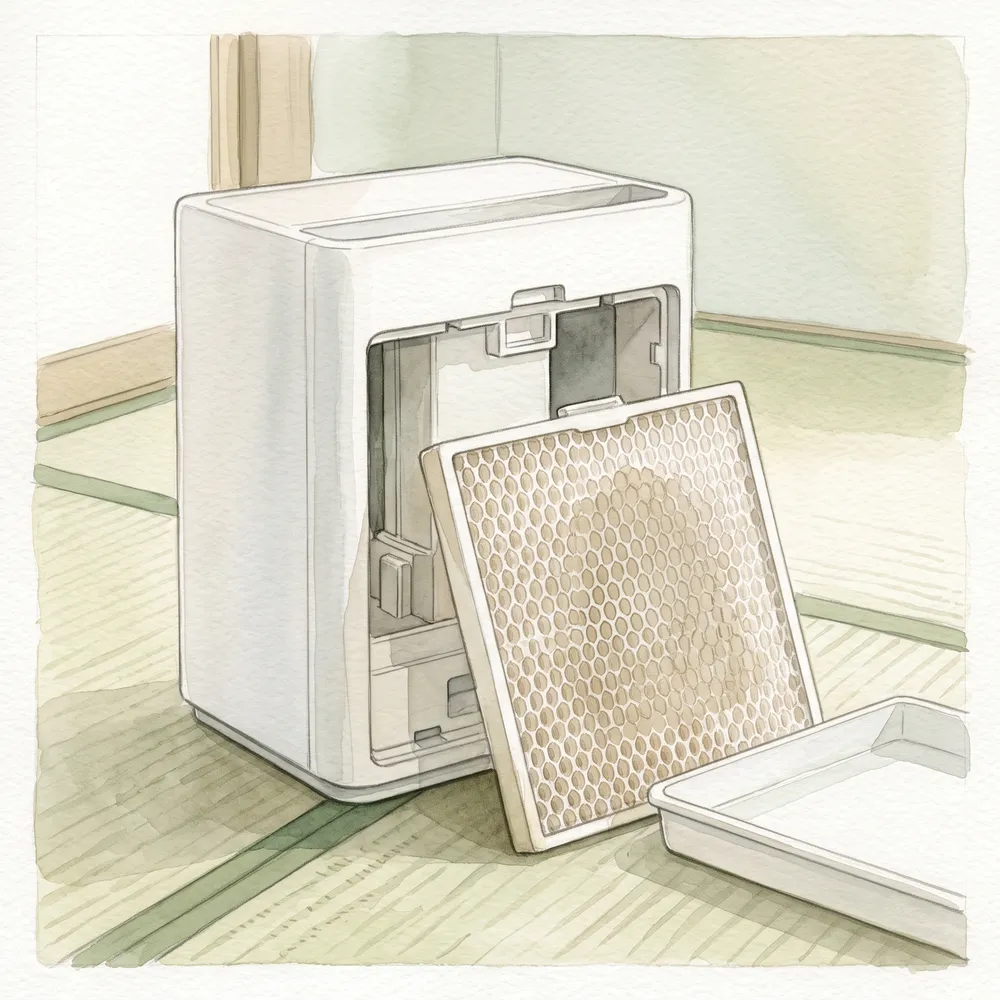
Every day: empty the old water and refill — don't top up. Every week: wash the tank and tray before they get slimy. End of season: soak the parts in citric acid to dissolve the white mineral scale from tap water (detergent won't shift it), then dry everything well before storing.
Hybrid and evaporative humidifiers have a filter that wears out. Both makers sell genuine replacement filters and parts by model number through their own online shops — worth checking before you buy, because when filters stop being available, the humidifier is effectively finished. Corona defines its filter replacement interval as the time until output falls to 50%, assuming 8 hours a day for a six-month season with proper cleaning — the better you clean, the longer it lasts.
Dainichi's 3-year warranty
Dainichi introduced a 3-year warranty on home humidifiers — the first in the industry, it says — and has offered it since it began making them in 2003: "a 3-year warranty on the main unit; if it stops working properly in normal use, we promise free repair." With design, production and service all in Niigata, the repair channel is in Japan.
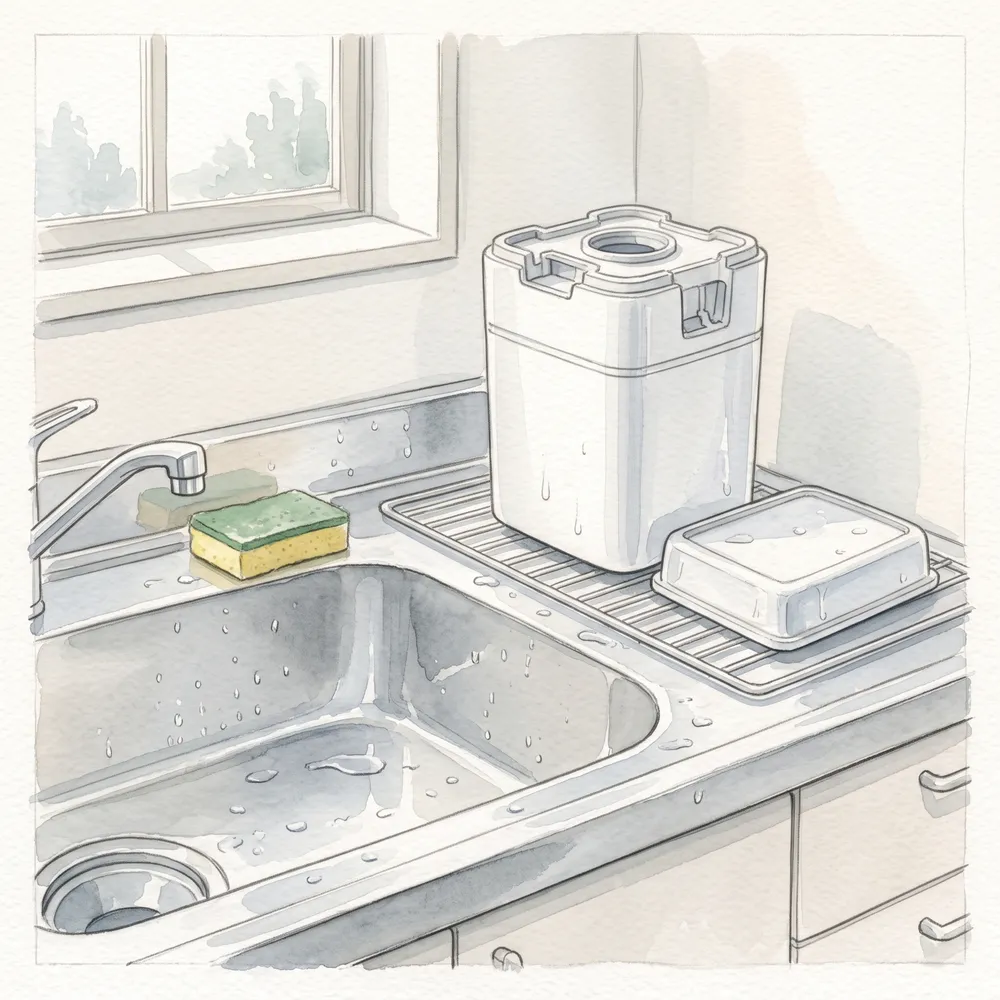
Dainichi HD-LX1226 — for open-plan rooms and stairwells
1,200 mL/h, for up to 20 tatami (wooden) or 33 tatami (prefab), with a 7 L tank. For a large LDK or a room open to the stairs.
The LX series has an easy filter cleaner built in — bigger machines have bigger filters, and this takes some of the work off you. In eco mode it still puts out 600 mL/h without the heater. Sold in Japan.
7. Buying One
If you live in Japan, all four models are sold through Japanese electronics stores and online shops, including Rakuten and Amazon.co.jp. They plug straight in.
Outside Japan, we could not find these models on Amazon.com, and neither maker offers a 120V or 100–240V version. You would need to buy in Japan (or through a forwarding service) and run it on a step-down transformer sized as in section 1. The warranty and repairs are handled in Japan.
8. Frequently Asked Questions
Can I use a Japanese humidifier in the US?
Only with a step-down transformer (120V→100V). The plug fits, but the voltage is 20% too high for the heater. Size the transformer at two to four times the humidifier's power: 500 W for the small Dainichi models, about 1,600 W for the HD-LX1226.
Steam or hybrid — which is better?
It depends on the room. Steam boils the water, so it is clean and fast but uses more power. A hybrid uses its heater only until the room reaches the set humidity, then runs on fan alone — better for a room where it runs for hours.
Which room-size number should I use?
"Wooden" for houses, tatami rooms and older or drafty homes; "prefab" for modern, airtight apartments. If in doubt, go by the wooden figure.
Is a bigger humidifier more expensive to run?
Not necessarily — the heater is what costs money. By Dainichi's figures, a 500 mL/h model costs about 14 times as much to run in standard mode (163 W) as in eco mode (12 W), and even the largest 1,200 mL/h model in eco mode costs about an eighth of a 500 mL/h model in standard mode.
What is the white powder on the filter?
Minerals from tap water, left behind when the water evaporates. Detergent won't remove it, but soaking in citric acid dissolves it. Do it at the end of each season.
What humidity should I aim for?
Around 40–70% is a common reference — it is the range Japan's building hygiene law sets for large buildings, though it doesn't apply to homes. Higher than that leads to condensation. Check with a hygrometer placed away from the humidifier.
Final Thoughts: Heater Makers, Making Humidifiers
The Japanese humidifiers we could confirm as made in Japan come from two Niigata companies, Dainichi and Corona — both kerosene-heater makers, building humidifiers in the same factories, in the same season.
Choose by the "wooden" room size if in doubt; for a bedroom, compare quiet-mode output and noise. Run the heater to raise the humidity and eco mode to hold it — that is what keeps the bill down.
In Japan, they simply plug in. Elsewhere, they are 100-volt machines: a properly sized step-down transformer, or a humidifier made for your own voltage.

Japanese Kerosene Heaters: Check Your Local Law First
Kotatsu: Buying a Japanese Heated Table That Lasts