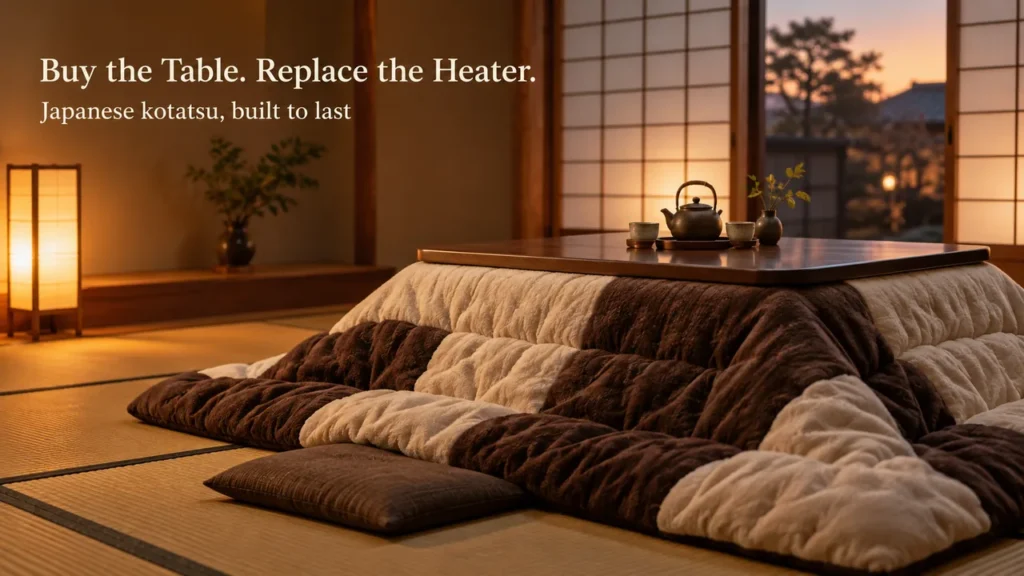
A kotatsu is a low table with a heater fixed underneath, a quilt draped over the frame, and a tabletop laid on top to hold the quilt in place. You sit on the floor with your legs under the quilt, and the warmth stays where you are instead of heating the whole room.
When you shop for one, you will look closely at the tabletop — the wood, the shape, the size. But what decides whether you can still use it in ten years is the heater, and specifically its size. Heaters wear out. Whether you can replace one depends on whether it is a standard size.
Nichibi, the furniture maker from Takamatsu in Kagawa Prefecture featured in this guide, states it plainly: its kotatsu heaters use a standard 29 cm square format, so "even if the heater reaches the end of its life or fails, you can easily replace it yourself with a commercially available heater of the same size." A sturdy frame and a standard heater are what make a kotatsu last. This guide covers how they are built, the voltage question if you live outside Japan, sizes in centimetres and inches, and how to pick and care for the quilt.
Quick Reference: Kotatsu Sizes at a Glance
| How many people | Tabletop width | Quilt (futon) size |
|---|---|---|
| 1–2 | 80–105 cm (about 31–41 in) | Tabletop + 100–120 cm (39–47 in) each way |
| 2–4 | 120 cm (about 47 in) — the widest choice of models | Same rule |
| 4 or more | 150–180 cm (about 59–71 in) | Same rule |
| With chairs (high type) | Check the height — the legs are longer | Tabletop + 130–150 cm (51–59 in) |
| Before you buy | Check that the heater is a standard size (such as 29 cm square), and check the voltage where you live. | |
1. Will a Japanese Kotatsu Work in Your Country?
Short answer: the table works anywhere. The heater is the part that needs thought — a step-down transformer in North America, a transformer and a plug adapter in Europe, the UK, and Australia.
That split is the useful thing to understand. A kotatsu is furniture with a separate heater unit bolted underneath. The tabletop, the frame, and the quilt don't care what country they are in. Only the heater plugs into the wall.
| Where you live | Voltage | Does the plug fit? | What you need for the heater |
|---|---|---|---|
| Japan | 100V | — | Nothing |
| United States / Canada | 120V | Yes — same Type A plug | A step-down transformer. The plug fits, but the voltage is 20% too high |
| Europe / UK / Australia | 230–240V | No | A plug adapter and a step-down transformer |
The dangerous case is the United States and Canada, precisely because the plug fits. Japan and North America use the same plug shape, so a Japanese kotatsu will switch on and seem fine. But a heating element run at 120V instead of 100V gets hotter than it was designed to. A kotatsu heater sits a few centimetres from a quilt and your legs. Don't plug it straight in.
- Use a transformer, not a travel converter. Cheap travel "converters" are only meant for simple heating appliances used briefly. Look for a step-down transformer (toroidal if you can).
- Size it from the heater's label. Read the rated wattage printed on the heater unit. For anything with a heating element, choose a transformer rated at two to four times that figure, because the draw at switch-on runs well above the label.
- Expect a box on the floor. A transformer big enough for a heater is a heavy unit that lives next to the kotatsu. That is the honest cost of running Japanese heating equipment abroad.
Because the heater is a separate, standard-size unit, the table is a long-term purchase and the heater is the part you solve for your own wiring. That is exactly why the heater size matters as much as it does.
2. Why Japanese: Kagawa, and a Factory That Does Everything
Nichibi is a furniture maker in Takamatsu, Kagawa Prefecture, on the island of Shikoku, founded in 1923 and incorporated in 1962. It describes itself as "a furniture factory and domestic furniture maker in Takamatsu, Kagawa," and as a place where "craftspeople of Sanuki make things with the wood of Sanuki" — Sanuki being the old name for Kagawa.
The line that matters most is this one: "woodworking, metalwork, and sewing are all done in our own single factory." The same factory cuts the tabletop, makes the metal fittings for the legs, and sews the kotatsu quilts. That is why a Nichibi table and a Nichibi quilt are designed to go together from the start.
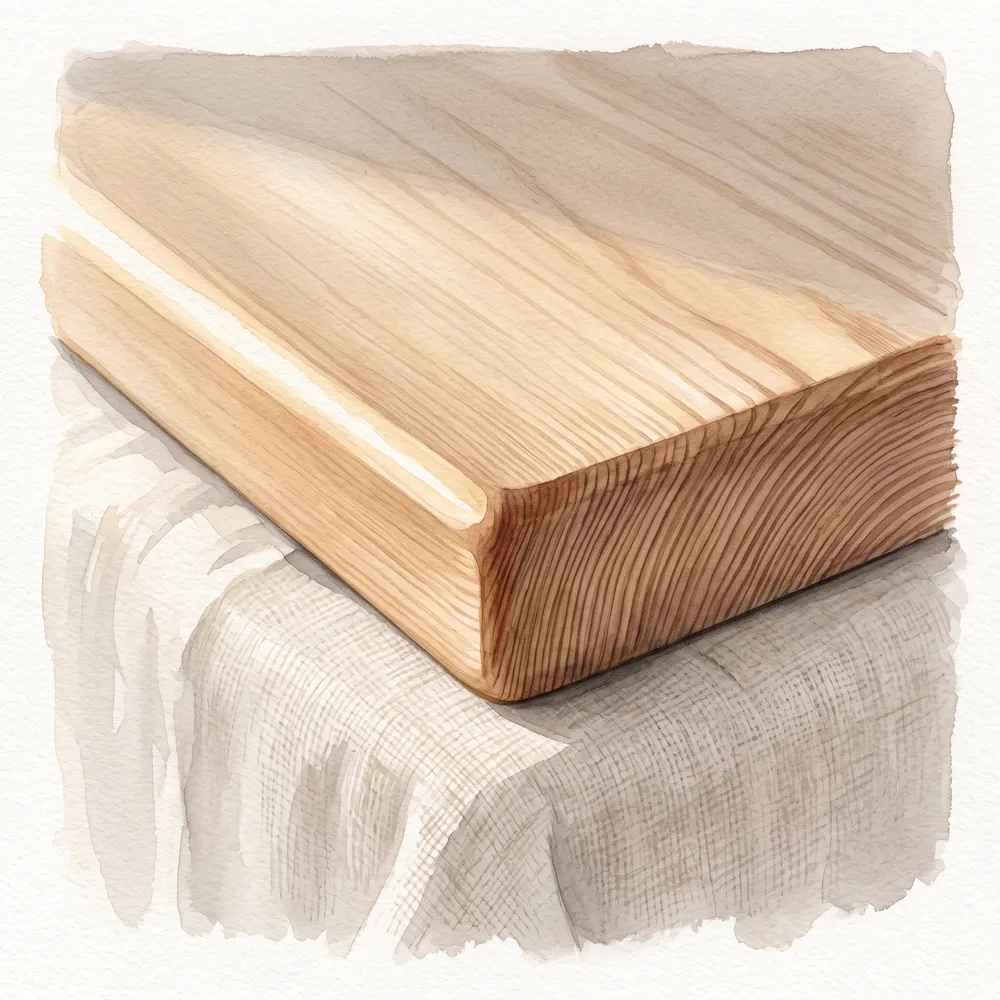
Kagawa also has a long tradition of lacquer work, and its finishing craftspeople have been part of making kotatsu tops there. A tabletop is a surface you touch every day, all winter. The quality of the finish is something you feel with your hands.
3. How a Kotatsu Is Built — and Why That Matters
From the top: tabletop, quilt, frame
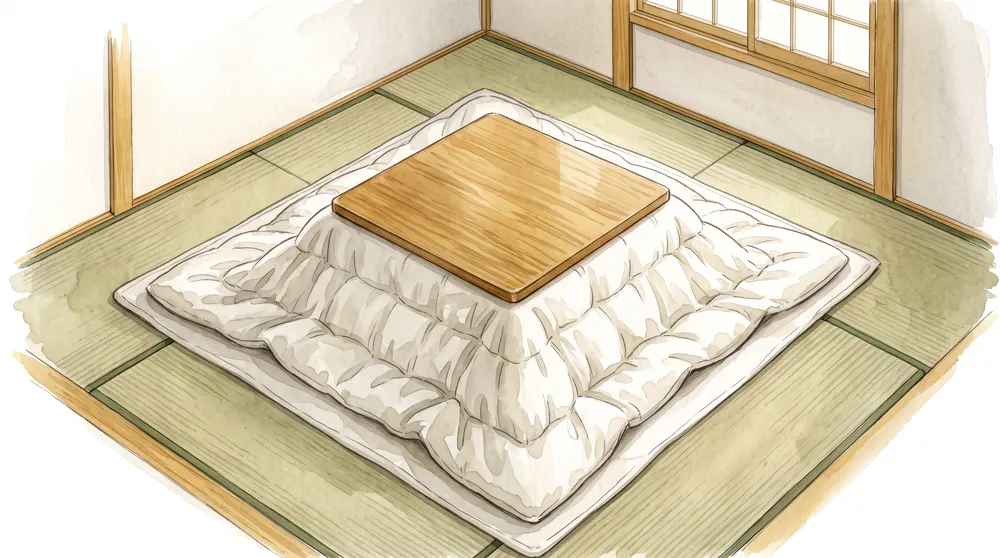
A kotatsu looks like one piece of furniture, but it is three layers stacked together.
At the bottom is the frame — the legs and the structure — and this is where the heater is mounted. Over the frame goes the kotatsu quilt (futon). On top sits the tabletop.
In Nichibi's words, "the quilt just goes under the tabletop. The weight of the tabletop holds it steady, so nothing special is needed." The tabletop doubles as the weight that keeps the quilt in place.
So the tabletop comes off every year
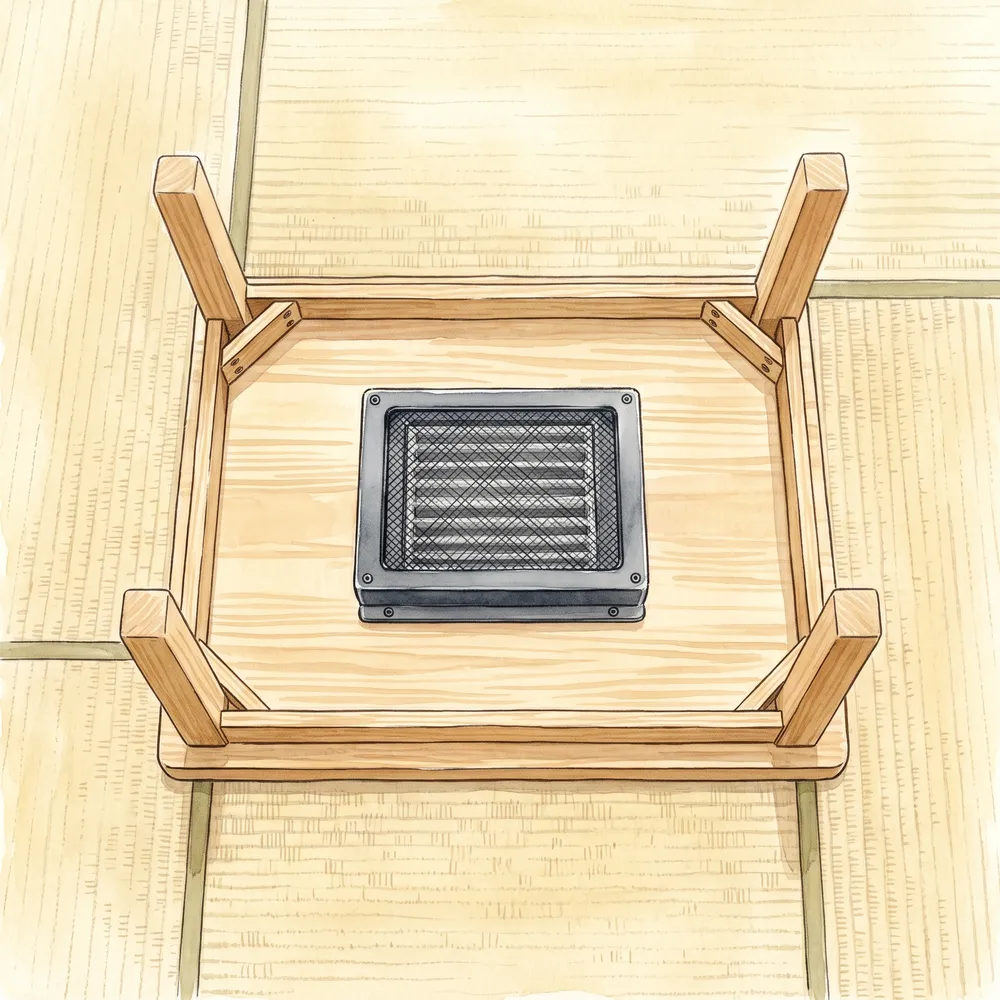
The tabletop is held on by a single fastener. On Nichibi's flat-board style frames it is a tabletop bolt; on its lattice (yagura) frames it is a wing screw in the side panel. Either way it comes off easily. To put the quilt in, you lift the top, lay the quilt over the frame, and put the top back. In spring, you do the reverse. The tabletop is a part you take on and off every season.
There are two frame styles. The flat-board type has a board directly under the tabletop and no side panels, so it looks cleaner when the quilt is off. The yagura (lattice) type has a latticed frame with side panels — in Nichibi's words, "from the outside you can't tell there's a heater at all."
Check the heater size before you buy
This is the most important point in this guide. Heaters are consumable — sooner or later they fail. When that happens, whether you can get a replacement depends on the size. Nichibi uses a standard 29 cm square heater, and says you can replace it yourself with a commercially available heater of the same size. If a maker uses its own proprietary dimensions, you depend on that maker for parts. Ten years from now, that is the difference between a quick fix and a new kotatsu.
4. Three Kinds of Heater, and You Can Switch Later
Kotatsu heaters come in three main types. None of them is "the right one" — they behave differently.
Quartz tube: the common standard
The type you'll find on most kotatsu. It warms you with far-infrared heat. It takes a little while to warm up after you switch it on, and the tube can break if knocked.
Halogen: warm almost immediately
Warms up quickly after switching on, and is generally said to last longer than a quartz tube. It tends to cost a little more to run. Good if you want to get warm the moment you come home, or use it in short bursts.
Flat carbon: nothing to bump your feet on
Thin and flat, it sits almost flush with the frame, so you don't hit it when you stretch your legs. It is generally said to heat more evenly and use less electricity. If you spend long evenings under the kotatsu, this may suit you best.
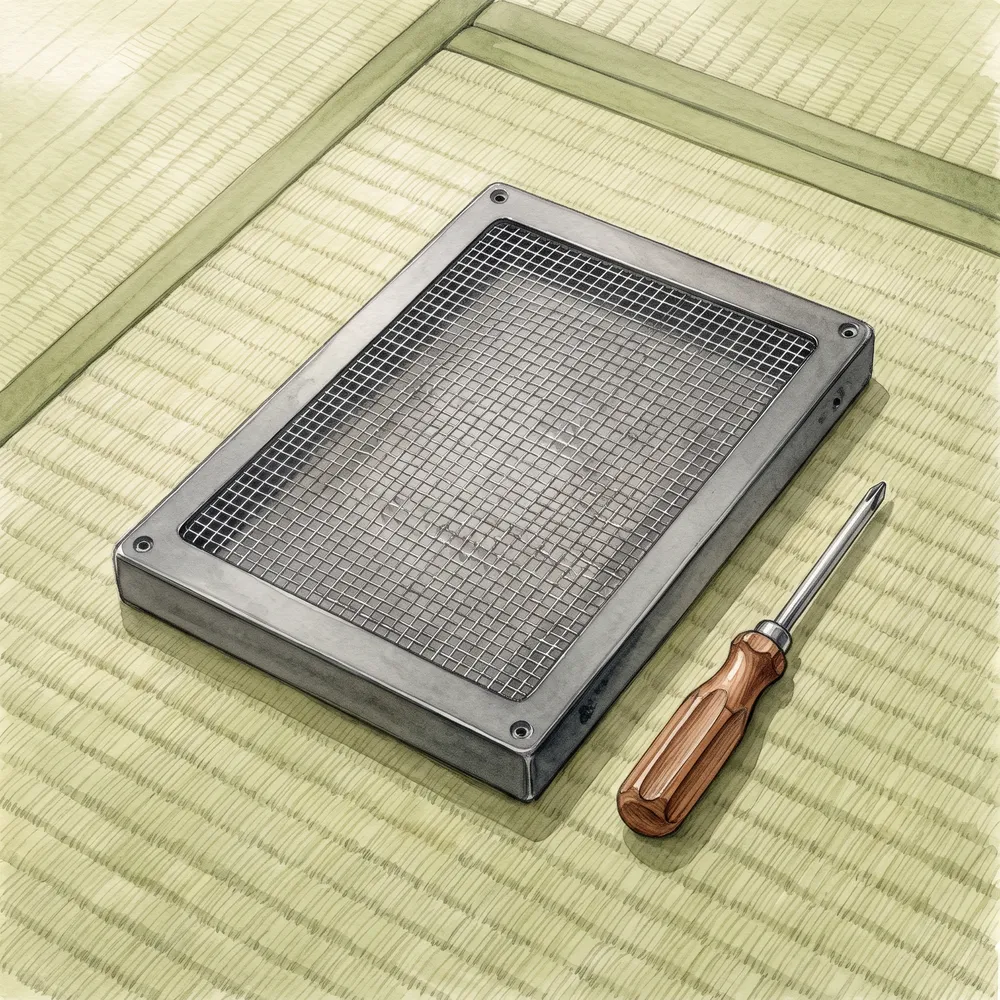
The point is that none of these locks you in. If the dimensions match, you can change to a different type later. So don't give up on a tabletop you love because of the heater type. Choose the table first; deal with the heater if it ever disappoints you.
5. Nichibi's Kotatsu Tables
Four of Nichibi's tables, chosen to cover different budgets and ways of living. All are made in Nichibi's factory in Takamatsu.
Rasmo — no corners, a bean shape
A tabletop shaped like a bean rather than a rectangle. With no corners, there is nothing for small children to bump into, and the rounded outline looks softer in a room. Japanese walnut (kurumi) veneer, in 105 cm and 120 cm widths. The most affordable of the four, and a good first kotatsu.
Lucius — spill on it, wipe it off
A melamine-faced top that shrugs off heat, scratches, and stains. A kotatsu becomes the dinner table: a hotpot in the middle, mandarins being peeled, drinks knocked over. Where solid wood would make you careful, this surface lets you relax. 120 cm wide, with rounded corners. The practical entry point if you see it as an everyday tool.
SAI Walnut II — the standard 120 cm, in walnut
120 cm wide, the most versatile size. Dark walnut anchors a room and works with both light and dark floors. There is also a 150 cm version if your household is growing.
NOMBE — a solid wood top
A solid wood kotatsu table. Unlike veneer or a laminate, solid wood can be sanded back and refinished, and its colour deepens with use. The most expensive of the four, and the one made for a ten- or twenty-year relationship. A kotatsu becomes where the family gathers all winter; this is a question of what you want to put at the centre of that.
6. Choosing the Tabletop: Surface, Shape, Size
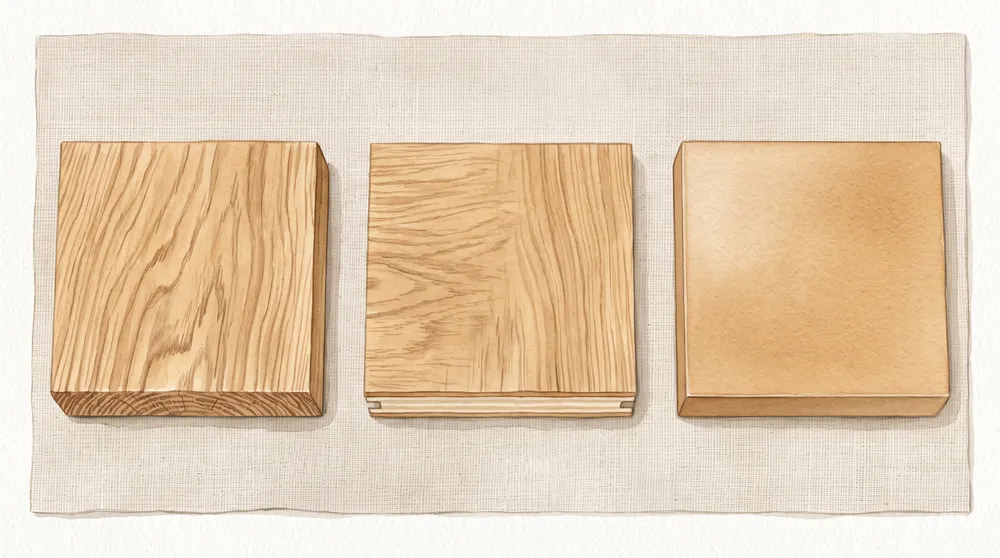
Choose the surface by how careful you want to be
There are three kinds of surface. It's not about better or worse — it's about how you'll use it.
- Solid wood: the real thing. Scratches can be sanded out, but you'll want to watch for water rings and hot pans.
- Veneer: a thin slice of real wood over a core. The grain looks close to solid wood, at a lower price.
- Melamine laminate: a resin surface that resists heat, scratches, and stains. Nothing to worry about.
If there will be hotpots, homework, and guests, the surface you don't have to protect is usually the one you end up happiest with.
Size: 120 cm is the baseline
120 cm (about 47 in) has the most models and suits two to four people. For one or two, 80–105 cm (31–41 in); for four or more, 150–180 cm (59–71 in).
Measure the space first. With the quilt on, a kotatsu takes up far more floor than the tabletop suggests — a 120 cm table ends up with a quilt around 220–240 cm (87–94 in) across. Size it from the tabletop alone and you may lose the walkway.
7. The Quilt: Sizing, Washing, Storing
Add 100–120 cm to the tabletop
A kotatsu quilt should be the tabletop's length and width plus 100–120 cm (39–47 in) each. An 80 cm square table takes a quilt of roughly 180–200 cm square (71–79 in). Too small and the hem doesn't reach the floor, so heat escapes; too large and it swamps the room. For a high (chair-height) kotatsu, add 130–150 cm (51–59 in) because the legs are longer.
"Washable" depends on your washing machine, not the quilt
The care label tells you whether the quilt can be washed in water. But a full-size kotatsu quilt usually won't fit in a home washing machine, whatever the label says. If it goes in with room to spare, wash it; if you have to force it in, don't — it won't get clean and it can damage the machine. The alternatives are washing it in the bath by treading on it, a laundromat with large machines, or a professional cleaner.
The easiest route is a cover. Put a kotatsu quilt cover over it and the cover takes the spills. A cover is thin enough for a home machine, and since a kotatsu is where people eat, it is the most realistic protection.
It spends most of the year in storage
In Japan a kotatsu is usually out from about November to March, so the quilt spends seven or eight months put away. How it comes out next winter depends on how it went in. Dry it completely first — even if you didn't wash it, air it, because it has absorbed a winter of sweat. Store it damp and it will smell, or grow mould.
Vacuum bags are fine with two conditions: the quilt must be completely dry, and don't flatten it all the way — about two-thirds of its original thickness is the limit, or it will struggle to recover. Store it up off the floor with air around it.
Heat also escapes downward
If your feet stay cold under the quilt, the heat is going into the floor — hard floors especially. Lay a thick kotatsu mat or rug underneath, a little larger than the quilt so the hem rests on it rather than on the bare floor. The layer of air between you and the floor makes the difference.
Nichibi LISO — a quilt from the same maker as the table
A kotatsu quilt sewn in Nichibi's own factory. Choose the table and quilt from the same maker and the colours are already worked out. The quilt is most of what you see of a kotatsu — the tabletop only shows at the edges. Note the tabletop's dimensions before you order.
EMOOR — a washable quilt you can order on Amazon.com
A kotatsu quilt from EMOOR, a Japanese bedding maker, made in Japan. Square, 73 × 73 in (about 185 cm), sold on its own without a cover. By the rule above, that suits a tabletop of roughly 65–85 cm square (26–33 in). It's made to be washed — check first that your machine takes a quilt this size.
EMOOR Washable Kotatsu Quilt, Square 73 × 73 in
Loading product details…
For a floor chair that sits at the right height for a kotatsu, see our guide to zaisu floor chairs.
8. Can You Buy One Outside Japan?
Not easily, and we'd rather say so. Nichibi's official shop lists product names in English but is otherwise in Japanese, and when we checked in October 2026 it did not mention international shipping. A kotatsu table is also furniture: large, heavy, and expensive to ship.
- Ask before you assume. If you want a specific model, contacting the maker or shop directly is the only reliable way to learn whether they will ship to you.
- Think about the heater separately. Whatever route you use, plan the heater for your own voltage (section 1). The table, frame, and quilt are the long-term part of the purchase.
- Check the heater format. Whatever kotatsu you buy, from any seller, ask whether the heater is a standard size. It is the single question that decides how long you can keep it running.
We will add listings you can buy from abroad here as we confirm them, one product at a time.
9. Frequently Asked Questions
Can I use a Japanese kotatsu in the US?
Yes, with a step-down transformer for the heater. The plug fits US outlets, but US voltage (120V) is 20% higher than Japan's (100V), so the heating element would run hotter than designed. Use a transformer — not a travel converter — rated at two to four times the heater's labelled wattage. The table itself needs nothing.
If the heater breaks, do I need a new kotatsu?
No — you replace the heater. The heater is a square unit mounted under the frame, and it comes off with a few screws. What matters is its size: Nichibi uses a standard 29 cm square heater and says you can replace it yourself with a commercially available one of the same size. With a proprietary size, you would depend on the original maker.
Which heater type should I choose?
It depends on how you use it. Halogen if you want warmth immediately, flat carbon if you spend long hours under it, quartz tube if the standard is fine. Don't agonise over it — with a standard-size heater, you can change later. The size is what to check first.
How big should the kotatsu quilt be?
Add 100–120 cm (39–47 in) to the tabletop's length and width. An 80 cm square table needs a quilt of about 180–200 cm square. For a chair-height kotatsu, add 130–150 cm instead. If the hem doesn't reach the floor, heat escapes.
What tabletop surface is best?
Whatever you're comfortable looking after. For hotpots, children, and guests, melamine is the easy choice. Solid wood can be sanded and refinished, which pays off over many years. Veneer gives you a real wood look at a lower price.
Can I leave a kotatsu out all year?
Yes — take the quilt off and it is a low table. The tables in this guide are designed to look finished without the quilt. If you won't use the heater over summer, unplug it, and keep the top out of direct sunlight.
Final Thoughts: Spend on the Part You Can't Replace
The kotatsu tables in this guide come from Nichibi in Takamatsu, Kagawa, a maker founded in 1923 that does its woodworking, metalwork, and sewing in a single factory — which is why its tables and quilts are made to match.
A kotatsu is built to be repaired: a tabletop held on by one fastener, a quilt held by the tabletop's weight, and a heater unit that wears out and can be replaced. Nichibi's heaters are a standard 29 cm square. Outside Japan, the heater is also the only part that needs solving for your voltage.
So spend your money on the part you can't swap. Pick a surface you're comfortable living with, size the quilt at tabletop plus 100–120 cm, and choose the place your household will gather this winter.

Zaisu: The Legless Chair, and Whether It Suits You
Japanese Hot Water Bottles (Yutanpo): Why Moist Heat Warms You Deeper