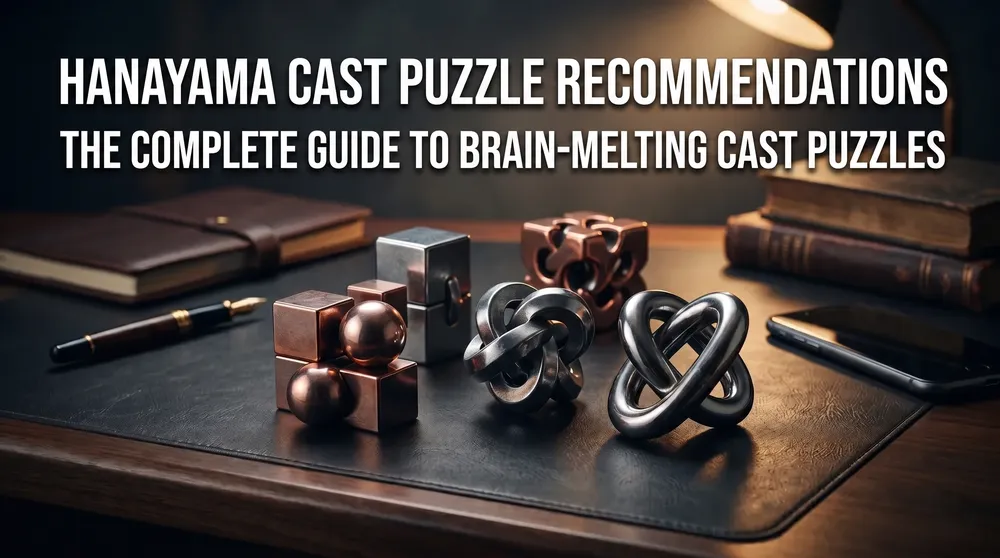
Hanayama's cast puzzles are small interlocking objects in die-cast metal that come apart — eventually — if you find the one alignment that lets them. They are graded from level 1 to level 6, and unlike most difficulty scales printed on boxes, this one is calibrated well enough to be worth trusting.
That is the useful part, so this guide is mostly about the scale: what each band actually feels like, why the top of it is a different activity rather than a harder version of the same one, and where to start. One practical note first — outside Japan these are sold as "Huzzle", so searching the Hanayama name alone will miss most of what is available to you.
Premium Cast Puzzles vs. Cheap Wire Puzzles
| Feature | Japanese Cast Metal (Hanayama) | Standard Wire Puzzle |
|---|---|---|
| Material | Heavy die-cast zinc alloy | Thin, bendable wire |
| Aesthetic | Looks like modern metallic art | Looks like a cheap toy |
| Precision | Tight tolerances; forcing damages rather than opens | Can often be bent or forced apart |
1. The Weight of Quality: Die-Cast Zinc
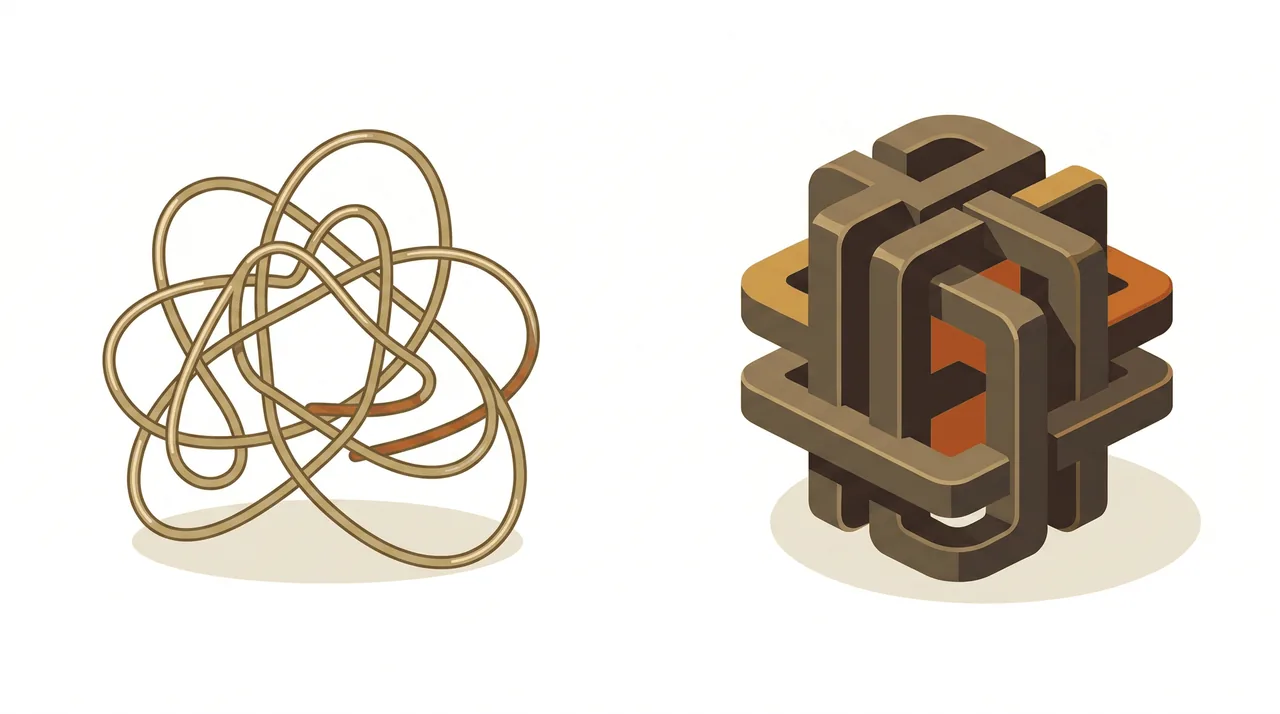
When you first pick up a Hanayama puzzle (sold internationally as Huzzle), the first thing you notice is the weight. They are surprisingly heavy. Made from high-quality die-cast zinc alloy, they feel substantial and cold to the touch.
This weight is not just for premium feel—it is essential for the mechanics. The weight of the metal allows gravity to play a role in solving the puzzles, requiring you to gently tilt and slide pieces rather than forcing them with brute strength.
2. Why People Keep One on the Desk
Forcing Focus
In an age of infinite scrolling, our attention spans are eroding. Cast puzzles force a different kind of brain engagement. They require spatial reasoning, patience, and tactile focus.
Many executives and creatives keep a Level 5 or 6 puzzle on their desk. When hitting a creative block or feeling overwhelmed by emails, spending 10 minutes manipulating the cold metal serves as a powerful mental palate cleanser.
3. Why Force Never Works
The Illusion of Impossibility
The brilliance of Japanese cast puzzles lies in their microscopic manufacturing tolerances. When locked, many of these puzzles look like a single, solid piece of metal. You cannot force them apart.
The solution is nearly always a specific alignment in which the pieces simply pass each other. When you find it, the puzzle opens with no resistance at all — which is the tell. If you are applying force, you have not found the alignment yet, and pushing harder takes you further from it.
This is also why these do not reward brute persistence in the way a jigsaw does. The productive move is to stop, look at where the pieces can travel, and try a different orientation. People who solve these quickly are not stronger or more patient; they are more systematic about eliminating positions.
Where the Puzzles Come From
Hanayama started in 1933 as a board game company and launched the cast puzzle series in 1983. What distinguishes the range is that the mechanisms come from named puzzle designers — Nob Yoshigahara and Oskar van Deventer among them — rather than from an in-house product team. Many of the designs existed as one-off wooden or metal originals before Hanayama industrialised them.
⚠ Outside Japan the same puzzles are branded Huzzle. Same puzzles, same numbering, different name on the box. If you are shopping in English and only searching "Hanayama", you are seeing a fraction of what is stocked.
4. Understanding the 6 Difficulty Levels
Every puzzle carries a number from 1 to 6 on the box. The scale is unusually honest — a level 4 from one design really is harder than a level 3 from another — which makes it the most useful thing on the packaging.
⚠ But it is not a linear scale, and this is the thing to understand before ordering. The step from 5 to 6 is far larger than the step from 1 to 2. Treat it less as a ruler and more as a set of bands describing different experiences:
- Level 1-2 — an evening. Ten to thirty minutes for most adults. Genuinely suitable for older children, and a reasonable way to find out whether you enjoy this at all before spending more.
- Level 3-4 — the band most people should buy. Hours, or a weekend of picking it up and putting it down. Hard enough that the solution feels earned, structured enough that you can reason your way there. If you are buying one puzzle, buy from here.
- Level 5 — days to weeks. Hidden internal mechanisms you cannot see and have to infer. Progress stops being continuous; you get nowhere for a long time and then everything at once.
- Level 6 — a different activity. Weeks to months, dead ends that feel like progress, and no guarantee. Some people never solve theirs and keep it on the shelf anyway.
⚠ Why level 6 is a bad first purchase
It is the obvious thing to reach for — the hardest one, as a challenge — and it is usually the wrong choice. Not because it is too hard, but because a level 6 gives you almost no feedback for a very long time.
A level 3 teaches you how these puzzles think: that pieces rotate as well as slide, that a shape which looks solid has a path through it, that the answer arrives when you stop pushing. A level 6 assumes you already know all of that and withholds any sign of progress until you do. Bought first, it usually ends up in a drawer.
Buy a 3 or a 4. If you solve it in an afternoon and want more, the 6 will still be there — and you will enjoy it instead of resenting it.
The level describes taking it apart, not putting it back
Worth knowing before you open one. Reassembly is frequently the harder half, and it is not what the number on the box is measuring. Taking a puzzle apart can be done by systematic trial; putting it back requires you to have understood why it opened. From level 4 upward, plenty of people take a photograph of the starting position before they begin — which is not cheating, and will save you an afternoon.
5. Top 3 Puzzles to Start Your Collection
Cast Star (Level 3)
The one to buy first.
A star held inside a curved ring. It looks good enough to leave out on a table, and the solution needs a genuine insight rather than fiddling — but only one, which is exactly right for a first puzzle. Solvable in an evening by most people, and satisfying rather than humiliating.
Cast Marble (Level 4)
A step up, and the best-looking of the three.
A sphere held inside an open cubic frame. The solution is a specific sequence of rotations rather than a single move, which is what makes it a 4 rather than a 3 — you have to hold several steps in your head at once. It also happens to be the one people most often leave out on a table.
Cast Enigma (Level 6)
The one to buy third, not first.
Based on a design patented in the United States in the 1970s, and among the most notorious in the range. The shapes are organic rather than geometric, which removes most of the visual logic you would normally reason with, and reassembly is harder than disassembly by a wide margin. Buy this because you already enjoy the category, not to test yourself.
6. Frequently Asked Questions
Do they come with the solution?
No, deliberately not. Hanayama does not include solution manuals in the box because the joy is in the struggle. (However, you can find solutions on YouTube if you truly give up).
Will the metal rust?
No, zinc alloy does not rust. However, the oils from your hands can cause the shiny plating to dull over time. Wiping them with a dry cloth keeps them looking premium.
I forced it and now it's stuck. What do I do?
Never use force. If it is wedged, gently wiggle and vibrate the pieces while applying zero pressure. The precision is so tight that force will permanently bend the metal, ruining the puzzle.
Is taking it apart the whole puzzle?
Only half of it. Putting a Level 5 or 6 puzzle back into its original starting position is often significantly harder than taking it apart, as you have forgotten the exact angles.
Are they safe for children?
Not for small children. While Level 1 is intellectually easy, they are heavy and could cause injury if thrown. They are primarily designed as adult collectibles.
Why is it called 'Cast' puzzle?
Because of the manufacturing process. Molten zinc is injected into steel molds (die-casting). This allows for much more complex, heavy, 3D shapes than simply bending wire.
7. Final Thoughts: Start at Three
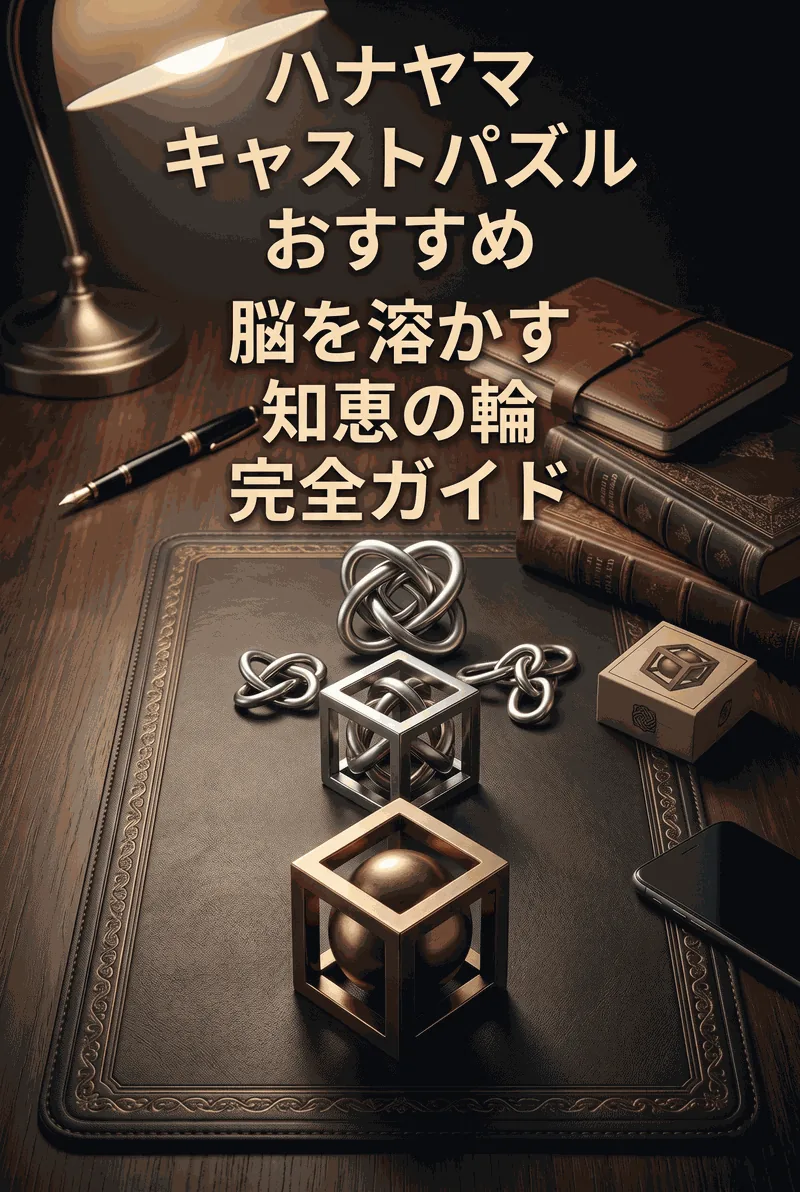
The number on the box is the most useful thing about this range, because it is one of the few difficulty ratings that means what it says. Use it — and remember that it climbs steeply rather than evenly.
Start at level 3 or 4. Not because the harder ones are beyond you, but because the lower levels teach you how these puzzles think, and a level 6 will not.
And search for Huzzle as well as Hanayama, photograph the starting position before you take anything apart, and stop pushing when it resists. All three will save you something.

Japanese Model Nippers: 5 Best Cutters for Clean Gates

Japanese Wrist Watches: Grand Seiko, Citizen, Knot & More