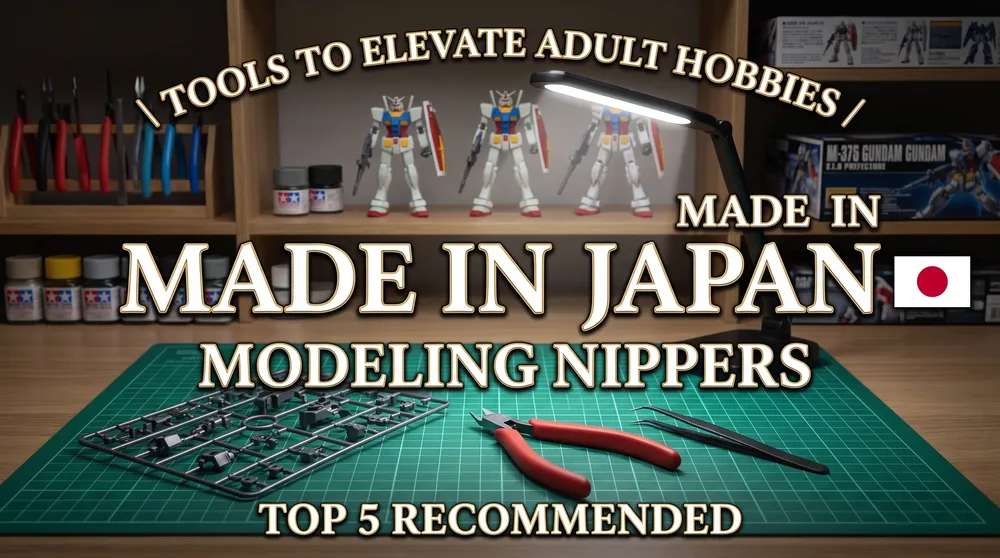
If you only buy one model nipper, buy the Tamiya 74123 Sharp Pointed Side Cutter.
If you build straight out of the box and never want to sand a gate again, add the
God Hand Ultimate Nipper 5.0 as a finishing tool. That is the short answer.
Those white marks left on your parts after cutting — stress whitening — are not
a skill problem. They happen because a thick blade crushes the plastic instead of slicing it,
and once the plastic has whitened, sanding will not bring the colour back.
This guide covers why single-blade and double-blade cutters do completely different jobs, the
two-stage cut that eliminates whitening entirely, and five Japanese nippers worth
owning — with honest notes on which ones you can actually buy outside Japan.
Quick Reference: Japanese Model Nippers at a Glance
| Nipper | Blade | Price | Best for |
|---|---|---|---|
| God Hand Ultimate Nipper 5.0 | Single | $50–70 | Zero whitening, no sanding. Finishing cuts only — the blade is fragile |
| Tamiya 74123 Sharp Pointed | Double | $25–35 | Buy this first. Sharp enough to finish, tough enough to survive |
| God Hand Blade One | Single | $35–45 | Single-blade cuts without the fear of snapping the edge |
| Tamiya Modeler's Nipper α | Double | $12–18 | Rough cuts off the sprue. Cheap enough to abuse |
| Mineshima Premium (D-25) | Double | $25–30 | Tsubame-Sanjo quality at a lower price than the famous names |
| The two-nipper setup most experienced builders use: a cheap tough one for cutting parts off the sprue, and an expensive sharp one that never touches anything but the last 2 mm of a gate. Doing this makes the expensive blade last for years. | |||
Why Japanese Model Nippers?
Roughly 90% of all plastic models made in Japan come from one prefecture: Shizuoka. Tamiya, Hasegawa and Aoshima are all based there. That concentration is not an accident of modern industry — it goes back four hundred years.
When Tokugawa Ieyasu built Sunpu Castle in Shizuoka in the early 1600s, he summoned miyadaiku — the master carpenters who build shrines and temples — from across Japan. They stayed. Combined with the region's forests, Shizuoka became Japan's woodworking centre, and by the early 20th century it was making wooden model kits.
When plastic arrived, those wooden-model companies did something most did not: they retooled completely, moving into injection moulding and steel die-making. The obsession with tolerances that shrine carpenters needed carried straight over into mould making — which is why a Tamiya kit's parts still fit together the way they do.
The nippers came from somewhere else. God Hand and Mineshima are both based in Tsubame-Sanjo, Niigata — the metalworking region that also produces Japan's kitchen knives and cutlery. So a Japanese model nipper is the product of two separate traditions meeting: Shizuoka makes the kits, Niigata makes the blades that cut them.
Did you know: "runner" and "sprue" mean the same thing
Japanese modellers call the plastic frame a runner. English-speaking modellers almost
always call it a sprue. Both refer to the same frame your parts are attached to,
and the little stub left behind is the gate in both languages.
If you have ever been confused reading a Japanese kit review in translation, this is usually why.
Why Your Parts Turn White (And Why Sanding Won't Fix It)
Cut a part off with hardware-store pliers and you get a pale, cloudy patch at the cut. That is stress whitening, and understanding it is the whole reason model nippers exist.
A thick blade does not slice plastic. It wedges into it and tears it apart. The polystyrene around the cut gets stretched past its limit, the internal structure fractures at a microscopic level, and light scatters off those fractures instead of passing through. The plastic looks white because it is physically damaged below the surface.
This is why sanding disappoints people. You are not removing a surface mark — the damage goes down into the plastic. You can sand until the visible white is gone, but by then you have removed real material and changed the shape of the part.
A purpose-built thin-blade nipper avoids the problem instead of fixing it. The edge is ground thin enough to part the plastic rather than crush it — the difference between cutting a tomato with a sharp knife and pressing down on it with a blunt one. No crushing, no fractures, no white.
Single Blade vs Double Blade: They Do Different Jobs
This is the one thing worth understanding before you spend money. These are not "good" and "better" — they are two different tools, and most experienced builders own both.
Double blade (両刃) — the workhorse
Two ground edges meet in a V, closing on the plastic from both sides. This is what almost every cutter you have ever used looks like. The blade is thicker, so it is strong: it will cut through a fat sprue gate all day and survive being dropped.
The trade-off is that a V-shaped cut leaves a small raised ridge, and a little compression at the edges. With a good one like the Tamiya 74123, that residue is small enough that a few passes with a file finishes it.
Single blade (片刃) — the finisher
Only one side is sharpened. The other is flat, acting as a cutting board. The blade slices along that flat face the way a knife slices against a chopping board, so the cut surface comes off almost perfectly flush — often with no visible gate mark at all.
For anyone doing a straight build with no paint, this is transformative. But the edge is ground extremely thin, and thin edges chip and snap. A single-blade nipper is a finishing instrument, not a general-purpose cutter. Use it on a thick sprue once and you can ruin it.
Did you know: the sound tells you which one you're holding
A double-blade nipper makes a distinct snap as the plastic breaks between the two edges.
A good single-blade one doesn't — the blade sinks through with almost no sound at all.
Japanese modellers describe the difference as pachin versus nuru. Once you have
heard it, you can tell a genuinely sharp nipper from a merely expensive one with your eyes closed.
The Two-Stage Cut
Never cut flush to the part on the first pass. Even with the best nipper in the
world, cutting a part directly off the sprue transfers force into the part itself, and that
force is what whitens plastic.
Cut one: leave 2–3 mm of gate. Cut out on the sprue, away from the part, using
the tough double-blade nipper. The part comes free and takes no stress.
Cut two: lay the flat face of the single-blade nipper against the part surface
and slice off the remaining stub. There is barely any material left, so there is barely any
force — and no whitening.
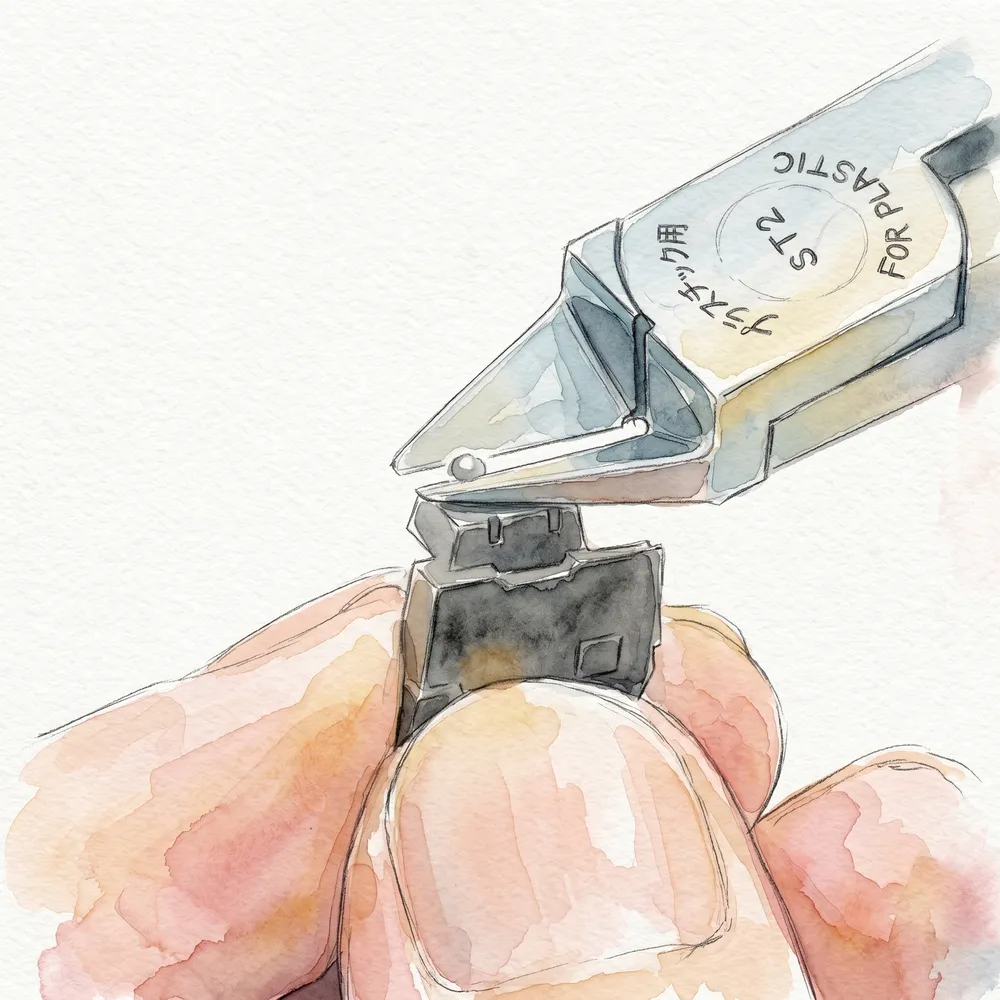
This one habit does more for your finish than any upgrade in tools. A cheap nipper used with a two-stage cut beats an expensive nipper used carelessly — and it is also what makes a $60 single-blade nipper last years instead of months, because it only ever meets 2 mm of plastic.
5 Japanese Nippers Worth Owning
Tamiya 74123 Sharp Pointed Side Cutter — buy this one first
The default recommendation for good reason. High-carbon steel, thin enough that the cut needs minimal cleanup, but double-bladed so it does not chip when you forget and cut something thick. The tapered nose reaches into tight recesses on Gunpla frames where a wider jaw cannot.
- Blade
- Double, sharp pointed
- Made in
- Japan
- Best for
- Doing everything reasonably well — the one-nipper answer
- Price range
- $25–$35
Perfect for: Anyone buying their first real model nipper, and anyone who wants a tool they will not baby.
God Hand Ultimate Nipper 5.0 (SPN-120) — the one people write essays about
Made in Tsubame-Sanjo, Niigata. The single blade is ground to something close to a razor, and the cut face it leaves is glassy enough that many builders stop sanding gates altogether. It is also genuinely fragile. Treat it as a finishing tool that never touches a sprue, never touches clear parts, and never gets twisted, and it will last for years.
- Blade
- Single (flush)
- Made in
- Tsubame-Sanjo, Niigata, Japan
- Best for
- Straight builds where every gate mark shows
- Price range
- $50–$70
Perfect for: Builders who do not paint, and therefore have nowhere to hide a gate mark.
Frequently out of stock and often marked up by third-party sellers. Check the price before buying — see the FAQ for alternatives.
God Hand Blade One — single-blade cuts you can relax with
God Hand built this for people who wanted the Ultimate Nipper's cut but were afraid of snapping it. Same single-blade geometry, slightly more metal behind the edge. You give up a little sharpness and get back a lot of confidence — the cut is still in a different league from any double-blade cutter.
- Blade
- Single (flush), reinforced
- Made in
- Tsubame-Sanjo, Niigata, Japan
- Best for
- Your first single-blade nipper
- Price range
- $35–$45
Perfect for: Anyone who wants flush cuts but does not want to think about the tool while using it.
Stock on Amazon US varies by seller, so this links to a search rather than a single listing.
Tamiya Modeler's Nipper α — the one you are allowed to abuse
Thick, blunt by comparison, and cheap. That is the point. This is the nipper that does the first cut in a two-stage workflow — hacking parts off the sprue where finish does not matter and force does. Buying this alongside a good finishing nipper is how you stop destroying the expensive one.
- Blade
- Double, thick
- Made in
- Japan
- Best for
- Rough cuts, thick sprues, anything you would not risk a good blade on
- Price range
- $12–$18
Perfect for: The second nipper in a two-nipper setup — or a complete beginner's first tool.
Mineshima Premium Thin Blade (D-25) — the one nobody outside Japan mentions
Mineshima has been making hobby tools in Niigata for decades and is well known to Japanese modellers while remaining almost invisible in English-language discussion. The D-25's hand-finished thin double blade cuts close to the Tamiya 74123 at a slightly lower price.
- Blade
- Double, thin, hand-finished
- Made in
- Niigata, Japan
- Best for
- Getting Tsubame-Sanjo quality without paying for the famous name
- Price range
- $25–$30
Perfect for: Readers who like finding the tool the locals buy.
Availability outside Japan is inconsistent. Hobby specialists that ship internationally are often the more reliable route.
Making a Sharp Blade Last
A thin-ground blade is a consumable if you treat it like a pair of pliers, and a lifetime tool if you do not. Three rules cover almost all of it.
Never cut clear parts with a thin blade
Clear styrene is noticeably harder than standard kit plastic. It is the single most common way people chip an expensive nipper. Use the cheap double-blade nipper for clear parts, then clean up with a file.
Never twist
Rotating the nipper to snap off a stubborn gate puts a sideways load on an edge designed only for straight compression. Close it fully, or reposition and cut again.
Oil it once a month
The blades are steel and will rust from skin oils and humidity alone. Brush the plastic dust out of the pivot with an old toothbrush, put one drop of light machine oil on the pivot and edge, wipe the excess off, and cap it. That is the whole routine.
Two files finish what the nipper starts
Even a perfect cut sometimes needs a touch. Tamiya's Craft File PRO is a metal file whose cut pattern resists clogging with plastic dust, which is what makes cheap files stop working. God Hand's Kamiyasu sanding sponges flex to follow curves, which rigid sandpaper on a stick cannot do — the right tool for a mecha shoulder or a car body.
Frequently Asked Questions
What is the best nipper for Gunpla beginners?
The Tamiya 74123 Sharp Pointed Side Cutter. It is sharp enough that gates need minimal cleanup, tough enough to survive learning mistakes, and cheap enough that ruining it is not a disaster. Add a single-blade nipper later, once the two-stage cut has become a habit.
Why do my parts turn white when I cut them?
Because the blade is crushing the plastic instead of slicing it. Stress whitening is fractured material below the surface, not a mark on top of it — which is why sanding it away means removing real material. A thin-ground model nipper plus the two-stage cut prevents it almost entirely.
Is the God Hand Ultimate Nipper worth the price?
Only if you build without painting. If you prime and paint, a $30 nipper plus thirty seconds of sanding gets you to the same place, because paint hides everything. If you build straight from the box, every gate mark is permanently visible — and that is exactly the problem this tool solves.
What can I use instead of the Ultimate Nipper if it's out of stock?
God Hand's Blade One is the closest thing, and it is more durable. It uses the same single-blade geometry with a slightly thicker edge. Alternatively, the Tamiya 74123 followed by a proper file gets you to an identical finish — it just takes an extra thirty seconds per part.
How long does a model nipper last?
A double-blade nipper lasts years; a single-blade one lasts as long as your discipline does. Thin edges do not wear out so much as chip, and almost every chip comes from clear parts, thick sprues, or twisting. Kept to finishing cuts only, an Ultimate Nipper survives hundreds of kits. Used once on a thick sprue, it can be finished in a single afternoon.
Can a chipped nipper be repaired?
God Hand offers a paid resharpening service, but it is Japan-based. For most buyers outside Japan the shipping makes it impractical, so treat the blade as something to protect rather than something to fix. This is a strong argument for the two-nipper setup: the cheap one absorbs all the risk.
Final Thoughts: Two Nippers, Not One
If you take one thing from this guide, make it the two-nipper habit: something cheap and tough
for getting parts off the sprue, something sharp and protected for the last two millimetres.
That single change does more for your finished models than any amount of money spent on one
expensive tool — and it is the reason a good nipper lasts years instead of months.
The carpenters who came to Shizuoka four hundred years ago were building shrines to a tolerance
nobody could see. That instinct is still in the plastic on your desk. It seems fair to cut it
with something equally considered.
Japanese Kitchen Knives: Best Types & Brands
Japanese High-End Tweezers: Pain-Free Precision