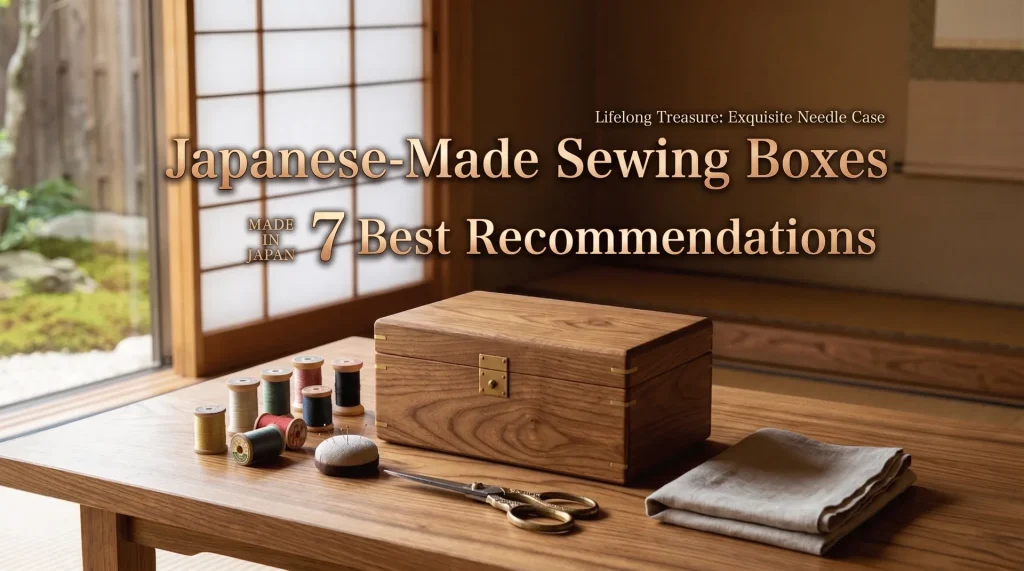
A button falls off. A hem unravels. You know you have a needle somewhere — but where exactly?
A sewing box solves that problem: needles, thread, scissors and spare buttons in one place, ready
to go. But if you're going to keep one on a shelf or desk where you see it every day, it might as
well be something you actually enjoy looking at.
Japanese wooden sewing boxes have been made with the same care as the country's best furniture
and tableware. Chestnut, oak, paulownia, hand-woven rattan — each material has a different
character. This guide explains what to look for and which Japan-made picks are worth considering.
Quick Reference: Japanese Sewing Boxes by Type
| Type / Material | Character | Best for |
|---|---|---|
| Chestnut (kuri) | Rich grain, deepens with age | Lifetime keepsake; display on shelves |
| Oak (nara) | Pale, neutral, suits any interior | Modern or Scandinavian-style rooms |
| Paulownia (kiri) | Very light; traditional Japanese look | Drawer-style organisation; Japanese interior |
| Rattan basket | Natural texture; easy to move around | Basket-style living; grab-and-go use |
1. What Goes in a Sewing Box? The Essentials
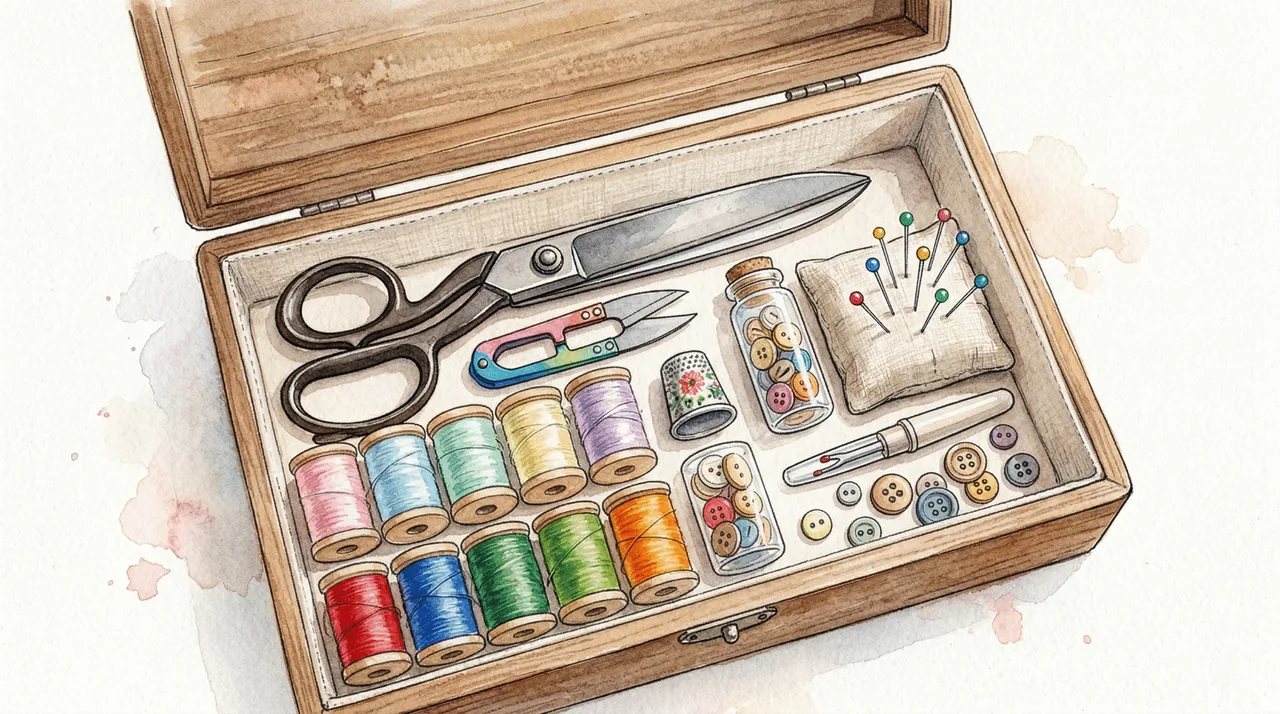
A well-organised sewing box covers everyday repairs — loose buttons, fraying hems, broken zips. The core kit is smaller than most people think:
- Needles & thread: Several colours of hand-sewing thread. A compartmented tray keeps spools from tangling.
- Scissors: One fabric scissors and one small thread snip. Keep them sharp and dedicated — using fabric scissors on paper blunts them fast.
- Thimble (指貫き): A metal thimble for hand-sewing through thick fabric or leather.
- Pins & pin cushion: For holding fabric in place during repairs.
- Seam ripper (リッパー): For undoing stitches cleanly. More useful than it looks.
- Spare buttons: A small assortment of shirt, trouser, and coat buttons.
- Tape measure & chalk marker: For measuring and marking before you cut.
In Japan, the sewing box (針箱, haribako) has historically been considered a bridal trousseau item — passed from mother to daughter, often lacquered or made from paulownia. That tradition has faded, but the category of well-made wooden sewing box has had a strong revival as part of broader interest in quality everyday objects.
2. Material Guide: Chestnut, Oak, Paulownia & Rattan
Chestnut (栗 / Kuri)
One of Japan's hardest domestic hardwoods. Chestnut has a deep colour and bold grain that grows richer and more lustrous with age and use. A chestnut sewing box from a maker like Classiky (倉敷意匠) looks like a piece of furniture — something you'd put on a shelf and feel pleased to see every day. The material is associated with longevity; it resists rot and moisture well.
Oak (楢 / Nara)
Japanese oak (nara-gaki) is lighter in colour than chestnut with a clear, straight grain. The neutral tone means it adapts to almost any interior — Japanese, Scandinavian, or contemporary Western. Classiky's nara sewing box has a composed, quiet elegance without the dramatic presence of chestnut.
Paulownia (桐 / Kiri)
Paulownia is Japan's traditional storage wood — used for centuries in tansu chests, kimono boxes, and musical instruments. It's exceptionally light (lighter than balsa for its size), and its structure naturally regulates humidity, protecting contents from moisture and insects. A paulownia sewing box with drawers follows the traditional organisation logic: one drawer per category.
Rattan Basket (籐 / Tō)
Toyooka (Hyogo Prefecture) — Japan's bag-making capital — also produces hand-woven rattan sewing baskets. The natural fibre texture sits comfortably between Japanese and Scandinavian aesthetics, and the basket format with a handle makes it easy to carry from room to room. Less organised than a drawer box, but more casually useful.
3. Drawer Type vs Box Type vs Basket Type
Drawer type
Multiple drawers allow you to sort by category — one drawer for thread spools, one for needles and pins, one for buttons and small tools. Everything is visible at a glance when you open the relevant drawer. Best for people with a full set of tools who want proper organisation. Standard sewing-box dimensions to accommodate typical sewing tools: around 25 cm wide × 15 cm deep × 10–15 cm tall.
Lidded box type
A single compartment under a lid, usually with a removable inner tray. Simpler, more compact, and tidier on a desk. Best for people who sew occasionally and have a smaller toolkit. A removable tray insert is key — it lets you sort tools without needing separate drawers.
Basket type
No drawers, no tight partitions — just an open woven vessel with a handle. Drop things in and take them out. Works well for people who also keep small fabric scraps, wool, or handcraft materials alongside sewing tools. The visual warmth of natural rattan makes it a living-room object as much as a storage tool.
4. Japan-Made Sewing Boxes Worth Buying
No.1 — Classiky (倉敷意匠) Chestnut Sewing Box
Made at a woodworking workshop in Shizuoka, the Classiky chestnut sewing box is handcrafted from solid kuri (chestnut) — a hardwood prized for its bold grain and durability. The interior has a removable tray for organising tools. No paint or lacquer: the natural oil finish lets the wood breathe and develop a patina over decades of use. This is a genuinely lifetime-quality object.
- Material
- Chestnut (kuri), oil finish, made in Japan
- Best for
- Lifetime keepsake; display on shelves; gifting
No.2 — Classiky (倉敷意匠) Oak Sewing Box
The same Shizuoka workshop, same construction quality — but in nara (Japanese oak). Where the chestnut box has drama, the oak version has composure: pale, quiet, universally compatible with interior styles from Japanese minimal to Japandi to contemporary Western. The lid closes with a satisfying precision that signals careful joinery. A practical daily-use object that also looks beautiful doing nothing on a shelf.
- Material
- Oak (nara), oil finish, made in Japan
- Best for
- Neutral modern interiors; Scandinavian or Japandi style
No.3 — Chatani Wooden Sewing Box with Tray (Made in Japan)
Chatani (茶谷産業) has been making Japanese household goods since 1941. Their wooden sewing boxes made in Japan combine a classic form with practical interior organisation — a lid, a removable inner tray, and thoughtful proportions that fit standard thread spools upright. A solid entry point for everyday sewing repairs, at a more accessible price than bespoke craft-studio pieces.
- Material
- Wood, made in Japan
- Best for
- Everyday repairs; first sewing box; desk use
No.4 — Hakoyoshi Paulownia (Kiri) Storage Box
Paulownia (kiri) is the wood of Japanese traditional storage — lighter than almost any other timber, naturally humidity-regulating, and gently insect-resistant thanks to natural tannins. Hakoyoshi is a long-running Japanese maker of kiribako (paulownia boxes), and their rectangular storage case in solid paulownia makes an excellent small sewing organiser — drop in your needles, thimble, thread snips and spare buttons. Available in multiple sizes so you can match the one you need. The pale cream-coloured wood has the quiet Japanese aesthetic of a traditional haribako.
- Material
- Paulownia (kiri), Hakoyoshi, made in Japan
- Best for
- Traditional Japanese interior; small tools and findings; gift packaging
No.5 — Haribakoya Hand-Woven Rattan Sewing Basket (Toyooka)
Toyooka (Hyogo Prefecture) is Japan's bag-making capital, where generations of craftspeople have worked with natural fibres. Haribakoya's hand-woven rattan sewing basket applies that tradition to household storage. The natural rattan weave suits both Japanese and Scandinavian interiors equally, and the handle means you can carry the basket from room to room as you work. One of the few sewing storage pieces that functions as room décor even when closed.
- Material
- Hand-woven rattan, made in Toyooka, Japan
- Best for
- Basket-style living; portable use; decorative storage
5. Care & Maintenance
Unlike bathroom accessories, a sewing box never gets wet — maintenance is minimal.
Daily care is just a soft cloth wipe to remove dust. For spills or marks, use a barely damp cloth and dry immediately. If a drawer starts binding, rub a small amount of beeswax (蜜蝋, mitsuro) along the drawer sides — it lubricates without staining.
Once or twice a year, apply a thin coat of beeswax or food-safe oil (camellia or linseed) to the exterior and buff off the excess. This prevents the wood drying and cracking, and builds the slow patina that makes well-maintained Japanese woodwork so distinctive. Avoid prolonged direct sunlight — UV fades and checks the wood over time.
6. Frequently Asked Questions
What size sewing box is practical?
For a complete everyday repair kit (needles, 5–6 thread colours, two scissors, pins, thimble, seam ripper, spare buttons), a box around 25 cm wide × 15 cm deep × 10–15 cm tall is comfortable. If you have more thread or want room for small fabric pieces, go larger. For desk use with a minimal kit, something closer to 18 × 12 × 8 cm works. Measure your thread spools upright — that's typically the dimension that drives the required interior height.
Chestnut or oak — which is better?
It depends on the room and the person. Chestnut has more visual weight and drama — a rich, dark grain that grows deeper with age. It works best in rooms that already have warm tones or natural wood furniture. Oak is pale and neutral, which makes it easier to place in any interior. If you're unsure which interior style you have, oak is safer. If you want an object with genuine presence, choose chestnut.
Is a sewing box a good gift?
Yes — it's a practical gift with an aesthetic dimension, which is a hard combination to find. It works for Mother's Day, birthdays, housewarming, and wedding gifts. The recipient is likely to use it regularly (everyone needs to sew on a button eventually), and a wooden box is the kind of object people keep for life. Pair it with a set of quality Japanese thread if you want to make the gift more complete.
I don't sew much. Is a sewing box still useful?
Very much so. The question isn't whether you sew — it's whether you ever need to: replace a button, fix a hem, repair a bag strap. Most people do, occasionally. Having a sewing box means you can handle those tasks in five minutes rather than hunting through drawers for twenty. A wooden box also doesn't look out of place on a shelf the way a plastic zip bag of loose needles does.
How do I store thread spools to stop them tangling?
Stand spools upright rather than lying flat — they're easier to see and less likely to unravel against each other. A drawer with vertical dividers, or a tray with individual slots, keeps spools in place. If using a basket, winding the thread tail a few times around the spool before storing prevents loose ends catching.
How do I care for a rattan basket sewing box?
Rattan is more sensitive to extremes than wood. Avoid prolonged direct sunlight and very dry heating environments — both cause the fibres to become brittle. Dust accumulates in the weave; remove it with a soft brush or vacuum brush attachment. If the surface marks, wipe quickly with a barely damp cloth and dry immediately. Do not immerse in water or leave wet.
Final Thoughts: Good Tools Make the Task Worth Doing
A sewing box is one of those objects that changes how you feel about a small task.
When your tools are organised in something beautiful, fixing a button or hemming a
pair of trousers shifts from a chore to a small, satisfying act.
The material choice matters less than making a choice: pick something you'll enjoy
seeing on the shelf every day. Chestnut if you want warmth and patina. Oak if you
want quiet versatility. Paulownia if you want organised drawers in the traditional
Japanese style. Rattan if you want something you can carry around the house.

Japanese Luxury Notebooks: 7 Brands Worth Writing In
Kintsugi Kits for Beginners: Repair Broken Ceramics in a Day