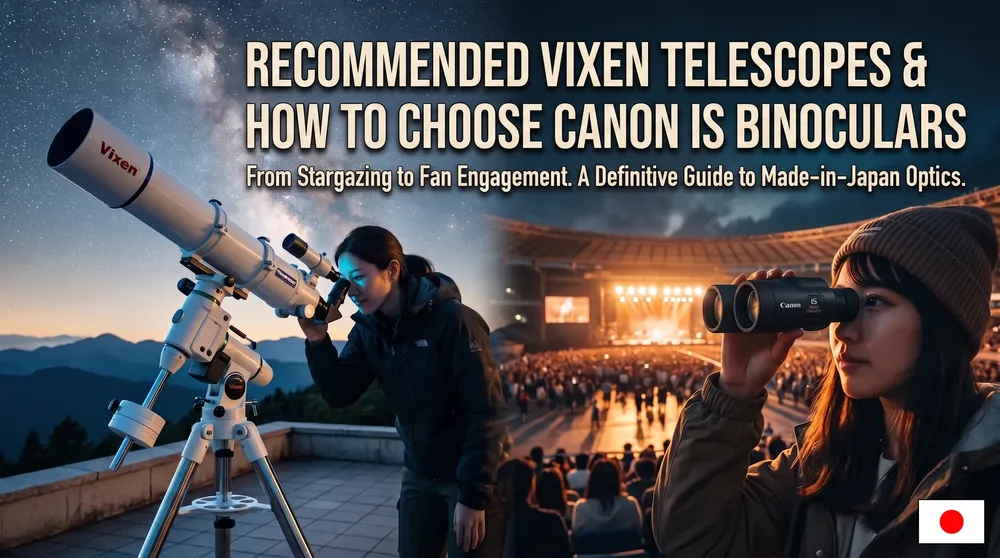
Optics are sold on one number — the aperture on a telescope, the magnification on a pair of binoculars — and it is the wrong number to shop by. What decides how much you actually see is how much light survives the trip to your eye, and that is settled by the coatings on the glass and the quality of the prisms, neither of which appears on the front of the box.
Japan makes a disproportionate share of the world's good glass, for the same reason it makes good camera lenses. This guide explains which specifications are worth reading, gives you the one calculation that predicts low-light brightness, and explains why the zoom binoculars at the top of every marketplace listing are the wrong purchase.
Premium Optics vs. Toy Binoculars
| Feature | Japanese Premium Optics | Cheap / Toy Optics |
|---|---|---|
| Lens Coating | Fully Multi-Coated (High transmission) | Uncoated or single coated (Dim) |
| Image Quality | Sharp to the edges, little colour fringing | Blurry edges, chromatic aberration |
| Eye Fatigue | Comfortable over long sessions | Causes headaches quickly |
1. The Secret is the Coating: Catching the Light
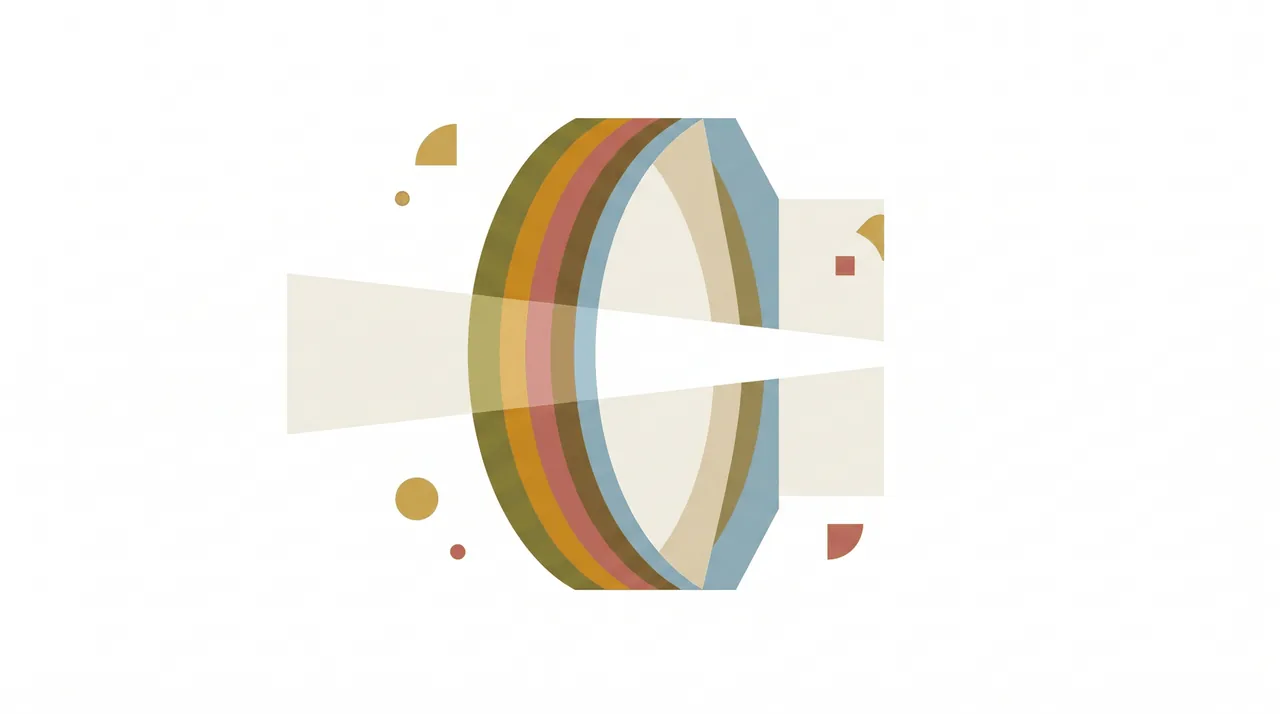
A common misconception is that higher magnification equals a better telescope or binocular. The truth is, magnification is useless if the image is dark. The real battle is light transmission.
Every glass-to-air surface reflects a little of the light back the way it came, and a pair of binoculars has a dozen or more of them. Uncoated, those losses compound into a visibly dim image. Multi-layer anti-reflective coating on every surface — the specification written as "fully multi-coated" — is what keeps most of the light in the system, and good ones land in the region of 90 per cent transmission overall.
⚠ Watch the exact wording, because it is deliberately slippery. "Coated" can mean a single layer on a single surface. "Fully coated", "multi-coated" and "fully multi-coated" are all different claims, and only the last means every surface has multiple layers. It is the cheapest thing in optics to lie about by omission.
The one calculation worth doing: exit pupil
Divide the objective diameter by the magnification. On an 8x42, that is 42 ÷ 8 = 5.25 mm. That figure is the width of the beam of light leaving the eyepiece, and it predicts low-light performance better than either number does alone.
Your own pupil opens to somewhere around 2-3 mm in daylight and up to about 7 mm in darkness, narrowing as you get older. If the exit pupil is smaller than your pupil, you are not using all of your eye, and the view goes dim.
- 8x42 → 5.25 mm. Works at dusk and under trees. This is why it is the standard birding size.
- 10x25 → 2.5 mm. Fine in daylight, poor at night. Compact binoculars are daylight instruments, whatever else the box says.
- 7x50 → 7.1 mm. The classic marine and astronomy size, chosen precisely to fill a dark-adapted eye.
It also explains a common disappointment: a 10x25 bought for an evening concert will look dimmer than the 8x21 someone else brought, despite the bigger numbers on it.
2. Equatorial Mounts: Following the Stars
Defeating the Earth's Rotation
If you look at the moon through a high-powered telescope, it will drift out of your vision in seconds because the Earth is spinning.
An equatorial mount answers this by tilting one of its axes to match the Earth's, so that a single slow rotation cancels the spin. Align it on the pole star, let the motor turn, and the planet stays in the eyepiece instead of sliding out of it. Vixen built much of its reputation on these mounts, and they remain the company's strongest suit.
⚠ Budget for the mount as a separate purchase, not an accessory. A good tube on a flimsy mount is unusable — every touch of the focuser sets off a wobble that takes seconds to settle, and at high magnification that is the whole experience. Beginners routinely spend everything on the optics and then wonder why the view shakes.

3. The "Oshi-Katsu" Phenomenon: Concert Binoculars
Stadium Seats to Front Row
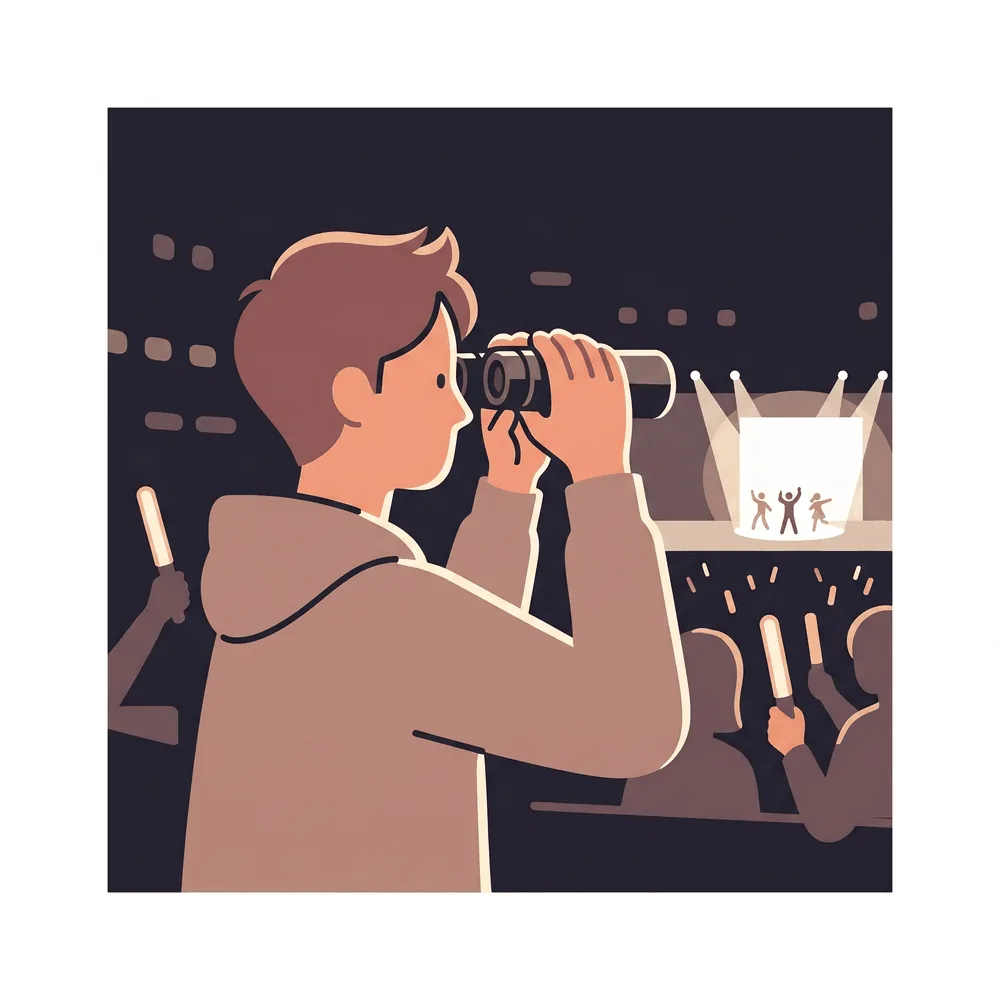
Recently, the biggest drivers of high-end binocular sales in Japan are not bird watchers, but concert-goers engaging in "Oshi-katsu" (supporting their favorite idols).
This has driven a genuinely useful sub-category: small, bright binoculars intended for a dark hall. Canon went further and moved image stabilisation across from their camera lenses, which does for a shaking view roughly what it does for a photograph — the image settles, and magnifications that are unusable freehand become usable.
Two things matter more for concerts than magnification. One is close focus: in a theatre you may be nearer the stage than the binoculars can focus, and a pair that will not focus below fifteen metres is useless in the stalls. The other is field of view — at high magnification you can lose the performer entirely and spend the song hunting for them.
Why Zoom Binoculars Are a Trap
Marketplace listings are dominated by binoculars advertising something like "10-30x zoom", and they are almost always the wrong purchase. Adding a zoom means adding moving elements, which means more glass surfaces, more places for the alignment to drift, and a compromise design that is optimised for none of its magnifications.
The practical result: the field of view narrows sharply as you zoom in, brightness drops with it, and at the top of the range you are looking through a dim straw at an image your hands cannot hold still. The high number on the box is the number you will use least.
Buy a fixed 8x or 10x. A fixed-magnification pair at a given price is built better in every respect than a zoom at the same price, because the money went into optics rather than into a mechanism.
4. Top 3 Japanese Optical Brands
Vixen
Telescopes, and above all mounts.
Based in Saitama, and the default recommendation for a first serious telescope in Japan. The Porta II altazimuth mount is the one usually pointed at beginners, for the reason given above — it is steady enough that the telescope on top of it is worth using. Their tracking mounts carry through to astrophotography. They also make the Atera stabilised binoculars, aimed squarely at the concert audience.
Canon (Binoculars)
Stabilisation, which changes what magnification is usable.
Canon put gyro sensors and a moving optical element inside a pair of binoculars. Hold the button and the view steadies, which matters because hand shake is magnified along with everything else — 12x is unusable freehand and perfectly comfortable stabilised. The trade-offs are weight and batteries, and they are real. For a dark stadium, or a boat, most people conclude they are worth it.
Kowa (Prominar)
Fluorite glass, and the birding standard.
Kowa uses fluorite crystal in place of ordinary glass in the Prominar line. Fluorite bends the different colours of light more evenly, which is what suppresses the purple and green fringes you see around a dark bird against a bright sky. It is expensive and it is difficult to work, which is most of why these cost what they do. Among European birders their spotting scopes are held in very high regard.
5. How to Read the Numbers (8x42, 10x21)
Binoculars always have two numbers, like 8x42.
- The First Number (8x): The magnification. The object appears 8 times closer. Note: Anything above 10x requires a tripod or Image Stabilization, because your hand-shake will also be magnified 10 times.
- The Second Number (42): The objective lens diameter in millimeters. A larger number (42mm) lets in much more light, making the image brighter, but makes the binoculars heavy. A smaller number (21mm) is compact and light, but struggles in dark settings.
- Divide one by the other to get the exit pupil, as above. That is the number that tells you how it will behave when the light goes.
- Recommendations: concerts and theatre, 8x21 or 10x25 — small enough to carry, and the hall is lit. Birding and general outdoor use, 8x42. Astronomy or anything at dusk, 7x50 or a stabilised pair.
- ⚠ If you wear glasses, check the eye relief before anything else. Under about 15 mm you will not see the whole field with your glasses on, and no amount of optical quality compensates for looking through a keyhole.
6. Frequently Asked Questions
Why shouldn't I buy a telescope from a toy store?
They use plastic lenses and wobbly mounts. A telescope that shakes violently every time you touch the focus knob will ruin the experience. A sturdy mount (like Vixen's) is just as important as the glass.
Can I see the rings of Saturn?
Yes, with a decent entry-level Vixen. Even a relatively small 80mm refractor telescope will show you the rings of Saturn and the cloud bands on Jupiter clearly.
What does 'Bak-4 Prism' mean?
It is a type of prism glass, and it matters less than the listings imply. Prisms turn the image the right way up. In porro-prism binoculars, BaK-4 does give a rounder exit pupil than cheaper BK-7, which means less light lost at the edges — so the claim has a real basis there.
In roof-prism binoculars, which is most modern designs, the glass type is not the deciding factor. Phase-correction coating and a dielectric mirror coating on the prism do far more for contrast and brightness than BaK-4 on its own. If a listing shouts "BaK-4" and says nothing about phase coating, that tells you something about the priorities behind it.
Are Image Stabilized (IS) binoculars heavy?
Yes, slightly. Because they contain motors and batteries, they are heavier than standard binoculars. However, the ability to see a perfectly still image at 12x magnification is worth the weight.
Can I use binoculars if I wear glasses?
Yes, look for 'Long Eye Relief'. Binoculars with an eye relief of 15mm or more allow you to see the entire field of view without taking off your glasses. Simply twist down the eyecups.
Do lenses degrade over time?
Only if attacked by fungus. If stored in a high-humidity environment, fungus can grow on the lens coatings and ruin them. Always store premium optics with silica gel desiccants.
7. Final Thoughts: The Numbers That Matter
The number on the front of the box is the one the marketing chose. The ones that decide what you see are further down the page: fully multi-coated, the prism coatings, and the exit pupil you work out yourself.
Buy a fixed magnification, not a zoom. Budget for the mount as seriously as the telescope. And if you wear glasses, check the eye relief before you fall for anything.
Get those right and a modest pair of binoculars will outperform an impressive-sounding one, which is the entire argument of this guide compressed into a sentence.


Japanese Wrist Watches: Grand Seiko, Citizen, Knot & More

Japanese Model Nippers: 5 Best Cutters for Clean Gates