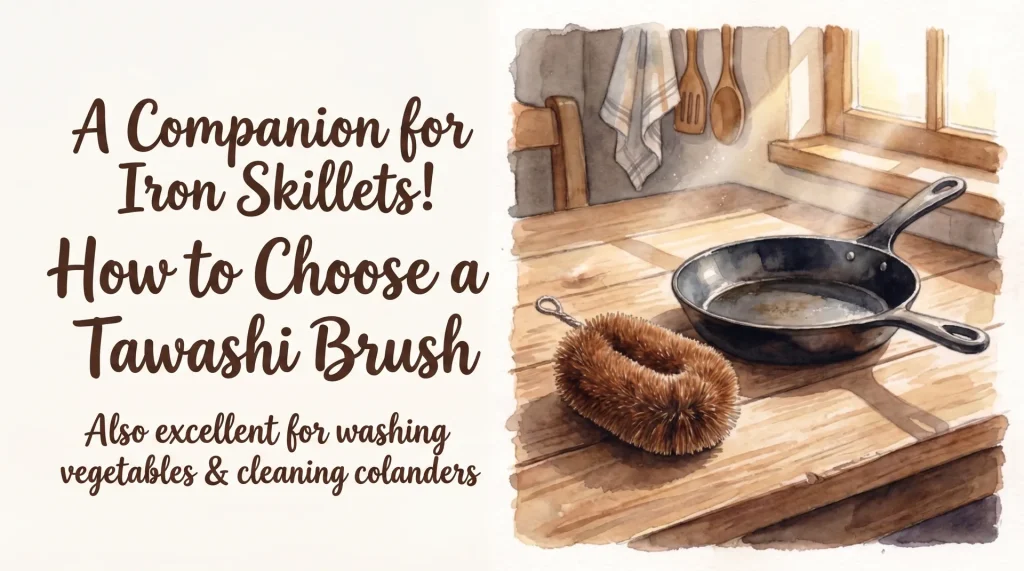
Think a scrub brush is just a scrub brush — something cheap you grab at the dollar store?
Think again. The Kamenoko Tawashi (亀の子束子), born in 1907 during the Meiji era, has remained virtually
unchanged for over 100 years. It is a masterpiece of eco-friendly, economical, and ecological
design — refined to perfection over a century of daily kitchen use.
If you own a cast iron pan or a
wooden cutting board and want them to last for decades, a quality tawashi is non-negotiable.
Countless natural fibers scrub away food residue without any detergent, while preserving the protective seasoning on
iron and the natural "breath" of wood — it's not folk wisdom; it's science.
A tawashi also excels at tasks no sponge can handle: scrubbing the thin outer skin off root vegetables or cleaning
the fine mesh of bamboo strainers. In this guide, we cover everything from the fascinating history of this Japanese
invention to the three natural materials (palm, shuro, and sisal), the science behind soap-free
cleaning, and how to keep your tawashi hygienic for years.
Quick Reference: Kamenoko Tawashi by Use Case
| Use | Size | Notes |
|---|---|---|
| Washing vegetables | Small–medium (palm-sized) | Shuro fibers gently remove mud without damaging skin |
| Pots & cast iron pans | Medium (standard) | Palm fibers scrub off burnt residue while preserving seasoning |
| Bathtubs & tiles | Large (cleaning size) | Sisal softens when wet, safe for coated surfaces |
| Entryway & floors | Large/heavy-duty | Hard palm fibers dig out sand and mud effectively |
1. One of Japan's Greatest Inventions: The 100-Year History of Kamenoko Tawashi
That oval scrub brush sitting by your kitchen sink was once a revolutionary idea — born from one Japanese craftsman's flash of inspiration. In some circles, the Kamenoko Tawashi is celebrated alongside Matsushita Konosuke's two-pronged socket adapter and Ishibashi Shojiro's rubber tabi socks as one of Japan's three greatest everyday inventions.
A Failed Doormat Becomes a Kitchen Legend
The Kamenoko Tawashi was invented in 1907 by Nishio Shozaemon. He initially designed a doormat from
palm fiber wound with wire — but the mat kept getting flattened under foot traffic, leading to a flood of returns
and a seemingly hopeless situation.
One day, his wife Yasu grabbed a piece of a returned mat, cut it into a smaller piece, curved it, and used it to
clean the grime off shoji screen lattices. Watching her bend and shape it, Shozaemon had his eureka moment. He
twisted natural fibers tightly around a wire frame into a compact oval shape that fit comfortably in a woman's hand
— the world's first purpose-built kitchen tawashi.
Named by His Son, Registered on "Tawashi Day"
When Shozaemon was struggling to name the product, his young son dropped the brush into a bucket of water and cried,
"Dad, look! A turtle swimming!" The brush did indeed look like a turtle — and since turtles symbolize longevity and
good fortune in Japan, the name "Kamenoko Tawashi" (turtle-child brush) was born. Even the kanji
characters for "tawashi" (束子) were chosen with the help of a classical scholar.
In 1915, the design received a utility patent on July 2nd — a date now officially registered by the Japan
Anniversary Association as "Tawashi Day." Over a century later, Nishio Shouten (now Kamenoko Tawashi Nishio Shouten
Co., Ltd.) continues to produce the original design — a true masterpiece of Japanese everyday craft.
[Tokyo] Kamenoko Tawashi Nishio Shouten
Founded 1907. The original and still the best.
Widely said to last three times longer than cheaper alternatives, thanks to an exceptionally tight wire binding
that holds the fibers in place to the very last strand. Each brush is hand-crafted by skilled artisans using
carefully selected fibers twisted into dense, even bundles. In recent years, the brand has also launched a modern
"white tawashi" series that doubles as a stylish kitchen accessory.
View the Kamenoko Tawashi brand page
Kamenoko Tawashi — Original Palm Fiber Scrub Brush
The authentic kamenoko tawashi made in Japan since 1907. Natural shuro (palm) fibers clean cast iron, cutting boards, and root vegetables without soap, while passing through 20+ quality checks before shipping.
View on Amazon2. The Science: Why Cast Iron Pans and Tawashi Don't Need Soap
Modern kitchen wisdom says you need dish soap to cut through grease — but with a Kamenoko Tawashi, you can clean most cookware without any detergent at all. For cast iron pans in particular, skipping the soap is the golden rule.
Natural Fibers That Repel Oil
When you scrub a greasy pan with a sponge, the oil gets trapped in the sponge's pores and you need a generous amount of soap just to clean the sponge itself. But the natural fibers of the Kamenoko Tawashi — primarily coconut palm — contain natural oils of their own, which prevent external grease from being absorbed. The fibers repel rather than absorb oil. Run hot water over the pan, scrub with the tawashi, and the debris is physically swept away — no soap needed, no oily sponge to deal with.
Remove Burnt Food Without Stripping the Seasoning
For a cast iron pan, the thin layer of polymerized oil bonded to the iron surface is everything — it prevents rust and keeps food from sticking. You must never wash it away with soap. A tawashi's firm, pointed fiber tips can physically dislodge burnt food particles sitting on top of that oil layer without disturbing the layer itself. It's precision cleaning that no sponge can replicate, which is why experienced cast iron users treat a good tawashi as an essential partner.
3. Know Your Materials: Palm, Shuro, and Sisal
Tawashi brushes come in three main natural fiber types, each with a different stiffness and best use case. Matching the material to the task is the key to getting the most from your brush.
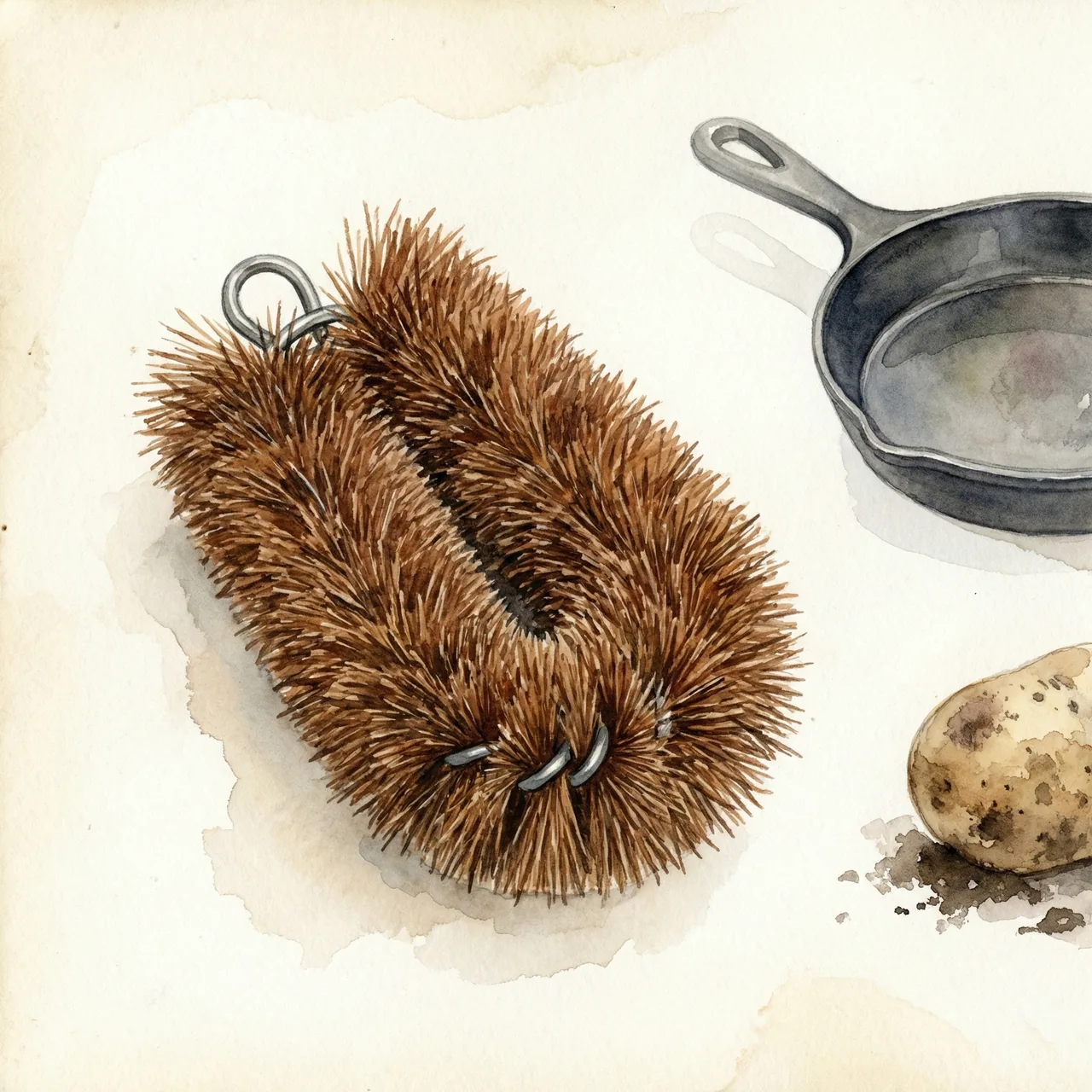
① Palm (Coconut Fiber) — Best Friend for Cast Iron & Strainers
The most common type worldwide — brown, stiff-bristled brushes made from coconut husk fiber. The firm,
pointed tips excel at physically digging out stubborn residue.
Perfect for cast iron pans, woks, grill grates, graters, bamboo strainers, and scrubbing mud off root
vegetables. The firm fibers work best on robust, hard surfaces. (Avoid on Teflon, ceramic with gold
trim, or plastic — it will scratch.)
Note: "White palm" is made by bleaching palm fiber for an even stiffer, cleaner-looking result.
② Shuro (Palm Tree Bark) — Ideal for Wooden Boards and Fine Cleaning
Made from the bark of the Japanese fan palm (shuro, a native species), these brushes have a slightly darker
color. They are softer and more flexible than palm, yet retain strong resilience. The fiber
tips are much finer than palm, allowing them to reach deep into grooves and knife marks.
Especially recommended for wooden cutting boards (to remove blackening trapped in knife cuts)
and for delicate cookware that you don't want to scratch. Shuro fibers also contain natural wax that polishes
bamboo baskets as it cleans them.
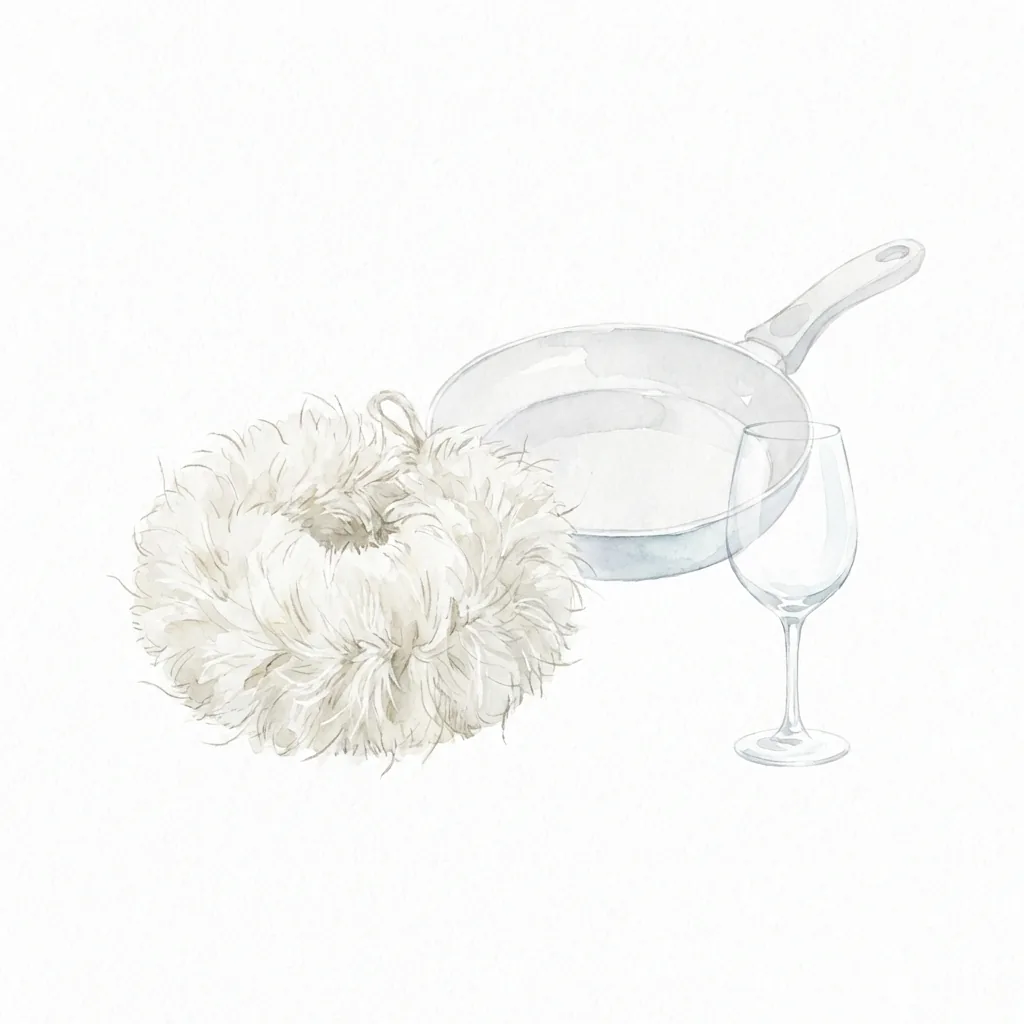
③ Sisal — Safe for Teflon, Supremely Soft When Wet
The "white tawashi" that has become hugely popular in recent years. Made from agave plant fiber, sisal is
stiff when dry but becomes remarkably soft and pliable when wet.
Its gentle "wiping" motion makes it ideal for Teflon-coated pans, stainless steel pots, and delicate
glassware. Kamenoko Tawashi even markets a sisal version as a body massage brush — that's how soft it
gets.
4. Beyond Scrubbing: Surprising Uses for Root Vegetables and Strainers
If you only use your tawashi for burnt pots, you're leaving half its value on the table. It can dramatically improve the flavor of your cooking and extend the life of expensive kitchen tools.
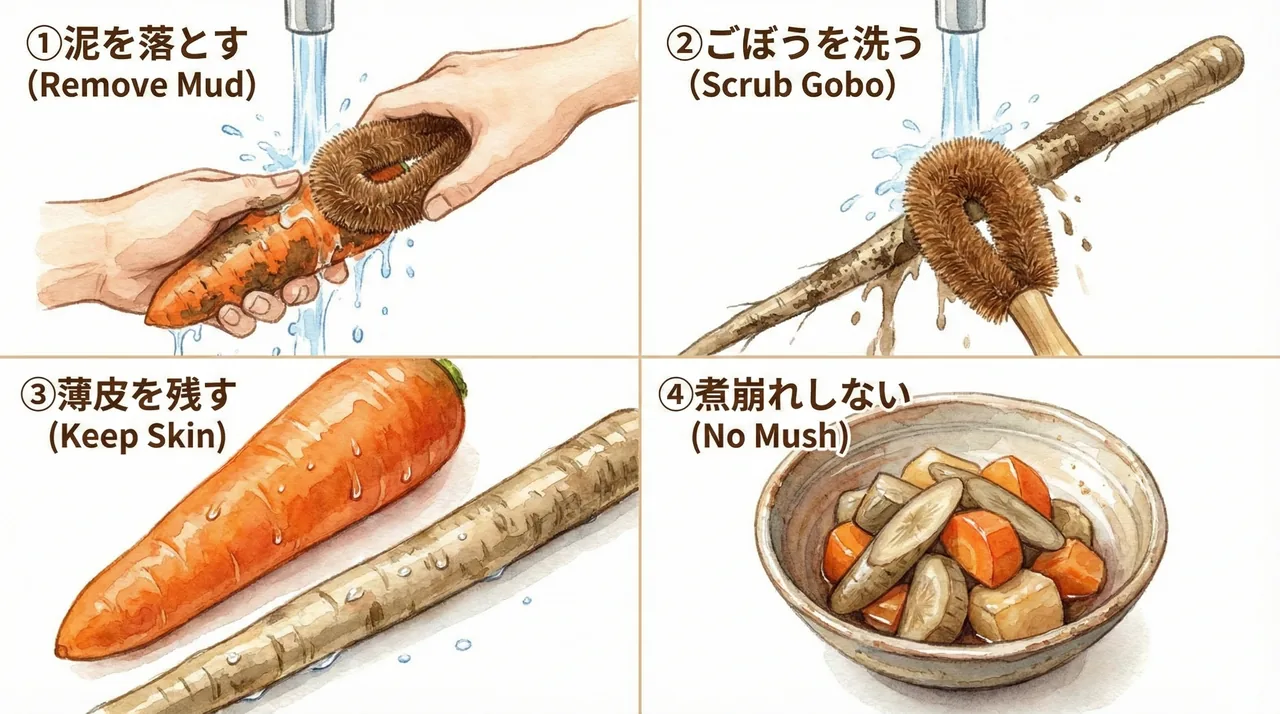
Remove Just the Outer Skin — Keep All the Flavor
Root vegetables like carrots, burdock (gobo), potatoes, and lotus root are packed with their most intense
nutrients, aroma, and umami right beneath the skin. A vegetable peeler strips away the best part along
with the peel.
Instead, hold the vegetable under running water and scrub firmly with a palm or shuro tawashi. You'll remove the
surface mud and just the thinnest translucent layer of skin — leaving all the flavor intact. The remaining fiber
structure also helps vegetables hold their shape during simmering. This is a technique used by professional
Japanese chefs.
Keep Your Bamboo Strainer and Grater Like New
A soft sponge can never clean the tiny gaps in a bamboo strainer (zaru) or a metal grater — it just pushes debris
deeper. The stiff, dense fibers of a tawashi go in at right angles to the mesh or teeth, physically extracting
stuck vegetable shreds, ginger fibers, and oil.
Bamboo strainers are expensive and prone to black mold when not cleaned thoroughly. A thorough tawashi scrub after
each use is the single most effective thing you can do to extend their life.
5. Frequently Asked Questions
Won't bacteria build up in the brush over time?
Not if you dry it properly — shake out the water and hang it after every use.
The most important step after washing is to snap the brush firmly through the air several times (like flicking
your wrist) to fling out trapped debris and moisture. Then hang it on an S-hook so air circulates around all
sides. Natural fibers dry faster than sponges, so mold and bacteria rarely have a chance to take hold. For extra
peace of mind, pour boiling water over it occasionally and dry it in direct sunlight.
Can I bleach the white sisal tawashi to remove stains?
Oxygen-based bleach is fine; chlorine bleach is absolutely not.
If your sisal tawashi picks up color from curry or other strongly pigmented foods, soaking it in an oxygen-based
bleach (such as sodium percarbonate) will restore it. However, chlorine bleach (like household bleach or Haiter)
will break down the natural protein structure of the fibers, causing them to dissolve or fray. Never use chlorine
bleach on any natural-fiber tawashi.
Which material should I use for wooden ohitsu rice pots and cutting boards?
Shuro (palm tree bark) fiber, by a wide margin.
Wooden cutting boards accumulate blackening deep inside the micro-grooves left by knife cuts. Shuro's ultra-fine
fiber tips reach down into those cuts and lift out debris without gouging the wood surface. Harder palm fiber
risks damaging softer woods like ginkgo or hinoki. Shuro also has a natural wax content that gently conditions
wood as it cleans.
My new shuro tawashi is releasing brown powder — is that normal?
Completely normal — it's harmless tannin from the natural bark.
Shuro fiber is made from raw palm bark, so the first few uses may release brown powder or slightly color the rinse
water. This stops after a few washes. There is no toxicity to humans or to your dishes.
Can I use a tawashi to clean my stainless steel sink?
A brown palm tawashi will likely leave fine scratches — use sisal instead.
Modern kitchen sinks with mirror or hairline finishes scratch more easily than you'd expect. If protecting the
finish matters, use a white sisal tawashi (which softens in water) or a soft kitchen sponge. Palm fiber is best
reserved for rougher, more resilient surfaces.
When should I replace my tawashi?
When the fibers have flattened or the brush has worn down to about half its original
thickness.
A well-made Kamenoko Tawashi can last close to a year with regular use, but once you notice the scrubbing power
has dropped, it's time to retire it. Don't throw it away immediately though — demote it to sink drain cleaning,
tile scrubbing in the entryway, or bicycle tire washing. Using it to the very last fiber is the most eco-friendly
approach.
Final Thoughts: Good Tools Are Kind to Your Hands and the Planet
In a world where three-packs of sponges cost almost nothing, choosing an authentic Kamenoko Tawashi is a
deliberate decision — and a rewarding one.
Nishio Shouten's artisan construction delivers outstanding durability and targeted cleaning power that cuts your
detergent use dramatically. Use brown palm for your cast iron pans and strainers. Switch to
shuro for wooden boards where you need fiber tips that reach deep. Reach for the soft white
sisal when cleaning Teflon or fragile glassware.
A humble tawashi, used with the right material for the right job, transforms daily cleanup into something
rational and even satisfying. This Japanese invention — over a century old and still unchanged — deserves a spot
in every serious kitchen.
Cast Iron Pan: How to Stir-Fry Vegetables to Perfect Crunch — Soap-Free Cleaning Guide
Magewappa Bento Boxes: Rice That Stays Delicious — Care Guide & How to Choose