Kamenoko Tawashi
A tawashi standard, born in Tokyo.
Founded in 1907 in Tokyo's Hongo district, Kamenoko Tawashi began with founder Shozaemon Nishio's invention of a shuro tawashi. Soon after, the company focused on palm fiber taken from coconuts as a key raw material. In 1908 it received a utility model approval and registered the turtle mark as a trademark, and later obtained a patent for "tawashi" — July 2 is now known as Tawashi Day. Today the headquarters is in Takinogawa, Kita-ku, Tokyo, with production at the Takinogawa and Wakayama factories. From classic tawashi brushes to sponges and body-care items, the lineup supports everyday cleaning and care.
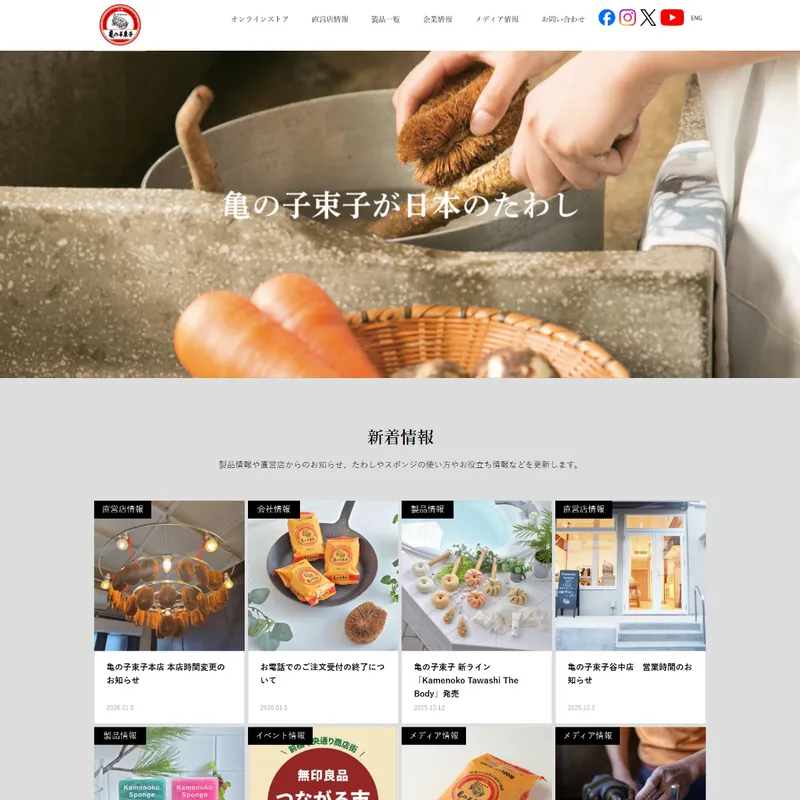
Why We Love It
If you are new to the brand, start with the classic Kamenoko Tawashi where you want a decisive scrub. Add a White Tawashi for lighter work like pre-washing cookware or cleaning strainers and graters. For everyday dishwashing, compare Ag+ and Do — anti-mold processing and shape preference make the choice easy. If you want to extend the routine to the bath, choose a body tawashi by firmness.
PROFILE About the Company / Workshop
Kamenoko Tawashi Nishio Shoten traces its roots to 1907 in Tokyo's Hongo area. Founder Shozaemon Nishio invented a shuro tawashi and soon adopted palm (coconut) fiber as a key raw material. In 1908 the company gained a utility model approval and registered the turtle mark as a trademark, then secured a patent for "tawashi" in 1915. That patent date, July 2, later became known as Tawashi Day. Today the headquarters is in Takinogawa, Kita-ku, Tokyo, with factories in Takinogawa and Wakayama.
Kamenoko tawashi brushes are defined by fiber choice. Palm offers firm scrubbing for scraping and removing residue. White palm is a slightly firmer version made by safely bleaching palm fiber with hydrogen peroxide. Shuro combines strength with flexibility and uses fine fibers to reach tight corners. Shuro tawashi are made by craftspeople in Japan, selecting good fibers and shaping each piece for its intended size and use. Sisal hemp is soft and absorbent, often used for gentler body-care tawashi.
The lineup goes beyond brushes. The White Tawashi series joined in 2014, Kamenoko Sponge in 2015, and Kamenoko Sponge Do in 2016. The sponge lines knead a silver-ion antibacterial agent into the sponge itself; Ag+ is offered with or without anti-mold processing and seasonal colors. In 2017, Kamenoko Sponge won the Grand Prize at the Japan Package Design Awards. Do emphasizes cleanliness and grip, with multiple shapes such as square, leaf, thin, and bath.
Manufacturing is centered on the Takinogawa and Wakayama factories. Kamenoko operates direct stores — the main store in Takinogawa and the Yanaka store (relocated to Nezu in 2020) — alongside an official online store with store-only items, early releases, and member programs. Products are distributed nationwide through household-goods wholesalers, and exports include the U.S., Canada, Australia, Europe, and Southeast Asia. You can buy via the direct stores or online.
A century-old standard, still evolving
Starting in 1907 and backed by early IP milestones, Kamenoko has treated tawashi as a true daily tool. Kamenoko Tawashi No.1 received the Good Design Long Life Design Award in 2013, reaffirming its place as a lasting standard.
Three natural fibers, three textures
Palm (coconut) fiber is the main material and excels at scraping and scrubbing. Shuro balances strength and flexibility and reaches into small spaces. Sisal hemp is soft and absorbent, making it suitable for gentler body-care styles. White palm is palm fiber safely bleached with hydrogen peroxide.
Kamenoko Sponge: Ag+ and Do
Both lines knead a silver-ion antibacterial agent into the sponge itself. Ag+ is available with or without anti-mold processing and seasonal colors. Do is thicker and comes in multiple shapes — square, leaf, thin, and bath — refreshed alongside Ag+ in 2021.
Made in Takinogawa and Wakayama, sold via direct stores
Production is based at the Takinogawa factory and the Wakayama factory. Kamenoko runs direct stores (the main store and the Yanaka store, later relocated to Nezu) and an official online shop with store-only items and early releases. Exports include regions such as North America, Europe, and Southeast Asia.
PRODUCTS Featured Products & Services
Contains promotional content

Original Kamenoko Tawashi No.1 (Small)
The "No.1" size distributed as Kamenoko Tawashi's standard model. Leveraging the firm stiffness of palm (coconut) fiber — easy to use for scrubbing pots, frying pans, and strainers.
Kamenoko White Tawashi White Palm Small (088238)
The "White Palm" small size of the White Tawashi series. White Palm is treated as a "firmer" wash feel — often listed as a model suited for scrubbing around cookware.
Kamenoko Sponge (Standard) White / Gray / Yellow
Kamenoko Tawashi Nishio Shoten's standard kitchen sponge. Listed as antibacterial / anti-mold specification — a standard type emphasizing the balance of foaming and water draining. Available in different colors.
Kamenoko Sponge Do Square Type (Set of 2) Green
The "square type" of Kamenoko Sponge Do. Treated as a thick square — a standard shape for when you want to firmly wash pots and frying pans. As a set sales page, convenient for bulk buying.
LINKS Official Links / Social Media
- Official Website https://en.kamenoko-tawashi.co.jp/
- Online Shop https://shop.kamenoko-tawashi.co.jp/
- Contact Form https://www.kamenoko-tawashi.co.jp/contact/form1
- X (Official) https://x.com/kamenoko_nishio
- Direct stores https://www.kamenoko-tawashi.co.jp/stores
- Product lineup https://www.kamenoko-tawashi.co.jp/lineup