"My hair is frizzy and dull by mid-afternoon even after a good conditioner…"
The culprit might not be your hair care products — it might be the plastic brush you use every morning.
The tsugegushi (つげ櫛) — a traditional Japanese comb carved from boxwood — is not just a historical artifact. It's a tool that actively improves hair quality with every stroke.
Natural boxwood generates almost no static electricity, and the camellia oil worked into the wood during manufacturing transfers a micro-thin coating to each strand as you comb — controlling frizz and creating genuine shine without product buildup.
"No water" sounds like an unusual maintenance rule, but a tsugegushi cared for correctly becomes an amber-colored treasure that outlasts every plastic brush you'll ever own.
This guide covers everything: how to choose by tooth spacing and hair type, the critical difference between Satsuma boxwood and imported alternatives, and the monthly oil-soak ritual that grows the comb more beautiful over time.
Quick Reference: Tsugegushi Selection & Care at a Glance
| Item | Details & Key Points |
|---|---|
| Wide-Tooth (Araba) | Permed, wavy, thick or voluminous hair — combs through like a hand brush |
| Medium-Tooth (Chuba) | Average hair types — the most versatile spacing; best choice for a first purchase |
| Fine-Tooth (Sashiba) | Straight, fine, or low-volume hair — smooths the hair surface for maximum shine |
| Wood: Satsuma Tsuge | Japanese domestic, highest grade. Dense annual rings — teeth rarely break. From ¥10,000 |
| Wood: Hon-Tsuge (Imported) | Southeast Asian origin. Good for a starter comb. ¥2,000–¥5,000 |
| Daily Rule | Dry hair only — never use on wet hair or expose to water |
| Monthly Care | Apply camellia oil → clean between teeth with a soft brush → wipe dry |
| Deep Conditioning (Oil Soak) | Wrap comb in plastic wrap saturated with camellia oil, leave overnight to several days |
1. Why Boxwood Combs Give Hair Shine: The Science of Static and Camellia Oil
The benefits are not traditional belief — there are clear, mechanistic reasons why natural boxwood combs improve hair quality.
The Problem with Plastic: Static That Strips Cuticles
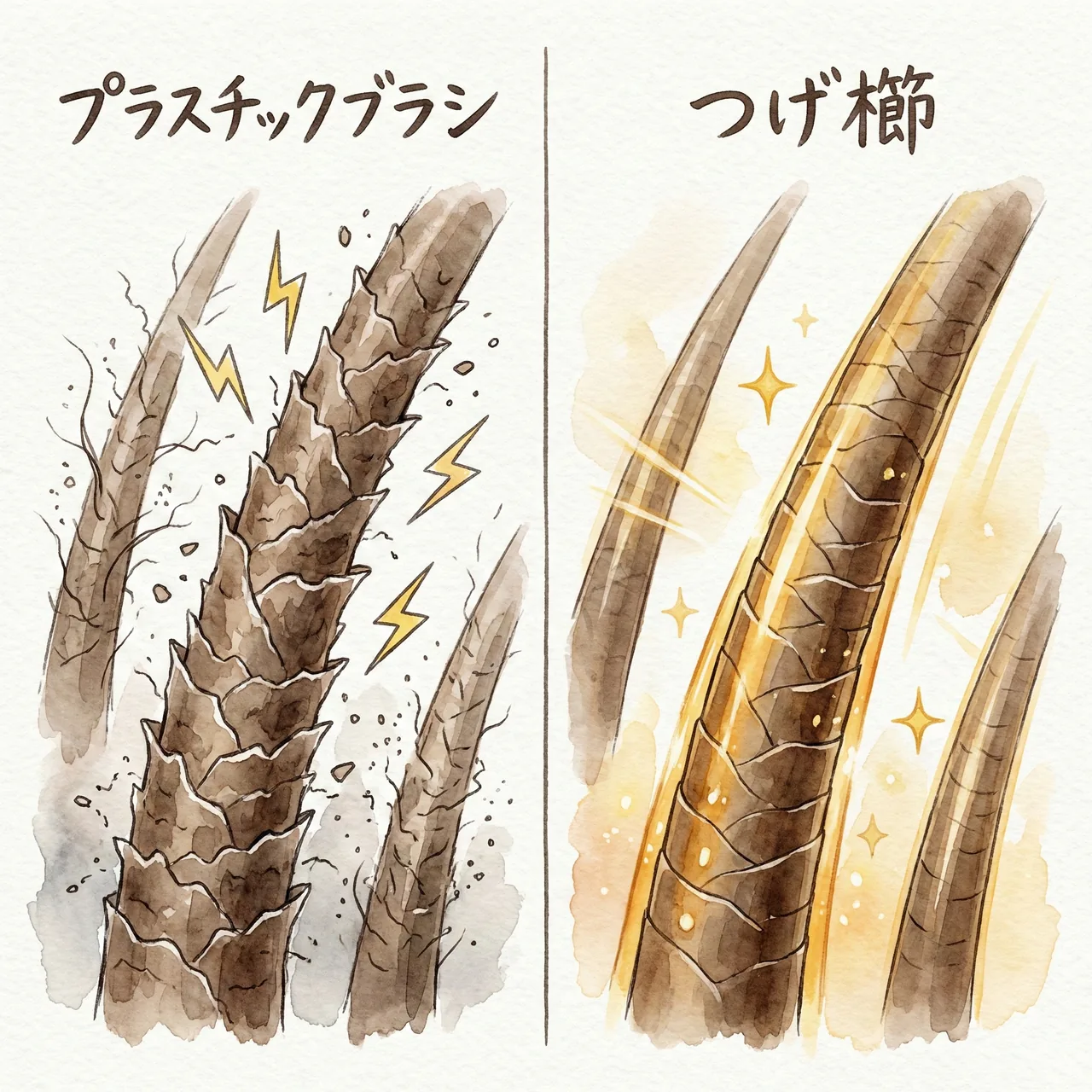
The outer layer of each hair strand is a cuticle — a delicate, scale-like structure that determines whether light reflects off the surface (shine) or scatters (dullness and frizz).
In dry conditions, combing with a plastic brush generates static charges of tens of thousands of volts. This electrostatic force physically lifts and separates cuticle scales, causing breakage, split ends, and the flyaway frizz that won't lie flat.
Natural boxwood has low electrical conductivity — static simply doesn't accumulate on its surface. Combing with a tsugegushi generates near-zero static, leaving cuticles undisturbed.
Camellia Oil: Why It Works When Others Don't
Tsugegushi are finished with camellia oil worked deep into the wood grain. With each pass through the hair, the wood releases a microscopic trace of oil that coats each strand.
Why camellia oil specifically? Approximately 85% of camellia oil's composition is oleic acid — a fatty acid that is structurally very similar to the lipids in human sebum. This makes it more readily absorbed by hair and skin than other oils, without leaving a greasy film.
The result: the subtle, undeniable shine described by tsugegushi users — the "angel ring" highlight on healthy hair — rather than the surface-coating shine of silicone-based products.
2. Satsuma Tsuge (Domestic) vs. Imported Boxwood: The Decisive Difference
Combs labeled "tsuge" range from ¥2,000 to over ¥30,000. The price reflects a real and significant difference in the wood.
| Type | Characteristics | Price Range |
|---|---|---|
| Satsuma Tsuge (Domestic, highest grade) |
Lifetime quality. Grown in the Ibusuki region of Kagoshima Prefecture. Extremely slow growth produces annual rings so dense they're nearly invisible to the naked eye. Hard but with genuine flexibility — fine teeth under repeated pressure almost never break. Develops a rich golden color over time. |
¥10,000 to ¥30,000+ |
| Hon-Tsuge / Akane (Imported) |
A good place to start. Primarily from Thailand, Myanmar, or similar climates (Siamese boxwood). Grows faster, so annual rings are wider and the wood less dense. Adequate for daily use but more likely to develop surface wear and tooth breakage over time than domestic grades. |
¥2,000–¥5,000 |
Note: "Hon-tsuge" labeling does not guarantee domestic origin. Genuine Japanese-grown boxwood is explicitly labeled "Satsuma tsuge" or "kokusan tsuge." If you want a comb that improves with decades of use, look specifically for Satsuma tsuge.
3. Years in the Making: How Satsuma Tsuge Combs Are Crafted
The price of a high-end tsugegushi reflects a manufacturing timeline that is genuinely difficult to compress.
Smoke-Drying (Ibushi) to Eliminate Warp
Raw boxwood logs from Kagoshima are not immediately worked. First, they undergo ibushi kansou (smoke-drying): slowly cured over smoke to eliminate insects, drive out excess moisture, and dramatically reduce the tendency to warp or crack. This curing process increases density and structural stability throughout the grain.
Natural Air-Drying: Minimum 1 Year, Up to a Decade
The smoke-dried logs are then cut into boards and stored — in a well-ventilated warehouse, through multiple Japanese seasons — for at least one year. Premium grades are stored for three to ten years.
Japan's seasonal humidity cycles — the wet tsuyu season alternating with dry winters — work the wood through expansion and contraction until it stabilizes. No further warping is possible after this process.
This is why the sub-millimeter teeth of a Satsuma tsuge comb can withstand the daily lateral stress of combing without breaking: the wood beneath them has been thoroughly conditioned by time.
4. Choosing the Right Comb: Tooth Spacing and Size
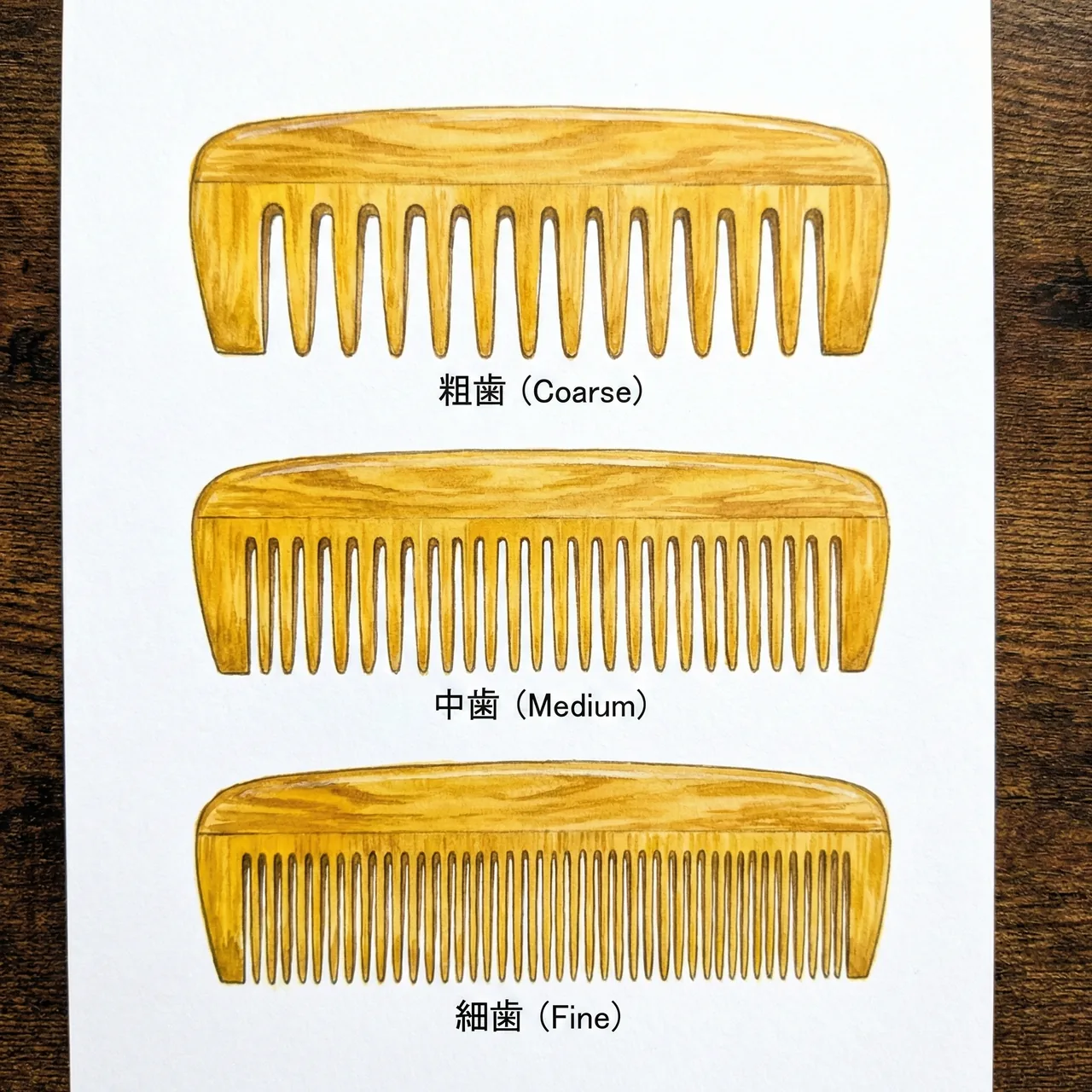
The most important variable in selecting a tsugegushi is the tooth spacing — it needs to match your hair type, not your aesthetic preference.
Tooth Spacing by Hair Type
- Wide-tooth (araba):
Permed or wavy hair, coarse or thick hair, very voluminous hair. Glides through loose waves without pulling. The closest to combing with your fingers. - Medium-tooth (chuba):
Average hair texture and density. The most versatile option — the default recommendation for anyone who isn't sure. - Fine-tooth (sashiba):
Straight, fine, or low-density hair. Aligns every strand surface for the most intense shine effect. Not suitable for curly or tangled hair — will pull.
Reading Size Markings ("Sun" and "Bu")
Japanese tsugegushi are sized in traditional units: 1 sun (寸) ≈ 3cm; 1 bu (分) ≈ 3mm.
-
Tokashi-gushi (standard comb form):
The most common shape — a slightly arched back with teeth on one side. For portable use or travel, 3.5 sun (~10.5cm) to 4 sun (~12cm) fits comfortably in a makeup pouch. - Handle combs (tetsuki-gushi):
Combs with an attached handle for a firm grip. Better for styling at home — when you want to apply real pressure for thorough detangling or a precise finish.
5. Care: No Water — Monthly Oil-Soaking to Grow the Amber Color
The cardinal rule of tsugegushi care is simple: no water. Wood swells when wet and contracts when it dries, leading to warping, cracking, and mold. Cleaning is done with oil — not water.
Why Camellia Oil (And Nothing Else)
"Can I use olive oil or jojoba oil?" — a common question, but the answer is no. Use only camellia oil (or apricot kernel oil) — non-drying oils for wooden comb care.
Olive oil, linseed oil, and many kitchen oils are drying oils — they oxidize when exposed to air and eventually polymerize into a sticky, hard film. Applied to a wooden comb, they will cause the teeth to gum together and develop an unpleasant rancid odor over time. A camellia or apricot kernel oil never hardens and keeps the wood supple indefinitely.
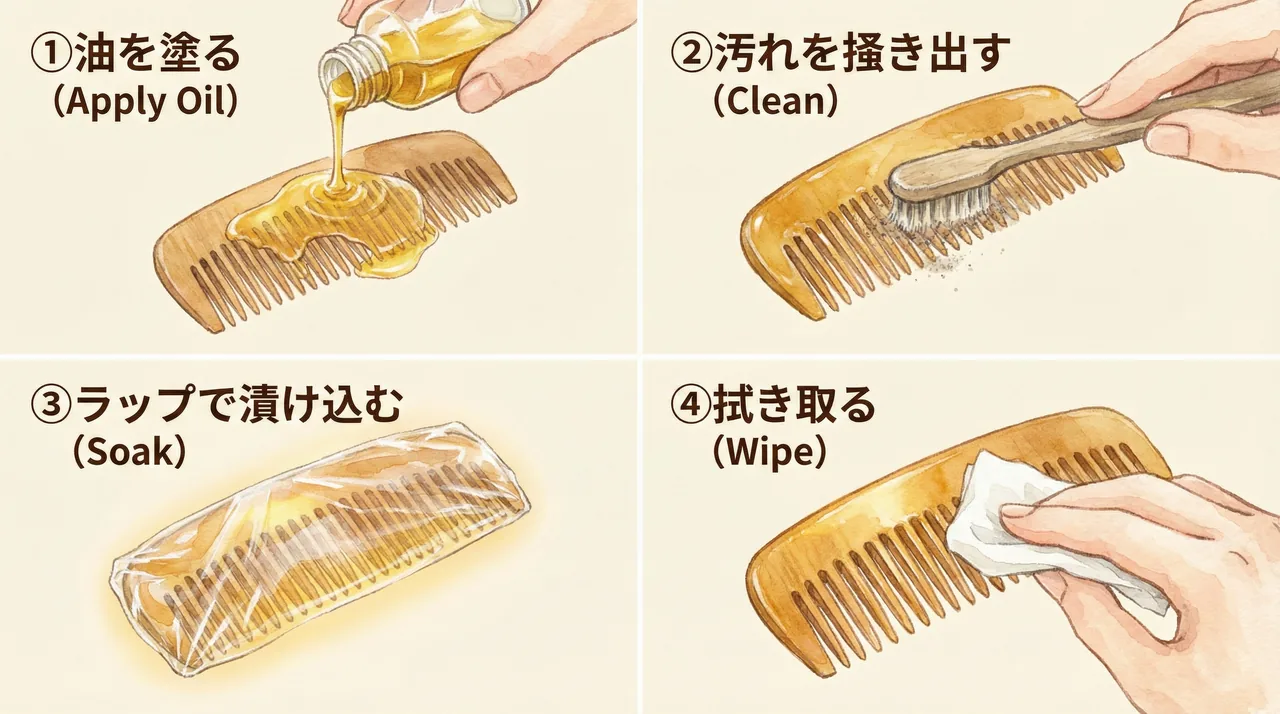
Monthly Maintenance Routine
- Lift the dirt: Apply camellia oil generously to the entire comb — especially at the base of the teeth where sebum and dust accumulate. Let it sit for 20–30 minutes to soften the buildup.
- Clean between teeth: Use an old soft-bristle toothbrush (or a dedicated comb cleaning brush) to gently work out the loosened debris from between the teeth.
- Wipe clean: Remove the oil and lifted dirt with a soft cloth or tissue. The comb should feel clean, not greasy.
- Optional deep soak (aging the comb): When time allows, wrap the comb in plastic wrap, saturate it with camellia oil, and seal it. Leave for one night to several days. The oil penetrates deep into the wood grain, increasing both strength and depth of color. This is what gradually transforms the pale new wood into the prized amber tone.
6. Recommended Workshops: Tsujichu and Jusanya
Tsujichu (Kaizuka, Osaka)
Japan's leading tsugegushi maker — every step in-house, from raw wood to finished comb.
Kaizuka City, Osaka, is Japan's most celebrated tsugegushi production area, home to the Izumi-gushi tradition. Tsujichu uses exclusively Kagoshima-grown Satsuma tsuge and handles every stage of production in their own workshop — from sawing and drying through tooth-cutting and final polishing.
Their carved decorative combs are particularly striking: cherry blossoms, camellias, roses, and other motifs executed in pierced relief work that is genuinely beautiful to look at before you even pick up the comb.
Wide range of sizes, tooth spacings, and shapes for both personal use and gifting — an excellent first purchase for anyone new to tsugegushi.
Jusanya (Kyoto / Tokyo Ueno)
"Thirteen" — the name that turned a superstition into good fortune.
The Japanese word for comb, kushi, shares its pronunciation with the characters for "suffering" (ku) and "death" (shi) — historically considered an ill omen as a gift. Shops that made combs avoided the reading by naming themselves after the sum 9+4=13.
The Kyoto Jusanya and Tokyo Ueno Jusanya comb shops carry this tradition and are among the most respected names in the field. Their combs use the finest available Satsuma tsuge, aged for years, with teeth cut and refined by experienced hands.
The contact of a Jusanya comb against the scalp is described by users as startlingly smooth — unlike any comb they've touched before. With proper care, these combs are designed to be passed between generations.
7. Frequently Asked Questions
Can I use it on wet hair, just after a shower?
No — this is the single most important rule. Wet hair on a wooden comb will damage both.
Water swells the wood fibers; as they dry unevenly, the comb can warp, crack, or develop mold. Wet hair is also more elastic and more vulnerable to mechanical stress — combing damp hair with anything causes more breakage than combing dry hair.
Use your tsugegushi only after your hair is completely dry — as a finishing tool after blow-drying, or for morning styling.
Is giving a comb as a gift bad luck?
Not at all — in the right context, it's one of the most meaningful gifts you can give.
The phonetic superstition about "kushi" (9+4) is real but rarely taken seriously today, particularly in gift contexts. In traditional Japanese culture, a man who gave a woman a comb was making a declaration — "I will care for your hair for the rest of my life." Combs were exchanged as engagement tokens.
Tsugegushi combs make exceptional gifts for a mother, close friend, or partner — they communicate thoughtfulness, longevity, and genuine care for the recipient's wellbeing.
One of the teeth broke. Can it be repaired?
Some workshops can re-cut the teeth — the comb becomes slightly shorter but is saved.
High-quality tsuge combs are worth repairing rather than discarding. The broken area is filed down, and a craftsperson re-cuts and finishes the teeth to restore full function.
The comb will be a little narrower after the repair, but retains all its other qualities. Contact the original workshop or a tsugegushi specialist — in Japan several major workshops offer this service.
How often should I use it?
Daily use gives the best results — for your hair and for the comb.
Morning styling and a brief evening pass — twice daily — is the ideal routine. Each use delivers camellia oil to the hair and also deposits the oils from your hand back into the wood.
Over months and years, this cycle is what transforms the light-colored new comb into the deep amber tone that makes a well-used tsugegushi so distinctive.
My new comb has a strong oil smell. Is that normal?
Completely normal — it fades with use.
New tsugegushi carry a noticeable scent from the wood's own natural aromatics (from the smoke-drying process) and the camellia oil applied during finishing. If the smell feels too strong, do a cleaning oil-soak: apply fresh camellia oil, wrap in plastic, leave overnight, then wipe clean. This flushes out the older oil and replaces it with fresh — the result is usually a more neutral, pleasant scent.
After a week or two of regular use, the smell typically becomes mild and unobtrusive.
Where can I buy one? Is online purchase reliable?
Both in-store and online are viable — each has advantages.
Tsujichu and Jusanya both have online stores and ship nationwide (and internationally for some items). Physical stores in Osaka, Kyoto, and Tokyo allow you to feel the tooth spacing and wood texture before buying — valuable for a first purchase where you're not yet sure what spacing suits your hair.
If buying online, look for clear specification of wood origin ("Satsuma tsuge" or "kokusan tsuge") and tooth spacing grade. When in doubt, medium-tooth (chuba) in Satsuma tsuge is a reliable starting point.
Final Thoughts: Turn Combing into Self-Care
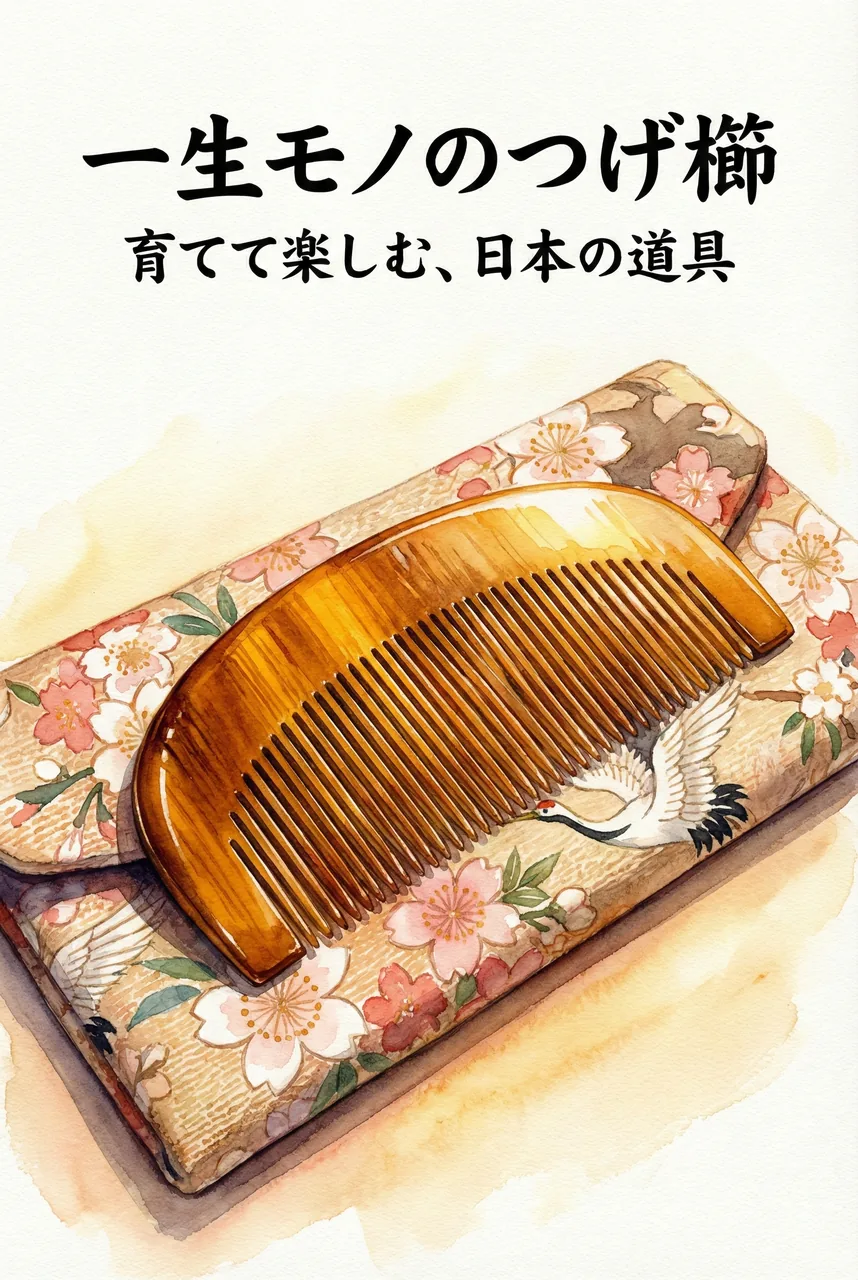
A tsugegushi is not finished when you buy it.
The pale, new wood on the day it arrives will darken — slowly, over months and years — as it absorbs the oil from your maintenance and the oils from your own hands.
"Raising" the comb with oil — watching it deepen from cream to honey to amber — is part of the practice. It asks you to pay quiet attention to a small object, regularly.
In that sense, the tsugegushi is not just a hair tool. It's an invitation to care for something carefully, over a long time.
The hair benefits are real. But so is everything else that comes from tending something with patience.

Japanese Camellia Oil: 10 Ways to Use It for Hair and Skin

Kumano Fude Makeup Brushes: The Ones Worth the Splurge

Magewappa Care Guide: Keeping Your Bento Box Mold-Free

Leather Shoe Care: Restore Shine and Extend Lifespan with Polish