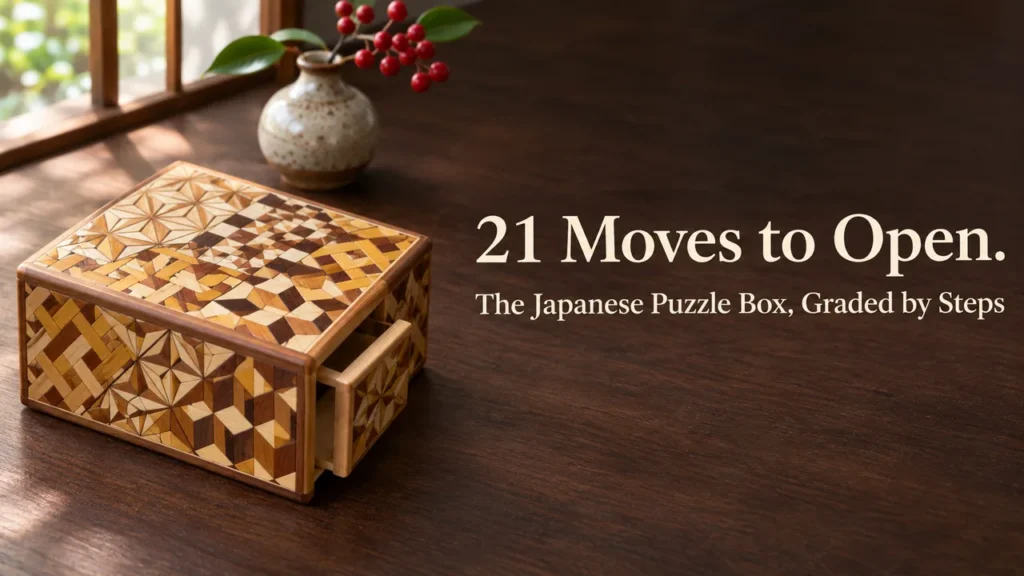
If you want a Japanese puzzle box that is challenging but still solvable, start with 7 to 14 steps. Go to 21 steps or more only if you already enjoy mechanical puzzles. The number in the name tells you almost everything: "4 sun 14 steps" means a box about 12 cm long that takes 14 moves to open.
These boxes come from Hakone, a hot-spring town near Mount Fuji, where craftsmen cover them in yosegi, a geometric pattern made only from the natural colours of different woods. This guide explains how to read the label, what makes a Hakone box Japanese, and four Japan-made boxes you can order from Amazon, from 7 steps to 27.
At a Glance: Four Japan-Made Puzzle Boxes
| Box | Steps | Size | Best for |
|---|---|---|---|
| 4 Sun, 7 Steps ▾ | 7 | about 12 cm | Your first box, or a gift |
| 4 Sun, 14 Steps ▾ | 14 | about 12 cm | A real challenge on a desk |
| 5 Sun, 21 Steps ▾ | 21 | about 15 cm | Puzzle fans |
| 5 Sun, 27 Steps ▾ | 27 | about 15 cm | A weekend project |
Tap a name to jump to the details.
1. Why Japanese: Patterns Made Only From Wood
No paint, no dye
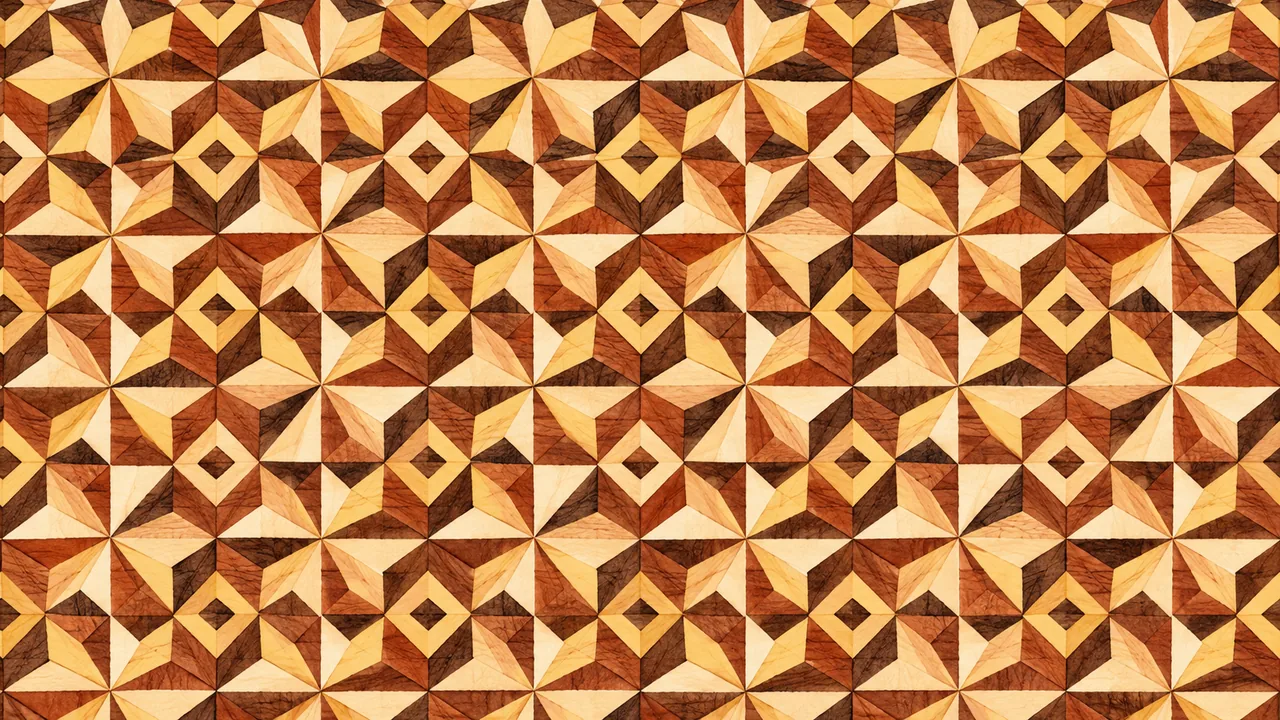
The fine pattern on a Japanese puzzle box is Hakone yosegi-zaiku, a craft from the mountains around Hakone. According to the Hakone town tourism association, it grew out of an older woodcraft from Suruga (today's Shizuoka) and was brought to Hatajuku, a village on the old Tokaido road, by a craftsman named Ishikawa Nihei in the Edo period.
Yosegi means "gathered wood." Craftsmen fit together strips of pale, yellow, reddish and almost-black woods, and those colours are never painted or dyed: they are the natural colours of each tree. Hakone yosegi-zaiku is officially recognised as a traditional craft of Japan.
Did you know: the pattern is shaved to 0.15 mm
In the traditional technique, called zuku, craftsmen glue the strips into a solid block of pattern and then plane it into sheets about 0.15 mm thick, thinner than a business card. Those sheets are what cover the sides of a puzzle box. A second technique, muku, developed in the 20th century, turns the block on a lathe instead.
2. Read the Label: Sun Is Size, Steps Are Difficulty
No nails, no keys, no lock
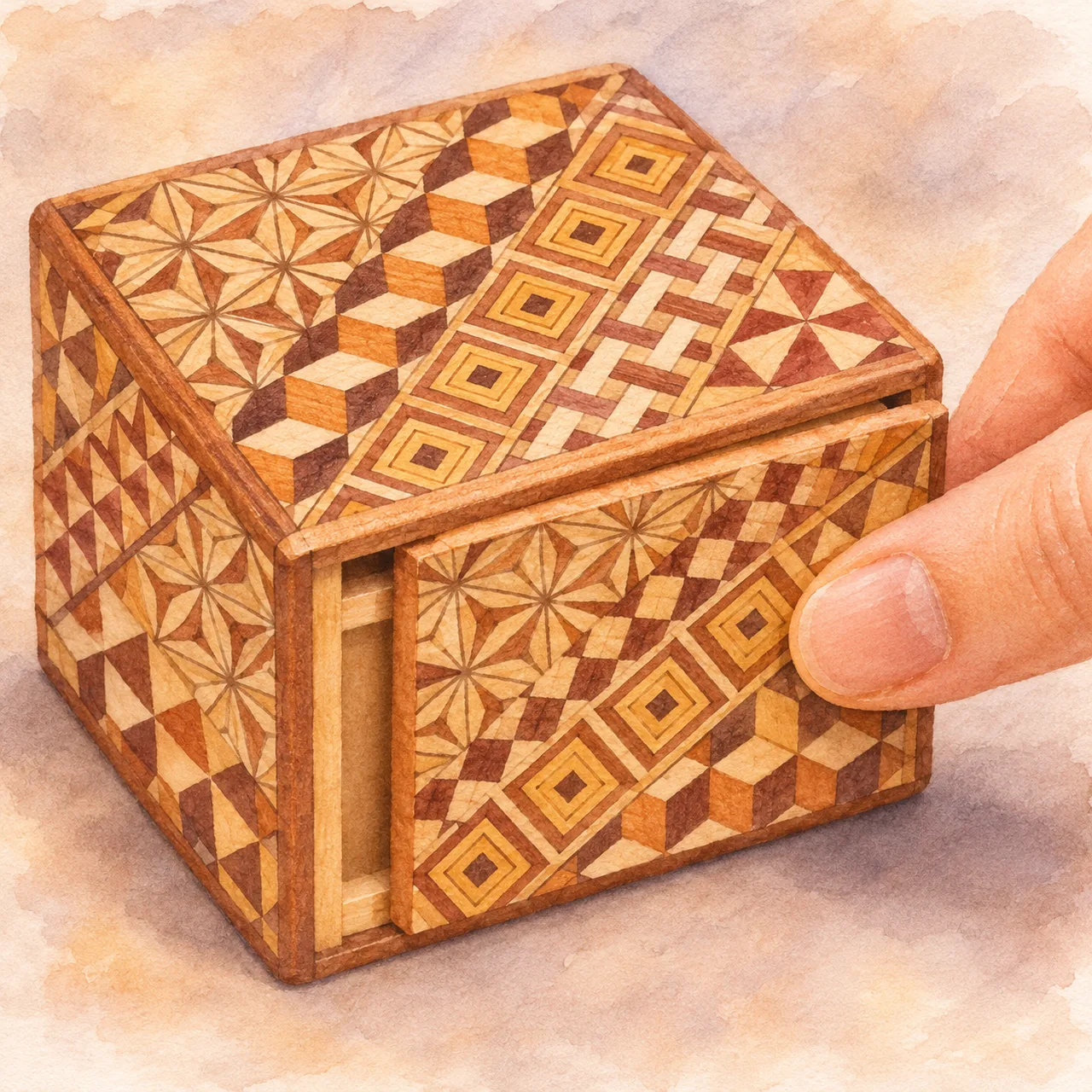
The Kanagawa Prefecture tourism association describes the puzzle box, or himitsu-bako, as a Hakone creation with more than 100 years of history. It uses no nails, no key and no lock, yet it will not open, unless you slide its hidden panels in exactly the right order.
Each move shifts one panel a little. Get the order right, and after the last move the lid slides free.
Two numbers on every box
Steps is the number of moves needed to open the lid. A 7-step box opens after seven moves; a 27-step box after twenty-seven, and you have to remember the order.
Sun is the old Japanese unit of length. One sun is about 3 cm (1.2 in), so a 4-sun box is about 12 cm long and a 5-sun box about 15 cm. Size tells you where it will sit and what fits inside. It does not tell you how hard it is.
Did you know: the same box comes in 4, 7, 10 and 14 steps
On Amazon, the Warashibe 4-sun box is sold in 4, 7, 10 and 14 steps, all the same size. A bigger box is not automatically a harder one. Pick the size for your shelf and the steps for your patience.
3. Japan-Made Puzzle Boxes, From 7 to 27 Steps
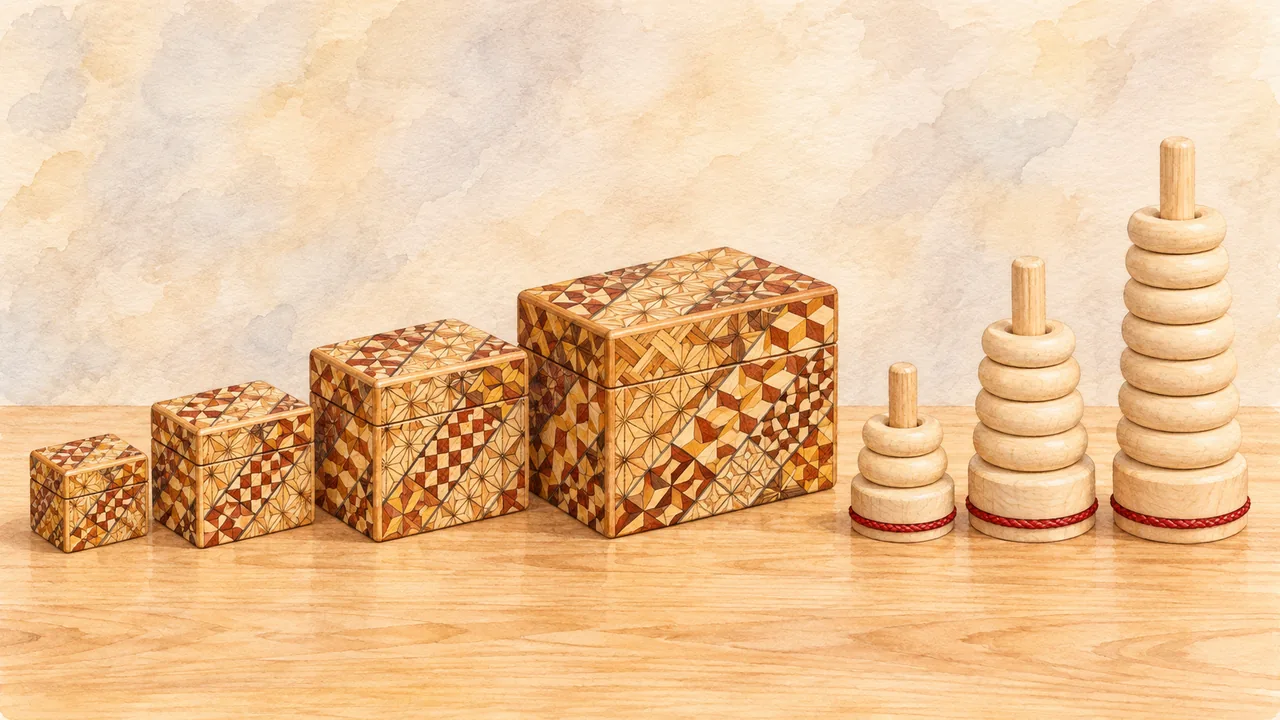
All four boxes below are listed on Amazon as Japan Made and come in an original gift box. Choose the step count you will actually finish.
Your first box: Warashibe, 4 Sun, 7 Steps
Seven moves, and the lid slides open. Short enough to solve in one sitting, long enough that the first "it moved" feels like a discovery. At about 12 cm it sits comfortably in one hand. The safest choice for a first box or a gift for someone new to puzzles.
Warashibe Japanese Puzzle Box 4 Sun 7 Steps
Loading product details…
A real challenge: Warashibe, 4 Sun, 14 Steps
Twice the moves, same size. Fourteen steps is where you start losing track of which panel you moved last, which is exactly the fun. A good desk companion for someone who finds 7 steps too quick.
Warashibe Japanese Puzzle Box 4 Sun 14 Steps
Loading product details…
For puzzle fans: Warashibe, 5 Sun, 21 Steps
Twenty-one moves in the right order. Several Hakone workshops make a 21-step box; it is a natural next step after 14. The larger 5-sun body, about 15 cm, also leaves room inside for small keepsakes once it is open. For someone who already owns a puzzle or two.
Warashibe Japanese Puzzle Box 5 Sun 21 Steps
Loading product details…
A weekend project: Warashibe, 5 Sun, 27 Steps
Almost four times the moves of the 7-step box. Put it down halfway and you may not remember where you were. Keep a notebook next to it and treat it as a project rather than a pastime.
Warashibe Japanese Puzzle Box 5 Sun 27 Steps
Loading product details…
4. Another Japanese Puzzle Graded by Number
One more ring, twice the work
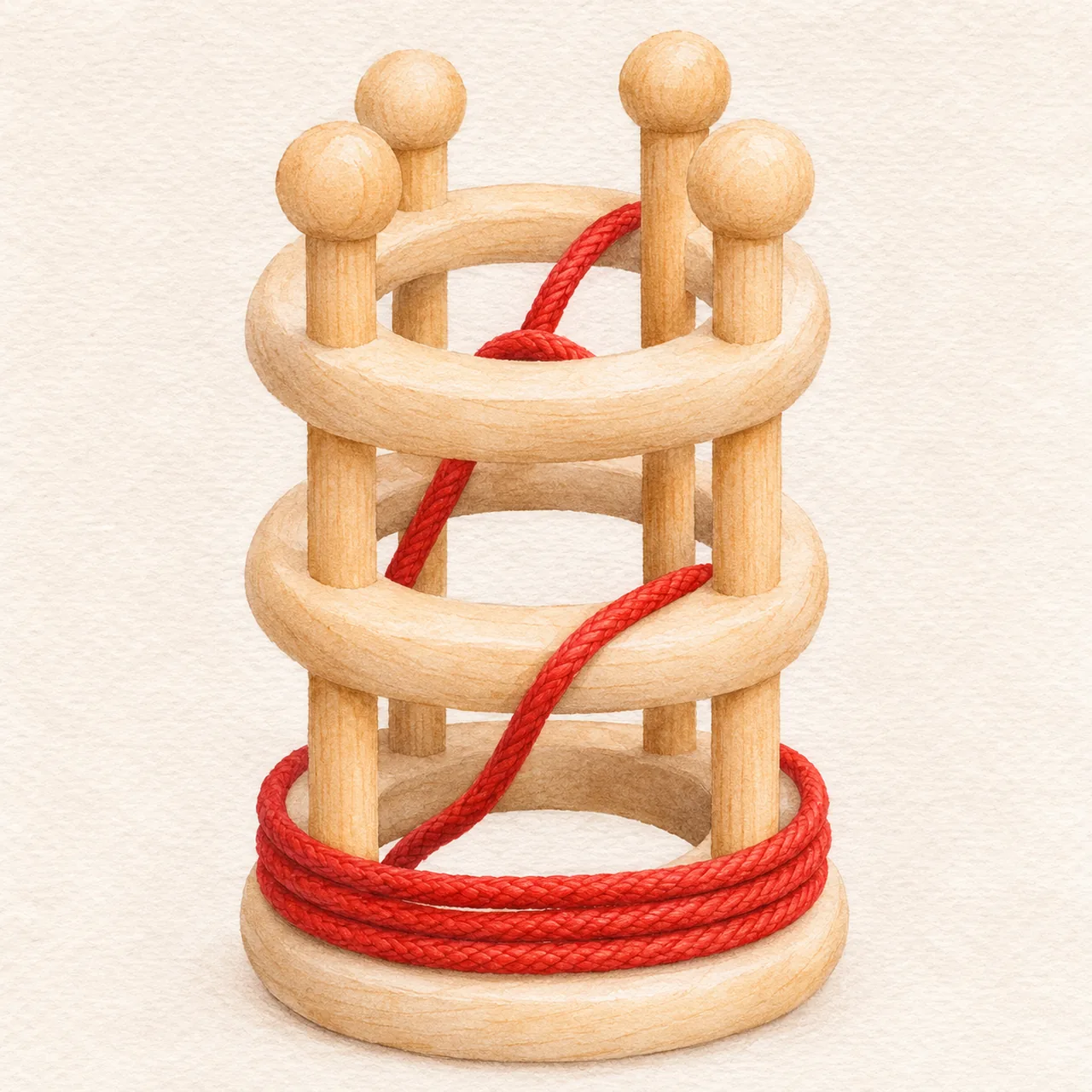
In Nagano, a woodworking studio called Ginga Kobo makes a three-dimensional wooden ring puzzle: wooden rings stacked like a tower, with a red cord wound around the bottom one. The goal is simply to pull the cord out. It comes in 2, 3, 4, 5, 6 and 9 rings.
The studio explains that the puzzle works on the binary principle: every extra ring doubles the number of moves needed to free the cord. Going from 3 rings to 9 means doubling six times, or 64 times the work.
It is sold mainly in Japan, so it is worth knowing about if you are visiting or have a friend there.
5. Giving One as a Gift
A puzzle first, a keepsake box after
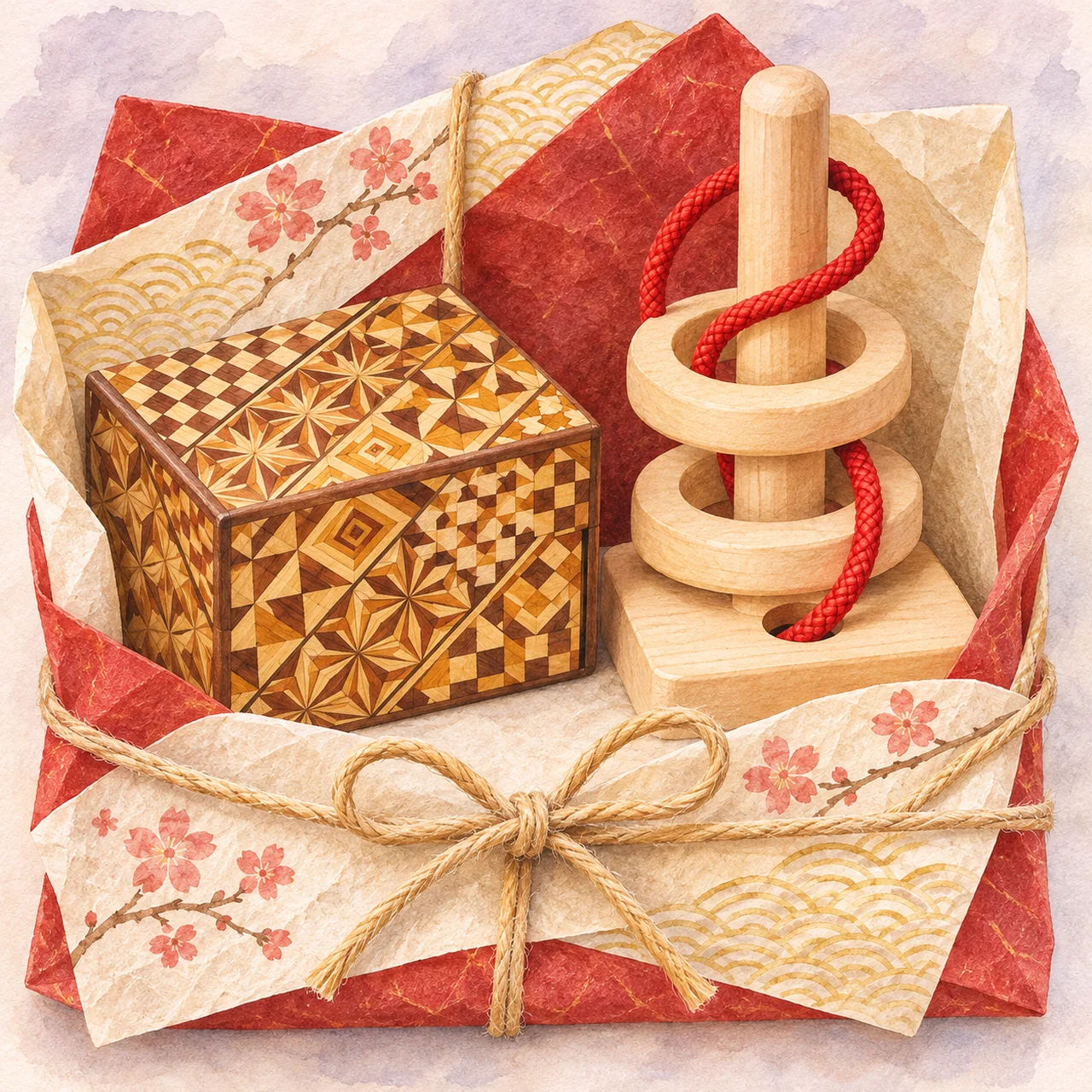
A puzzle box gives twice. First it is a puzzle; once solved, it becomes a small box for rings, notes or a key, with a pattern made entirely from wood.
Match the steps to the person. For most people, 7 or 14 steps is the kind choice. Save 21 and 27 for someone who already loves puzzles. If you want to hide a note or a ring inside, the 5-sun boxes have more room.
6. How to Open One Without Forcing It
Push gently, and write it down
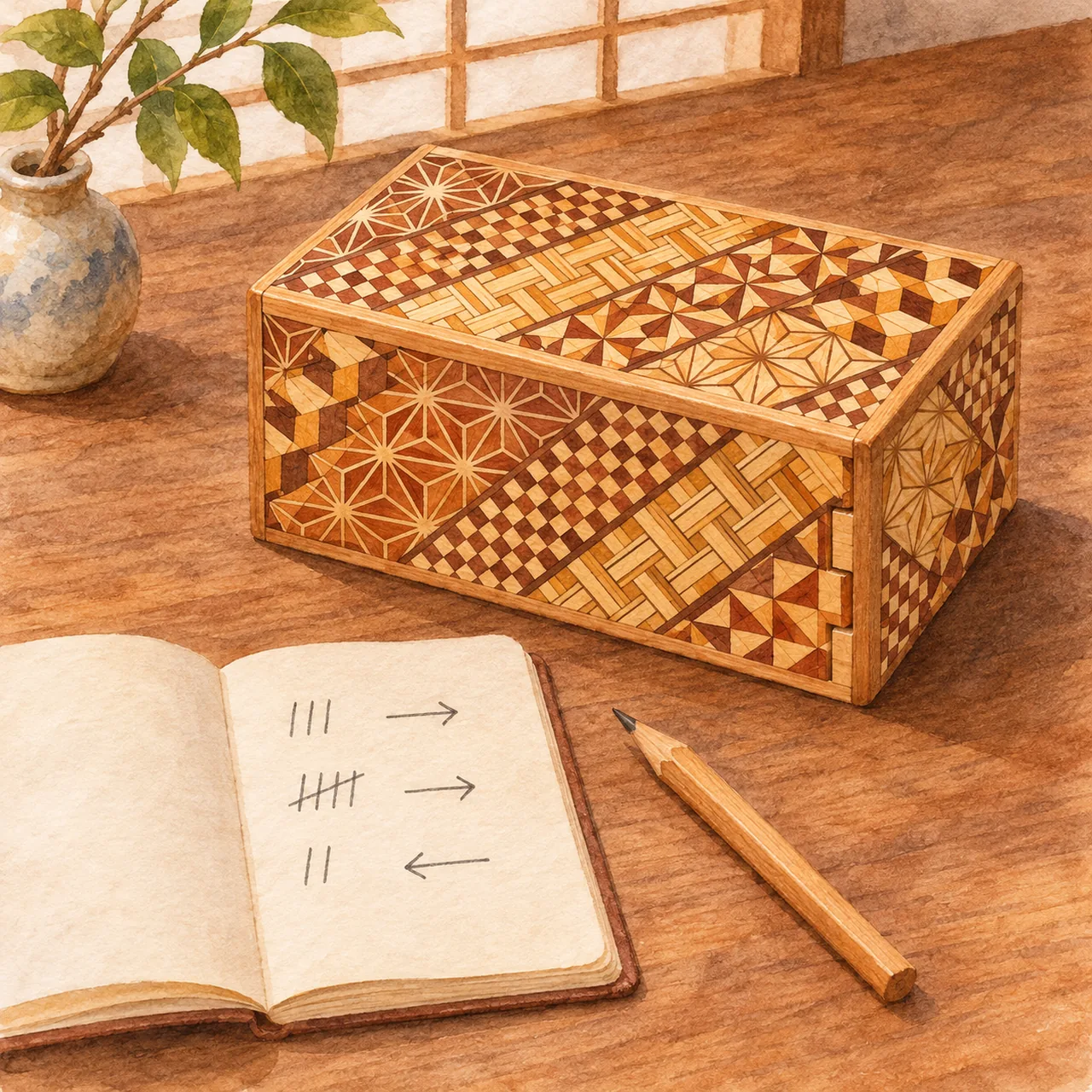
Only the right panel, moved at the right time, will shift. Pushing a panel that will not move gets you nowhere. Press each side lightly with a fingertip and feel for the one that gives a little.
On boxes with many steps, note each move as you go. To close the box, retrace the same steps in reverse.
Each box is made from natural wood, so the colour and pattern vary slightly from piece to piece. Wipe it with a dry cloth now and then.
7. Frequently Asked Questions
What does "21 steps" mean on a Japanese puzzle box?
It is the number of moves needed to open the lid. You slide hidden panels in a fixed order; after the 21st move, the lid comes free. More steps means more to remember, not a bigger box.
What does "sun" mean?
Sun is an old Japanese unit of length, about 3 cm (1.2 in). A 4-sun box is about 12 cm long and a 5-sun box about 15 cm. It describes the size only; the difficulty is in the steps.
How many steps should a beginner choose?
7 steps, or 14 if you like a challenge. Both can be solved in one sitting. 21 steps and up are better once you have opened a box or two.
Can I keep things inside a puzzle box?
Yes. Once open, it is a small box for rings, notes or a spare key. The 5-sun boxes have the most room.
Is the pattern painted?
No. Hakone yosegi uses the natural colours of different woods, fitted together and shaved into thin sheets. That is also why no two boxes look exactly alike.
Where do Japanese puzzle boxes come from?
Hakone, in Kanagawa Prefecture, near Mount Fuji. The yosegi craft was brought to Hatajuku in the Edo period, and the puzzle box has been made there for more than 100 years.
Final Thoughts: Choose the Number, Then Enjoy the Wood
A Japanese puzzle box tells you how hard it is before you buy it. Steps are the difficulty; sun is just the size. Start with 7 or 14 steps, and move up when you want more.
Behind the number is a craft from the mountains of Hakone: no nails, no lock, and a pattern made only from the natural colours of wood, shaved thinner than a business card. Once it is open, it stays with you as a small wooden box.
Japanese Kendama: JKA-Certified Ozora and How to Choose
Shogi Sets: Tendo Pieces, Kaya Boards, and Shin-Kaya