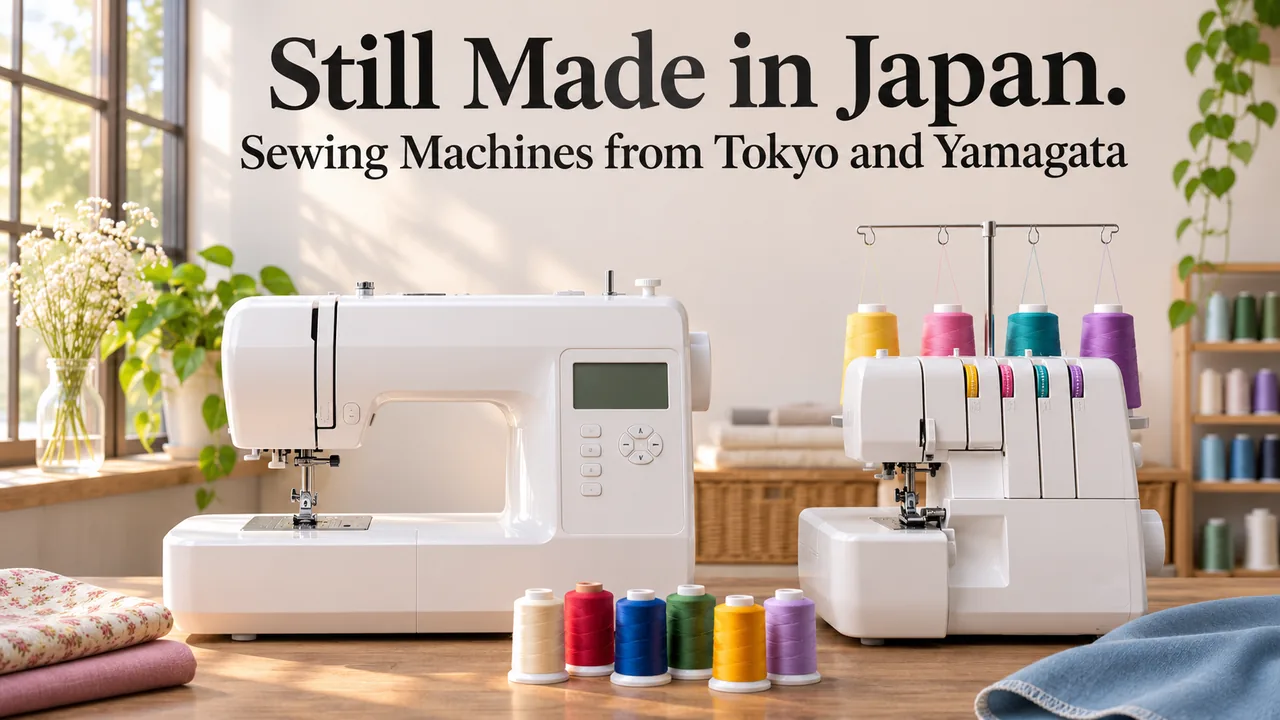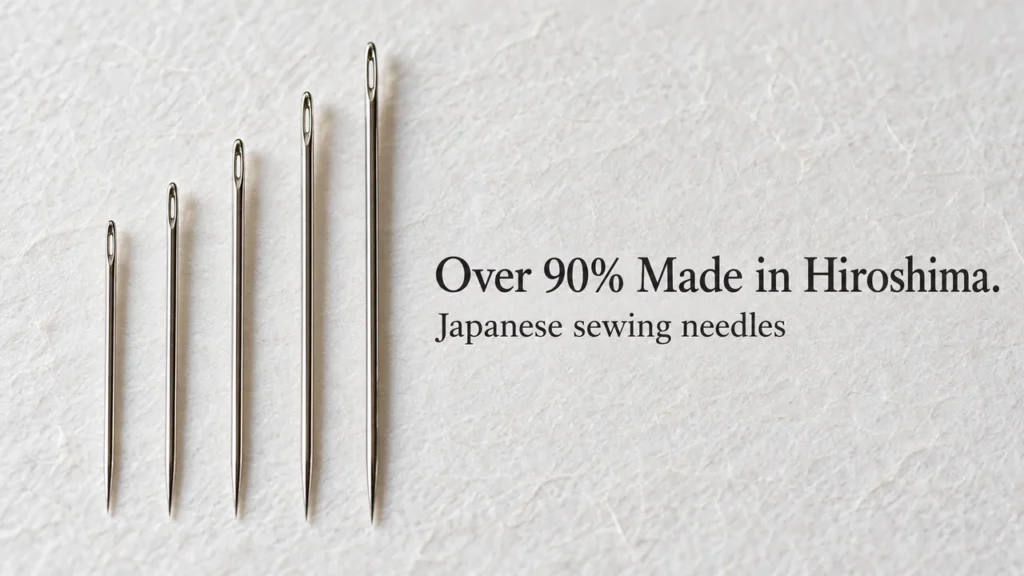
Almost every hand-sewing needle made in Japan comes from one place: Hiroshima.
Tulip, a needle maker based there, says so on its English site: "Even today, Hiroshima remains the largest sewing needle production center in Japan, producing over 90% of the country's sewing needles and pins."
Turn a Japanese needle pack over and you'll usually find a pair of numbers, such as 0.76 mm × 54.5 mm. That's thickness and length. Once you can read those two numbers, you can choose needles for yourself. This guide covers why needle-making settled in Hiroshima, how to read the pack, what changes from one kind of needle to the next, and the Kyoto needles that are named after fabric instead of measured in millimetres.
Quick Reference: Needles Come Down to Thickness and Length
| Needle | Numbers on the pack (real examples) | Choose by |
|---|---|---|
| Sewing needles ▾ | 0.71–0.76 mm × 36.4–54.5 mm (about 1.4–2.1 in) | The weight of the fabric |
| Quilting needles ▾ | Thickness barely moves (0.51–0.53 mm). Only the length changes: 22–29 mm | Length, i.e. your hand and how you stitch |
| Embroidery needles ▾ | Eight sizes, from No.3 at 0.97 mm to No.10 at 0.46 mm | How many strands of floss you thread |
| Pins ▾ | 0.55 mm × 48.0 mm (about 1.9 in) | The fabric you're pinning. Thinner than a sewing needle |
| Remember | The higher the number, the finer and shorter the needle. The lower the number, the thicker and longer. | |
Tap a needle type to jump to its section.
1. Why Japanese: Over 90% of Japan's Needles Are Made in Hiroshima
It began as piecework for low-ranking samurai
Tulip tells the origin story on its Hiroshima Needle page. Needle-making there "stretches back over 300 years, to when the ruling Asano Clan of Hiroshima Domain spread the practice as piecework for low-ranking samurai to support themselves." A side job the domain encouraged became the region's trade.
And today, the same page says, Hiroshima produces "over 90% of the country's sewing needles and pins." If you have a Japanese needle in your sewing box, there's a good chance it came from Hiroshima.
Tatara iron, carried down a river, became needles
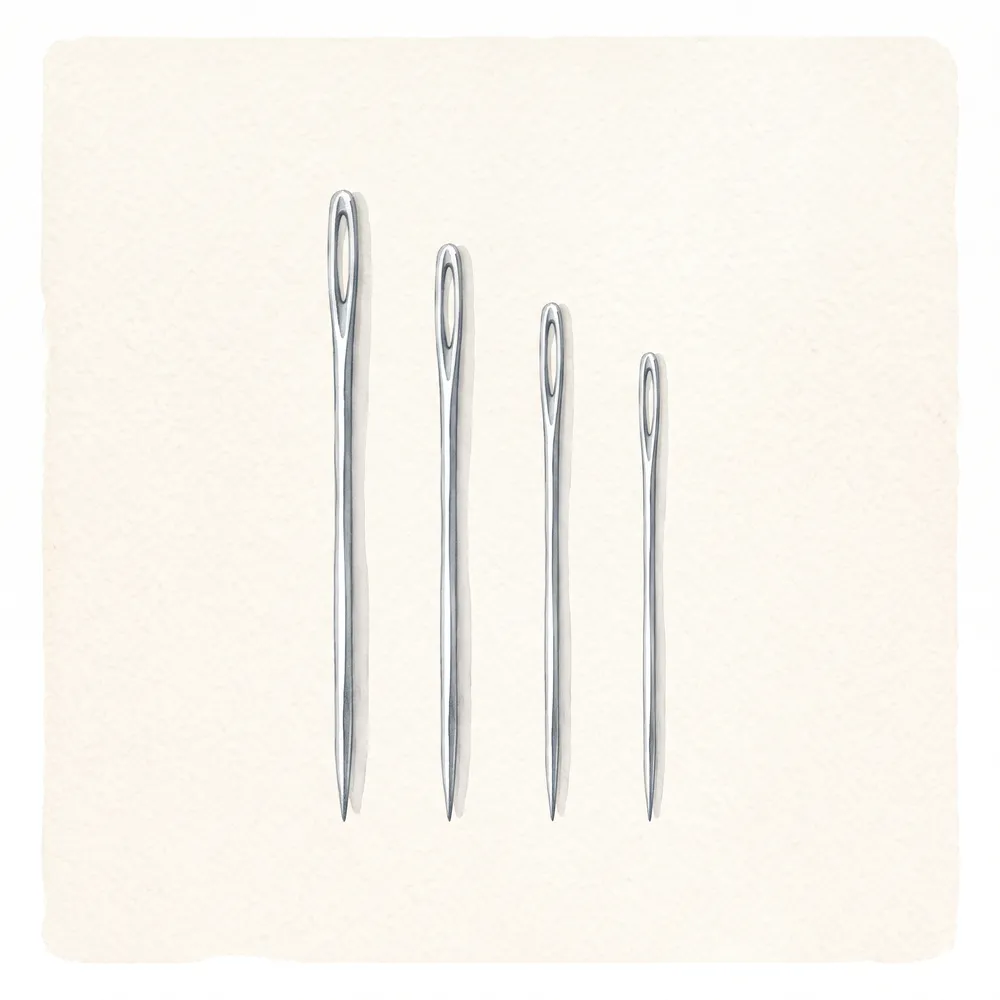
Why Hiroshima? Tulip's answer is really a map. Its needle factory is in Kake, now the town of Akiōta, "about 50 kilometers upstream from Hiroshima Bay along the Ota River, in the heart of the Chugoku Mountains." In the Edo period, Kake was a centre of tatara iron-making (the traditional smelting of iron sand, the same method behind Japanese sword steel), rivalling Izumo. Iron made from Kake's iron sand was shipped down the Ota River to what is now the city of Hiroshima, "where it was processed into needles."
Iron sand from the mountains, smelted, floated downriver, and turned into needles in the town at the river mouth. And Tulip's factory is still in Kake. The reason from three centuries ago and the company's current address are on the same river.
More than 30 steps, and a registered name
A needle is a length of fine steel wire that has been cut, shaped, and polished. Tulip says its needles go through "a process consisting of over 30 steps." It describes what it wants from each part: a slightly larger eye that's smooth inside and out, a body with "just the right amount of flexibility" so it resists bending and breaking, and a point given a special polishing treatment for sharpness.
"Hiroshima Needle" is a registered regional collective trademark (No. 5124410). The name of the place is the name of the brand.
Tulip "Hari Monogatari" needles for regular fabric — start with these eight
Item THN-061, eight needles; the specification reads "Made in Japan: Hiroshima Needle." These are the most basic needles, for regular-weight fabrics such as cotton and linen.
Four sizes, two of each: 0.76 × 54.5 mm, 0.71 × 45.5 mm, 0.71 × 39.4 mm and 0.71 × 36.4 mm (about 2.1, 1.8, 1.6 and 1.4 in). The thickness is nearly the same; the length comes in four steps, so one pack teaches you which length suits which job. The series promises a smooth eye for threading, a body that flexes without breaking, and a point that passes through fabric smoothly.
The eight-needle set above is the pack sold in Japan. On Amazon.com, Tulip’s regular sewing needles come as this assortment in sizes 7–9:
Tulip Sharps Hand Sewing Needles, Sizes 7–9
Loading product details…
2. The Numbers on the Pack Are Thickness × Length
Read the two numbers in order
If a pack says 0.76 mm × 54.5 mm, the first number is the thickness and the second is the length. That's all there is to it.
Think of thickness as the size of the hole the needle makes in the cloth. Heavy or loosely woven fabric wants a thicker needle; light or tightly woven fabric wants a finer one.
Length decides how many stitches you can load onto the needle at once. A long needle lets you run several stitches in one pass; a short one is better for small, fiddly work.
Quilting needles don't change thickness
This is the clearest example. Tulip's quilting needles (the short needles English-speaking quilters call betweens) are sized like this:
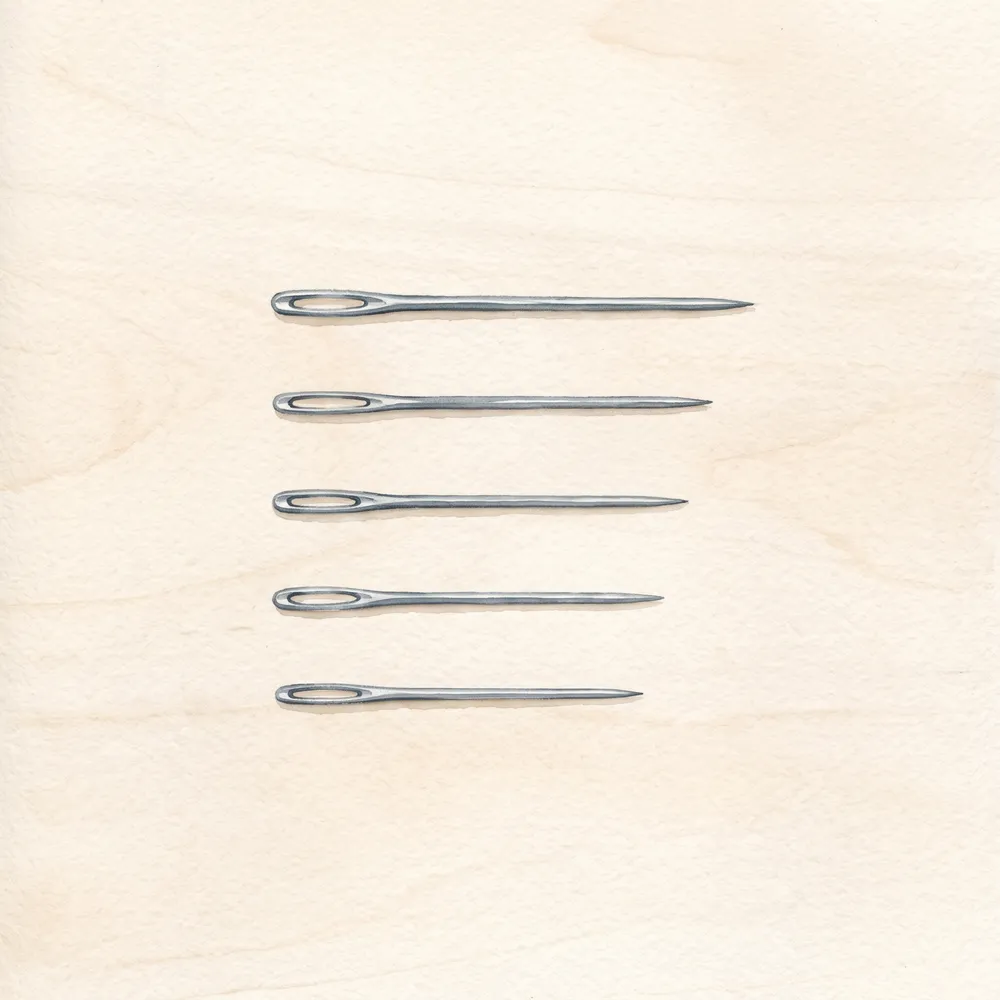
NO.8: 29 mm, 0.53 mm. NO.9: 27 mm, 0.53 mm. NO.10: 25 mm, 0.53 mm. NO.12: 23 mm, 0.53 mm. NO.13: 22 mm, 0.51 mm. In inches, that's roughly 1.14 down to 0.87.
The thickness hardly moves. Only the length changes. So choosing a quilting needle really means choosing a length. One Japanese shop puts it simply: everyone's hands are a different size, so there's no single best length, but for beginners it recommends NO.9.
If quilting feels awkward, try a shorter needle
The same shop adds: if your current quilting needle feels hard to work with, try going a little shorter, because with quilting, shorter is sometimes easier than longer.
In other words, the trouble may not be your technique; the needle may simply be the wrong length for your hand. If NO.9 feels clumsy, try NO.12 or NO.13. The steps are only a millimetre or two, but a needle is pinched and steered between your fingertips, and those millimetres change how it feels.
Higher number, shorter needle. Remember that one direction and you won't be lost in a shop.
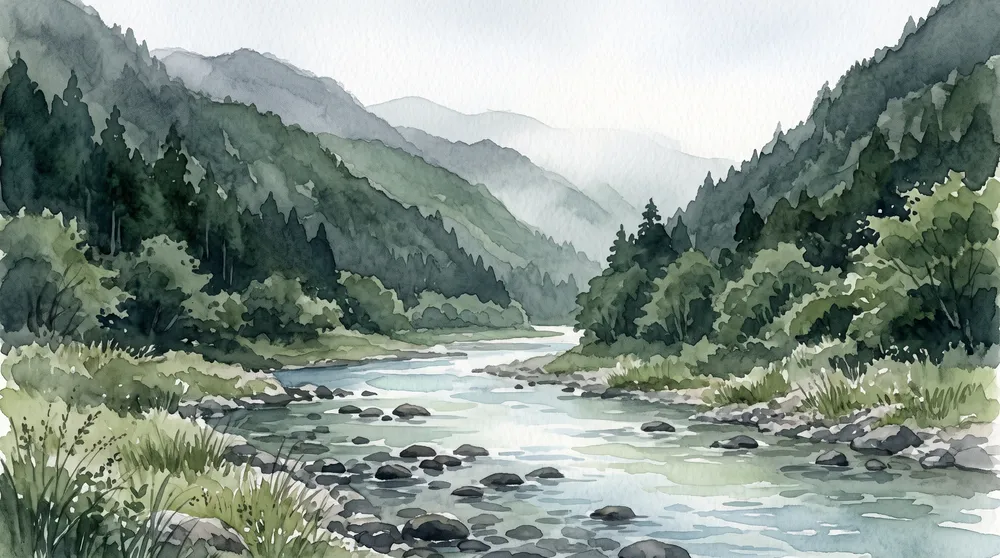
Tulip "Hari Monogatari" quilting needles — choose the length by number
Listed as "Hiroshima Needle, Hari Monogatari, made by Tulip," in five sizes: NO.8, 9, 10, 12 and 13. Lengths run from 29 mm down to 22 mm in steps of one or two millimetres, while the thickness stays at 0.51–0.53 mm. What you're choosing is the length.
The shop describes them as a premium series "pursuing the best passage through fabric and ease of use," and adds that they're "fine but don't break." For a first pack, NO.9. If your hands are small or you like very small stitches, NO.13 is worth a try.
On Amazon.com, Tulip’s quilting needles are sold one size per pack; this is No.10:
Tulip Quilting Needles, No.10 (6 Pack)
Loading product details…
3. Embroidery Needles Are Numbered by Strands of Floss
Match the thread, not the fabric
Embroidery needles are chosen on a different axis. What matters isn't the fabric but how many strands of floss you're stitching with.
The specification for Tulip's French embroidery needles spells it out for each number, using No.25 stranded cotton (standard six-strand embroidery floss): No.3 is for 5–6 strands, or No.5 pearl cotton. No.6 is for 3–4 strands. No.9 is for a single strand.
Thicker thread needs a bigger eye, so the strand count decides the needle. Decide how many strands you'll use, and the needle picks itself.
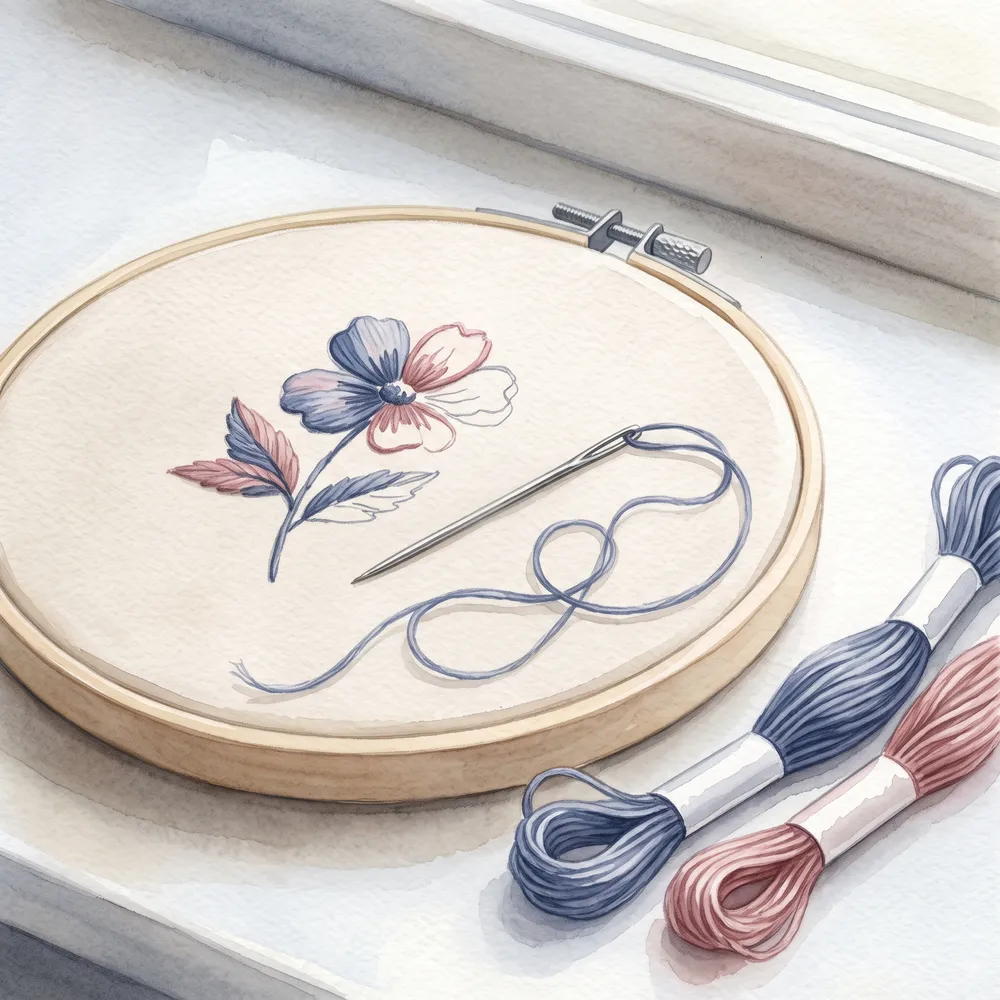
Number and size line up neatly
All eight sizes are given in millimetres: No.3 0.97 × 44.5, No.4 0.91 × 42.9, No.5 0.84 × 41.3, No.6 0.76 × 39.7, No.7 0.69 × 38.1, No.8 0.61 × 36.5, No.9 0.53 × 34.9, No.10 0.46 × 33.3.
Each step up in number makes the needle both finer and shorter. Unlike quilting needles, thickness and length move together.
The material is listed as "steel wire / nickel plating." Since it's steel, it's best not left out somewhere humid. Putting needles back in their case after use is a small habit that makes them last.
Many Japanese people's first needle came from here
Tulip writes that its "needle sets made for the home economics classes of elementary schools comprise the top share in Japan." In Japan, sewing is taught at primary school, and every child gets a little needle kit. For many people, that was the first needle they ever held.
The same page says Tulip crochet hooks "have been exported to more than 50 countries globally for many years." The needle kit in a Japanese classroom and the crochet hooks on a craft-shop shelf abroad lead back to the same place in Hiroshima.
Tulip "Hari Monogatari" French embroidery needles — choose by strand count
Listed as "Hiroshima Needle," in eight sizes from No.3 to No.10, eight needles per pack, described as having "a sharp point, ideal for French embroidery."
The use for each number is printed in the specification. With six-strand floss: 1 strand, No.9 or No.10; 3–4 strands, No.6; 5–6 strands, No.3 or No.4. If you always stitch with the same number of strands, one pack is enough. If you switch, keep two numbers on hand so you don't have to stop halfway.
On Amazon.com, an assorted pack of Tulip embroidery needles:
Tulip Embroidery Needles, Assorted Thin (8 Pack)
Loading product details…
4. Pins Aren't Made for Sewing
Their job is to hold
A pin doesn't sew fabric; it keeps fabric from moving. You layer the cut pieces and pin them before stitching. It's a tool for holding things temporarily.
So there's no thread, and no eye. A head takes the place of the eye, and without an eye to make room for, the shaft can be finer.
Put the numbers side by side and it's obvious. Tulip's pins are 0.55 × 48.0 mm. Sewing needles in the same series are 0.71 to 0.76 mm. The pin is thinner. When all you're doing is holding, the smaller the mark left in the cloth, the better, and that difference shows up in 0.55 versus 0.71.
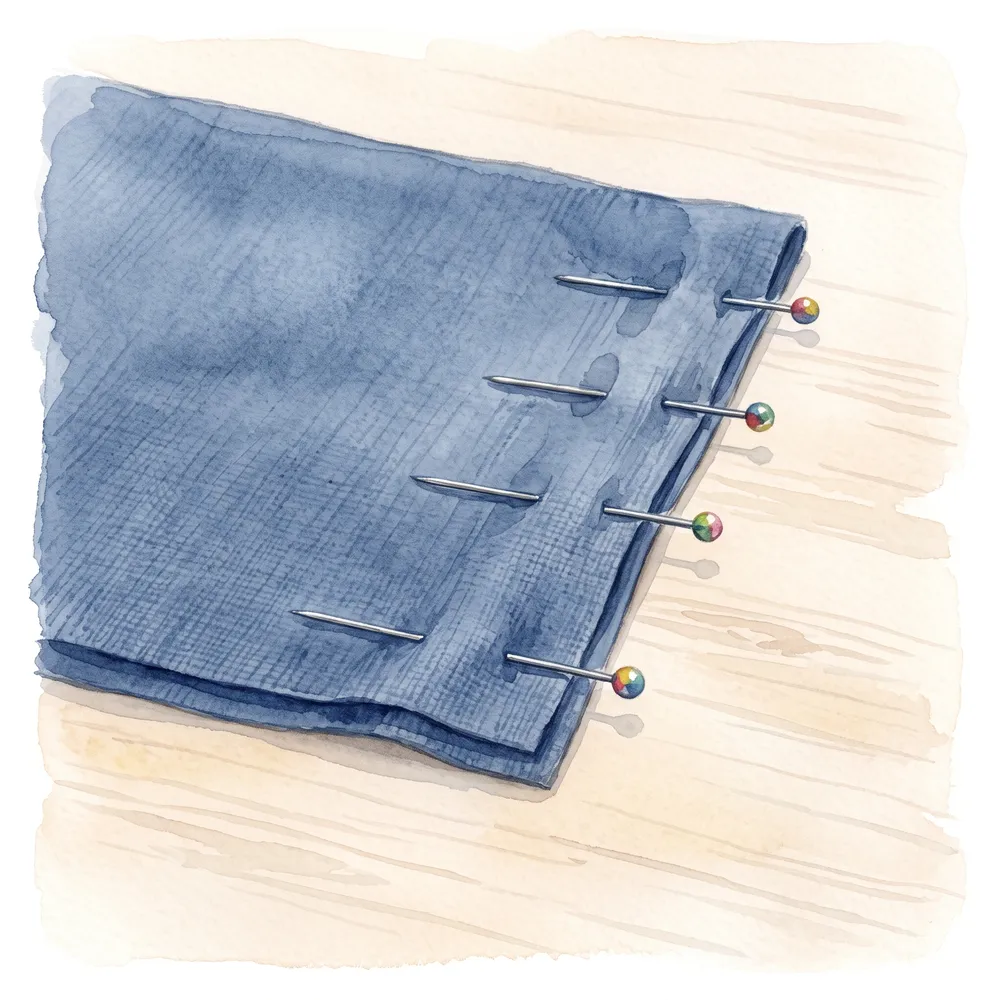
Choose them for the fabric you're pinning
Tulip's description names the fabrics: "ideal for temporarily holding regular fabrics such as cotton, linen and wool."
Here too, what you look at is the weight and weave of the fabric. Push a thick pin through a light or tightly woven fabric and it can leave a mark after you pull it out.
And buy more than you think you need. Pins are the tool that ends up on the floor, a few at a time. A spare pack beats running out mid-project.
Tulip "Hari Monogatari" pins — 0.55 mm for holding
Item THN-074, fifteen pins; the specification reads "Made in Japan: Hiroshima Needle." Size 0.55 × 48.0 mm (about 1.9 in long), for cotton, linen, wool and other regular fabrics. Most fabric used in everyday dressmaking and small projects falls in that range.
Same series as the sewing needles, with the same "hard to break, moderately flexible body." A bent pin keeps snagging fabric, so pins are the needles most worth checking and replacing as you go.
On Amazon.com, Tulip’s pins carry the item number THN-074e:
Tulip Straight Pins THN-074e
Loading product details…
5. In Kyoto, Needles Are Named After Fabric
Hiroshima makes over 90%. What about the rest?
One answer is Kyoto's Misuya needles, still sold today as a separate lineage from Hiroshima's.
The interesting part is how they're named. Hiroshima needles are called by their dimensions, like 0.76 × 54.5 mm. Misuya needles aren't.
Kinu-bari and momen-bari: silk needles and cotton needles. The fabric you sew becomes the name of the needle. Sizes go by names such as yon-no-go ("four-five"), san-no-ni ("three-two") and ō-chabo.
Western dressmaking measures one way and Japanese kimono-making another. The same tool, counted in a different system.
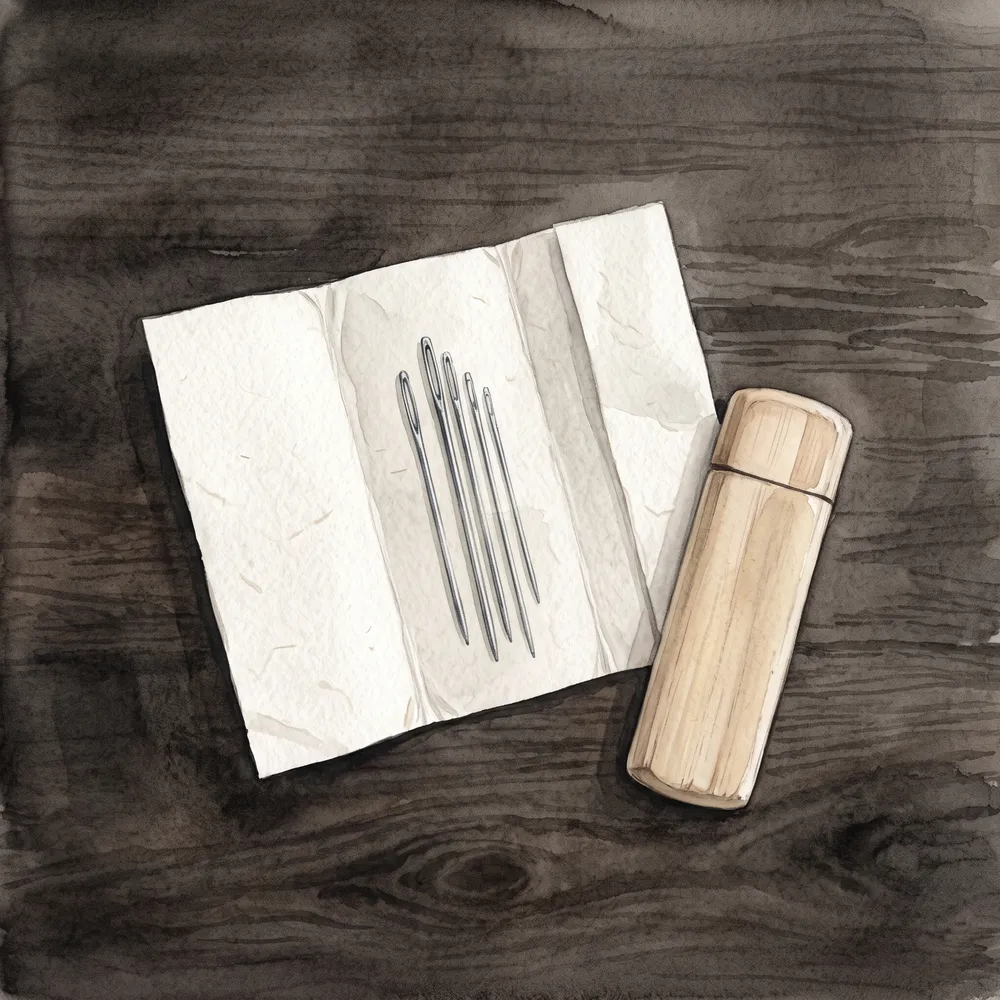
A different eye, too
The description of the Misuya set carries one note: "all have grooved eyes." Instead of a round hole, the eye is a long, narrow slot.
This isn't a question of which is better. A different lineage means a different eye, different names, and different ways of putting a set together. Having both is what gives you a choice.
A good order is to get to know Hiroshima needles first, then try these. Holding both, you'll find out which one your hand prefers.
Misuya Chūbei reissue Kyoto Misuya needle set — silk needles and cotton needles
Sold by Misuya Chūbei of Kyoto in its own official shop, with "country of manufacture: Japan" on the listing. The shop explains that it revived the packaging of a needle set it once sold and filled it with the silk and cotton needles still in common use today.
Five each of silk needles (yon-no-go, yon-no-ni) and cotton needles (san-no-go, san-no-ni, ō-chabo), 25 in all, plus a needle threader and a needle case. All grooved eyes. Because the packaging is a reissue, it looks genuinely old, and the listing suggests it as a small gift. With the case included, it's a complete kit on its own.
The reissue set above is sold in Misuya Chūbei’s own shop. On Amazon.com, a 25-needle Misuya assortment:
Misuya Hand Sewing Needle Assortment (25 Needles)
Loading product details…
6. Buying From Outside Japan
Tulip has an English site covering its sewing needles, crochet hooks and knitting needles, along with the Hiroshima Needle story. Its needles are also stocked by quilting and needlework shops in the US; eQuilter and Snuggly Monkey, for example, carry Tulip needles under the "Hiroshima" name. The packs sold abroad aren't necessarily the same sets as the Japanese "Hari Monogatari" packs in this guide, so check the type and size on each listing.
In the EU, Tulip lists De Bondt B.V. in the Netherlands as its business partner.
We didn't find an English site or information on international shipping for Misuya Chūbei. We will add listings you can buy from abroad here as we confirm them, one product at a time.
7. Frequently Asked Questions
What is a Hiroshima needle?
A needle made in Hiroshima. According to Tulip, needle-making there goes back over 300 years, to when the Asano Clan spread it as piecework for low-ranking samurai. Hiroshima now produces over 90% of Japan's sewing needles and pins, and "Hiroshima Needle" is a registered regional collective trademark (No. 5124410).
What do the numbers on a Japanese needle pack mean?
Thickness first, then length. 0.76 mm × 54.5 mm means a needle 0.76 mm thick and 54.5 mm (about 2.1 in) long. Thickness is the size of the hole it makes, so heavier fabric takes a thicker needle. Length decides how many stitches you can load at once. Where needles are numbered instead, the higher the number, the finer and shorter the needle.
Which embroidery needle should I use?
It depends on how many strands of floss you thread. Tulip's French embroidery needles give a guide for six-strand floss: 1 strand, No.9 or No.10; 2–3 strands, No.7; 3–4 strands, No.6; 5–6 strands, No.3 or No.4. Decide on the strand count first and the needle follows.
Which quilting needle should I choose?
Choose by length. Tulip's quilting needles run NO.8 29 mm, NO.9 27 mm, NO.10 25 mm, NO.12 23 mm, NO.13 22 mm, with the thickness almost fixed at 0.51–0.53 mm. One shop recommends NO.9 for beginners, and suggests going a little shorter if quilting feels awkward. The right length depends on your hand.
What's the difference between pins and sewing needles?
Their job. Pins hold fabric in place; they don't sew. With no thread there's no eye, and a head instead. They're thinner, too: Tulip's pins are 0.55 mm against 0.71–0.76 mm for its sewing needles, presumably because a pin that only holds should leave as small a mark as possible.
What are kinu-bari and momen-bari?
The names Kyoto's Misuya needles use: silk needles and cotton needles. They're named for the fabric you sew rather than their dimensions, and sizes go by names like yon-no-go, san-no-ni and ō-chabo, a different counting system from Hiroshima's millimetres. The Misuya set notes that all its needles have grooved eyes rather than round ones.
Final Thoughts: 300 Years in a Very Small Tool
Over 90% of Japan's sewing needles and pins are made in Hiroshima, a trade that began more than 300 years ago as piecework for low-ranking samurai. The reason is geography: iron sand from Kake in the mountains, smelted by the tatara method, carried down the Ota River to be made into needles. Tulip's factory is still in Kake.
Choosing comes down to reading the pack: thickness, then length; the higher the number, the finer and shorter. After that, each kind has its own axis. Sewing needles follow the fabric. Quilting needles hardly change thickness, so you choose length, which means your hand. Embroidery needles follow the strand count. Pins don't sew, so they're finer and chosen for the fabric they hold.
And in Kyoto, Misuya needles count differently: silk needles and cotton needles, named for the cloth. Start with a pack that has several lengths in it, and find the one that fits your hand.
Japanese Fabric Scissors: Shozaburo, Misuzu, Thread Snips
Japanese Wooden Sewing Boxes: Chestnut, Oak & Rattan Picks