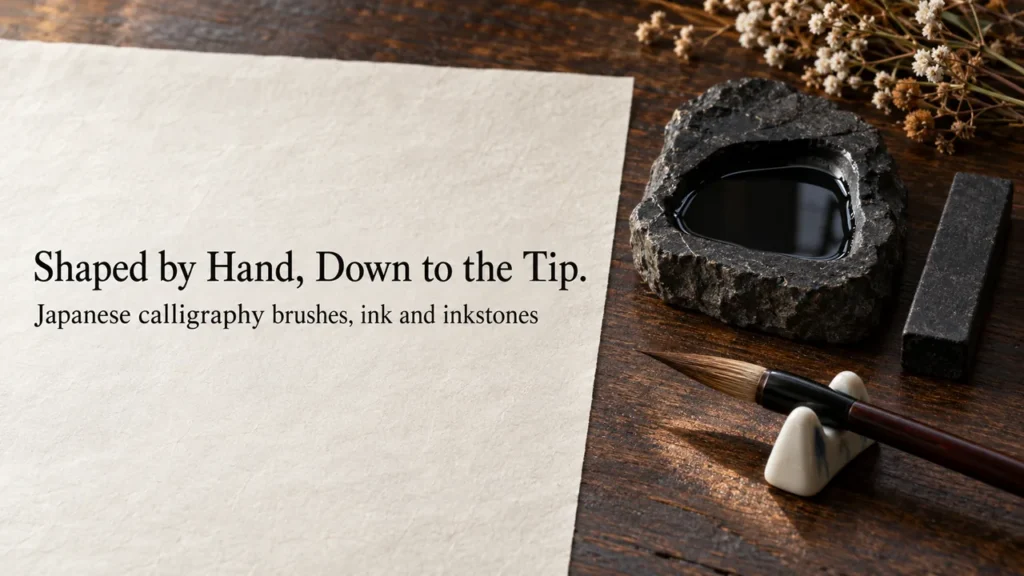
The tip of a calligraphy brush has hairs called inochi-ge — "life hairs." In the hair-assembly of a Kumano brush, hairs of different lengths are chosen, layered, and built into a single tuft, so even the tiny point that touches the paper is shaped by hand.
The ink it carries begins with collecting soot. The stone you grind it on begins with carving rock. Follow three Japanese makers — Ikkyuen in Kumano, Hiroshima; Kobaien in Nara; and the Ogatsu inkstone makers of Miyagi — and the way you see these tools changes a little.
Start with one brush that suits the characters you want to write now. From there, widen out to the colour of the ink and the surface of the stone. This guide covers how to choose a brush by its measurements, how sumi is made, what an inkstone actually does, and how to care for brushes properly.
Quick Reference: Brush, Ink, and Inkstone at a Glance
| Tool | In this guide | What to look at |
|---|---|---|
| Brush (fude) | Ikkyuen Ouhou brush, Nos. 6, 5, 4 ▾ | Tuft diameter and length — not just the number |
| Ink stick (sumi) | Kobaien "Ochimatsu" pine-soot ink ▾ | Enjoy pine-soot ink in dark and pale tones |
| Inkstone (suzuri) | Ogatsu inkstones, two sizes ▾ | Outer size, and the area you actually grind on |
1. Measure the Brush You Have, and the Next One Gets Easy
Large characters on a sheet of hanshi paper and small characters added to a letter can both be written with a brush, but they call for different tufts. Decide the paper size, the character size, and the script you want first, and you can narrow the field far more than by reading product names. If you study with a teacher, start from their model sheets and recommendations.
If you're replacing a brush, measure the tuft of the one you use now. "A slightly shorter tuft," "a thicker brush than this" — you'll have something to compare against. Read the tuft diameter and tuft length alongside the hair type, and you'll have the brush's outline.
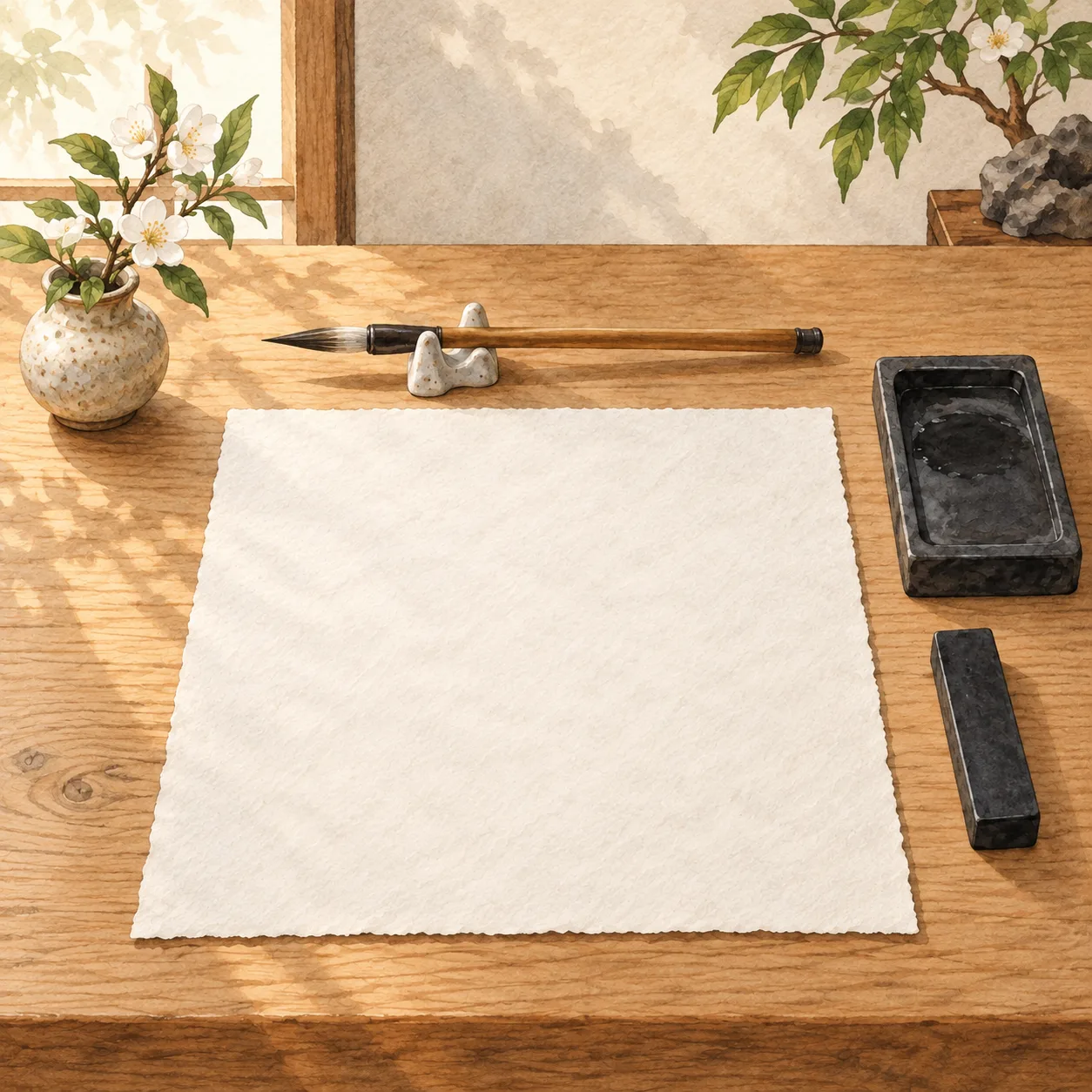
2. Why Japanese: Three Crafts Meet on One Sheet of Paper
Each of the three tools in this guide comes from a different region and a different kind of handwork:
- The brush — Ikkyuen of Kumano, Hiroshima, a maker and seller of Kumano brushes, a nationally designated traditional craft. Hairs of different lengths are sorted and assembled into one tuft.
- The ink — Kobaien of Nara, which publishes its own process: collecting soot, kneading it with glue, and drying it slowly in ash.
- The inkstone — the Ogatsu inkstone cooperative in Ishinomaki, Miyagi, whose craftspeople carve each stone from local Ogatsu slate.
On one sheet of paper, those three crafts meet. The sections below follow each in turn.
3. From Tip to Root, the Hairs Are Different Lengths
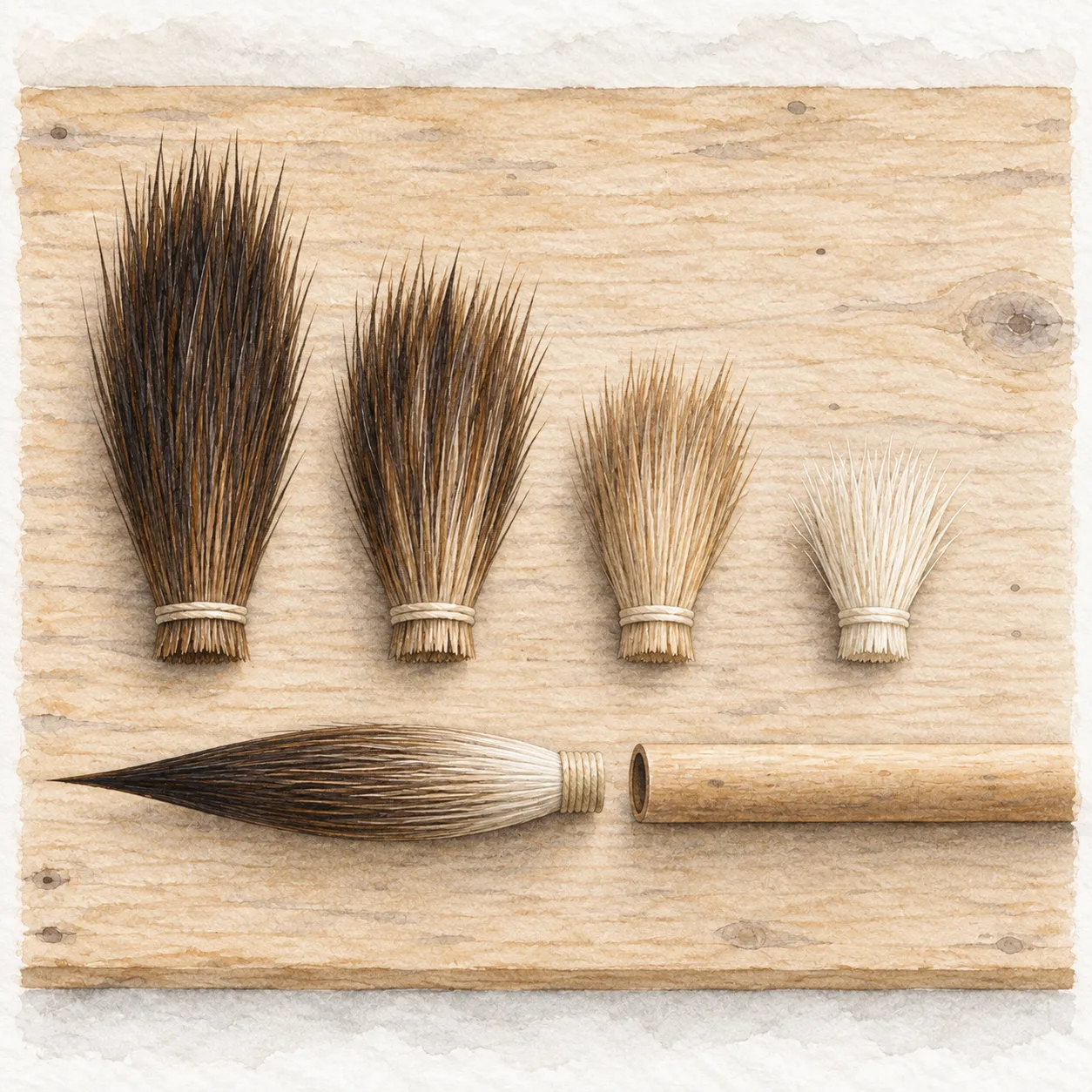
Named in order: inochi-ge, nodo, hara, koshi
Ikkyuen makes brushes in Kumano, Hiroshima, and its range includes weasel-type and goat-hair brushes. Here we look at its Ouhou brush.
In the traditional Kumano process, the hair is combed to remove unwanted strands and sorted by length. Inochi-ge, nodo, hara, koshi — the tip, the "throat," the "belly," the "waist." Hairs of different lengths are blended and layered to build the tuft; this is kegumi, hair-assembly. Outer hairs are then wrapped around, the base is tied, and the tuft is set into the handle. The handwork continues inside, hidden even in the finished brush. (Process as described by the Association for the Promotion of Traditional Craft Industries, "Kumano-fude.")
Compare the Ouhou brushes by their measurements
Ikkyuen lists the Ouhou brush as a weasel-type brush; its official listing gives the main materials as "weasel hair and black mink," while a retailer describes it as a kolinsky-weasel brush for regular and semi-cursive script. The names vary. Here are the official measurements, Nos. 6 to 4:
| Ouhou brush | Tuft diameter | Tuft length |
|---|---|---|
| No. 6 | 8 mm | 35 mm |
| No. 5 | 9 mm | 41 mm |
| No. 4 | 9.5 mm | 44 mm |
Each step down in number makes the tuft both thicker and longer — but not by even steps. From 6 to 5, the diameter grows 1 mm and the length 6 mm; from 5 to 4, only 0.5 mm and 3 mm. The numbers aren't an evenly spaced scale, so compare the millimetres against your current brush or model sheet. (Measurements and materials from Ikkyuen's official product pages, checked September 2026; some retailer listings differ by 1–2 mm. This doesn't mean everything except size is identical.)
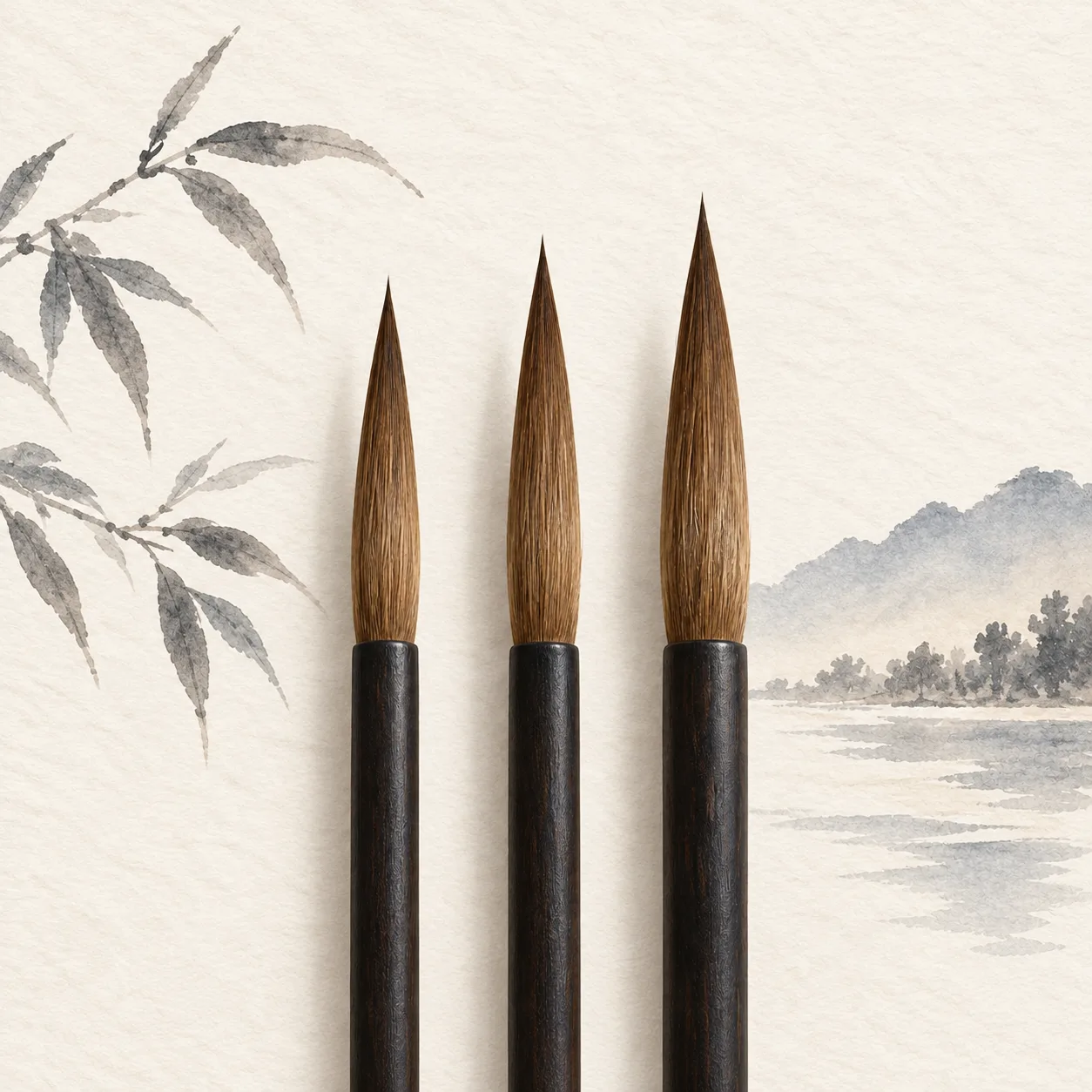
Ikkyuen Ouhou brush No. 6 — the smallest tuft of the three
A tuft of 8 × 35 mm, the thinnest and shortest. The listed materials — "weasel hair and black mink" — are identical to Nos. 5 and 4, so across the three, only the tuft size changes. If your current brush's tuft is longer than 35 mm, this is a step shorter.
Ikkyuen Ouhou brush No. 5 — the one to put in the middle
9 × 41 mm, 1 mm wider and 6 mm longer than No. 6. A good baseline when you're unsure: if it feels too long, move to No. 6; if it's not enough, to No. 4. With all three sharing one name, you can move a single step and compare.
Ikkyuen Ouhou brush No. 4 — the largest tuft of the three
9.5 × 44 mm, the thickest and longest — only 0.5 mm and 3 mm more than No. 5. Don't read the numbers as stages of progress; choose by how much tuft the characters you want to write need. The same work of sorting hairs into inochi-ge, nodo, hara, and koshi is inside this tuft too.
4. The Soot Is Collected From a Cover Over a Flame
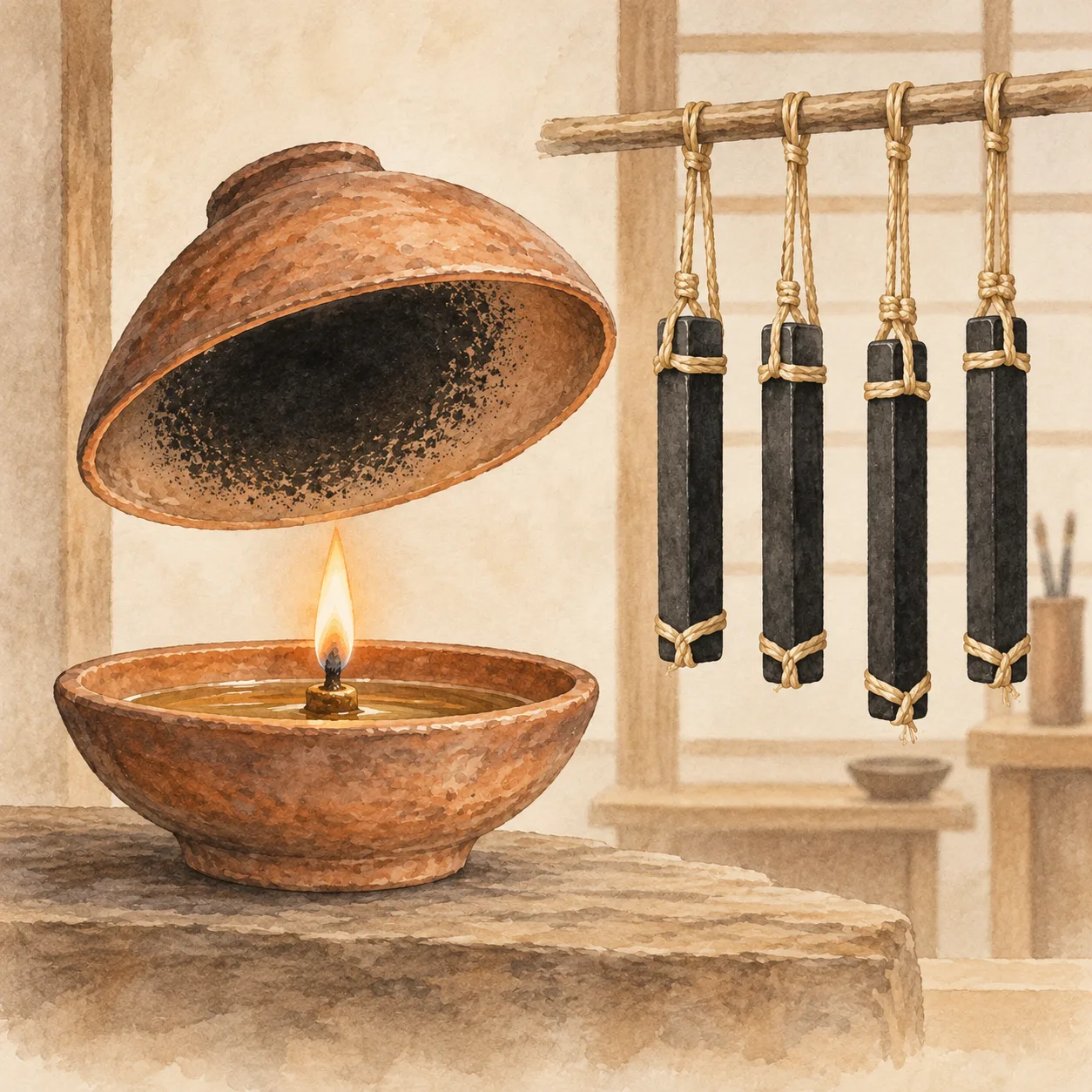
Oil in an earthenware dish, a wick of rush
In the oil-soot collection that Kobaien of Nara describes, pure vegetable oil is poured into an earthenware dish and a wick made of igusa rush is lit. An earthenware cover goes over it, and the soot that collects on the inside is gathered. Before ink becomes a hard stick, there is a small flame to watch. (Process from Kobaien, "The Birth of Sumi." Vegetable-oil soot is the method for yuen-boku, oil-soot ink — keep it separate from the pine-soot ink introduced below.)
Soot and glue, kneaded at 100 to 60
The soot is mixed with a solution of animal glue (nikawa) — Kobaien publishes the ratio as 100 parts soot to 60 parts glue solution, with fragrance added — and kneaded thoroughly. The company writes that "this kneading decides the life of the ink." Kneaded until glossy, it is pressed into wooden moulds at about 25 g each.
Drying by changing the ash, day by day
Out of the mould, the sticks are buried in wood ash to dry — and not once. On day one they go into damp ash; from day two they're moved into progressively drier ash. Rather than rushing, the ash is what changes. Once ash-drying has removed about 70% of the moisture, the sticks are bound in woven straw and hung from the ceiling to dry naturally indoors. The waiting is part of making sumi.
The tool that polishes ink is a clamshell
Kobaien's finishing includes polishing the surface of the ink with a clamshell. After drying, the stick is warmed over charcoal to soften the surface slightly, then polished. Even the sheen on a black stick of ink comes from a tool and a hand.
Pine-soot "Ochimatsu": see the colour of pale ink
The pleasure of ink isn't only in a deep black. Kobaien describes its pine-soot ink (shoen-boku) this way: dark, it is "a bright black with absorbency"; pale, "a faint blue that seeps out of a gentle black is quite mysterious." "Ochimatsu" is one of the names on Kobaien's pine-soot page. Try a dark line and a pale line side by side on your usual paper, and look again once it's dry. The colour depends on paper and dilution, so judge it on your own paper rather than a photograph.
Kobaien "Ochimatsu" pine-soot ink, 1-chō size — pale, and blue comes through
Ink made from pine soot, sold as "Ochimatsu shōen (koematsu)," 1-chō size. Change the dilution and the colour you see changes. The kneading at 100 to 60 and the day-by-day change of ash are processes Kobaien itself publishes; the stick that arrives at your desk comes out of that time.
5. An Inkstone Grinds With Tiny Teeth in the Stone
Carved from stone 200–300 million years old
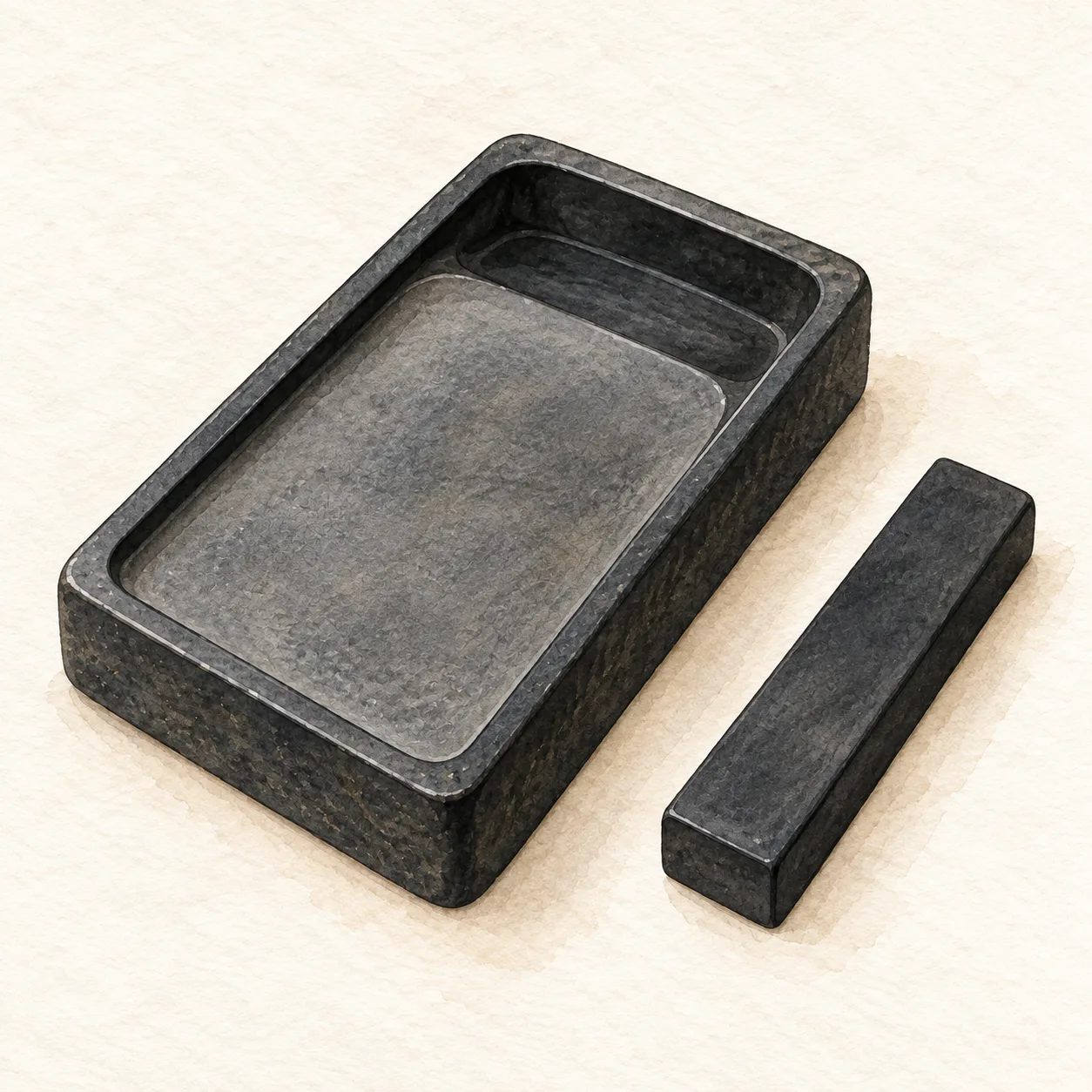
Ogatsu stone, from Ogatsu in Ishinomaki, Miyagi, is a black, hard slate also called genshō-seki. The cooperative describes it as belonging to the Toyoma formation of the Kitakami mountains, from the Permian period — 200 to 300 million years old. It is pure black, strong under compression and bending, and absorbs little water, so it doesn't alter chemically or over long years. A stone that won't drink water, chosen for a tool that holds ink and water every time.
The grinding surface has hōbō — the texture that acts as teeth when you grind ink. What the cooperative values is the balance of their coarseness, fineness, hardness, and softness. An inkstone is a tool that grinds ink with the surface of the stone itself.
"Hon-ryōshi" is a carving style, not a grade or size
"Hon-ryōshi" in the product names isn't a grade or a size — it's the name of a carving style. The cooperative's shop says ryōshi-bori is said to be a Chinese-style inkstone adapted to Japanese use, and that rectangular inkstones are considered the basic form, cut from the raw stone to standard sizes. The two here are the same style in two sizes. They arrive in a special box made only of Hida paulownia, a soft, pale wood.
Ogatsu inkstone, hon-ryōshi "shigohei" — a one-off carved by a craftsperson
Outer dimensions about 135 × 75 mm, the smaller of the two. The cooperative describes it as "a one-of-a-kind inkstone, with material dug from Ogatsu genshō stone and carved one by one by skilled craftspeople." Not cut from a template, so measurements and photos are a guide. Keep the outer size separate from the area you can actually grind on.
Ogatsu inkstone, hon-ryōshi "gosansun" — the same style, a size up
About 150 × 90 mm, with more room both ways. Same stone, same carving style; only the size changes. Choose by the size of your ink stick and the space on your desk. Also one-of-a-kind, hand-made, so dimensions are approximate.
A "natural shape" inkstone isn't shaped by nature
The cooperative's shop explains that its tennen-gata ("natural shape") inkstones have the edges of the cut stone carved to look like a natural rock. The outline that looks untouched is carving too — something easy to miss if you take "natural" literally.
6. Change One Thing at a Time
If the brush, ink, and stone all appeal, start by choosing the one thing you want to change now. For a brush, start from a tuft size that suits your model sheet or current brush. For ink, from looking at its colour with your usual brush and paper. For an inkstone, from your ink stick and desk space. Change one tool at a time and it's easier to tell what you liked. "I want to write more with this tuft length." "I want to keep that pale line." The next choice can wait until you've seen the paper.
As a gift, for someone who already writes, ask the name and size of their favourite brush. Thicker isn't automatically better, and nor is pricier. Paying attention to the tools they use is what makes a gift fit their writing time.
7. Not Every Brush Should Be Washed in Water
Loosen a new brush a little at a time
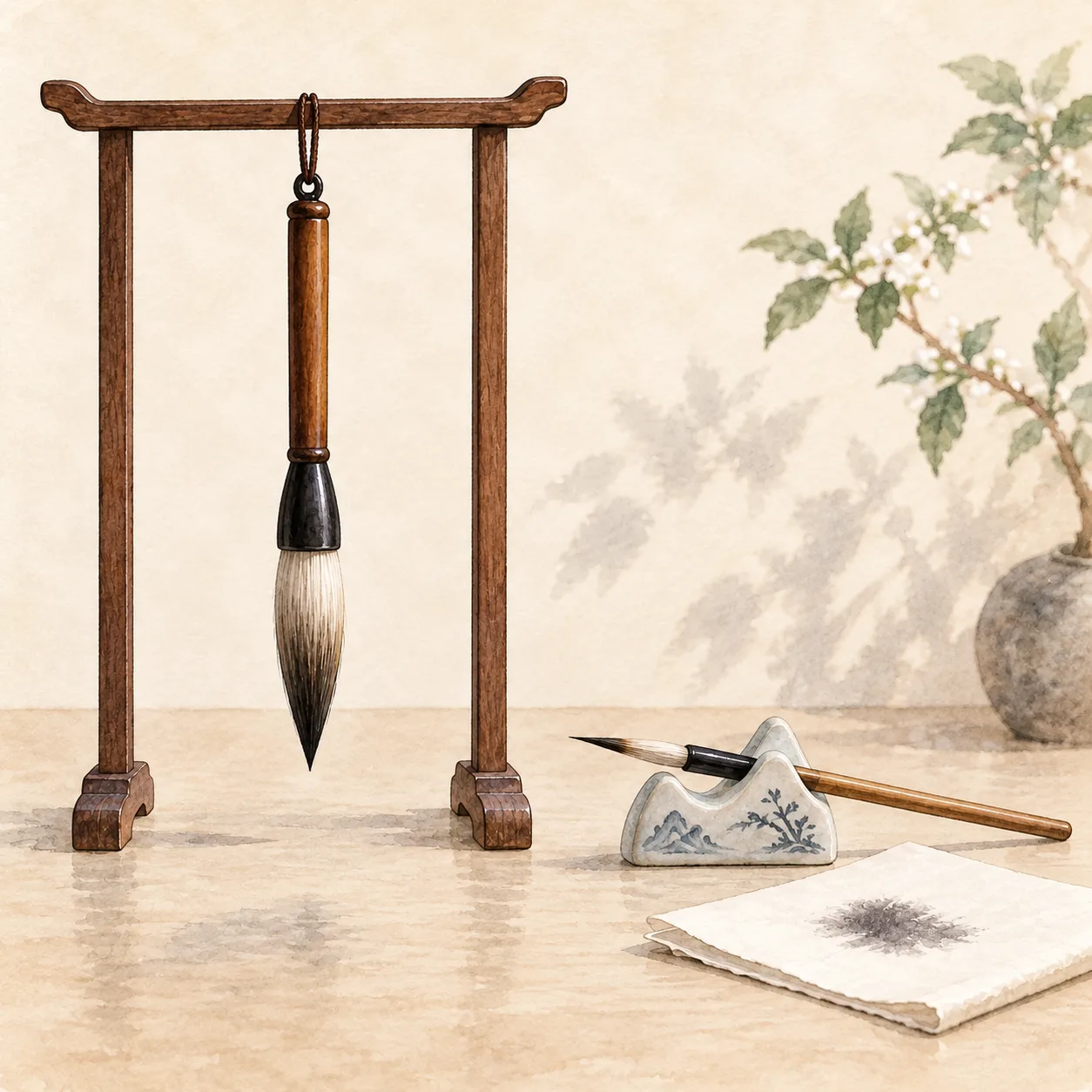
Ikkyuen's instructions say a glue-stiffened new brush should be loosened from the tip toward the root, adjusting how far you open it. Large brushes are usually opened to the root, though not always — it depends on the purpose. Small brushes are opened about a third to half of the tuft. Before dunking every new brush in water the same way, read that brush's instructions once.
Wash the ones opened to the root
A brush opened to the root is washed in water right to the root so no ink remains, then shaken out, reshaped, hung up, and stored only when completely dry. A partly opened brush has the used part wiped with cloth or paper and then a damp paper, and reshaped. Ikkyuen doesn't recommend washing the glue out of small brushes with water. Don't rinse every brush the same way. (Based on Ikkyuen, "How to Handle Brushes." If your brush came with its own instructions, follow those.)
8. Buying From Outside Japan
We didn't find English shops or stated international shipping for these three makers when we checked in October 2026. The Ogatsu inkstone cooperative's official site (in Japanese) describes the stone and links to its own shop.
- For brushes, look for the tuft diameter and length in millimetres, not only the number.
- For ink, check whether it is pine-soot (shōen) or oil-soot (yuen) ink.
- For inkstones, check the stone's name and origin — Ogatsu stone is from Ishinomaki, Miyagi.
We will add listings you can buy from abroad here as we confirm them, one product at a time.
9. Frequently Asked Questions
How do I choose my first calligraphy brush?
By the size of the characters and the model sheets you use. If a class specifies a brush, start there. When replacing one, measure your current brush's tuft diameter and length and compare.
What's the difference between Ouhou brushes No. 4, 5, and 6?
Ikkyuen's official listings give No. 4 as 9.5 × 44 mm, No. 5 as 9 × 41 mm, and No. 6 as 8 × 35 mm (diameter × length). The listed materials are the same for all three, so what changes is size. Don't read the numbers as a ranking of quality or skill.
Does the hair type tell me how a brush writes?
Not on its own. The Ouhou brush is a good example: a retailer calls it "kolinsky weasel," while Ikkyuen lists "weasel hair and black mink." Brushes are assembled from blended hairs, and tuft length and thickness differ too, so read the hair type and the measurements together.
Does all pine-soot ink turn blue?
Not always the same blue. Kobaien says a faint blue appears in its pine-soot ink when pale. Paper and dilution change how it looks, so try dark and pale on the same paper.
How do I choose between the two inkstone sizes?
By your ink stick's size and your desk space. The two here are about 135 × 75 mm and 150 × 90 mm on the outside. Not all of that is grinding surface, so check how the rim and the well are laid out in the photos.
Can I wash my brush in water every time?
It depends on the brush and how far it's opened. Ikkyuen advises washing brushes opened to the root, and wiping small brushes with cloth or paper. Make drying them before storage part of the end of your writing session.
Final Thoughts: From Hair, Soot, and Stone to a Single Character
A Kumano brush built from hairs of different lengths, shaped right to the tip. Nara ink made by collecting soot, kneading it, and waiting for it to dry. An Ogatsu inkstone carved from local stone to make a surface for grinding. Three crafts meet on one sheet of paper.
Start with a brush that suits what you write now — compare Ouhou tuft sizes. If ink colour interests you, try Ochimatsu dark and pale. When you want time to grind your own ink, choose an Ogatsu stone that fits your desk. Before gathering everything, think of the one character you want to write.

Kumano Makeup Brushes: Which 3 to Buy First

Japanese Letter Paper: Washi Feathers, Smooth Doesn’t