If you have arrived here from the fountain pen world, "Japanese paper" probably means
Tomoe River — the impossibly thin sheet that takes any ink without bleeding, and which
the community spent two years panicking about when its maker stopped producing it.
Washi is not that. Handmade Japanese paper has fibre and texture and a soft
surface, and wet fountain pen ink spreads into it. They are two different products that
happen to share a nationality.
There is also a second thing nobody warns you about, and it will make a beautiful
letter set unusable: formal Japanese letter paper is ruled vertically.
Quick Reference: Match the Paper to the Pen
| You write with | Buy | Avoid |
|---|---|---|
| A wet fountain pen | Smooth wove paper | Textured washi |
| A glass pen | Smooth wove paper | Anything fibrous |
| A brush pen | Washi — this is its use | — |
| Ballpoint or gel | Either works | — |
| Writing in English | Blank, or horizontally ruled | ⚠ Vertical ruling |
| The safest single purchase is a blank pad of smooth paper with a ruled guide sheet to slide underneath. It works with any pen and in any direction. | ||
Two Things to Check Before You Buy
1. Washi has texture, and texture spreads ink
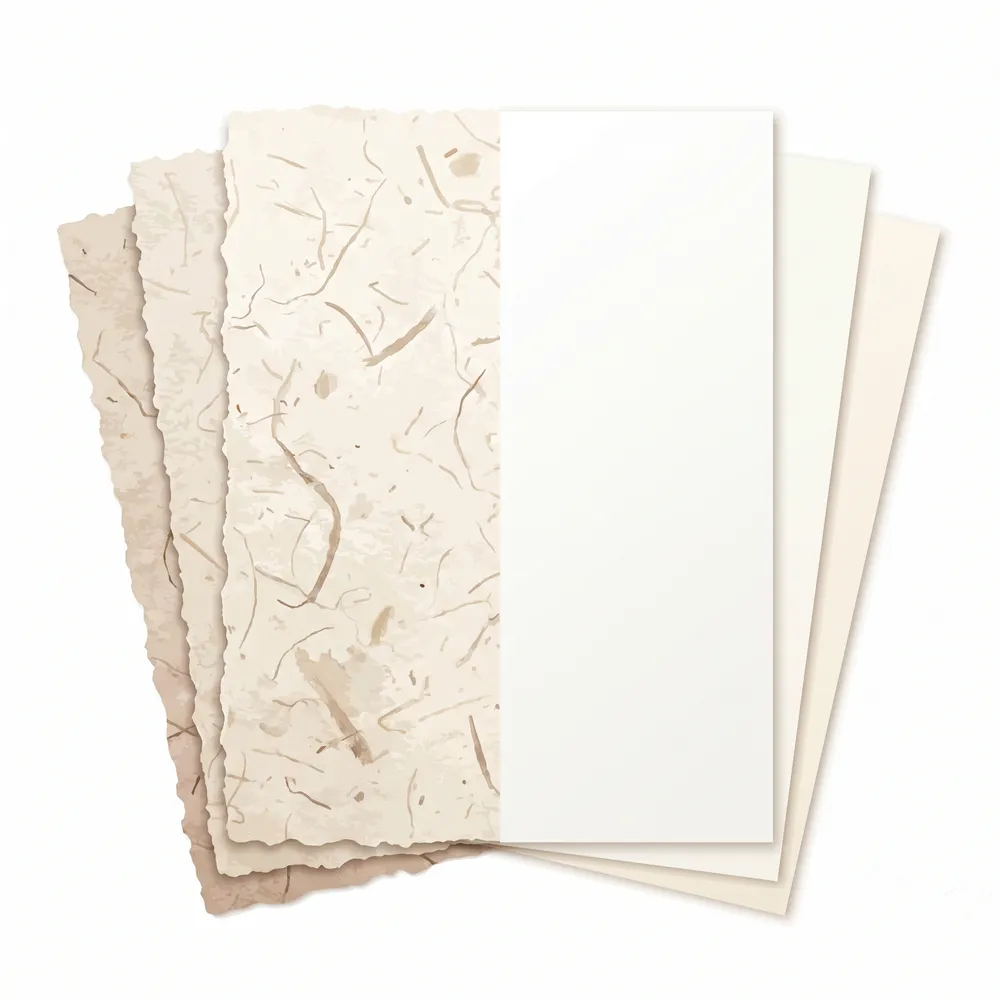
Washi's appeal is the fibre — the soft, slightly uneven surface and the way light comes through it. That is also what makes wet ink creep sideways along the fibres, so the line thickens and the edges go fuzzy.
The same paper is excellent with a brush pen, which is what it was made for and which wants exactly that absorbency. It is the fountain pen that is the mismatch, not the paper that is at fault.
The alternative is what Japanese stationers call jōshitsushi — fine wove
paper. Smooth, closely made, no show-through, and ink colour sits on top of it looking
like the colour in the bottle.
This is the paper the Japanese letter-writing tradition actually uses for long
letters, and it is what the fountain pen world knows Japan for.
"Japanese paper" and "washi" are not synonyms.
2. ⚠ Check which way the lines run
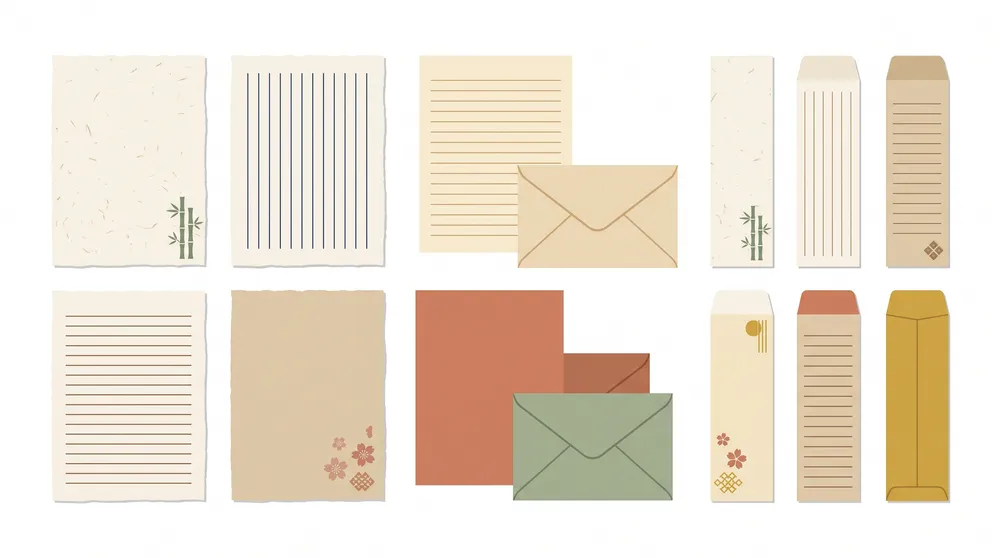
In Japanese, a formal letter is written vertically, top to bottom and right to left — so formal letter paper is ruled with vertical lines, and the envelope is addressed the same way.
You cannot write English on it as intended. Turning the sheet sideways works but
leaves the decorative border in the wrong place, and the envelope will still be laid out for
vertical addressing.
Product photographs make this genuinely hard to spot, because fine ruling
disappears at thumbnail size. Look for the words "horizontal ruled" or "blank", and if
the listing does not say, assume vertical on anything sold as formal.
Casual and seasonal designs are usually ruled horizontally — Japan writes horizontally in everyday life too. It is the formal, elegant, plain sets — precisely the ones you would choose for an important letter — that are most likely to be vertical.
Why Japanese — Echizen, Mino, and the Tomoe River Story
Two districts dominate washi for letters. Echizen in Fukui has been making paper for well over a millennium and is the source of the heavier, more formal sheets. Mino in Gifu makes a famously thin, even paper — the kind used in shoji screens, where consistency shows immediately when light passes through it.
What you are buying is the fibre. Washi uses long bast fibres — kozo, mitsumata, gampi — rather than the short wood fibres of Western paper, which is why a sheet can be thin and still strong, and why the surface has that faint irregularity.
And then there is the other Japanese paper
Tomoe River is a machine-made wove paper, and for about fifteen years it has been the most admired writing paper in the world among people who use fountain pens. It is 52 gsm — thinner than airmail paper — and yet takes a soaking wet nib without bleeding through.
The part everyone in the hobby lived through
Tomoegawa launched the paper in 1981. In spring 2019 the company announced it
was retiring the specific machine that made it and moving production to another — and users
immediately reported that the paper had changed.
Then in 2021 Tomoegawa stopped making it altogether, and there was a period of
genuine hoarding.
It was saved: Sanzen bought the formula and the name, and restarted production,
refining the recipe in 2024 and again in 2025.
Which is why you will see "Tomoe River" and "Tomoe River S" sold side by side,
sometimes with the milling year stated. Both are good. They are not identical, and the
hobby will argue about it indefinitely.
What to Buy
A Tomoe River writing pad — the answer to both problems at once
Blank sheets, so the ruling question disappears — and it comes with a
double-sided guide sheet, 6 mm graph on one side and 12 mm lines on the other, that
you slide underneath and write over. You can rule it in whichever direction you
want.
A pad of 200 sheets is a lot of letters, and at this price it is also the
cheapest way to find out whether you like the paper.
- Paper
- Tomoe River / Tomoe River S, 52 gsm
- Size
- A5, 200 sheets
- Ruling
- Blank + underlay guide sheet
- Price
- About $25
⚠ One honest caveat: ink dries slowly on it. The surface is so smooth and so unabsorbent that wet ink sits on top for several seconds. Left-handed writers and anyone who moves quickly down a page will smudge it — which is the trade for that perfect colour.
A washi letter pad — for a brush pen, or for the look
Buy this because you want the paper to be beautiful, not because you want it
to be technically excellent under a fountain pen. Seasonal designs, visible fibre, sometimes
a watermark that only shows against a window.
Pair it with a brush pen or a ballpoint and it is a genuine pleasure. Pair
it with a broad wet nib and you will be disappointed, through no fault of the paper.
- Paper
- Washi, often Echizen or Mino
- Best with
- Brush pen, ballpoint, pencil
- Fountain pen
- Test a sheet first
- Check
- Ruling direction before buying
Two Japanese stationers worth knowing that we could not find an international route
to: Kyukyodo, which has been selling paper and incense in Kyoto since the 17th century
and has shops across Tokyo, and Masuya, whose cream writing paper is a fountain-pen institution
in Japan.
Both are straightforward to buy from in person and neither ships to you, so
note them for a trip rather than searching for them now.
The Ippitsusen: One Line Is Enough
An ippitsusen is a small pad — roughly a third of a sheet of A5 — for writing a single sentence. It has no Western equivalent as a product category, and it is the most useful thing in this article.
It exists because a full letter is a commitment. Sitting down to write a page to thank someone for lunch is disproportionate, so most people write nothing. An ippitsusen is small enough that one line fills it, which removes the obligation to say more.
You tuck it into a parcel, hand it over with a returned book, or leave it on a desk. It is the format, not the sentiment, that makes it easy.
It is also the cheapest way into this whole category — a pad costs a few dollars, the designs are seasonal and often lovely, and the ruling is nearly always horizontal because it is an everyday item rather than a formal one.
Writing and Storing It
- Test every new paper with your actual pen before writing the letter. One sheet, one line, both sides — feathering and show-through are immediately obvious and completely unpredictable from a photograph.
- Use a guide sheet under blank paper. This is standard practice in Japan and it is why so much good letter paper is sold unruled: you supply the lines, in your direction.
- Cream paper flatters most ink and is easier on the eye than bright white, which is why so much Japanese writing paper is cream rather than white.
- Let it dry longer than feels necessary on smooth paper before folding. Fold too soon and you print the letter onto its own facing page.
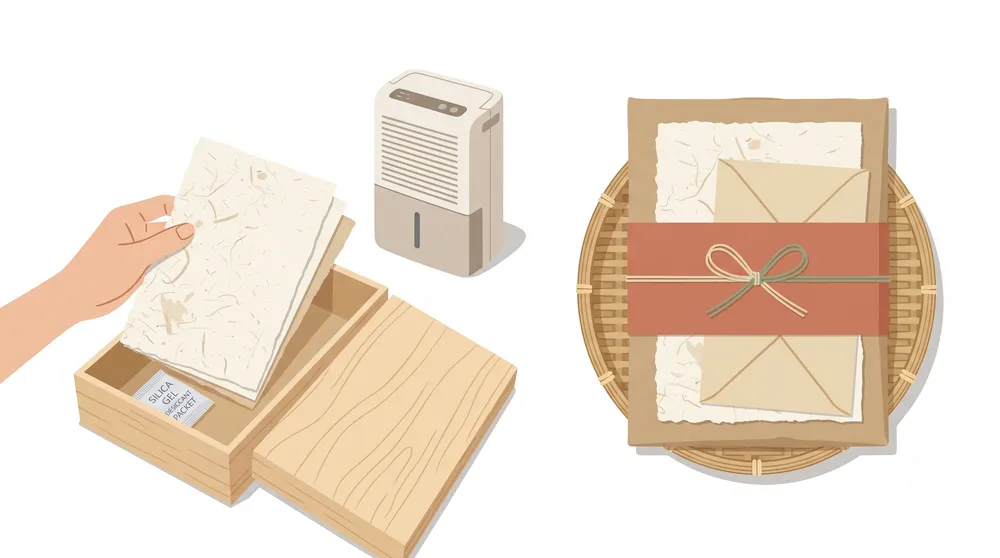
- Store it flat, away from light. Washi yellows in sunlight and any paper cockles in a humid room — a flat drawer or the box it arrived in is right.
- Buy the envelopes at the same time. Matching envelopes sell out separately and the sizes are not standardised across makers.
Frequently Asked Questions
Can I use a fountain pen on washi?
Sometimes, and you have to test it. Smooth, densely made washi is fine; anything
with visible surface texture will spread a wet line and soften the edges.
A fine nib and a drier ink help considerably — the problem is volume of ink, so
an EF nib on washi behaves far better than a broad one.
Is vertical or horizontal writing more formal?
Vertical is the formal convention in Japanese — for letters to seniors, thank-you
notes and anything ceremonial. Horizontal is normal for casual correspondence.
None of this applies to a letter written in English, so buy horizontal or blank
and do not worry about it.
What is the difference between Tomoe River and Tomoe River S?
The maker. The original was made by Tomoegawa, which stopped production in 2021;
Sanzen bought the formula and name and now makes it, with the "S" designating their version.
Both are excellent and they are not identical — the current Sanzen paper has
been refined twice since 2024, and opinions in the hobby remain lively.
Why is the paper so thin?
Because it can be. Long bast fibres in washi and a very dense making in Tomoe
River both allow strength at low weight, and a 52 gsm sheet that does not bleed is a genuine
technical achievement.
Practically, thin paper means a longer letter for the same postage — which is
why airmail paper was always thin.
What is an ippitsusen for?
A single sentence. It is a small note pad for the thank-you or the explanation
that does not justify a whole letter.
The size is the point — it removes any expectation that you write more, which is
exactly what stops most people writing anything.
Where should I buy Japanese letter paper?
Specialist Japanese stationery retailers, which are unusually good in English.
They list paper weight, ruling and fountain-pen suitability, which general marketplaces do not.
That information is the whole difficulty with this category, so paying a little
more at a shop that states it is worth doing.
Final Thoughts: Two Papers, One Country
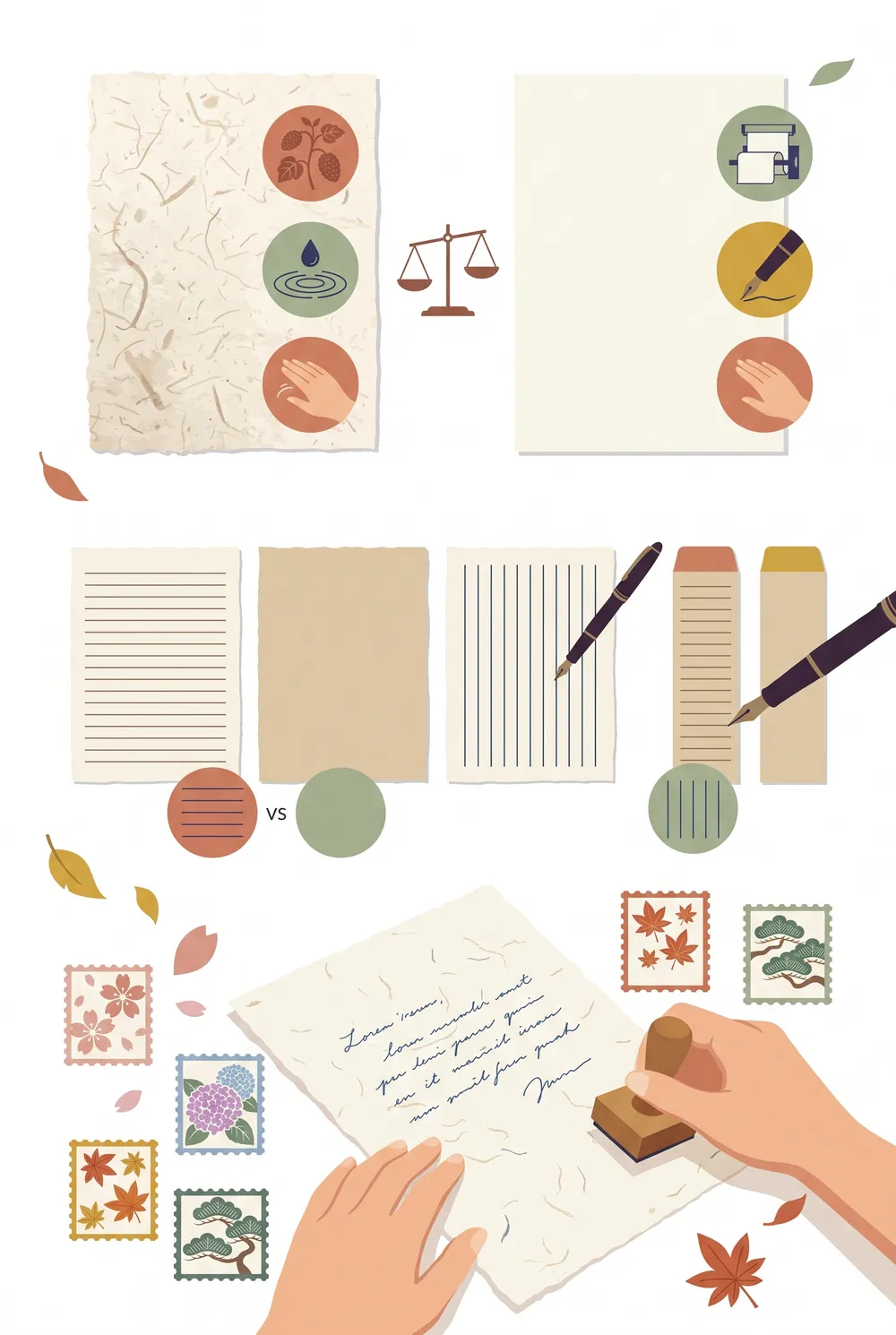
Japan makes the most fibrous, characterful writing paper in the world and also the smoothest, most ink-perfect one, and the confusion between the two is responsible for most disappointing purchases in this category.
Choose by the pen in your hand, and check which way the lines run. Those two checks are the entire skill.
And if you are not sure, buy an ippitsusen. It costs almost nothing, it holds one sentence, and one sentence sent beats a beautiful letter never written.
Japanese Fountain Pens: Finding Your Perfect Gold Nib
Japanese Fountain Pen Inks: Iroshizuku, Shikiori Reviewed