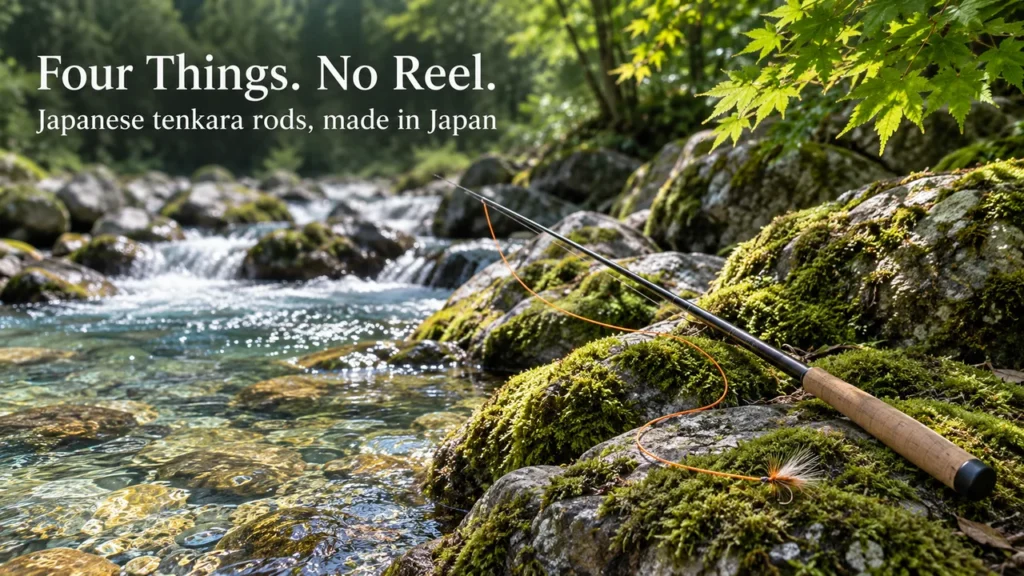
Tenkara takes four things — a rod, a line, a tippet, and a fly — and no reel. If you want a rod actually made in Japan, one maker states it on its own site: Nissin, in Tamba, Hyogo, which runs one of Japan's few in-house domestic rod production lines and fires its own carbon in its own kilns.
It is a way of fishing handed down in Japan's mountains: tie a single fly to the end of the line and fish a mountain stream with nothing else. Collapsed, the rod is 57 cm (about 22 in) — short enough to slide down the side of a backpack.
And the word needs no translation any more. "Tenkara" has become an established genre name within English-language fly fishing. This guide covers how to choose rod length, how line and fly work together, Nissin's rods, and what to check before you step into a river. It doesn't teach casting.
Quick Reference: The Four Things Tenkara Needs
| Item | What it does | Starting point |
|---|---|---|
| Rod | Almost everything | 3.0–3.6 m (about 10–12 ft) |
| Line | Its weight carries the fly | Fluorocarbon level line |
| Tippet | Joins line and fly | Around Japanese size 0.8 |
| Fly (kebari) | Instead of bait | A few is enough |
| Reel | — | Not used |
| Before the river | Check the local fishing permit and season (section 7) | |
1. Four Things, and No Reel
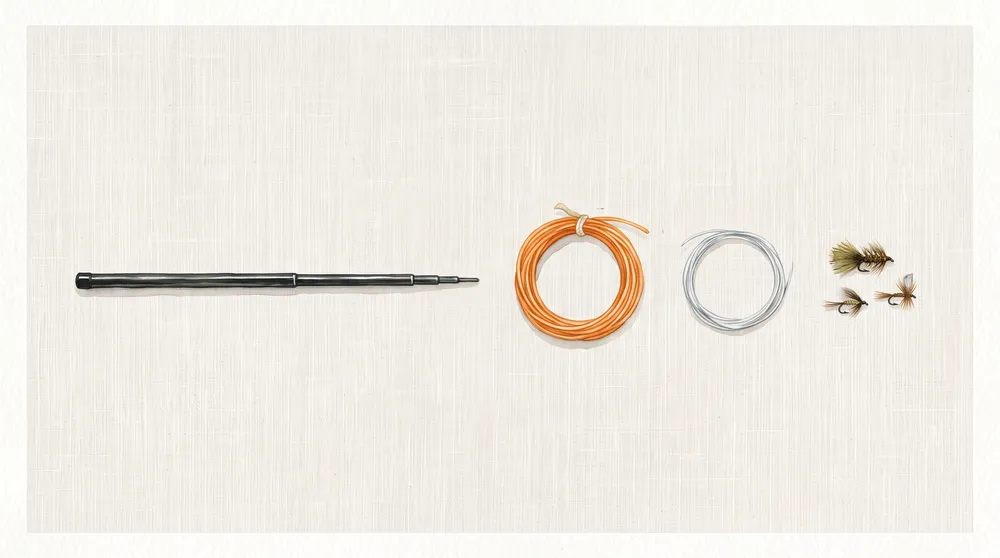
Most people who want to start fishing stall on the gear: rod, reel, line, rigs, lures, weights. You're tired before you begin. Tenkara is completely different. A rod, a line, a tippet, and a fly — that's the whole system. Tie the line to the rod tip and a fly to the end of the line, and you're done.
What changes without a reel
Lightness, first. With no reel there's no weight at your hand, so the whole rod is lighter and your arm still works at the end of the day. Less to learn, second. There's no line to wind in, so the gear itself rarely gets in your way: the line length is set from the start, and the rest is cast, drift, set the hook. The trade-off is reach: you can only fish as far as rod plus line. It isn't about casting far, but about working the water in front of you carefully.
The line does the job of a weight
A fly weighs almost nothing, so how does it fly? The line's own weight carries it. That's why tenkara lines are thicker and stiffer than ordinary fishing line. The standard is a fluorocarbon level line of uniform thickness. A heavier line casts more easily; a lighter one drifts less in the wind — so once you're comfortable, you can change the feel without changing rods.
2. Why Japanese: Made in Tamba, Hyogo
From bamboo, and still fired in its own kilns
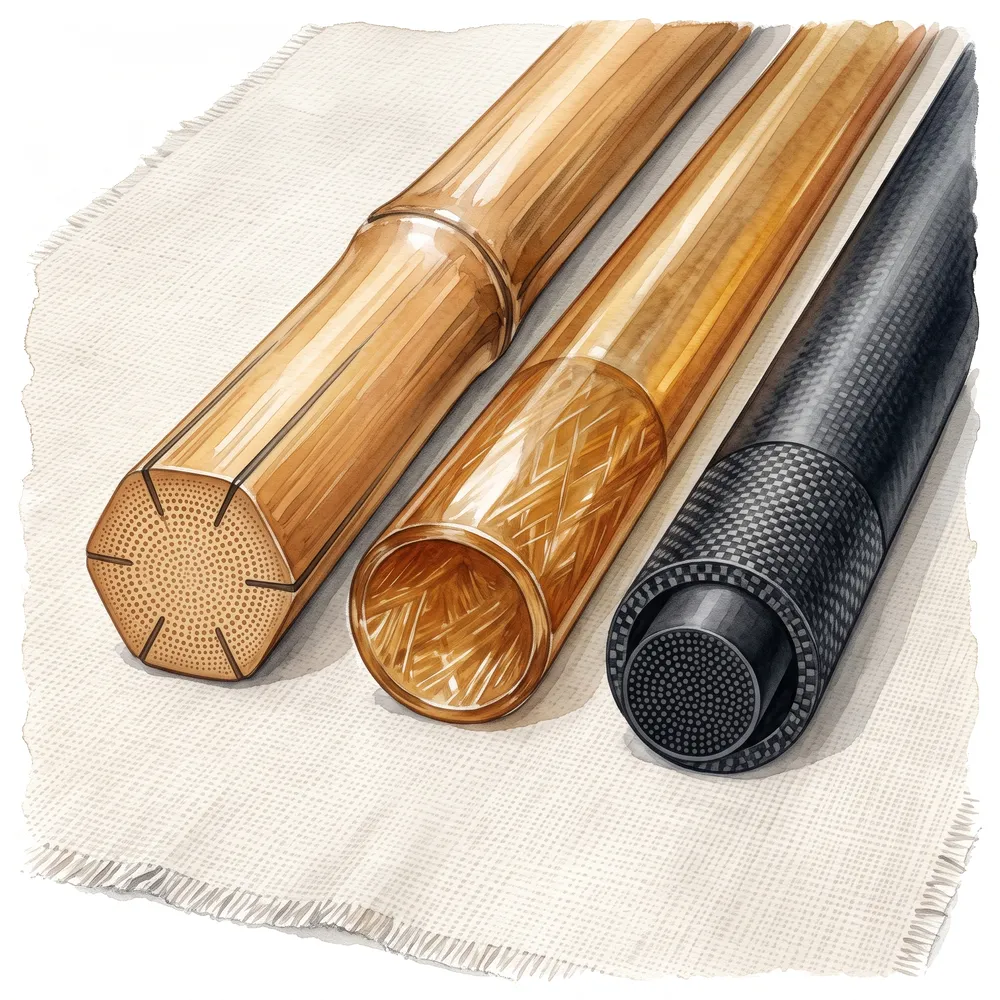
One maker of tenkara rods is Nissin (Uzaki Nissin) in Tamba, Hyogo Prefecture, founded in 1948. It began with bamboo rods, moved through fibreglass, and now makes carbon rods.
Its own site says it is "based on production in Japan," runs "one of Japan's few in-house, integrated domestic production lines for rods," and is "a manufacturer with its own kilns." Carbon rods are cured in a kiln, so whether a maker owns that kiln goes to the root of how its rods are made. Nissin offers more than ten tenkara models alone, from starter rods to big-river rods, made in the same factory.
A Japanese brand name doesn't say where a rod was made
Worth remembering: a brand name tells you who sells a rod, not where that particular rod was made. If you're looking for a rod made in Japan, look for the maker's own statement about its production — on its official site, not in a retailer's description.
3. Rod Length: Start at 3.0–3.6 m, Packs to 57 cm
If in doubt, 3.6 m — shorter if the trees are close
Tenkara rods run roughly from 3.0 to 4.5 m (about 10 to 15 ft). For a first rod, 3.0–3.6 m (about 10–12 ft) is easiest to handle. Longer reaches farther water; shorter is easier to swing. Mountain streams often have branches right overhead, so in a tight creek, shorter is right; on an open river, longer wins. Some rods change length — extending the handle section to switch between, say, 3.1 m and 3.6 m — which solves the problem when you can't decide which water you'll fish.
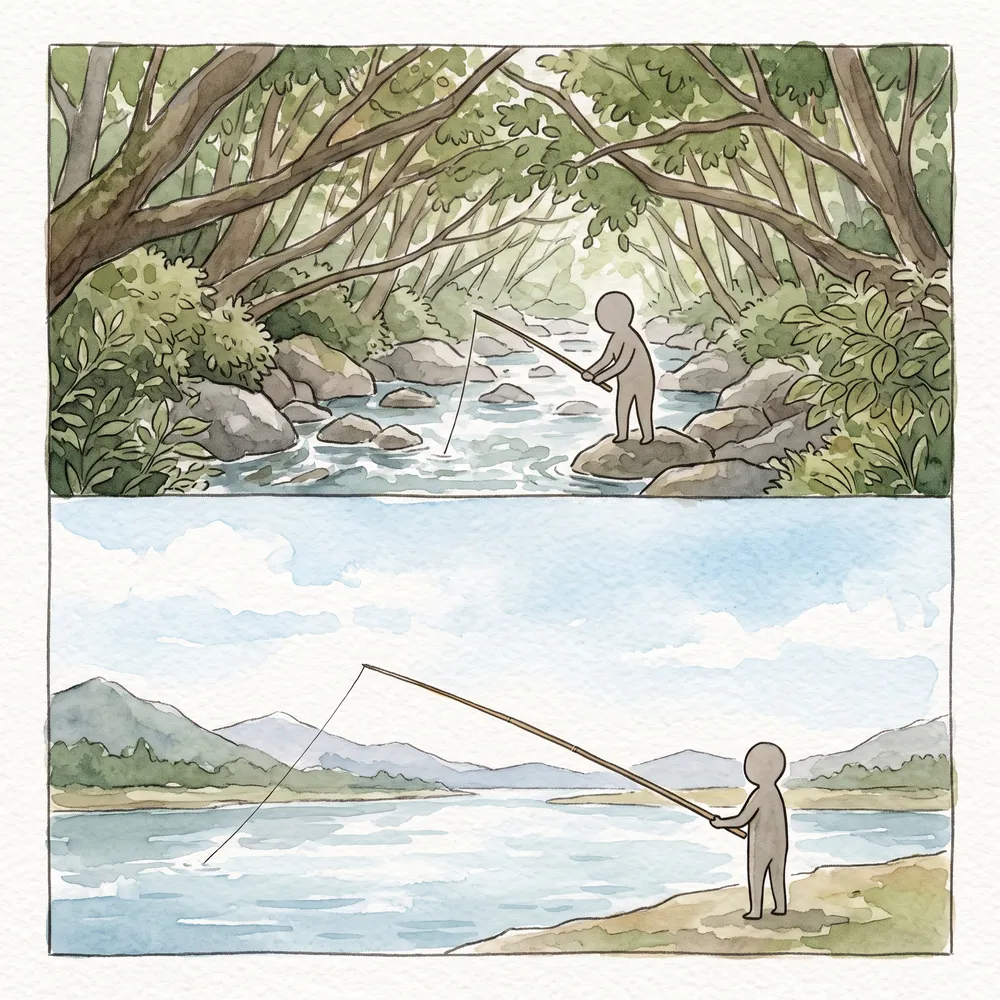
Look at the collapsed length
Tenkara rods are telescopic: extend to fish, collapse to carry. Nissin's starter set collapses to 57 cm (about 22 in) whether the rod is 3.15 m or 3.60 m, and weighs 60–65 g — lighter than a bottle of water. For anyone who walks into the mountains, that matters: take a train, hike up a creek, and fish, all with a rod down the side of your pack.
4. "Tenkara" Crossed the Ocean and Grew Differently
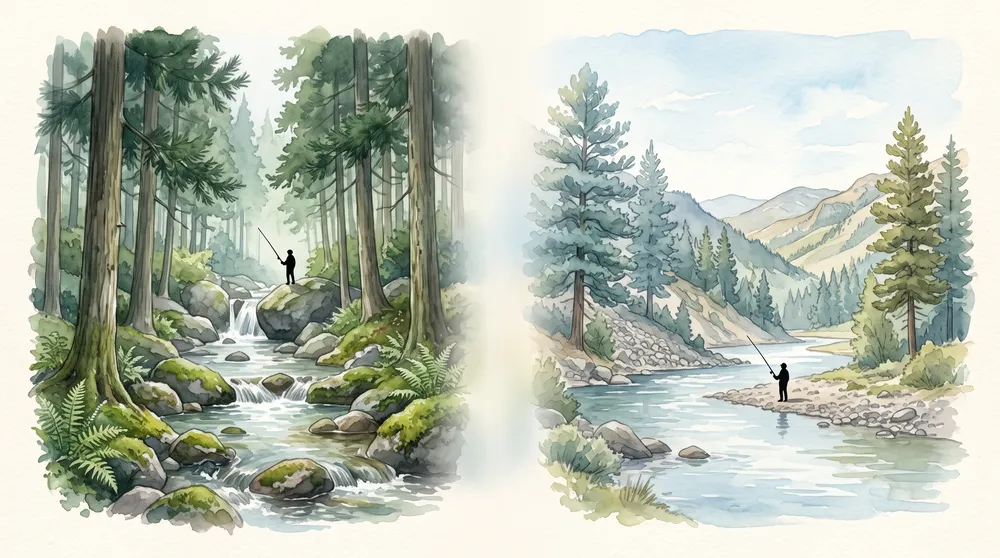
Tenkara began as the fishing of people who lived in Japan's mountains — a way to catch river fish without the trouble of bait, closer to a livelihood than a pastime. Now it's understood abroad under its own name. What caught on was probably how little it needs: no reel, no fly line, just a rod, line, and fly. It was reread as a way of stripping gear down. Something that began as a working skill in Japan was received elsewhere as minimalism — the same tools, a completely different way in.
5. Nissin Picks by Use
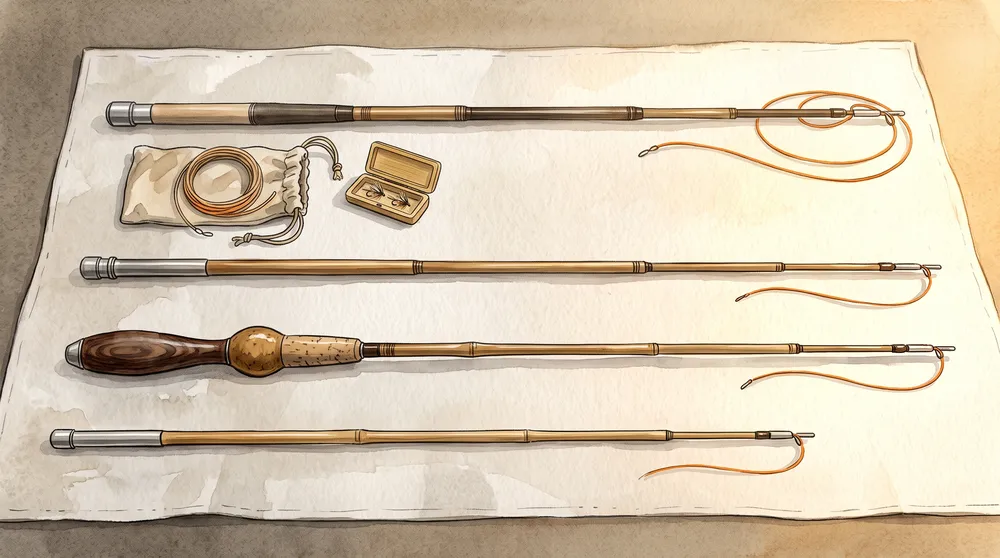
The most important thing about a first rod is not to agonise over it. Start with a set that includes rod, line, and flies, and you can be on the water the day it arrives.
The first kit: Nissin Tenkara Starter Set
On the water the day it arrives. The rod, a pre-rigged line set with a fly, three spare flies, and a fly case — all four essentials. Even if you don't know the knots, the rig comes assembled. Two lengths: 3.15 m (60 g) and 3.60 m (65 g), both collapsing to 57 cm. If your stream is tight, take the shorter; if it's open, the longer.
Nissin Tenkara Starter Set, 3.60 m
Loading product details…
The standard rod: Nissin ZEROSUM Tenkara
Pick a length and build from there. Offered at 3.2, 3.6, 4.05, and 4.5 m, so you can match the river you fish. Rod only, so you choose your own line and flies. It also works as a second rod: once the set has taught you the feel and you know your water, add one at the right length.
Nissin ZEROSUM Tenkara 6:4, 3.6 m
Loading product details…
Two lengths in one: Nissin PRO SPEC 2WAY Tenkara
For when you can't decide which water you'll fish. A zoom rod switching between 3.1 m and 3.6 m — one rod covers a stream that starts tight and opens out. A gourd-shaped cork grip sits well in the hand, so changing length doesn't change how you hold it.
Nissin PRO SPEC 2WAY Tenkara 6:4, 3.6 m
Loading product details…
Small creeks and carrying: Nissin TENKARA MINI
For streams with branches overhead. Near the headwaters there's no room to swing a long rod; a short one is far easier, picking through each plunge pool while dodging the trees. Also for anyone cutting weight — one to slip in the pack on a hike.
Nissin TENKARA MINI 3620
Loading product details…
Flies, line, and tippet
A few flies are enough to start — a commercial set will get you through a day. Types include floating flies, standard kebari, the distinctive sakasa kebari (reverse-hackle fly, with hackle facing forward), and bangasa kebari. Some are hand-tied by craftspeople, and many anglers end up tying their own. Line and tippet are consumables: fluorocarbon level line of uniform thickness, and tippet around Japanese size 0.8. You'll lose both to snags and branches, so carry spares — and try changing line weight before buying another rod.
6. Before You Step Into a River
Wherever you fish, the local permit and season come before the gear. Rules differ by country, region, and river.
- If you fish in Japan: many mountain streams are managed by local fishing cooperatives, which stock the fish and maintain the river. Fishing them requires a fishing ticket (yugyoken), often sold at nearby tackle shops, convenience stores, or riverside shops, as day or annual tickets — and increasingly by smartphone. There's also a season, because stream fish have a spawning period. Dates and prices differ by river and change by year, so check the cooperative's notice for that river, that year.
- If you fish at home: check your own local fishing licence and season rules before you go.
It can feel like a chore, but these systems are why there are fish in the river. Buying a ticket is sharing the cost of keeping that river alive.
7. Buying From Outside Japan
Nissin's site is in Japanese, and we could not find an English site or any mention of international shipping when we checked in October 2026. We'd rather say so than guess.
- Check the maker, not just the word "tenkara." Look for the Nissin name and model (Starter Set, ZEROSUM, PRO SPEC 2WAY, TENKARA MINI).
- If you're fishing in Japan, tackle shops near mountain streams are the natural place to buy — and to buy your fishing ticket.
We will add listings you can buy from abroad here as we confirm them, one product at a time.
8. Frequently Asked Questions
Do you really not need a reel?
No reel. The line ties to the rod tip, with tippet and fly beyond it. The line length is fixed from the start and nothing winds in. That limits you to the reach of rod plus line — it's for working the water in front of you, not for casting far.
What rod length should I get?
3.0–3.6 m (about 10–12 ft) for a first rod; if in doubt, 3.6 m. In a tight creek under branches, shorter swings more easily; on open water, longer reaches farther. If you can't decide, a zoom rod changes length in one.
How do I know whether a fishing rod is made in Japan?
Look at the maker's own statement of where it produces. A brand name alone doesn't tell you. Nissin, for example, states on its official site that it is based on production in Japan and runs an in-house domestic production line. Check what the maker writes, not a retailer's description.
How many flies do I need?
A few to start — a commercial set is enough for a day. Collect more types once you know what you want to change. Flies get lost easily, so spares come first.
What line and tippet should I use?
A fluorocarbon level line and tippet around Japanese size 0.8. Heavier line casts more easily; lighter line drifts less in wind. Both are consumables — carry spares.
Do I need a permit to fish tenkara in Japan?
On many streams, yes — a fishing ticket from the local cooperative, often sold at tackle shops, convenience stores, or riverside shops, or online. There's also a closed season. Rules and prices differ by river and year, so check that river's current notice before you go.
Final Thoughts: One Rod, Down the Side of Your Pack
Tenkara needs four things: a rod, a line, a tippet, and a fly. No reel means less weight and less to learn.
Start at 3.0–3.6 m — shorter under trees, longer on open water. Collapsed to 57 cm and weighing around 60 g, it rides in a backpack.
Nissin in Tamba, Hyogo began with bamboo in 1948 and still fires its carbon in its own kilns on a domestic production line. To find a rod made in Japan, read the maker's own statement, not the brand name. And before the gear, check the river: its permit and its season are why the fish are there.
Japanese Fishing Brands for Beginners
Japanese Fishing Reels: Do You Need the JDM One?