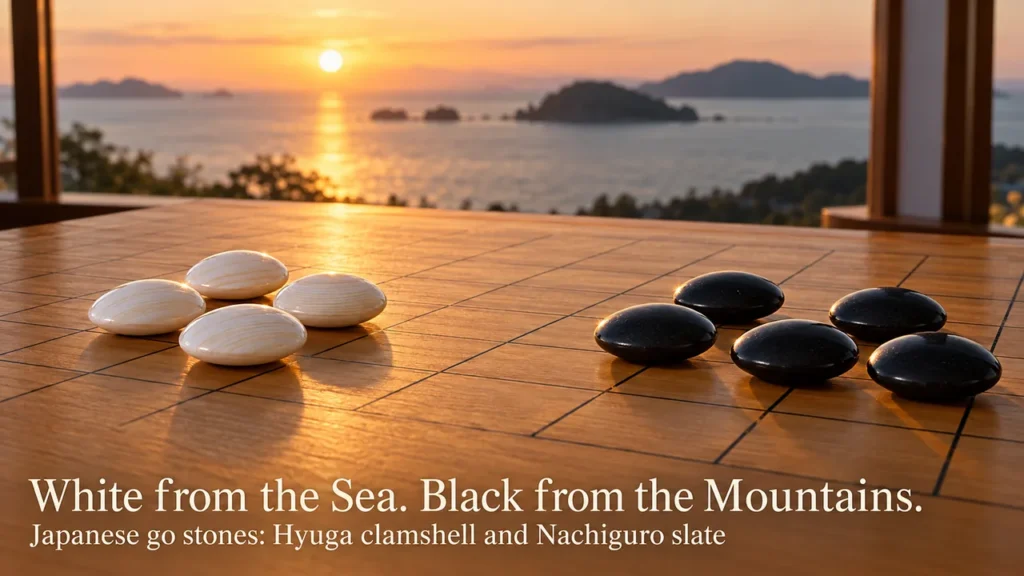
The white and black stones in a Japanese go set come from completely different places: white from clamshell cut and polished in Hyuga, Miyazaki, and black from Nachiguro slate quarried in Kumano, Mie. On one board, the sea off Kyushu faces the mountains of the Kii Peninsula.
Price isn't set by thickness alone. The grade depends on how fine the striations in the shell are, and thickness moves on a separate scale. So a thicker stone isn't necessarily a better one.
And there's one detail worth knowing before you buy: "Hyuga tokusei" and "Hyuga tokusan" differ by one character, and that character tells you where the clam came from. The maker writes it that way on purpose. This guide covers grades, sizes, go bowls (goke), and the 24 steps every one of a set's 361 stones goes through.
Quick Reference: The Two Scales That Decide a Set of Go Stones
| What to look at | Steps | What changes |
|---|---|---|
| Grade (striations) ▾ | Jitsuyo → Tsuki → Yuki | How fine the shell's stripes are. Thickness stays the same |
| Size number (thickness) ▾ | No. 22 → 25 → 28 | 6.3 mm → 7.0 mm → 7.5 mm |
| Label ▾ | Hyuga tokusei / Hyuga tokusan | Where the clam came from — the maker labels it |
| Go bowls ▾ | Large / extra large / XXL | The stone size decides the bowl size |
| Remember | Grade and thickness are separate scales. Decide each one on its own. | |
1. Why Japanese: White From the Sea, Black From the Mountains
The black stones come from a 4 km band
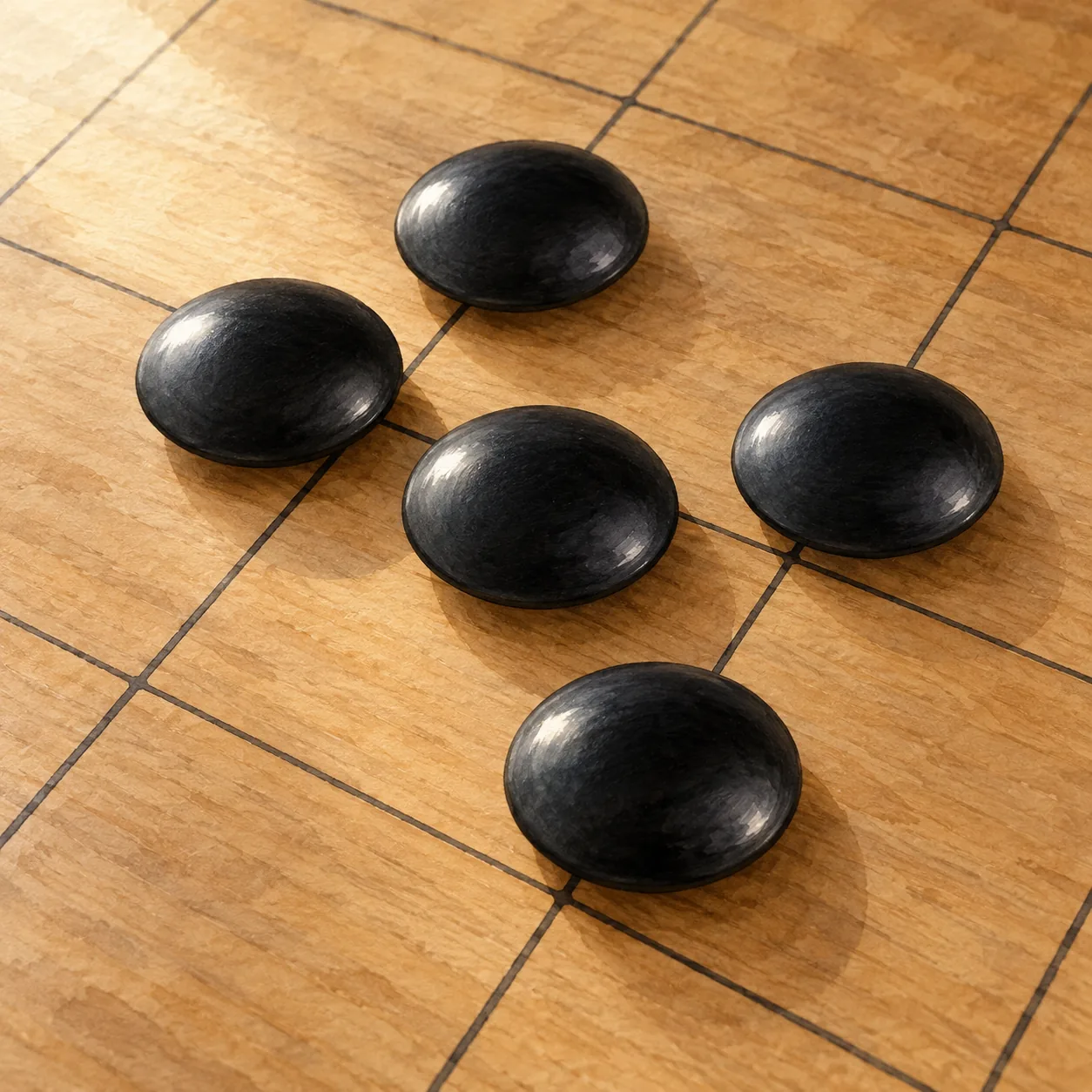
The black stones are Nachiguro stone. According to the Mie Prefectural Museum, Kamikawa in Kumano City, Mie, is the only place in Japan where it is found, and the deposit is narrow: from the Konokami settlement to Okawara, roughly 4 km east to west. It is an extremely dense sedimentary shale, designated a traditional craft of Mie Prefecture.
Most black go stones are made from it. It has also been used for inkstones, paperweights, and touchstones, and there is a story that Japanese envoys to Tang China took go stones with them as gifts.
The white stones are cut from clamshell
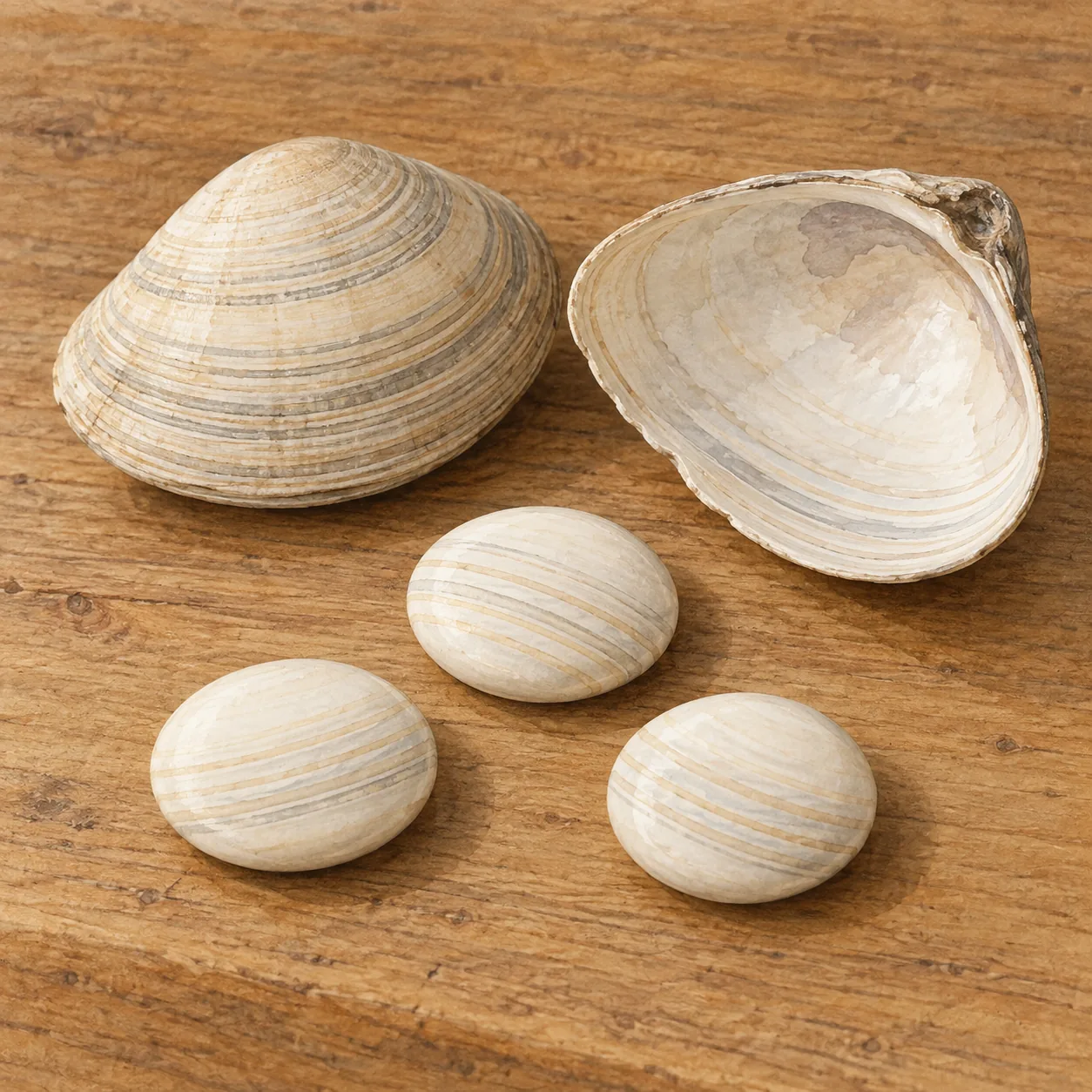
The white stones are clamshell (hamaguri). Thick shells are chosen, cut into discs, ground, and polished — work done in Hyuga, Miyazaki, known for go stones. Because they are shell, not stone, every one has a different pattern: the growth lines of the shell show as stripes, and those stripes are what decide the grade later on. A stone dug from a mountain and a shell taken from the sea, cut to the same size and set on the same board.
Why there's one more black stone than white
A set is 180 white and 181 black — 361 in total, matching the 19 × 19 = 361 points of a full board (as explained by the Nihon Ki-in). Black has one more because black plays first, so there are exactly enough to fill the board.
2. "Hyuga Tokusei" and "Hyuga Tokusan": One Character Apart
The maker draws the line itself
Kuroki Goishi, which has made go stones in Hyuga for about a century, states on its own site that clamshell stones labelled "Hyuga tokusei" (日向特製, "specially made in Hyuga") or "Gensen" use Mexican clam as the raw material, and that stones made from Hyuga clam are labelled "Hyuga tokusan" (日向特産, "Hyuga specialty").
Tokusei and tokusan — one character separates where the shell came from. It's easy to miss in a shop, but it is the maker who raised its hand first to make the distinction.
A shell chosen from the world's seas
Very few clams are left on Hyuga's beaches now, which is why stones labelled Hyuga tokusan are called "phantom" go stones. The demands on a go-stone shell are strict: it has to be thick, with even layers and fine stripes running through. The search for shells that meet them led to the seas off Mexico.
The shells cross the ocean, but it is Hyuga's craftspeople who cut them into discs, grind them, and polish them. What gives a go stone its value is the eye that selects the shell and the work that follows.
Read the label as written. Both are Hyuga work; the raw shell differs and so does the price. Neither is "better" — a set for regular play points to tokusei, a set matched to its region points to tokusan.
3. Same Thickness, Different Striations: The Grades
Go stone grades are called Yuki (snow), Tsuki (moon), and Jitsuyo (practical). The names don't make the order obvious, but the standard is how fine the striations run through the shell: finest is Yuki, fewest is Jitsuyo, Tsuki sits between. Stones are sorted on four criteria — shape, colour, striations, and flaws. Shells with very fine stripes are scarce, so Yuki is rare.
The key point is that grade has nothing to do with thickness. It's easier to see than to explain, so here are three sets of the same thickness with only the striations changed.
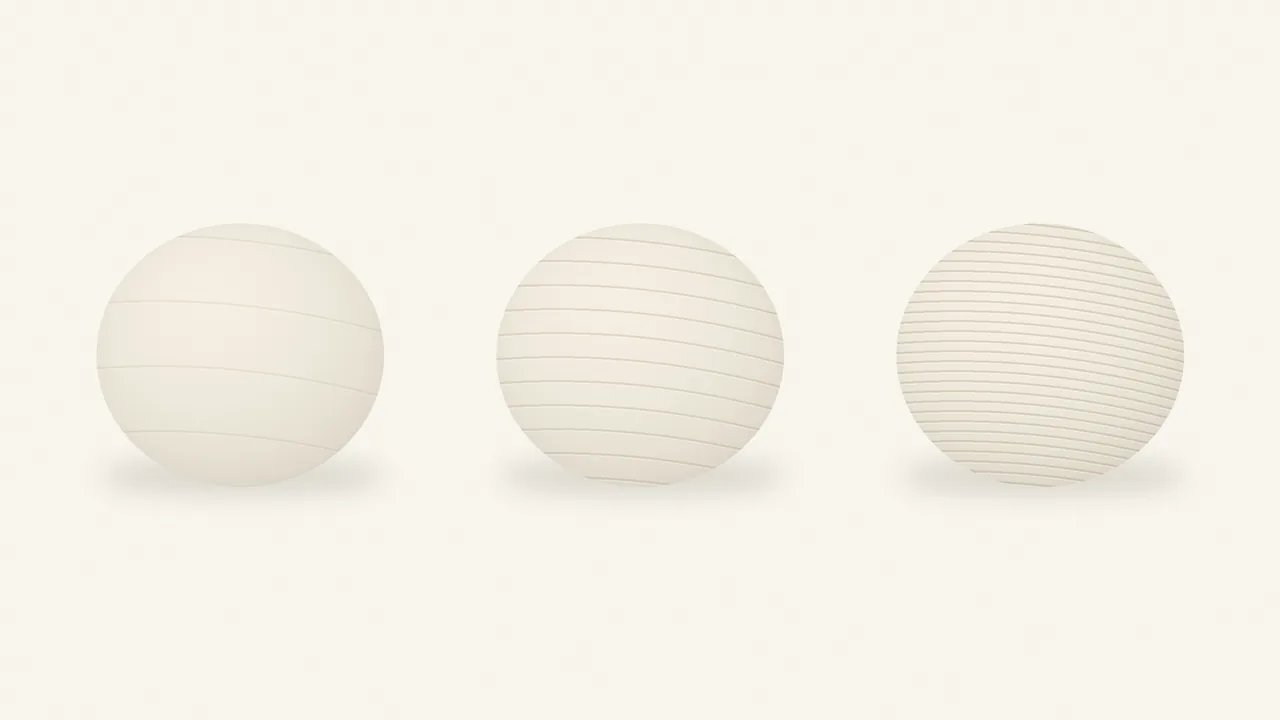
Hyuga tokusei clamshell, No. 22, Jitsuyo — the easiest set to start with
No. 22 is 6.3 mm thick; all three sets in this section share that thickness. Fewer stripes, but still shell — the cool feel between your fingers and the sound on the board are a different thing from plastic stones. Paired with Nachiguro black. The natural place to start a first set.
Hyuga tokusei clamshell, No. 22, Tsuki — more stripes, more character
Still 6.3 mm; only the striations have changed. Put Jitsuyo and Tsuki side by side and the density of lines inside the white is visibly different. Turn a stone over and no two are striped alike — each shell grew at its own pace. One step up from Jitsuyo, with the price rising gently.
Hyuga tokusei clamshell, No. 22, Yuki — the finest stripes
Also 6.3 mm, and yet more expensive — because of the striations. Yuki stones look packed with fine stripes, which is presumably why they're named for snow. For anyone who wants to raise the look of the stones without changing their thickness, and it's this scale that changes the board's appearance most.
All three are No. 22, 6.3 mm, and the price still moved. If you shop assuming "thicker means pricier," that difference makes no sense — because thickness and grade are separate scales. Next, the reverse.
4. Same Grade, Different Thickness: The Size Numbers
The number is the thickness
A go stone's number (gō) is its thickness: No. 22 is 6.3 mm, No. 25 is 7.0 mm, No. 28 is 7.5 mm, No. 30 is 8.0 mm. Thicker stones have more heft between the fingers, a lower sound on the board, and a different feel as you let go. The two sets below are both Tsuki grade, building on the No. 22 Tsuki above and changing only thickness.
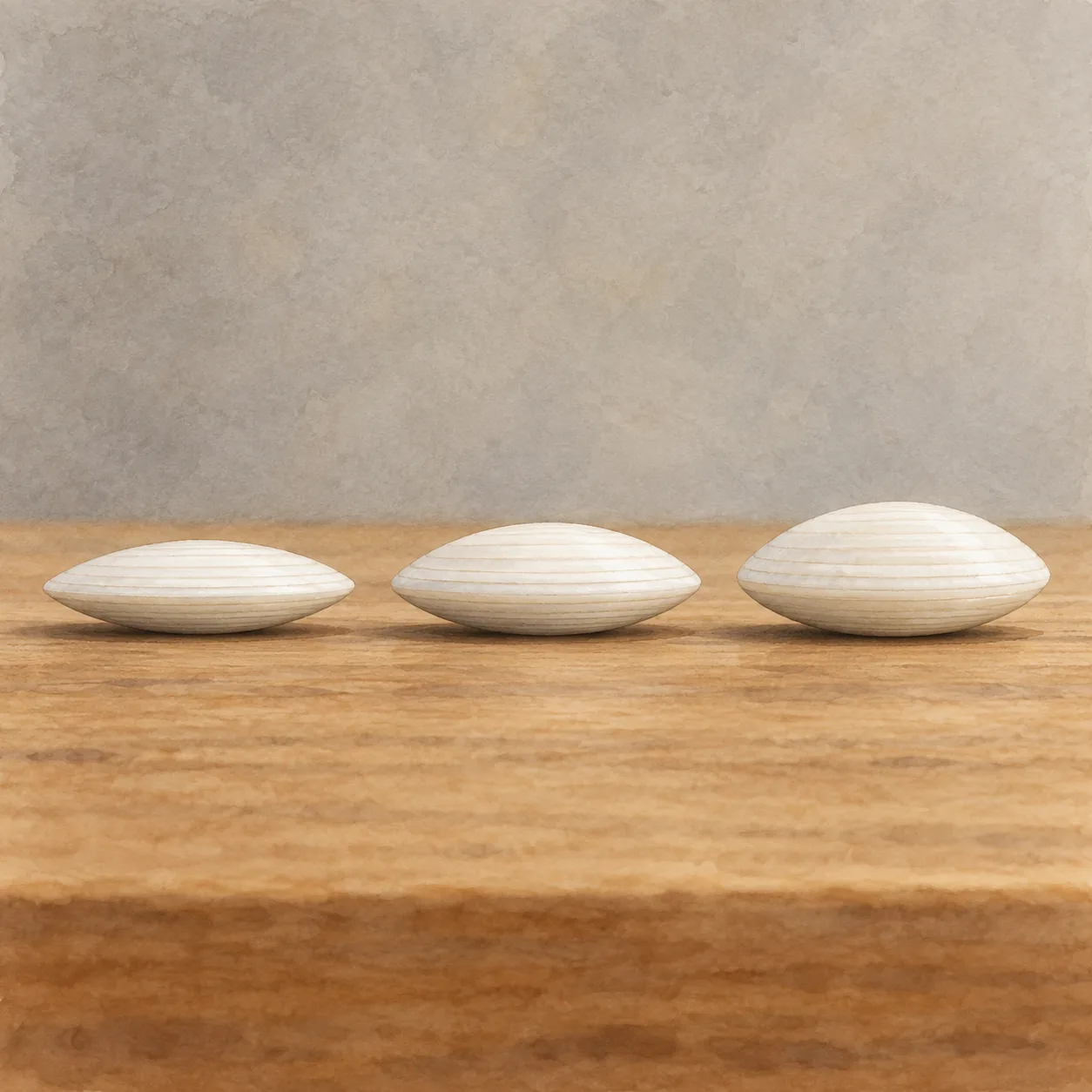
Hyuga tokusei clamshell, No. 25, Tsuki — 0.7 mm thicker
From 6.3 mm to 7.0 mm at the same grade. On paper it's 0.7 mm; in the fingers you can tell. You grip a little shallower and release from a little higher — over hundreds of moves a game, the difference stays with you. A good balance between practical thickness and the satisfaction of holding it.
Hyuga tokusei clamshell, No. 28, Tsuki — 7.5 mm, a different heft
Same grade, 7.5 mm — 1.2 mm thicker than No. 22. Thick stones can only be cut from thick shells, and those are limited, so the price rises for a different reason than it did with striations. The bowl you choose will need to fit this size.
So decide the two scales separately. You can keep No. 22 and go up to Yuki, or the reverse. Where to put the budget is a matter of how you like to play.
5. Go Bowls Follow the Stone Size
Go bowls (goke) are the wooden containers for the stones. Names like large, extra large, and XXL correspond to stone sizes, and listings often say things like "holds clamshell stones up to No. 30." Choose the stones first, and the bowl follows. Chestnut and cherry are common woods; chestnut has a bold grain, and the places your hand touches slowly darken with use.
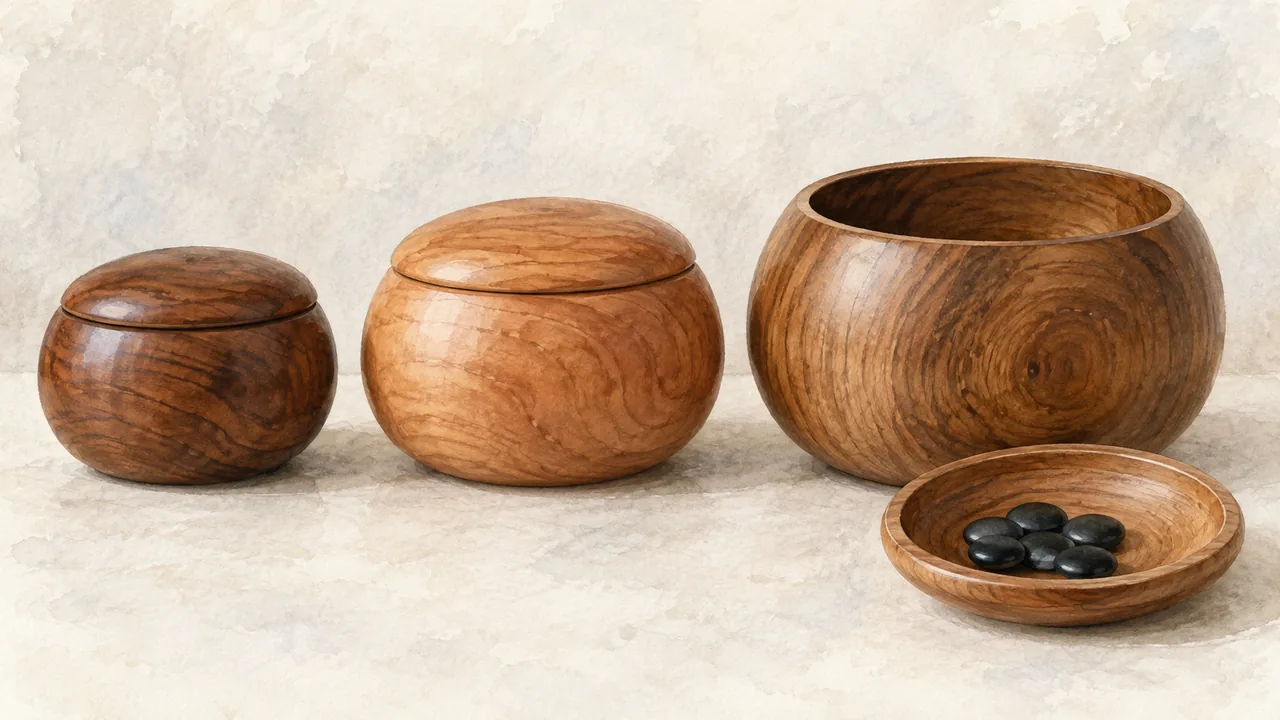
Chestnut go bowls, large — fits up to No. 30
Chestnut bowls sized for clamshell stones up to No. 30, so every set in this guide fits. Your fingers brush the rim every time you take a stone, and that's where the shine comes in.
Hand-turned chestnut go bowls by a certified traditional craftsperson
The same chestnut, turned on a lathe by a nationally certified traditional craftsperson and finished until the lid and body close perfectly. Like stone grades, the difference shows in how it sits in your hand, not in a big visual change. If you've invested in the stones, the bowls are worth matching.
6. 361 Stones, 24 Steps
Every stone passes through a craftsperson's hands
Kuroki Goishi describes how its stones are made: "over roughly three months and as many as 24 stages, every single stone is touched at least once by a craftsperson." A set is 361 stones, and every one has spent three months passing through 24 steps. The shell is sliced, cut into discs, brought to an even thickness, edged, and polished — and sorted on shape, colour, striations, and flaws. Miss on any one, and the stone leaves the set.
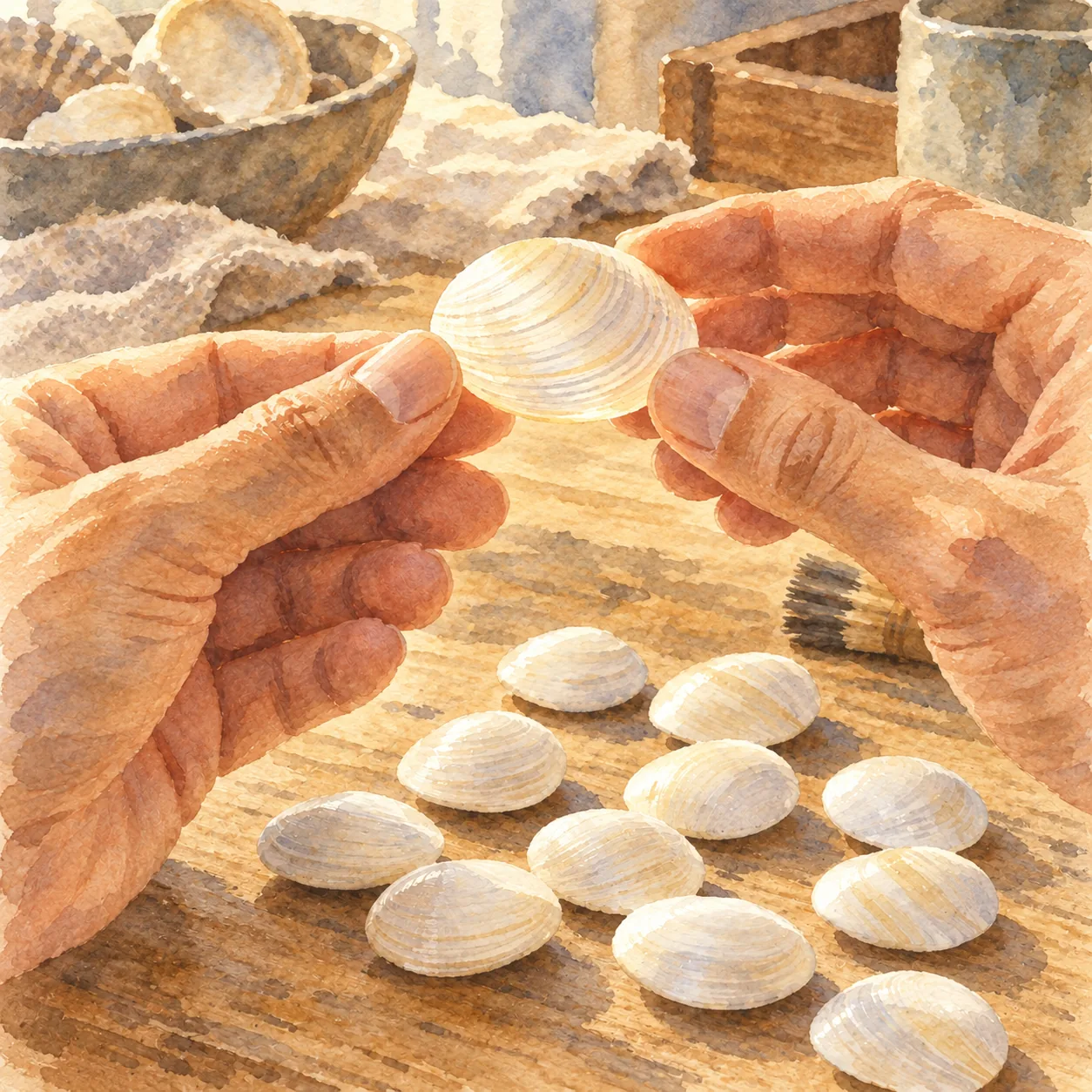
Care: a dry cloth is enough
Clamshell and Nachiguro both dislike moisture. After a game, wipe the stones with a dry cloth and return them to the bowls. In humid seasons, keep them somewhere airy rather than shut away, and away from direct sun and heater vents. With use, the white stones take on the oils of your hands and develop a sheen — they are not at their best on the day you buy them.
7. Buying From Outside Japan
Kuroki Goishi has an English page with its address in Hyuga and a link to its online shop for go stones, boards, and bowls. When we checked in October 2026, the page did not state international shipping, so contact the shop or check its checkout before ordering.
- Read the listing's terms literally. Look for the grade (Yuki, Tsuki, Jitsuyo), the size number (and its thickness in millimetres), and whether it says Hyuga tokusei or tokusan.
- Buy the bowls to match the stone size, not the other way round.
We will add listings you can buy from abroad here as we confirm them, one product at a time.
8. Frequently Asked Questions
"Hyuga tokusei" uses Mexican clam. Isn't it made in Japan?
The go stones are made in Hyuga. The raw shell comes from Mexico, and Hyuga's craftspeople cut, grind, and polish it — the search for shells that meet the requirements for go stones currently leads to the seas off Mexico. Stones made from Hyuga clam are labelled separately as "Hyuga tokusan."
What size should my first set be?
Around No. 22 (6.3 mm) to No. 25 (7.0 mm) is the usual starting range. Thicker stones feel more substantial but cost more and need bigger bowls. It's fine to start there and go thicker with a second set.
Do Yuki and Jitsuyo stones play differently?
At the same thickness, no — the grip and placement are the same. Grade is about the fineness of the shell's stripes, so what changes is the look. Change the size number to change the feel; change the grade to change the appearance.
Do I have to buy bowls with the stones?
No, but choose the stones first. Bowl size follows stone size, and listings usually say which sizes they hold ("up to No. 30," for example).
Can I buy extra black or white stones?
Specialist shops sometimes sell replacements, and Nachiguro black stones are sometimes sold individually. Clamshell white stones each have their own stripes, though, so added stones may look different alongside the originals.
Can I wash go stones in water?
Wipe them with a dry cloth instead. Clamshell and Nachiguro both dislike moisture; if needed, use a well-wrung cloth and dry them straight away. They develop a sheen from your hands over time, so don't over-polish.
Final Thoughts: Two Scales, Decided Separately
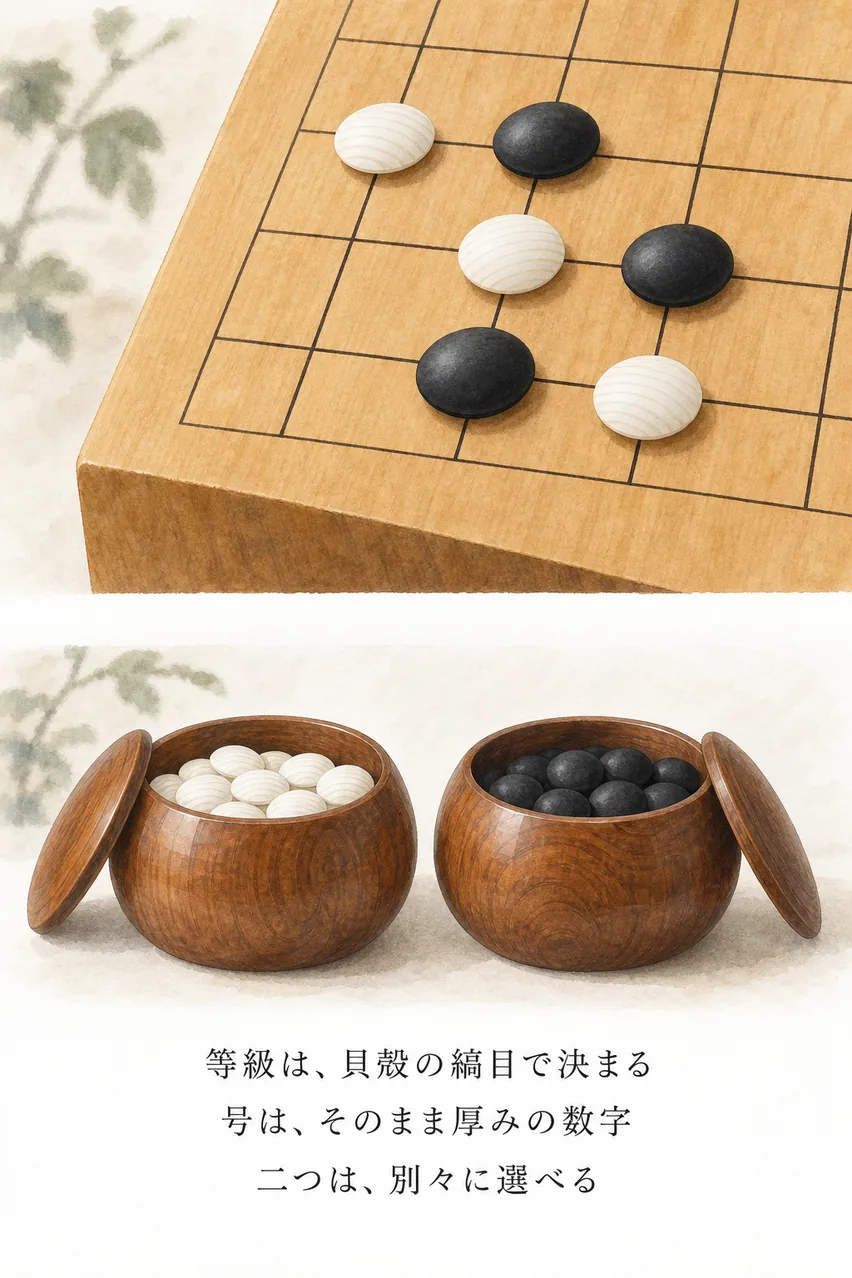
White and black come from different places: clamshell cut in Hyuga, Miyazaki, and Nachiguro stone from Kamikawa in Kumano, Mie — found, according to Mie Prefecture, only within about 4 km.
"Hyuga tokusei" and "Hyuga tokusan" differ by one character and by the source of the shell. Hyuga clams are now very scarce, so most shells are chosen from the world's seas and brought to Hyuga — and the maker labels the difference itself.
Two scales set the price: grade, the fineness of the shell's stripes (Yuki, Tsuki, Jitsuyo), and size, which is simply thickness (No. 22 is 6.3 mm). Each one moved the price on its own. Pick the stones, and the bowls follow. And every one of the 361 stones has passed through about three months and 24 steps, touched by hand at least once. Pick one up — its stripes won't match any other.
Shogi Boards and Pieces: Tendo, Hyuga Kaya, and What "Shin-Kaya" Means
Japanese Kendama: JKA-Certified Ozora and How to Choose