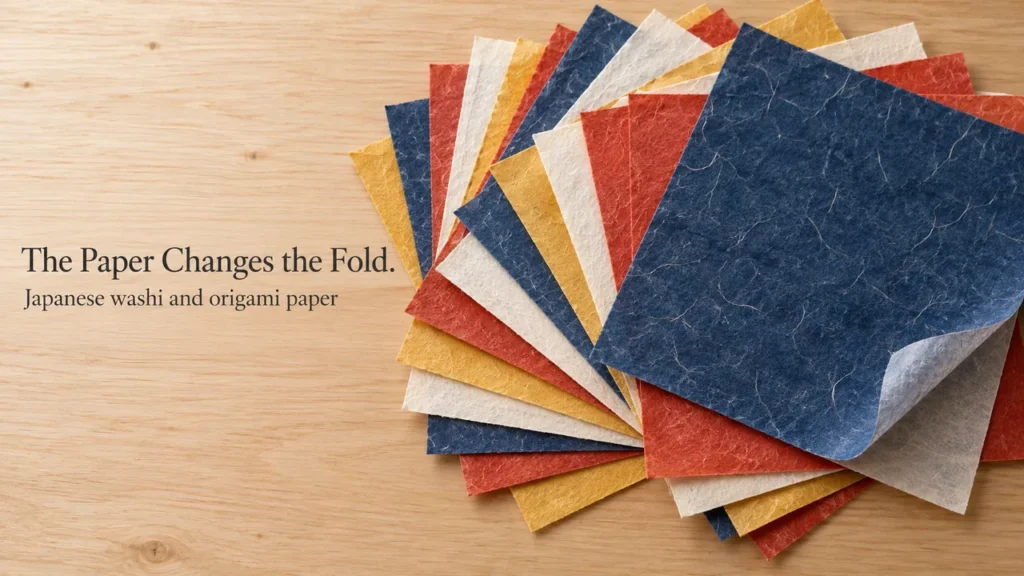
If your origami tears at the fine points or the corners never quite meet, the paper may be the problem, not your folding.
Origami paper looks like the same coloured square everywhere. It isn't. How the fibres are bonded, how precisely the sheets are cut, and how a pattern is printed each shape the finished model in a different way.
What makes Japanese origami paper interesting is that a different company has put its effort into each of those three things: one into the paper itself, one into cutting it true, one into printing patterns by hand. This guide introduces all three Japanese makers, then covers size (in centimetres and inches), thickness, and colour count.
Quick Reference: What You're Folding Decides the Paper
| What you're folding | The paper to use | Who makes it |
|---|---|---|
| Cranes, everyday models | Standard single-colour origami (kami) | Toyo (Tochigi) ▾ |
| Connected cranes, kusudama (crisp creases) | Mino washi origami | Furukawa Shiko (Gifu) ▾ |
| Boxes and envelopes (hold their shape) | Heavier washi | Furukawa Shiko (Gifu) ▾ |
| Showing a pattern, gifts | Chiyogami | Isetatsu (Tokyo) ▾ |
| Remember | Paper changes which models you can fold, not how good you are. | |
1. Not All Origami Paper Is the Same
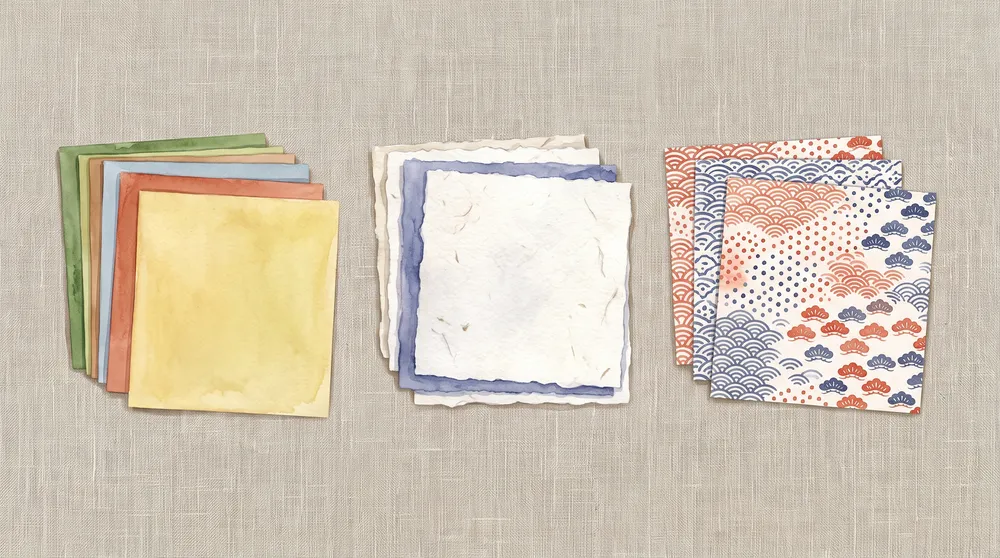
Origami paper falls into three broad kinds: single-colour paper (often called kami), washi origami paper, and patterned chiyogami.
- Single-colour paper is the familiar one. Lots of sheets, lots of colour choice. Best for models folded straightforwardly from one sheet, like a crane.
- Washi origami paper is built differently at the fibre level. It resists tearing and holds a crease sharply, and costs more per sheet.
- Chiyogami is paper made to show a pattern — less for folding than for the pattern that appears once it's folded. Many people also use it to cover boxes and small objects.
Every maker talks about "hari"
Researching origami paper, one thing stood out: the makers all talk about hari — the paper's stiffness, its body. Too much and it splits mid-fold; too little and it sags and the creases go soft. That balance shows directly in the finished model. The company that makes the paper and the company that cuts it are watching the same thing — and once you know that, you can see where the price differences come from.
2. Why Japanese: Three Makers, Three Different Kinds of Care
The three makers in this guide don't compete on the same ground. Each has put its hands on a different part of what makes a sheet fold well.
| Maker | Where its effort goes | What you notice |
|---|---|---|
| Furukawa Shiko (Mino, Gifu — founded 1835) | The paper itself — Mino washi with the fibres bonded by the nagashizuki method | Thin but hard to tear; crisp creases |
| Toyo (own factory in Tochigi since 1971) | Getting it square — colour collation and final cutting done by hand | Corners that meet; patterned and odd-size sheets cut true |
| Isetatsu (Yanaka, Tokyo — founded 1864) | The print — patterns hand-printed one colour at a time from cherry woodblocks | Chiyogami that works as a picture on its own |
None of these is "the best." They just care for different things — so you choose by what you are going to fold.
3. Furukawa Shiko: Mino Washi That Won't Tear
The fibres interlock, so thin paper stays strong
Furukawa Shiko is in Mino, Gifu Prefecture. It was founded in 1835, originally as a trader in paper made in Mino. The paper of this region is Mino washi, counted among Japan's three great washi traditions.
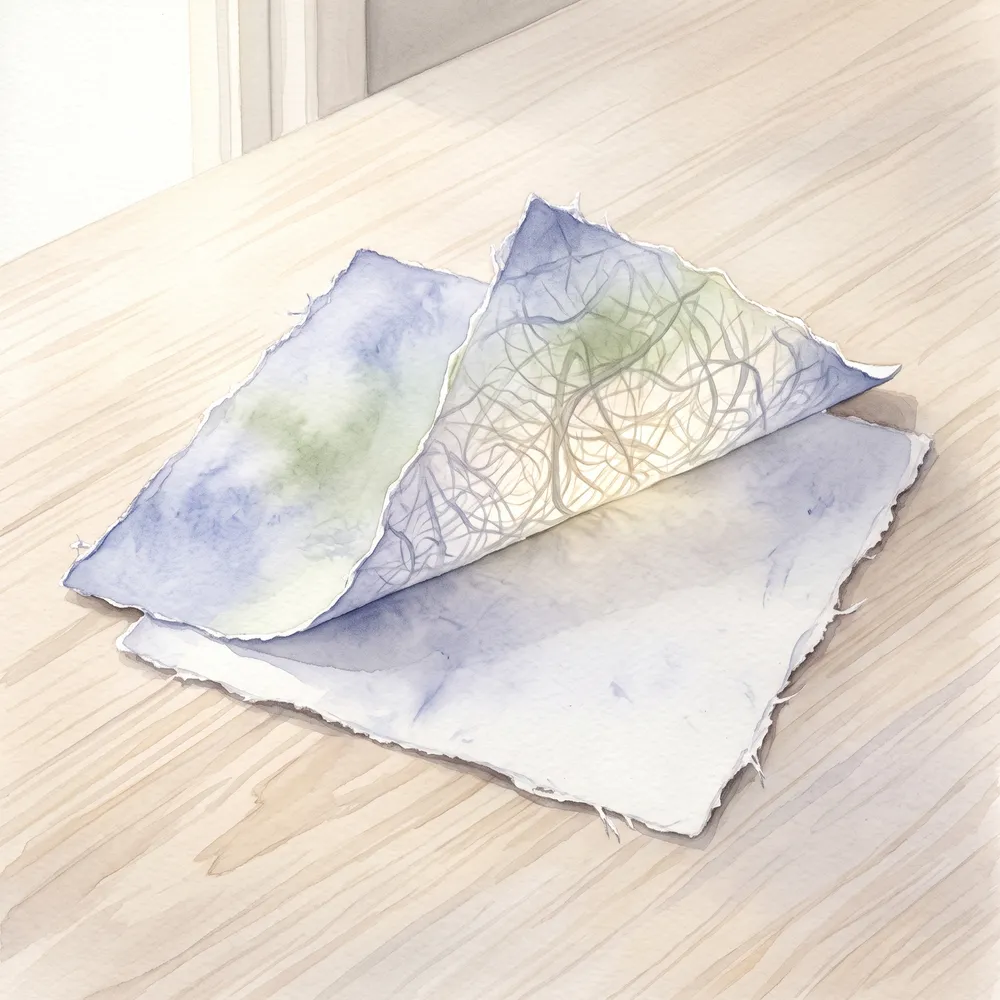
Hand-made Mino washi uses a method called nagashizuki: the pulp is rocked back and forth across the mould, so the fibres become intricately entangled, producing paper that is thin, strong, and even. Furukawa Shiko's origami paper brings that hand-papermaking technique into machine-made paper. That is why it is thin and yet hard to tear when pulled.
More models become possible
The company's own description says it best: "folds that used to tear will tear less, and finish crisp." In practice that means three things. It survives complex folds like connected cranes (renzuru), where several cranes are folded from one uncut sheet and the narrow joins are where paper usually gives way. Creases come out sharp, which matters for kusudama, where the creases themselves build the form. And its body lets boxes and envelopes hold a crisp shape. The sheets have a smooth side and a textured side; try both before you start.
Mino paper is in Japan's oldest surviving paper
The Shosoin repository in Nara holds family registers from 702 AD — regarded as the oldest surviving paper in Japan — and they came from three provinces, Mino among them. Papermaking in Mino has gone on for about 1,300 years. Hand-made Honminoshi was designated an Important Intangible Cultural Property in 1969, and in 2014 it was inscribed by UNESCO, together with Hosokawa-shi (Saitama) and Sekishu-banshi (Shimane), as "Washi, craftsmanship of traditional Japanese hand-made paper." Origami paper is machine-made, but its method traces back to that technique.
Coloured washi origami — start by changing the paper
Plain-coloured Mino washi. The clearest test is to fold a model you always fold, on this paper. You'll see the difference in the creases and how the points hold. There are sets with many colours and packs with a lot of one colour — the first for experimenting, the second for folding the same model many times.
Washi chiyogami sets — pattern and plain together
Patterned chiyogami paired with plain-coloured washi. Stack only patterns and some models look busy; with plain sheets in the set you can balance them. Folk-craft patterns and fine komon patterns are available. For boxes and small containers, these give the richest result.
Yuzen Chiyogami and Plain Mino Washi, 40 Sheets (10 cm)
Loading product details…
Echizen Washi Origami Paper, 20 Patterns (14.5 cm)
Loading product details…
4. Toyo: Still Cutting Origami by Hand
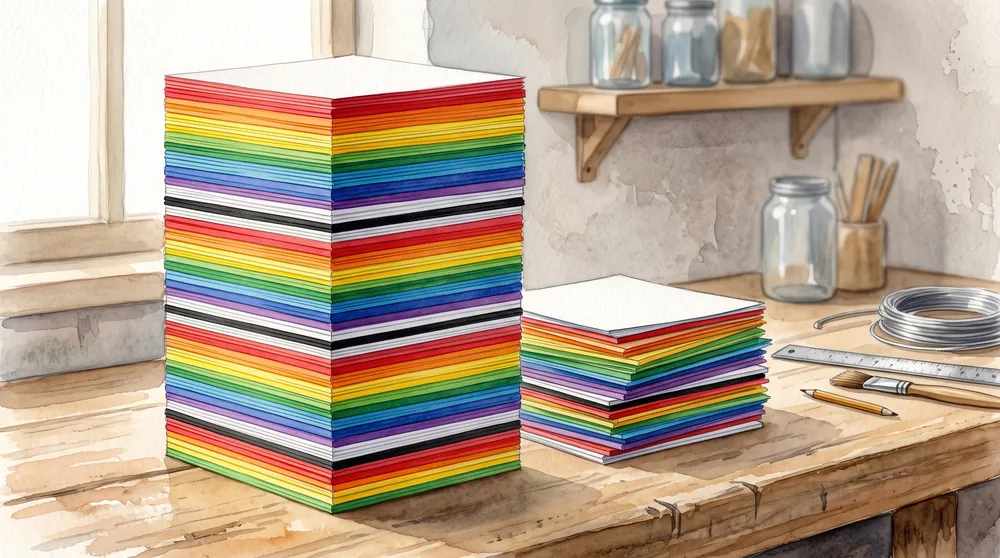
If you grew up in Japan, the origami paper you used was probably Toyo's. Toyo is one of the longest-established origami makers in Japan, producing it in its own factory in Tochigi since 1971, where almost all of the work is done by hand by a factory staff of 49. Its paper uses Hokuetsu's "eco pulp," bleached without chlorine (ECF).
Cutting 20 colours at once is a question of stiffness
The paper arrives as large coloured rolls (gentan), stored carefully because sunlight fades them and humidity changes them. The rolls are cut on a large cutter — and the clever part is that several colours are cut at the same time, up to 20, which builds rough colour combinations in one pass. But the more colours, the harder it is to adjust the tension: too much and the paper tears partway; too little and it sags, so sizes don't match or it wrinkles. That stiffness, hari, again.
Cut by machine, the corners won't meet
A cutter can only make so many colours, so the sets are combined and reordered into a 60-colour sequence. This is chōai (collation), and it is done by hand: sheets are picked in order and knocked against a right-angled metal plate at the left and back to square the edges.
Then comes the final cut to size, dansai — the most remarkable part. Toyo says that cutting by machine introduces drift and produces defective sheets with corners that don't line up, so it does the final cut by hand. First the four corners are trimmed; once all four sides are straight, the stack is cut to product size. A standard 15 cm square yields twelve stacks from one pre-cut sheet. Because the cutting is done by hand, Toyo can offer patterned origami, where the cut has to fall exactly, and many different sizes. Corners that meet turn out to be held up by people's hands.
Standard single-colour origami — choose by colour count
The familiar, plain-coloured paper. Plenty of sheets, good for practice. If in doubt, start with 15 cm (6 in). Colour counts vary, and some sets include gold and silver — worth having if you fold decorations.
Patterned origami and larger sizes — possible because it's hand-cut
Patterned sheets, and sizes above and below standard. On patterned paper, a cut that drifts makes the whole pattern look crooked — which is why a hand-cutting factory can offer them. Larger sizes suit boxes and helmets (kabuto); smaller ones suit tiny models and miniature books.
5. Isetatsu: Chiyogami Printed From Cherry Woodblocks
The same printing method as ukiyo-e
In Yanaka, Tokyo, is a shop called Kikujudo Isetatsu, founded in 1864 at the very end of the Edo period as a publisher of chiyogami and toy prints. Its chiyogami are made by hand woodblock printing: the same method as ukiyo-e colour prints, with a specialist printer laying down one colour at a time.
The blocks are the remarkable part. They are cherry wood, left to dry for 20 to 30 years after felling, because if the wood swells and shrinks with humidity, the colours fall out of register. The paper is mainly hand-made hōsho paper from Ehime. Hand-printed woodblock chiyogami has become genuinely rare.
Expect to find it somewhere other than an origami aisle: at the Yanaka shop itself or specialist washi stores, choosing patterns and buying sheet by sheet.
Chiyogami travelled from Kyoto to Edo
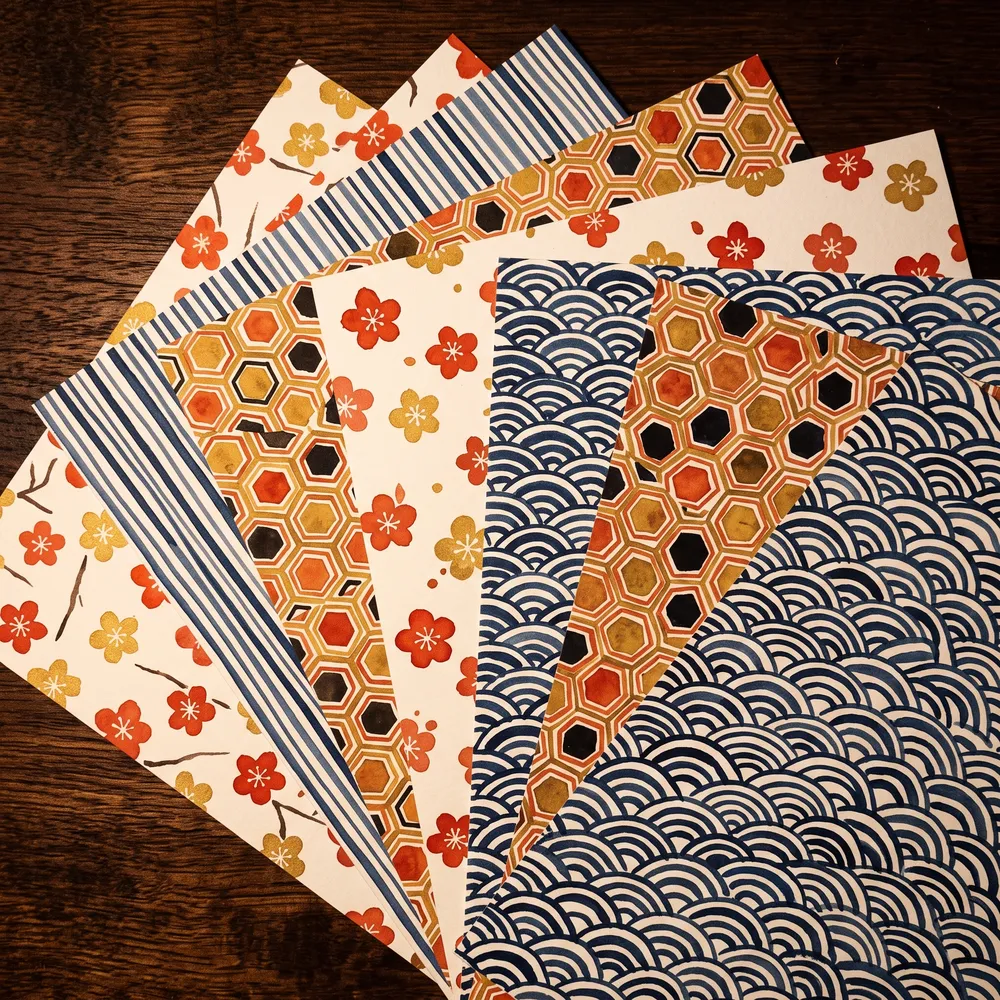
Chiyogami is said to have begun as decorated paper used to wrap gifts. Combined with woodblock printing it came to be produced in quantity, and in the late 18th century it spread from Kyoto to Edo (Tokyo). The patterns come from different places: Kyoto's draw on court culture and the yuzen dyeing of kimono, while Edo's took their subjects from town life — kabuki plays, actors' crests, stripes. The same name, but each paper copies something different.
6. How to Choose: Size, Thickness, Colour Count
1. Size: when in doubt, 15 cm (6 in)
The standard is 15 cm square (about 6 in), and most diagrams are drawn for it — so if you want to follow a book, start there. Small sizes such as 7.5 cm (3 in) suit tiny models and decorations, though your fingers won't fit into complex folds. Larger sheets, such as 17.6 cm (about 7 in), suit boxes and helmets: they take more effort to crease but finish more solidly.
2. Thickness: fine folding, or holding a shape
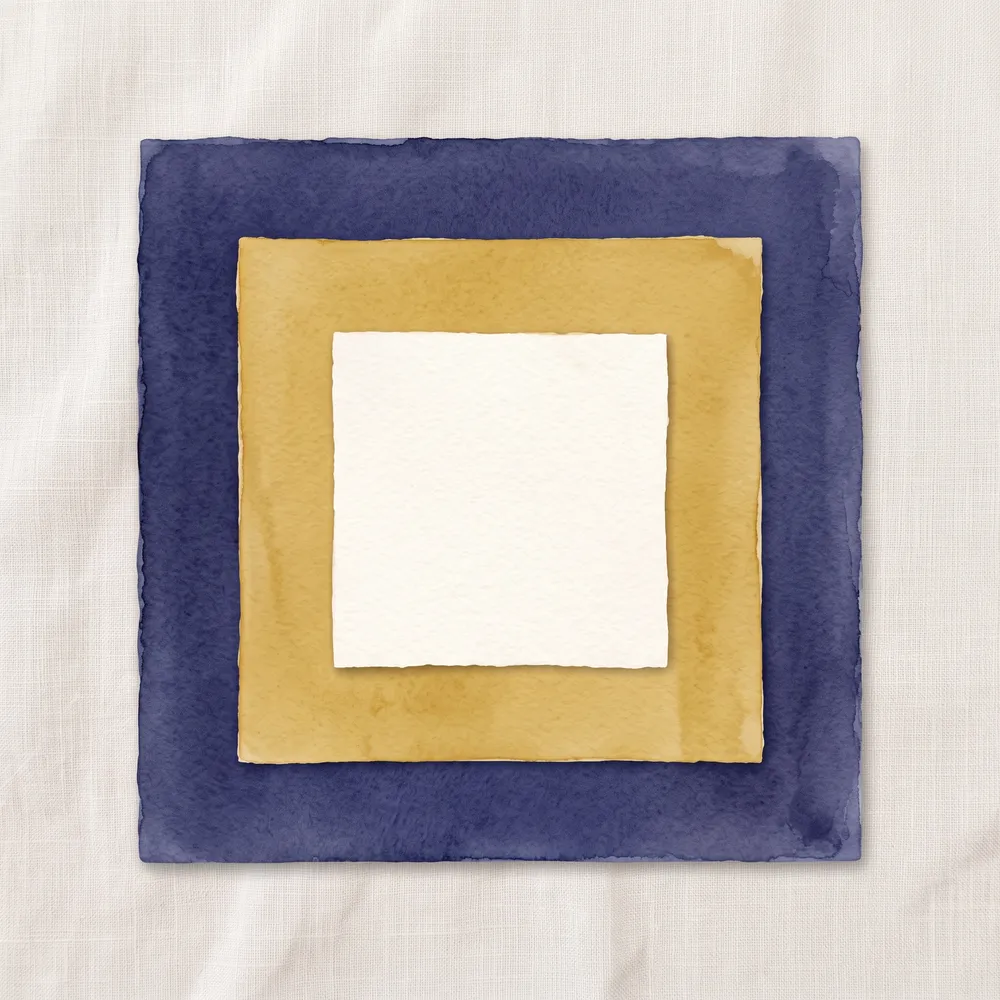
Thin paper can be folded over and over; on a model with many layers, thick paper bulges at the end and won't close. Thick paper holds its shape afterwards — boxes, dishes, envelopes, anything that sits on a table. Thin and strong together is what washi origami paper offers, and that is where its price comes from.
3. Colour count: for big projects, single-colour packs
Multi-colour sets are good for trying things. But for a kusudama that needs dozens of sheets in one colour, buy single-colour packs. And keep some gold and silver aside — on decorative models, one sheet changes the whole impression.
7. What to Do With What You Fold
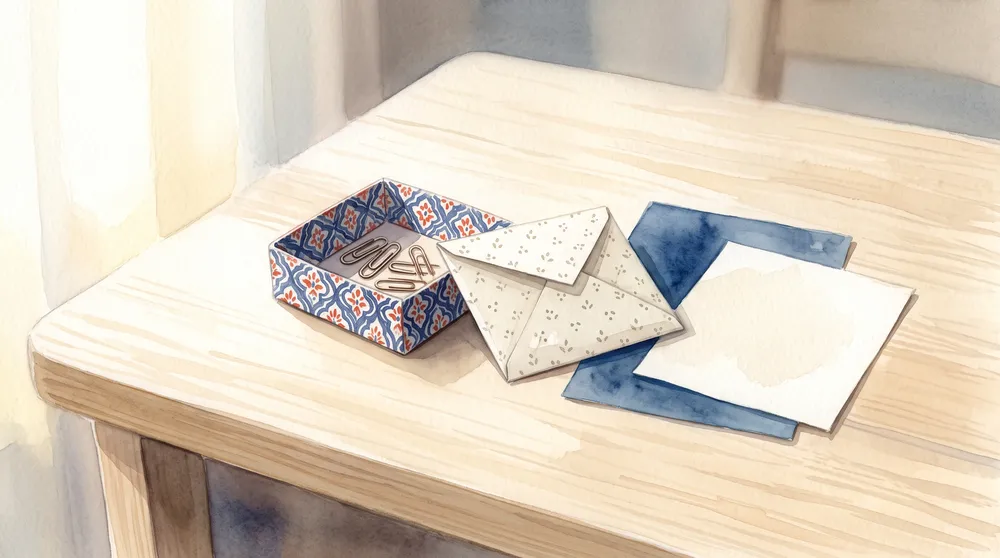
- Fold boxes and use them. The most useful thing to fold is a small box. In heavier washi the corners stand up and it keeps its shape: a paperclip tray, a day's pills, a scrap bowl while cooking. When it gets dirty, fold another.
- Fold envelopes. A pochibukuro — a small envelope for money or a thank-you — can be folded from one sheet. In patterned chiyogami, it looks finished on its own.
- Paste it or frame it. Chiyogami has long been pasted onto wooden boxes, tins, and notebook covers. A beautiful woodblock-printed sheet also stands on its own framed on a wall.
Practise on plentiful paper, and change paper only for the piece you want to keep. Once a fold is in your hands, good paper shows you how much the same steps can change.
8. Buying From Outside Japan
None of the three makers had an English shop or stated international shipping when we checked in October 2026. Furukawa Shiko and Toyo have Japanese sites; Isetatsu is a shop you visit in Yanaka, Tokyo.
- If you're visiting Tokyo, Isetatsu's Yanaka shop is worth a trip in itself — woodblock chiyogami is bought sheet by sheet, by choosing the pattern.
- Check the maker on any listing. Look for the company name — Furukawa Shiko, Toyo, or Isetatsu — rather than a generic "Japanese origami paper" label.
We will add listings you can buy from abroad here as we confirm them, one product at a time.
9. Frequently Asked Questions
What's the difference between origami paper and chiyogami?
Chiyogami is patterned paper, and you can think of it as one kind of origami paper. It began as paper for wrapping gifts, not only for folding, so pasting it onto boxes or framing it are traditional uses too.
Why do 15 cm sheets vary so much in price?
Because the paper and the work that goes into it differ. Washi origami paper is formed so the fibres interlock, so it resists tearing even when thin. Some chiyogami is woodblock-printed one colour at a time. Practise on plentiful paper and switch only for the piece you want to keep.
Which paper is best for connected cranes or kusudama?
Paper that resists tearing and holds a crisp crease. Connected cranes are folded from one uncut sheet, so the narrow joins tear easily; kusudama are built from the creases themselves. Mino washi origami paper suits both. Kusudama use dozens of sheets of one colour, so buy single-colour packs.
Smooth side or textured side — which goes on the outside?
There's no rule; choose the look you want. The smooth side shows colour more strongly; the textured side scatters light and looks softer. Fold the same model both ways once and you'll see the difference.
How should I store origami paper?
Away from sunlight and humidity. Paper fades in the sun and changes when it absorbs moisture — even the factory stores its raw paper carefully. Keep it in its packet, in a drawer or box; standing it upright helps stop it curling.
Is washi origami paper suitable for children?
Yes. While they are still learning how hard to press, paper that resists tearing actually helps them finish. Since children fold a lot, plentiful single-colour paper for everyday folding and washi for special decorations is a practical split.
Final Thoughts: Change the Paper, Fold More
When paper tears mid-fold or the corners won't meet, the cause can be the paper, not your hands. The same square differs in how its fibres bond, how precisely it is cut, and how its pattern is printed.
Furukawa Shiko in Gifu makes Mino washi with interlocking fibres, thin yet hard to tear. Toyo in Tochigi has made origami in its own factory since 1971 — and still does the final cut by hand, because a machine won't make the corners meet. Isetatsu in Yanaka, Tokyo, prints chiyogami one colour at a time from cherry blocks dried for 20 to 30 years.
Choose by size first (15 cm / 6 in to follow diagrams), then thickness, then colour count. Changing one sheet of paper changes what you can fold.
Japanese Letter Paper: Washi Feathers, Smooth Doesn't

Japanese Washi Paper Lighting: Isamu Noguchi AKARI and Gifu Lanterns