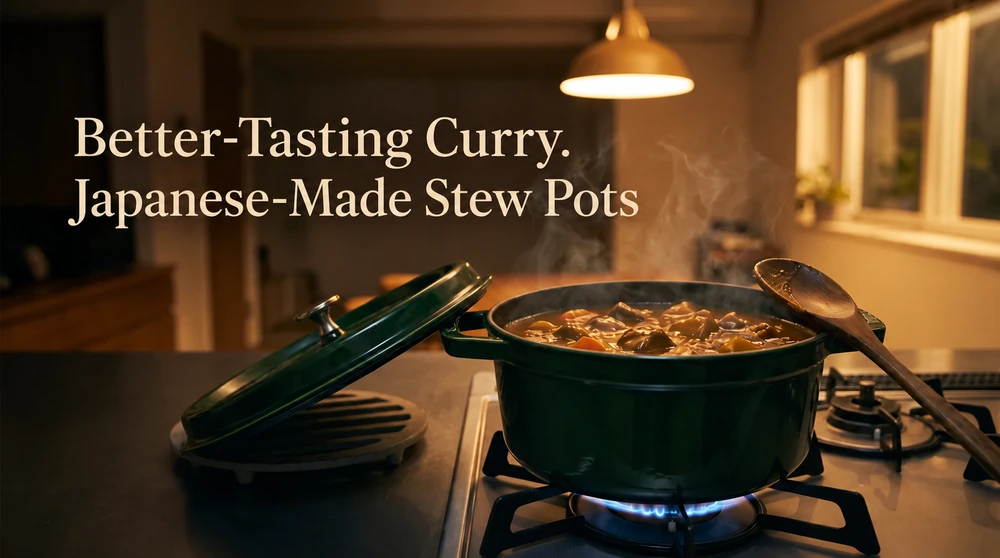
A craftsman spends about an hour on each pot, adjusting where the lid meets the rim to a
tolerance of 0.01mm. Roughly a seventh of the width of a human hair, by hand, one pot at a
time — and each lid is machined to fit its own pot and no other.
That sounds like an obsession without a purpose until you know what it is for.
The seal makes the pot substantially more airtight than a French enamelled Dutch oven,
and airtightness is the entire requirement for musui — cooking with no added water at
all.
This guide is about whether that is worth the money, what the cheaper Japanese
alternatives actually give up, and how to buy the right size.
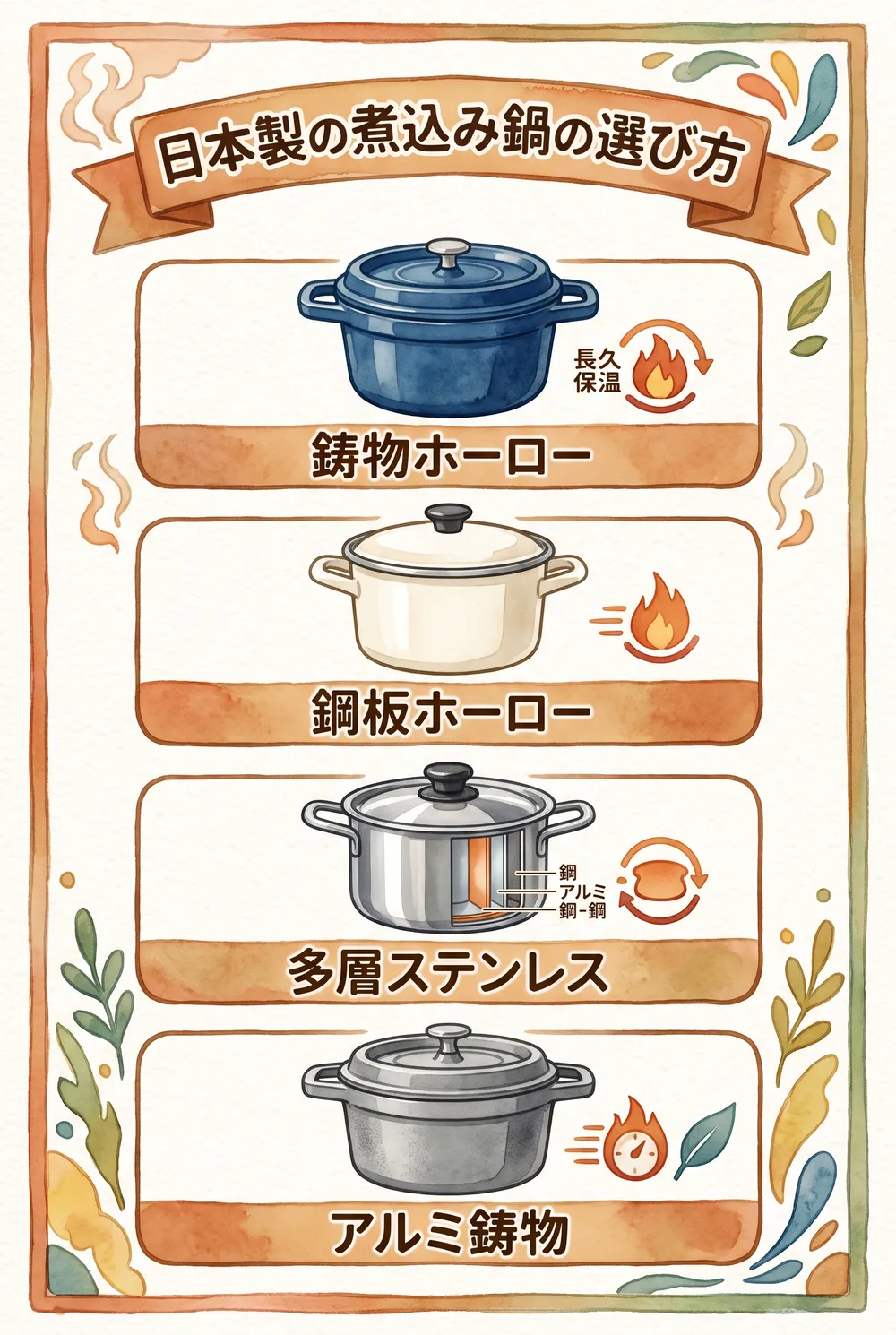
Quick Reference: Which Material
| Type | Strength | Cost |
|---|---|---|
| Enamelled cast iron | Best for braising. The seal, the mass | Heavy and expensive |
| Enamelled steel | Light enough to use daily; goes in the fridge | Cheap. Chips if dropped |
| Multi-ply stainless | Retained-heat cooking; lasts forever | Mid to high |
| Size: number of people, plus one litre. Four people, five litres. This is the rule that stops people buying too small. | ||
Le Creuset, Staub, and What Japan Did Differently
If you want a heavy enamelled pot, the two names you already know are French, and they are good. Le Creuset and Staub between them defined the category and have owned it for decades.
Japan did not try to make a better French pot. It optimised for a different thing:
the seal between lid and body.
A French Dutch oven vents. That is not a defect — a braise wants some evaporation, and Staub's
dimpled lid is designed to condense and drip. The Japanese approach removes the venting
almost entirely, so the pot's contents cook in their own moisture with nothing escaping.
What that changes in practice
- You can cook vegetables with no added liquid at all. Onions, carrots and a pinch of salt produce enough of their own water to braise in. This is musui, and it is a genuinely different result — concentrated rather than diluted.
- Less seasoning is needed, because nothing has been thinned by added water.
- The pot is fussier. Very little liquid plus a heavy base means scorching is easy if the heat is wrong. A French pot is more forgiving because it holds more liquid.
So the honest comparison is not "better." It is "different, and narrower." If you want one pot for stock, stews and bread, a French one is arguably the safer buy. If the waterless method is what interests you, the seal is not a marketing point — it is the mechanism.
Why Japanese — One Hour Per Lid
Vermicular is made by Aichi Dobby, a Nagoya foundry founded in 1936 that spent most of its life casting industrial parts. Two brothers of the founding family — Kunihiro Hijikata, who joined in 2001, and his younger brother Tomoharu, who joined in 2006 — started developing a cooking pot in 2007 on Tomoharu's suggestion. It took about three years and launched in February 2010.
What the hour actually buys
Casting cannot hold a tolerance of 0.01mm. No foundry process can — cast iron shrinks unpredictably as it cools, and the rim of a pot comes out of the mould approximately round.
So the contact surface is machined afterwards, by hand, pot by pot. A craftsman
works a single pot for around an hour, checking and adjusting repeatedly until the lid seats
within 0.01mm all the way round — which is why the lid belongs to that pot and will not fit
another.
That is a foundry's answer to a cooking problem, and it is the reason a company
that made industrial castings could arrive somewhere Le Creuset had not.
The claim usually quoted is that the result is more than ten times as airtight as a comparable French pot. Take the multiple as the manufacturer's, but the mechanism is not in doubt: machining a cast surface to a measured tolerance is a real process with a real cost, and the price of the pot is that hour of labour.
The Three Materials
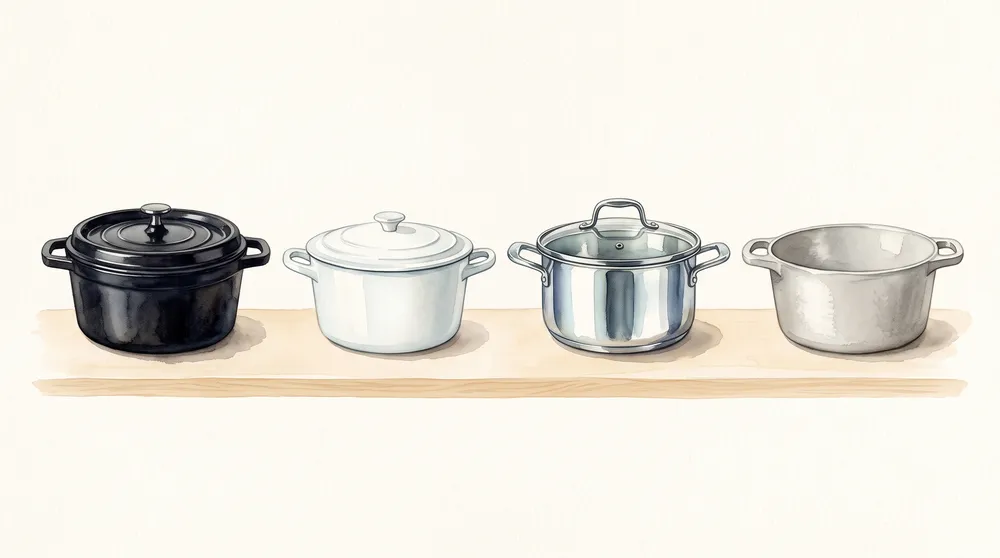
Almost everything about how a pot behaves comes from what it is made of, and the three types are genuinely different tools rather than price tiers.
Enamelled cast iron — the braising one
Heavy, slow to heat, and once hot it stays hot. That thermal mass is what stops a stew from dropping off the boil every time you lift the lid, and it is why cast iron owns this category.
The cost is weight. A 5-litre cast pot full of stew is a genuine lift, and people with wrist or shoulder problems stop using them. Try lifting one before buying.
Enamelled steel — the one you will actually use
The type English-speaking kitchens know least, and the most practical. Thin enamelled steel heats fast, weighs a fraction of cast iron, and — because enamel is glass — you can put leftovers in the fridge in the pot without any metallic transfer.
What it gives up is thermal mass, so it scorches more easily and does not hold heat for retained-heat cooking. It also chips if dropped. But at a third of the weight and a fraction of the price, it gets used on a Tuesday, which a 6kg pot does not.
Multi-ply stainless — the lifetime one
Layers of stainless around an aluminium or copper core, giving even heat with no coating to fail. Nothing to chip, nothing to season, dishwasher-safe, effectively permanent.
Its trick is retained-heat cooking — bring to temperature, turn the heat off, and let the mass finish the job. Excellent for beans and stocks, and cheaper to run. Less good at browning than cast iron.
Size: People, Plus One Litre
The Japanese rule of thumb is the number of people plus one litre, and it is better than the vague sizing most manufacturers offer.
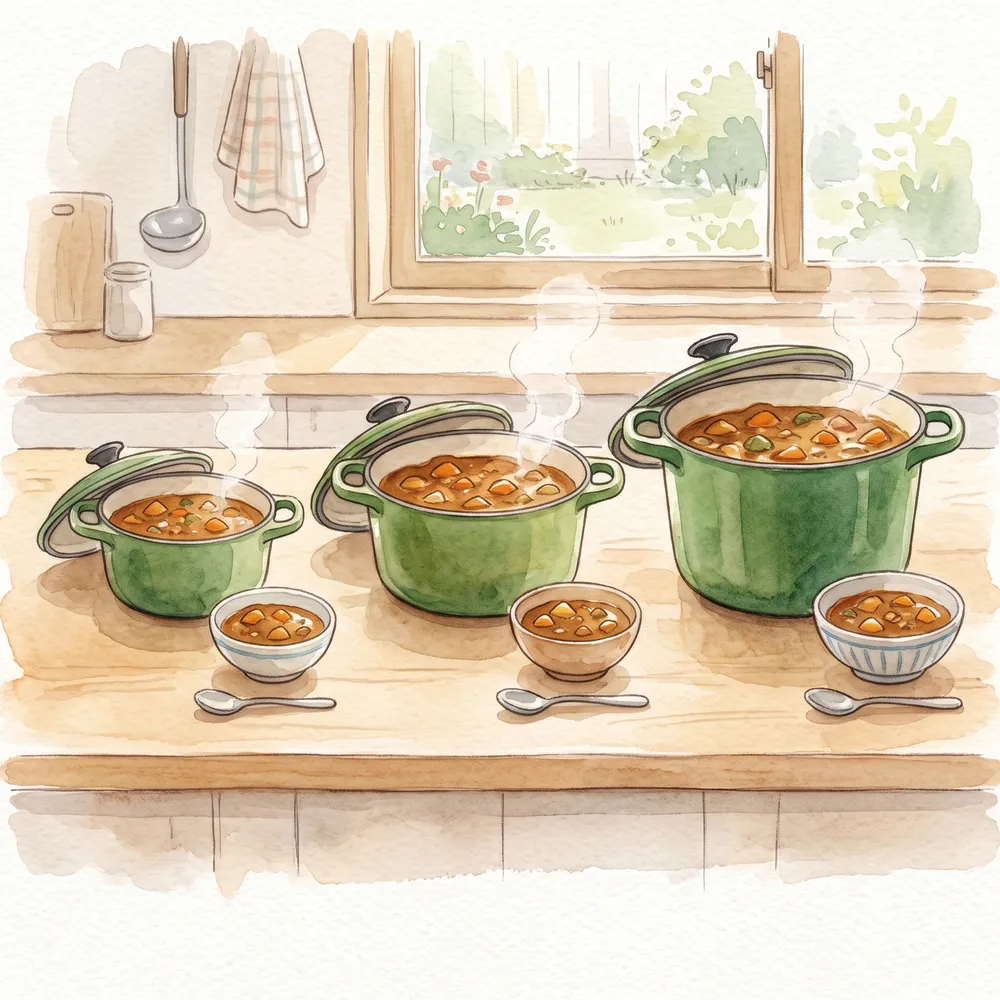
- 1–2 people — 2.5 to 3L (about 18cm)
- 3 people — 4L (about 20cm)
- 4 people — 5L (about 22cm)
- 5+ or batch cooking — 6L and up (24cm+)
The extra litre is headroom. A pot filled to the rim boils over, cannot be stirred, and cannot go in an oven safely.
Deep or shallow
- Deep — stocks, soups, boiling, anything with a lot of liquid.
- Shallow — braising, where you want surface area for browning and a thinner layer of food. Better for waterless cooking, since the contents sit in a wider, shallower bed.
Three things to check before ordering
Induction compatibility — cast iron and steel are fine; some multi-ply is not, so
check.
Oven-safe knob — plastic knobs cap your oven temperature. Metal or phenolic rated
to 250°C is what you want.
Weight, as a number. Look it up rather than imagining it. A 5L enamelled cast pot
is often 5–6kg empty.
What to Buy
Vermicular Oven Pot — the pot itself
An enamelled cast iron pot with the machined lid, and nothing electrical about
it. It works on gas, induction and in an oven like any other Dutch oven — the
difference is entirely in how well it closes.
Vermicular run a US site, which makes this reachable without a forwarding
service. Start here if you want to understand what the seal does before
committing to the cooker.
- Material
- Enamelled cast iron, machined rim
- Tolerance
- 0.01mm, hand-finished, ~1 hour per pot
- Power
- None — it is a pot
- Heat
- Gas, induction, oven
- Made
- Aichi Dobby, Nagoya — founded 1936
Perfect for: Anyone who already owns a French Dutch oven and wants to know what the fuss is about.
Vermicular Musui-Kamado —this one plugs in
The same pot sitting on a dedicated induction base that holds temperature far
more precisely than a hob can — which is the point, because waterless cooking is intolerant of
heat that drifts.
Unlike the Oven Pot, this is an electrical appliance. Do not import the
Japanese one. A 120V version is sold for the US market, so the voltage problem
that ruins most Japanese appliance purchases is already solved here — but only if you buy the
right one.
- What it is
- Cast iron pot + induction cooker
- Voltage
- Buy the 120V US model, not the Japanese one
- Why
- Precise, stable low temperatures
- Also does
- Rice, sous-vide-style cooking, steam-roasting
Perfect for: People who want the waterless method to work reliably rather than fighting a hob's thermostat.
If the price is the problem
Japan makes excellent enamelled steel and multi-ply stainless pots at a fraction of
this, and for most cooking the difference is smaller than the price gap suggests.
But their English distribution is patchy and we have not verified it, so we are
not going to send you to a search that returns something else. If you are in Japan, a
department store kitchenware floor is the place; the enamelled steel pots in particular
are the ones Japanese households actually use daily.
Not Burning It, and Not Chipping It
Why curry burns on the bottom
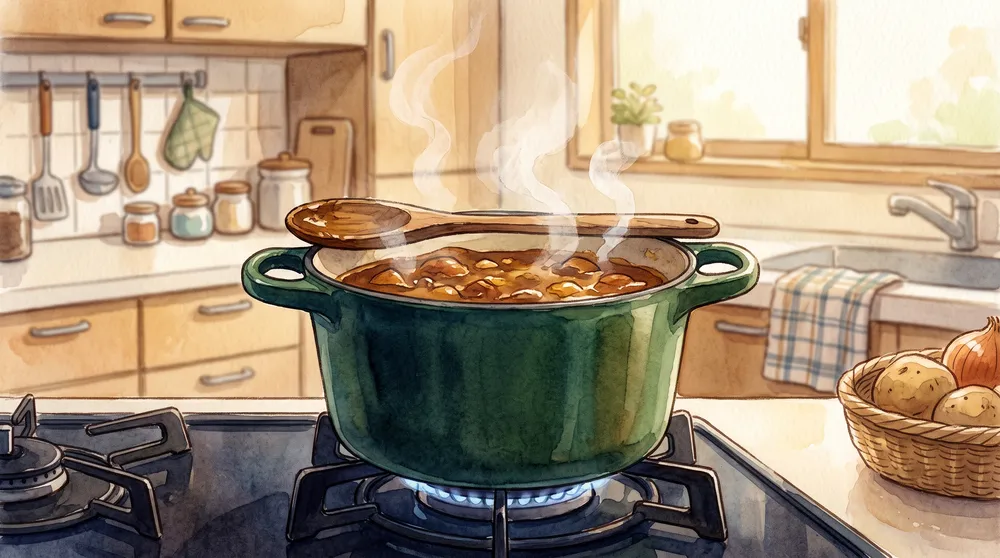
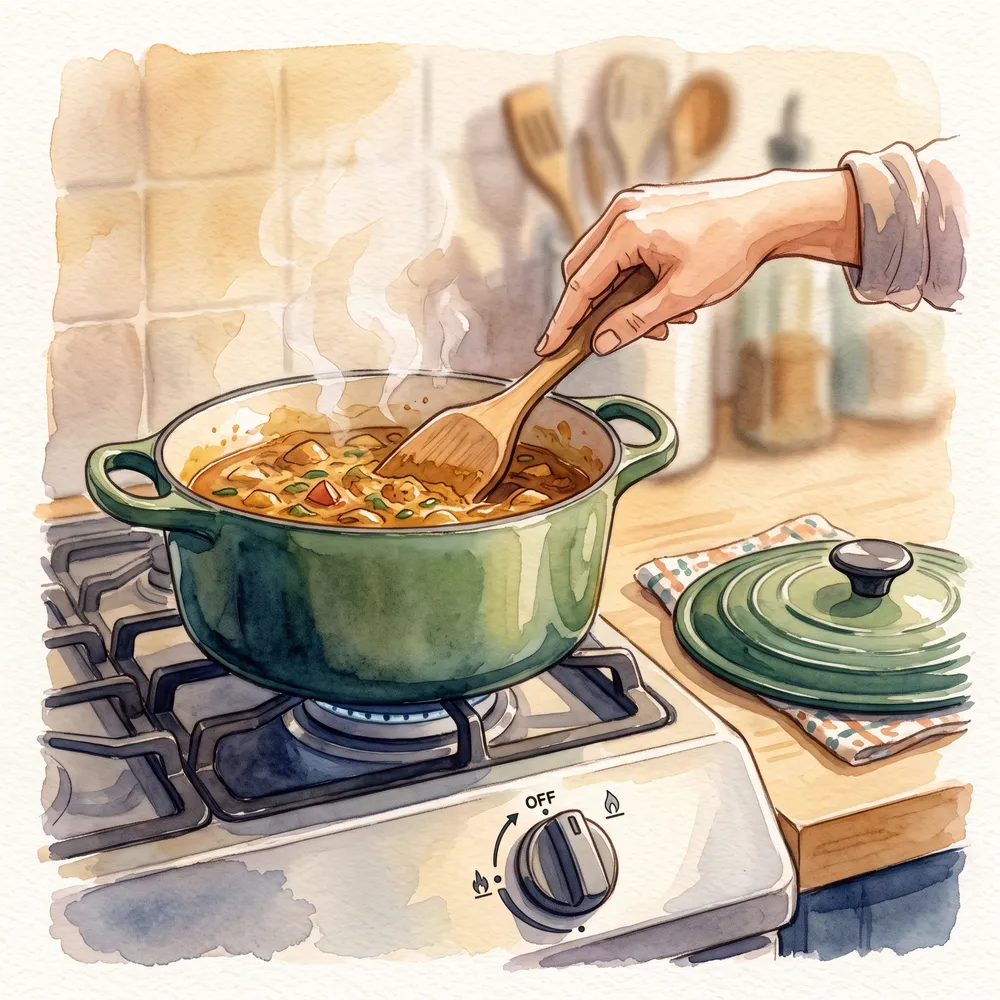
- The heat is too high, almost always. A heavy pot needs a low flame — it concentrates heat at the base and holds it, so what works in a thin pan scorches here.
- Add roux or thickener off the heat, stirred through completely before the pot goes back on. Thickened liquid stops convecting and the bottom layer cooks alone.
- Scrape the base, not the middle. Stirring the surface achieves nothing; a flat wooden spatula along the bottom is what prevents a burnt layer forming.
- Residual heat keeps cooking after you turn it off. Stop earlier than you would with a thin pan.
Enamel is glass, and behaves like it
- Never plunge a hot pot into cold water. Thermal shock cracks enamel, and that is the most common way these are destroyed.
- No metal utensils, no abrasive scourers. Wood, silicone, or a soft sponge.
- Soak burnt-on food; do not chisel it. Water and time, or a little baking soda simmered in the pot.
- Dry it fully before storing, and put a cloth between the lid and rim — stacking metal on the machined edge is exactly where you do not want a chip.
If the enamel chips on the outside or the rim, the pot is still usable. Keep it
dry so the exposed iron does not rust.
A chip on the inside cooking surface is different — exposed iron will rust and
leach into food, and pieces of enamel can come away. Stop using it for cooking.
Frequently Asked Questions
How is a Japanese pot different from Le Creuset or Staub?
The seal between lid and pot. Vermicular machines the contact surface by hand to
0.01mm — about an hour per pot — so each lid fits only its own pot and almost
nothing escapes.
French pots vent deliberately, which suits a conventional braise. The Japanese
design exists to enable cooking with no added water at all.
What is waterless cooking?
Musui — cooking with no added liquid, relying on the water already in the
vegetables or meat. The airtight lid keeps that moisture circulating instead of escaping as
steam.
The result is more concentrated and needs less seasoning. It also scorches more
easily, because there is very little liquid in the pot.
Cast iron enamel or steel enamel?
Cast iron for braising, steel for daily cooking. Cast iron holds heat far better;
enamelled steel weighs a third as much, costs far less, heats quickly and
goes straight into the fridge with the leftovers still in it.
The pot you actually use beats the pot that is technically better — a 6kg pot gets
left in the cupboard.
What size for a family of four?
Five litres — the number of people plus one. The extra litre is headroom for
stirring and for not boiling over.
Shallow rather than deep if you intend to braise, since a wider, thinner bed of
food browns better and suits waterless cooking.
Does the Vermicular need a special power supply?
The Oven Pot needs no power at all — it is simply a pot. Gas, induction or oven,
anywhere in the world.
The Musui-Kamado is different: it includes an induction cooker, so it is an electrical
appliance. A 120V version is sold for the US market — buy that one rather than
importing the Japanese model.
The enamel chipped. Can I still use it?
Outside or rim: yes, but keep it dry so the exposed iron does not rust.
Inside, on the cooking surface: stop cooking in it. Exposed iron rusts into food
and more enamel can flake away. The usual cause is thermal shock — a hot pot into
cold water — which is entirely avoidable.
Final Thoughts: The Hour Is the Product
What you are paying for is an hour of a person's time per pot, spent closing a gap you cannot see, so that a cooking method that needs no water becomes possible. That is an unusual thing to buy, and it is a real one.
But be honest about whether you want it. A French Dutch oven is more forgiving and does more things. The Japanese pot is narrower and better at one method — and if that method does not interest you, the seal is expensive precision you will not use.
And if the price is the obstacle, buy enamelled steel. A third of the weight, a fraction of the money, and it goes in the fridge with dinner still in it — which is why it is the pot Japanese households reach for on a weeknight.
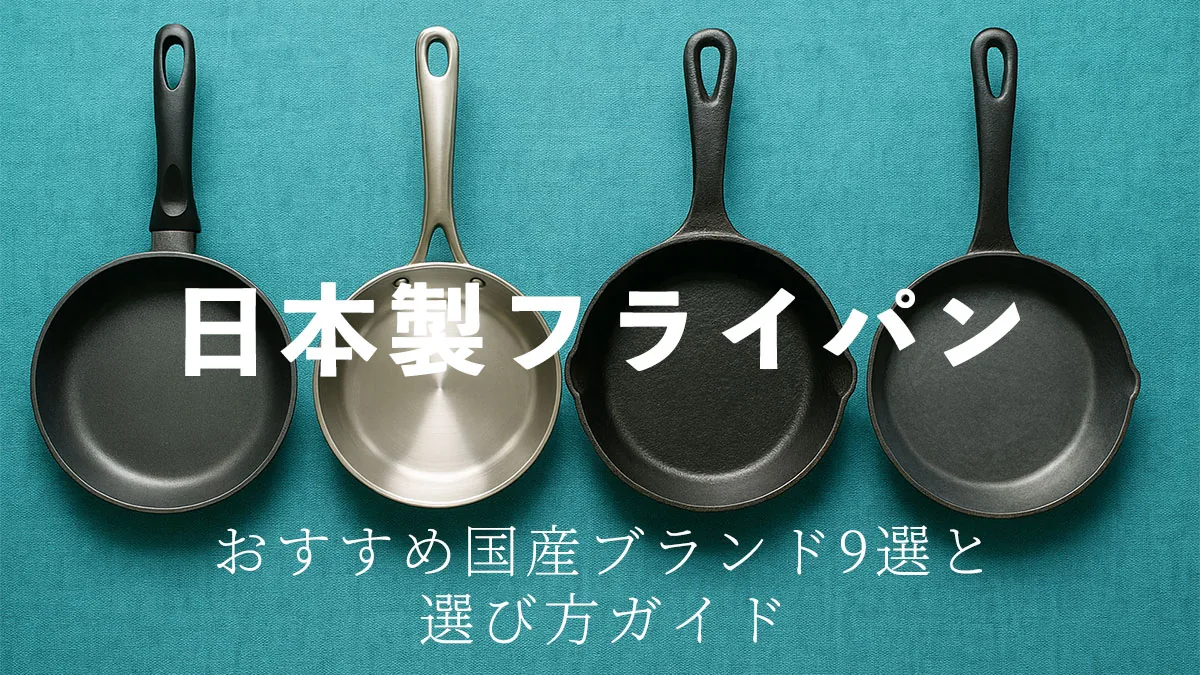
Japanese Frying Pans: Iron, Steel and Coatings
Enamel Containers: Glass on Steel, and Why It Lasts