You have probably already bought a Japanese apron without knowing it. The
cross-back apron — no neck loop, straps crossing between the shoulder blades, pulled on over the
head — is now sold by every workwear and kitchen brand in the English-speaking world.
The design came from Japan. It is also completely free to copy, so most of what
is sold as a "Japanese-style apron" was made nowhere near Japan.
Which leaves two separate questions. What does the crossed strap actually do for
you — and, if the shape is available everywhere, is there any reason left to buy the Japanese one?
Quick Reference: Choosing by How You Use It
| If you | Strap | Fabric |
|---|---|---|
| Wear it for hours at a time | Cross-back | Linen |
| Put it on and off all day | Neck loop | Cotton or linen |
| Work near fire, oil or tools | Cross-back | Canvas or denim |
| Wash up constantly | Either | Linen — dries fastest |
| Wear long sleeves | — | A kappogi, not an apron |
| The strap decides comfort. The fabric decides whether it is worth buying from Japan — because the strap design is copied everywhere and the cloth is not. | ||
The Crossed Strap, and What It Actually Does
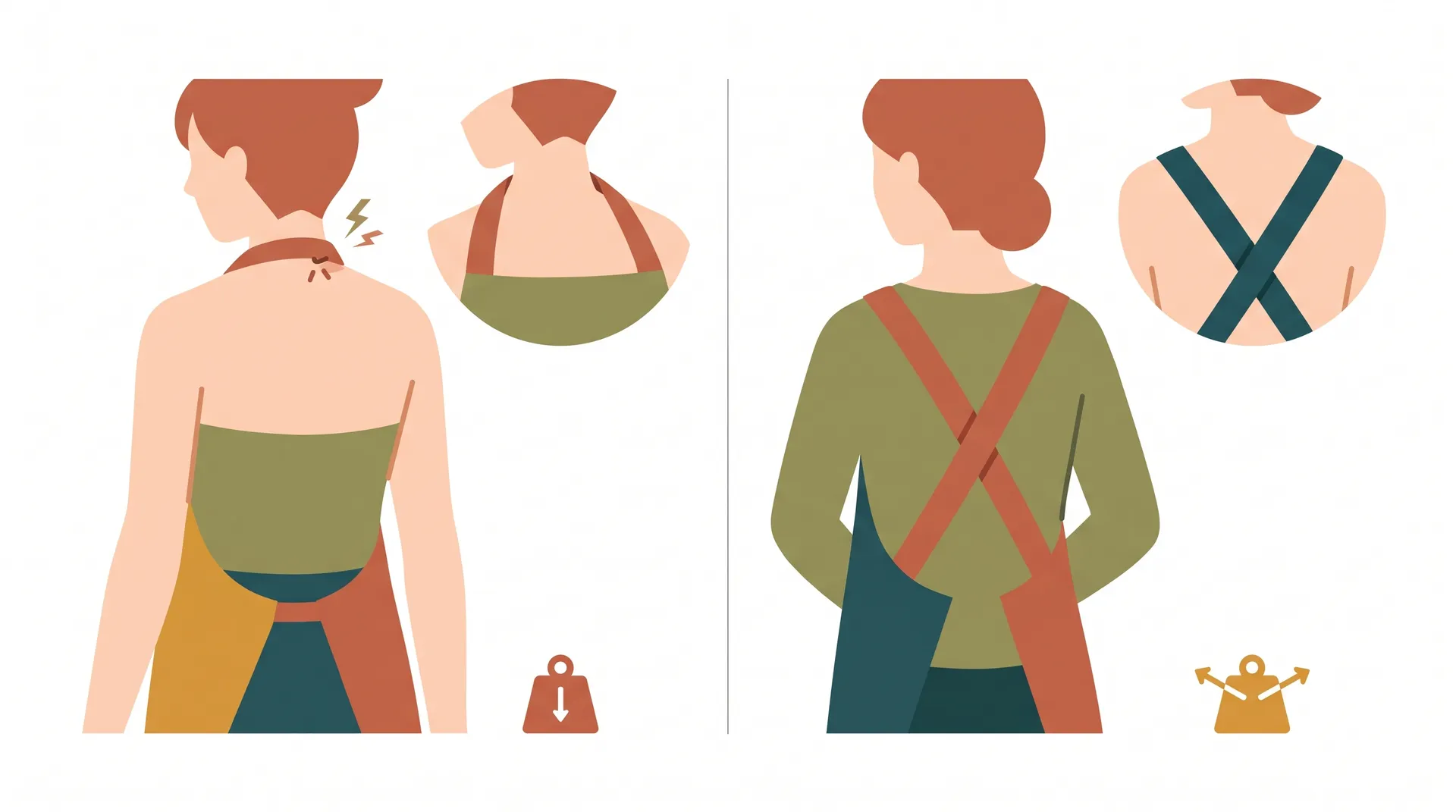
An apron is heavier than it feels, and it gets heavier when wet. The question is only where that weight ends up.
Neck loop: fast to put on, all the load in one place
A single loop over the head, tied at the waist — on in about a second, which is
genuinely the right answer if you put an apron on and take it off ten times a day.
But every gram hangs off the back of your neck, pulling forward against the
muscles that are already holding your head up. An hour is fine. A whole day is not.
Cross-back: the load goes where a rucksack puts it
The straps pass over both shoulders and cross between the shoulder blades, so
the weight is carried by the shoulders and upper back instead of the neck — the same reasoning
as a rucksack rather than a shoulder bag.
There is nothing touching your neck at all, which is most of the difference over
a long day. The cost is that you pull it on over your head, and there is no
quick release.
This is why Japanese nursery teachers, potters and cooks wear cross-back and why it spread once English-speaking makers noticed it. The people who wear an apron all day converged on it independently.
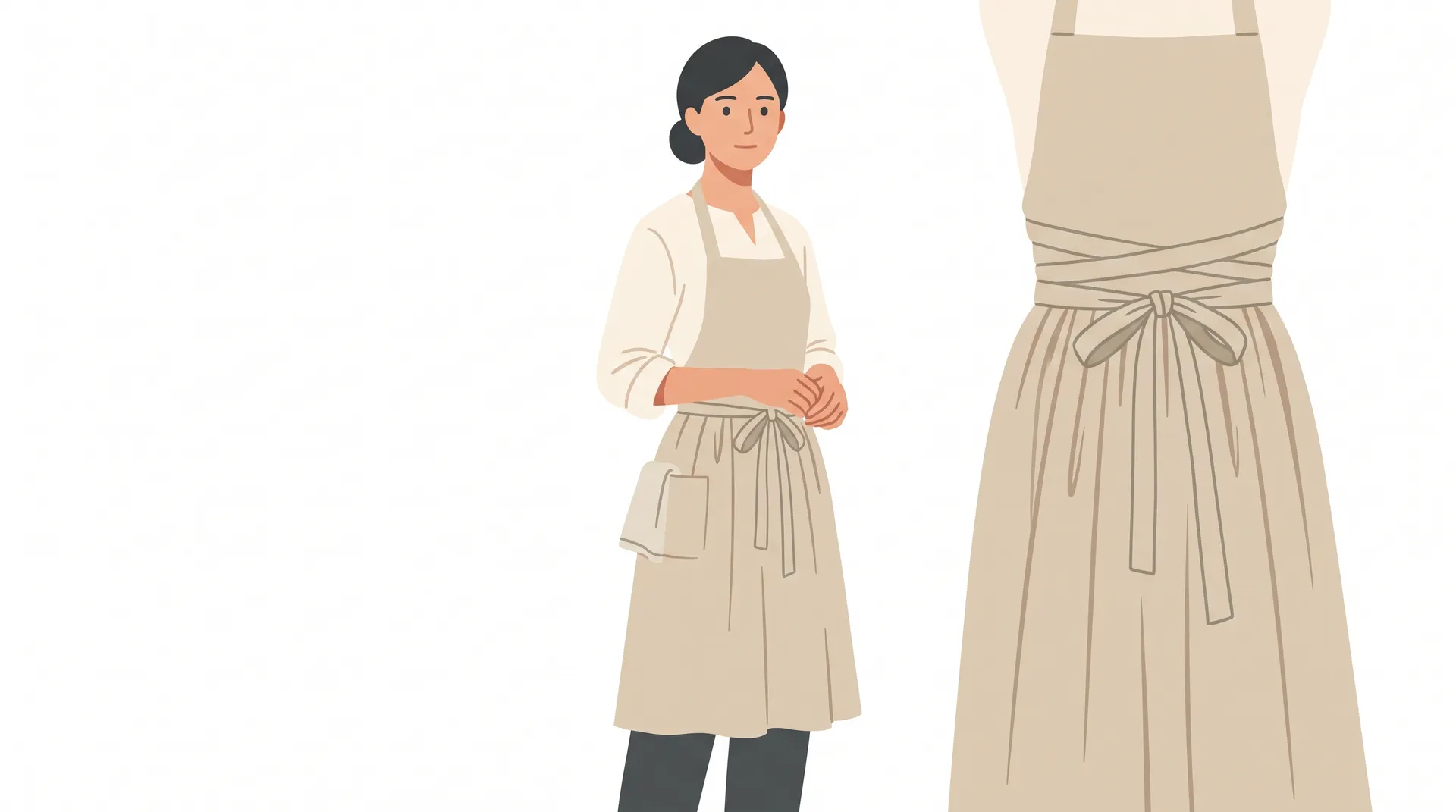
One more detail: tie it at the front
Many Japanese aprons are cut with waist ties long enough to come round and knot in
front. It looks deliberate rather than fussy, and it means you can tighten it
yourself without reaching behind your back.
It also stops the knot digging into you when you lean against a counter — a
small thing that you notice only once someone has removed it.
Why Japanese — The Strap Is Free, the Cloth Is Not
Search "Japanese cross back apron" and most of what comes back was not made in
Japan. The phrase has become a style description, like "French press" or "Panama hat",
and sellers use it accordingly.
That is not fraud and those aprons are often fine. But it does mean the words
"Japanese apron" no longer tell you anything about where it was made —
so if that matters to you, you have to look at the fabric instead.
Here is the useful way to think about it: the shape is a free idea, and the cloth is not. Anyone can sew crossed straps. Nobody can relocate a hundred-year-old weaving region.
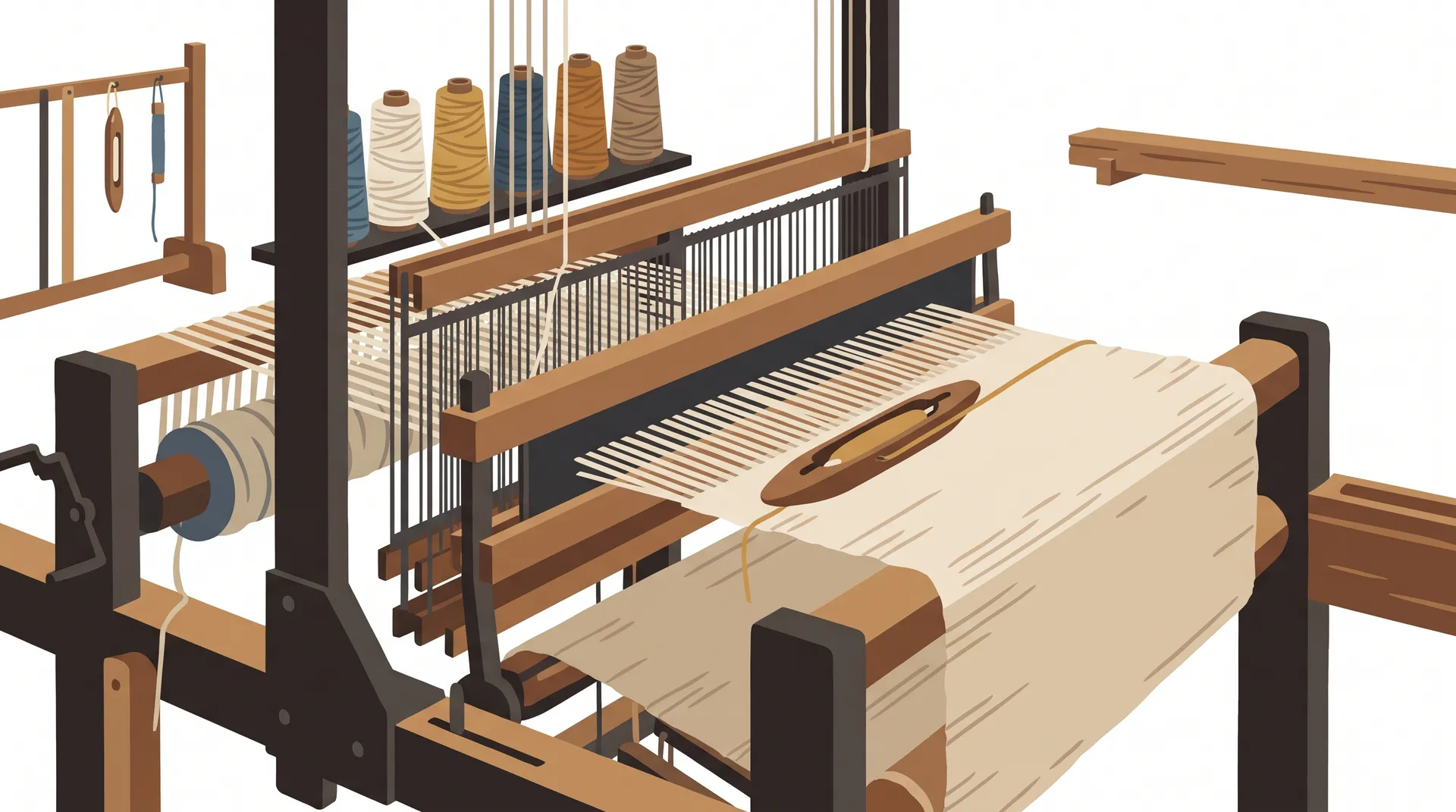
Kurashiki hanpu — about 70% of Japan's canvas
Hanpu is sailcloth, in the literal sense — the cotton canvas that was strong enough for ship's sails and is used now for truck covers. Around 70% of all canvas made in Japan comes from Kurashiki in Okayama, where it has been woven since 1888.
It is made on old shuttle looms that run slowly, which is what produces the density. New canvas is stiff and slightly awkward; it softens over years without thinning, shrugs off oil spatter and sparks, and outlasts several rounds of whatever else you own.
Okayama denim — the same region, the cloth you already know
Okayama is the denim region, and the apron makers there have access to the same mills, the same shuttle looms and the same wash houses that supply the jeans. A denim apron from Okayama is heavy, holds a crease, and fades exactly the way your jeans do.
⚠ Linen is the honest exception
Japan does not grow flax at any scale, so Japanese linen aprons are made from European
linen — Lithuanian, Belgian or French. Even the best-known Japanese linen apron brands
say so openly.
So for linen, "Japanese" means the design, cutting and sewing — not the fibre.
That is still worth something, because the fit and the drape are the whole point of a linen
apron. But it is a different claim from the one canvas and denim can make, and
anyone telling you otherwise is selling.
Linen, and the Wrinkles You Are Supposed to Keep
Linen absorbs something like four times its weight compared with cotton and gives it up again quickly, which is the entire argument for a linen apron at a sink. The front gets soaked, and then it does not stay soaked.
It also creases, permanently and immediately, and you are meant to let it. Wash it, hang it, wear it. Ironing a linen apron is a category error — the soft collapsed texture that develops is the finished state, not a failure to maintain it.
Buy "washed" linen if the option exists. New linen is stiff, and washed linen
has been through that process at the factory — so it is soft out of the packet instead
of after a month of your own laundry.
This matters most if you are buying it as a gift, since the recipient gets the
good version immediately rather than the stiff one.
The Kappogi: The One English Has No Word For
An apron protects your front. It does nothing whatsoever for your sleeves, which is why anyone who cooks in a jumper ends up pushing them up every few minutes.
The kappogi solves that: a smock with sleeves, pulled on over your clothes, gathered at the wrist or elbow, reaching to about the knee. It covers the parts of you an apron ignores.
It was invented in the Meiji era for exactly this — to wear over a kimono, whose
sleeves are catastrophically ill-suited to cooking. The problem it solves has not
changed, it just moved to knitwear.
Worth knowing about if you cook in winter clothes, or paint, or pot. It is
unfamiliar enough in English that most people have never considered the option.
What to Buy
Okayama denim work apron — the one that outlives you
Heavy Okayama denim with leather pockets, made in Japan and sold through a
knife specialist rather than a homeware shop — which tells you who it is aimed at.
It is machine washable and will shrink a little the first time, then behave
like a pair of good jeans: stiff at first, and increasingly yours.
- Fabric
- Okayama denim, leather pockets
- Size
- 850 × 760 mm
- Made
- Japan
- Price
- About $187
- Shipping
- Worldwide via DHL
Perfect for: Cooking over fire, workshops, gardening, anything with sparks.
NAPRON — the Okayama workwear label
Based in Okayama and built on vintage workwear patterns, NAPRON is the label
to look at if you want the apron to read as clothing rather than as equipment. They use the
region's canvas and denim.
The easiest English route is their collaboration range, which quotes
international shipping openly — around $30 to the US and €25 to Europe,
with duties and taxes already in the price.
- Based
- Okayama
- Style
- Vintage workwear, modular pockets
- Made
- Japan
- Shipping
- Quoted per region, duties included
A kappogi, if you want your sleeves covered
Made in Kurume, a cotton-weaving town in Kyushu better known for its indigo
kasuri cloth. This is the plain domestic article rather than a designer
interpretation — which is the point.
Sizing runs to Japanese measurements, so size up if you are between sizes or
plan to wear it over a jumper.
- Type
- Full smock with sleeves
- Made
- Kurume, Japan
- Best for
- Long sleeves, winter cooking, pottery, painting
We are deliberately not linking a general search for "Japanese apron". We
checked, and it returns mostly aprons made elsewhere in the Japanese style — which would send you
to the opposite of what this article just recommended.
Two brands worth knowing but which we could not find an English route to: Lino
e Lina, whose linen aprons are the domestic standard, and Fabrizm in Osaka, which cuts and sews
everything in its own factory and makes kappogi as well as aprons.
Both are straightforward to buy if you are in Japan.
Oil, Bleach and Length
- Oil first, water second. Work a little washing-up liquid into a fresh oil spot dry, before it goes anywhere near the machine — once water hits it the oil sets into the fibre and a normal wash will not shift it.
- Never chlorine bleach anything dyed or linen. It strips colour unevenly and weakens the fibre. Use oxygen bleach if you must, and expect indigo to lift regardless.
- Length: mid-thigh to just above the knee for kitchen work, longer if you want your trousers protected too. Full-length looks impressive and catches on drawer handles.
- Do not tumble dry linen or canvas. Both shrink; canvas can shrink enough to change the fit noticeably.
- New canvas is supposed to feel wrong. Give it a month of real use before deciding — it does not soften in a drawer.
Frequently Asked Questions
Is a cross-back apron really more comfortable?
Over a long session, clearly yes — the weight sits on both shoulders and the
upper back rather than pulling forward on your neck.
For short bursts it makes little difference, and the neck-loop version is faster
to get on and off. Choose by how long you wear it, not by which looks better.
Are aprons sold as "Japanese style" actually made in Japan?
Usually not. The cross-back design is unpatented and has been widely adopted, so
the phrase now describes a shape rather than an origin.
Check the fabric instead of the styling — Kurashiki canvas, Okayama denim or a
named Japanese mill is a claim about where it was made. "Japanese-style" is not.
Linen or canvas?
Linen for wet work, canvas for hot and dirty work. Linen soaks up splashes and
dries fast, which is what you want at a sink.
Canvas resists oil spatter and sparks and takes a decade of abuse, but it is
heavy and stiff for months. Neither is better in general.
What is a kappogi?
A smock with sleeves, worn over your clothes and reaching about the knee. It
covers your arms, which an apron does not.
It was designed in the Meiji era for cooking in a kimono, and the problem has
simply moved to jumper sleeves.
What is a maekake?
The waist-only apron with a shop's name printed on it, traditionally worn by
sake brewers, greengrocers and market traders, tied with a thick cord at the front.
It protects your legs and nothing above the waist, so it is a different tool —
good for carrying and lifting, useless against splashes.
Why do the waist ties tie at the front?
So you can adjust it yourself and see what you are doing. Long ties come round
the back and knot in front, which is both easier and the conventional look.
It also keeps the knot off your lower back, where it otherwise presses in every
time you lean on a counter.
Final Thoughts: Buy the Cloth, Not the Word
The best thing about Japanese aprons has already escaped. The crossed strap is everywhere now, it costs nothing to copy, and that is a good outcome — more people have comfortable aprons than did twenty years ago.
What did not escape is the cloth. Kurashiki canvas and Okayama denim are tied to a place and a set of old looms, and those are the reason to buy from Japan rather than from whoever sewed the same shape nearest to you.
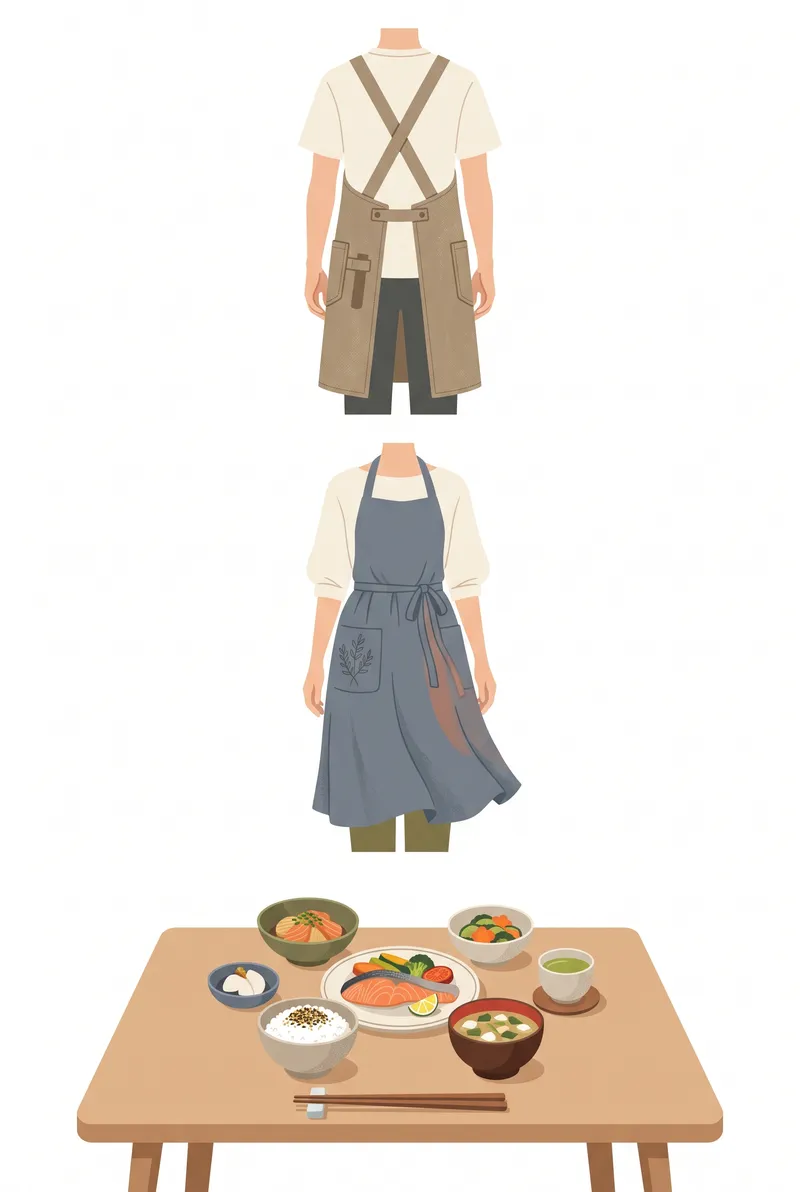
So: cross-back if you wear it for hours, linen at a sink, canvas near fire — and check the fabric rather than the adjective.
Japanese Canvas Bags: Heavy-Duty Quality That Ages Beautifully
Japanese Selvedge Denim: 7 Best Brands for Life