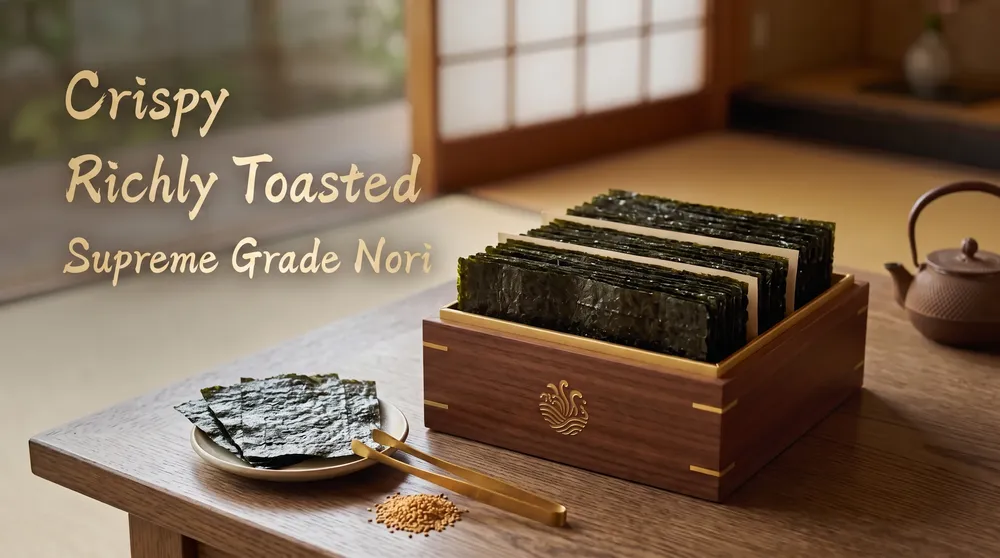
Put a piece of nori on your tongue and do nothing.
Good nori dissolves. It goes in perhaps ten seconds, leaving sweetness and a deep
savoury note. Cheap nori sits there like a piece of leather and has to be chewed.
Same seaweed, same species, entirely different product — and almost nobody outside Japan knows the
grading system exists.
The best of it comes from a sea where the tide lifts the entire crop into the air twice a
day, which is not a metaphor and is the reason it tastes the way it does.
Quick Reference: What Separates Good Nori
| Check | Good | Ordinary |
|---|---|---|
| On the tongue | Dissolves in seconds | Stays leathery, must be chewed |
| Colour held to light | Deep black-green, even | Brownish, patchy, pinholes |
| Label | Named sea, first harvest | Just "nori" |
| Size for sushi | Zenkei — the full sheet | Eighth-cut is for rice balls |
| Nori absorbs moisture from the air within minutes of opening. The desiccant sachet is not packaging filler — reseal it immediately. | ||
The Melt Test
You can run this now, with whatever nori is in your kitchen. Tear off a small piece, put it on your tongue, and leave it alone.
Good nori disappears. Within about ten seconds it has softened and gone, leaving
a sweetness and a savoury depth behind.
Ordinary nori does not. It softens at the edges and stays — a thin sheet of
something you now have to chew, tasting faintly of the sea and mostly of paper.
The difference is the age of the seaweed when it was cut, and how thin and even the sheet was made from it. Young growth has thin cell walls and comes apart in the mouth; older growth is fibrous and does not.
The other two checks
- Hold a sheet up to a window. Good nori is dense and even, a deep black-green. Poor nori shows pinholes and patchy thin spots, and reads brownish rather than green-black.
- Read what the packet says about origin. A named sea and a stated harvest is a producer telling you something specific. "Nori" alone, with no origin, is a commodity — and there is nothing wrong with that for a bowl of ramen.
None of this makes cheap nori bad. It makes it a different product for a different job. What it does mean is that if you have only ever had the commodity, you have not really had nori — and the gap is much larger than the price difference suggests.
Why Japanese — The Tide Farms It
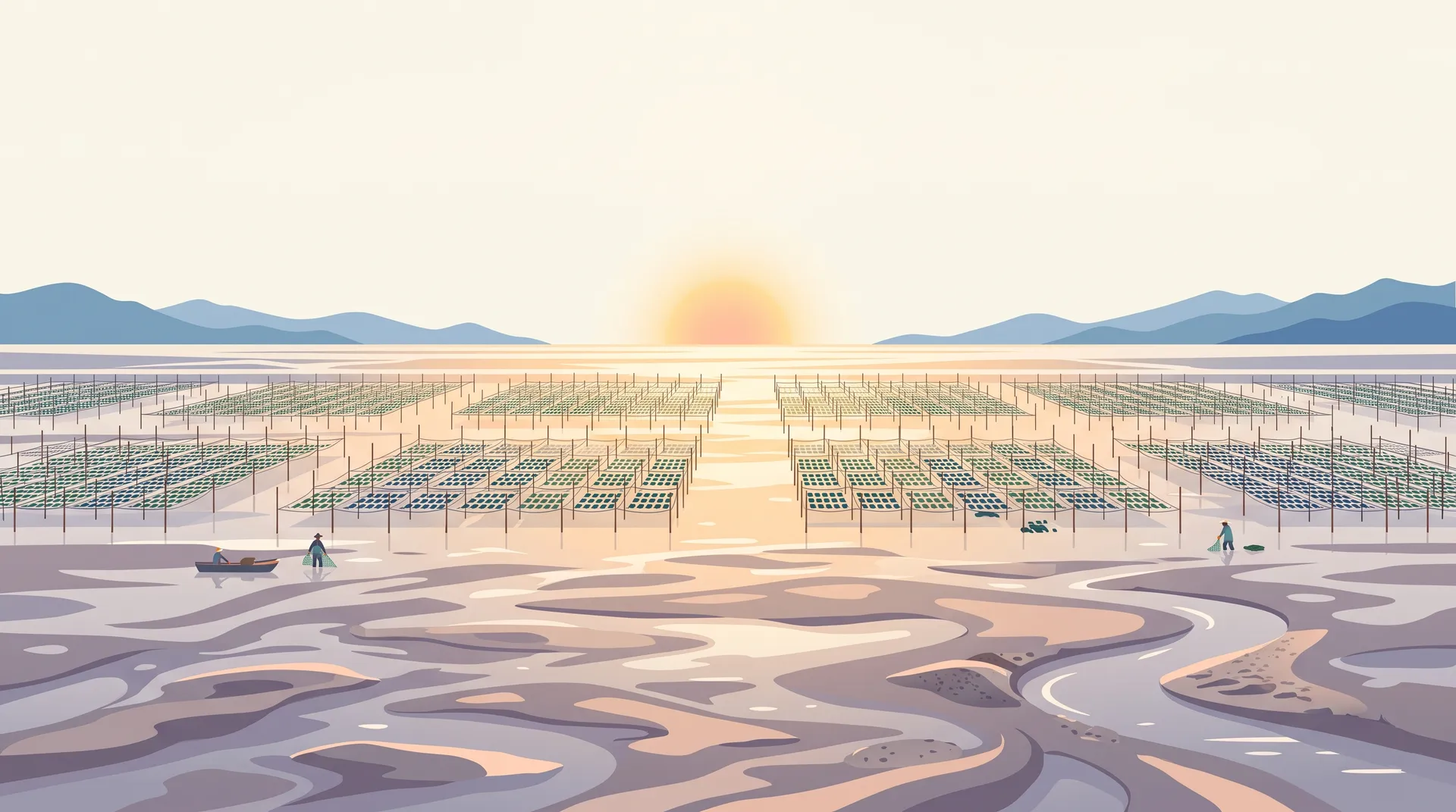
The Ariake Sea, on the western side of Kyushu, produces around 40% of Japan's nori, and it does so because of one geographical accident: its tidal range is among the largest in the world, reaching six metres in places.
What six metres allows you to do
Nets are strung on poles driven into the seabed — a method called shichu-shiki. Around two thousand poles, each about ten metres long, are pushed into the mud by hand.
The nets are hung at a fixed height, and then the tide does the work.
At high tide the nets are underwater and the nori grows. At low tide the
water drops away and the nets are left hanging in the air, where the crop dries in sun and
wind — a process called kanshutsu.
That exposure is not incidental. It is the point. Periodic drying strengthens the
nori and suppresses disease and the diatoms that would otherwise colonise the nets.
So the seaweed is being alternately submerged and air-dried, twice a day, for its whole life. It is a form of farming in which the main piece of equipment is the moon — and it only works in a handful of places on earth with a tidal range that extreme.
The other reason Ariake works is fresh water. Over a hundred rivers feed into it, carrying nutrients off the land, which is why the sea is productive enough to support this at all.
First Harvest, Cut Once a Year
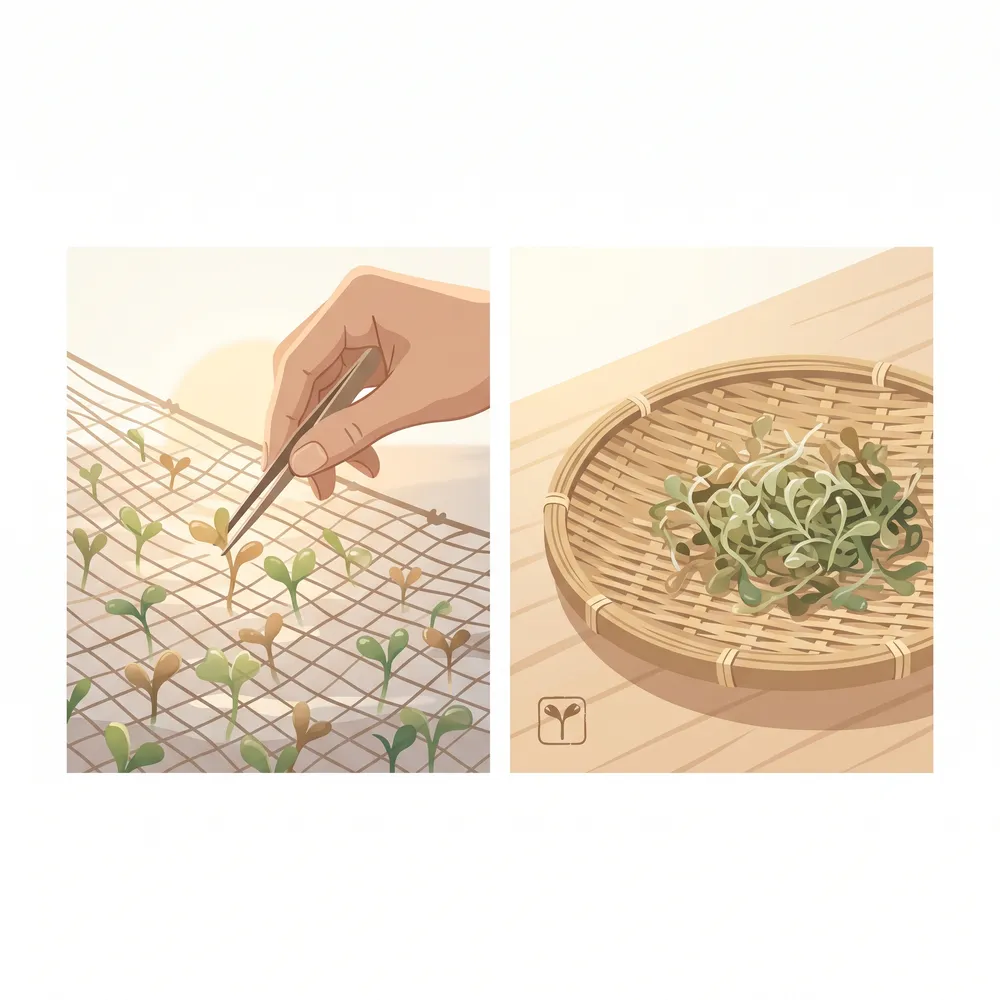
A nori net is cut several times in a season, and the seaweed regrows after each
cut. The very first cut is a different product from all the ones after it.
Hatsu-tsumi or ichiban-tsumi — first harvest — is the young growth,
and it is the grade prized for melting on the tongue and for a deeper savoury character.
It can only be cut once a year, which is the whole reason it costs what it does.
Later cuts are tougher. The regrown seaweed has thicker cell walls and more fibre — perfectly good nori, more robust, and entirely appropriate for wrapping a rice ball that has to survive a lunchbox. It just will not dissolve.
The Japanese phrase for first-harvest nori translates as "the young leaves of the
sea," which is sentimental and also accurate — it is the seaweed equivalent of a first
flush tea, cut young, once, before the plant has toughened.
If a packet says first harvest, that is the single most informative word on it.
Plain, Seasoned, and What Size to Buy
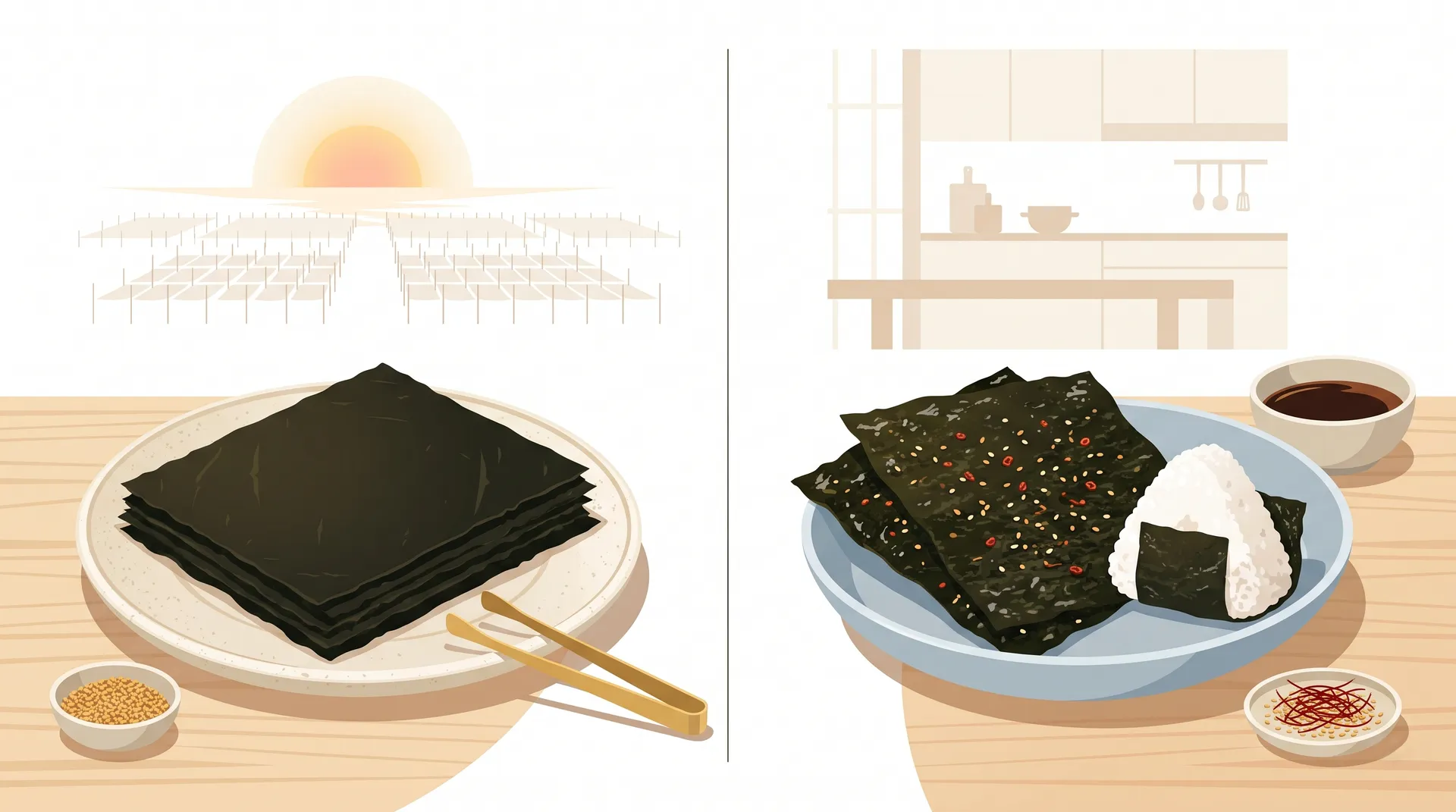
Yaki-nori or ajitsuke-nori
- Yaki-nori — plain, roasted, nothing added. This is what sushi is made with, and the only kind where the quality of the seaweed is fully exposed. Buy this if you are buying good nori; there is nowhere for it to hide.
- Ajitsuke-nori — seasoned with soy, mirin and sugar. Delicious with rice, and a completely legitimate product. But seasoning masks the sheet, so paying a premium for seasoned nori is largely paying for the seasoning.
The sizes, which matter more than you would expect
Japanese nori is sold cut to standard fractions of a full sheet, and buying the wrong one is the most common practical error.
| Cut | Roughly | For |
|---|---|---|
| Zenkei — full sheet | About 21 × 19cm | Sushi rolls. Buy this for maki |
| Hangiri — half | Half a sheet | Hand rolls, temaki |
| Eighth-cut | Small rectangles | Rice balls, breakfast, over rice |
If you are buying nori to make maki, you need full sheets — and a surprising amount of what is sold internationally as "sushi nori" is a smaller cut that will not go round a roll.
How to Buy It
We have not linked a marketplace search here, deliberately. "Nori" is a generic word, and a search returns mostly seasoned Korean snack sheets — a good product, and not remotely what this article is about. A search link would send you somewhere the article argues against.
What to look for on the packet
- 1. A named sea. Ariake is the one to know; Seto Inland Sea nori is also excellent and generally crisper and lighter. No origin stated means commodity.
- 2. First harvest — hatsu-tsumi or ichiban-tsumi. This is the single most informative word on a nori package.
- 3. Plain roasted, not seasoned, if you are paying for quality.
- 4. The right cut. Full sheets for rolls; eighth-cut for rice and rice balls.
- 5. A tin, if it is a gift or you will use it slowly. Nori's enemy is humidity, and a sealed tin handles that far better than a bag.
Where it can actually be bought
Ariake Suisan is the producer we could confirm reaching English-language shops — Japanese speciality importers carry it, and it is the realistic route if you are not in Japan.
The famous houses, for when you are in Japan
Yamamoto Noriten, Maruyama Noriten and Shirako are the long-established Tokyo
nori merchants, and their top grades are what Japanese people buy as serious gifts — tinned,
first harvest, Ariake.
We could not confirm English-language direct sales for any of them, so treat these
as names to look for in a department store food hall rather than things to order.
A department store basement is the single best place to buy nori in the world, and
they will let you look at the sheets.
Storage: The Thing Everyone Gets Wrong
Nori absorbs moisture from the air faster than almost any food in your kitchen. A crisp sheet left out on a humid day is limp within the hour, and once it has gone soft the melt is gone with it.
- Reseal immediately, every time. Not after you finish cooking — immediately. The desiccant sachet is doing real work, so leave it in.
- An airtight tin beats the bag. If you have bought good nori, decant it into something that seals properly.
- Freezer for long storage, not the fridge. A fridge is humid, and taking nori in and out of it invites condensation. Frozen nori keeps well — bring the sealed package to room temperature before opening it, or it will sweat.
- Limp nori is recoverable. Pass it briefly over a low flame or a dry pan — seconds, not minutes — and the crispness comes back. The aroma does not.
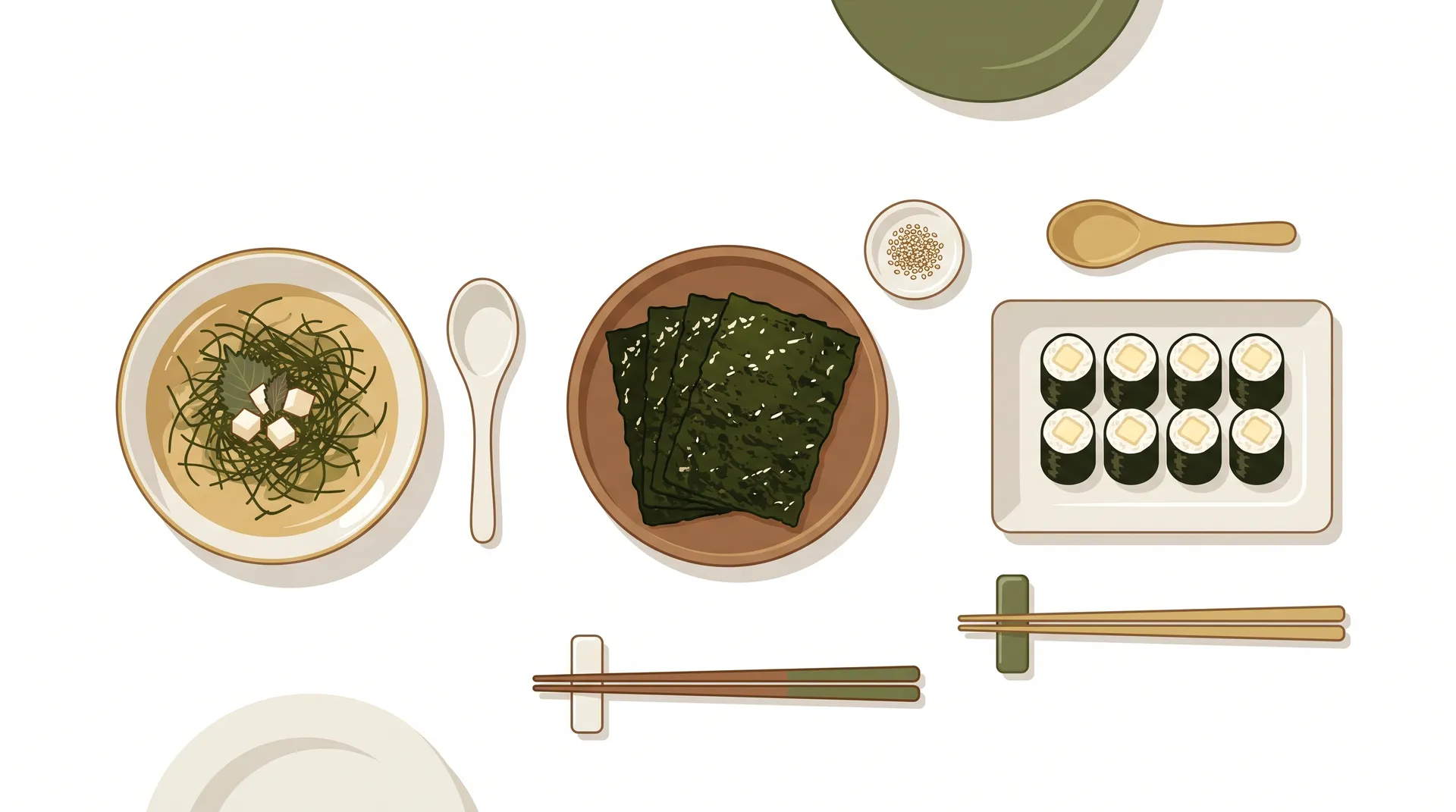
Good nori is worth eating plainly at least once before it goes into anything. Over hot rice with a little soy, or simply on its own — it is the only way to find out what you actually bought, and a sushi roll hides most of it.
Frequently Asked Questions
How do I tell good nori from cheap nori?
Put a piece on your tongue and wait. Good nori dissolves in about ten seconds;
ordinary nori stays leathery and has to be chewed.
Then hold a sheet to the light — good nori is dense, even and deep black-green,
while poor nori shows pinholes and reads brownish.
Why is Ariake Sea nori considered the best?
Because of a six-metre tidal range. Nets are hung on poles at a fixed height, so
at high tide the nori is underwater and at low tide it hangs in the air and dries.
That periodic drying — kanshutsu — strengthens the seaweed and suppresses disease
and diatoms. Very few places on earth have a tide extreme enough to farm this way.
What does "first harvest" mean?
The first cut of the season, taken once a year, before the seaweed has regrown and
toughened. Young growth has thin cell walls, which is exactly why it melts.
Later cuts are tougher and more fibrous — good nori, and better for wrapping a
rice ball that has to survive a lunchbox.
What size do I need for sushi rolls?
Full sheets — zenkei, about 21 × 19cm. Anything smaller will not go
around a roll.
Eighth-cut is for rice balls and for eating over rice, and a fair amount of what
is sold internationally as "sushi nori" is actually the smaller cut.
My nori went soft. Can I save it?
Yes — pass it briefly over a low flame or a dry pan. Seconds, not minutes. The
crispness returns.
The aroma does not come back, which is why the real answer is to reseal the packet
the moment you take a sheet out, with the desiccant left in.
Is nori safe during pregnancy?
Seaweed contains iodine, and intake guidelines differ considerably between countries.
Nori contains far less iodine than kombu, which is the seaweed usually behind
iodine warnings — the two should not be treated as equivalent.
We are not going to give a number. If you are pregnant or managing a thyroid
condition, ask your doctor about seaweed intake rather than relying on a shopping guide.
Final Thoughts: Farmed by the Moon
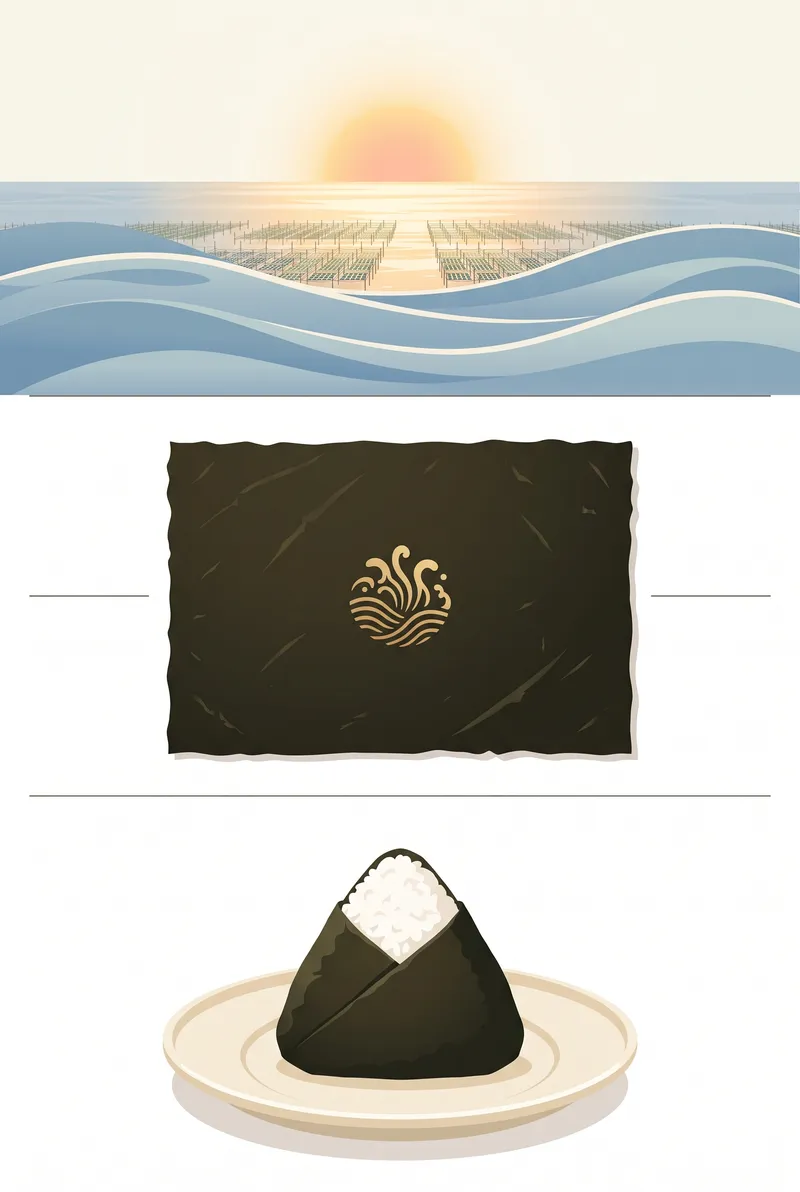
Nori is a word everyone knows and a product almost nobody outside Japan has met properly. The version in most kitchens is the commodity grade — fine for its job, and a different thing entirely from what the melt test is describing.
Buy plain roasted, first harvest, from a named sea, in full sheets, and eat the first one on its own over hot rice before it disappears into anything else.
And it is worth remembering how it was grown. Two thousand ten-metre poles pushed into mud by hand, nets hung at a calculated height, and a six-metre tide lifting the entire crop into the open air twice a day, every day, all winter.
Dashi: The Stock That Underlies Everything
Umeboshi: Salt, Time, and Nothing Else