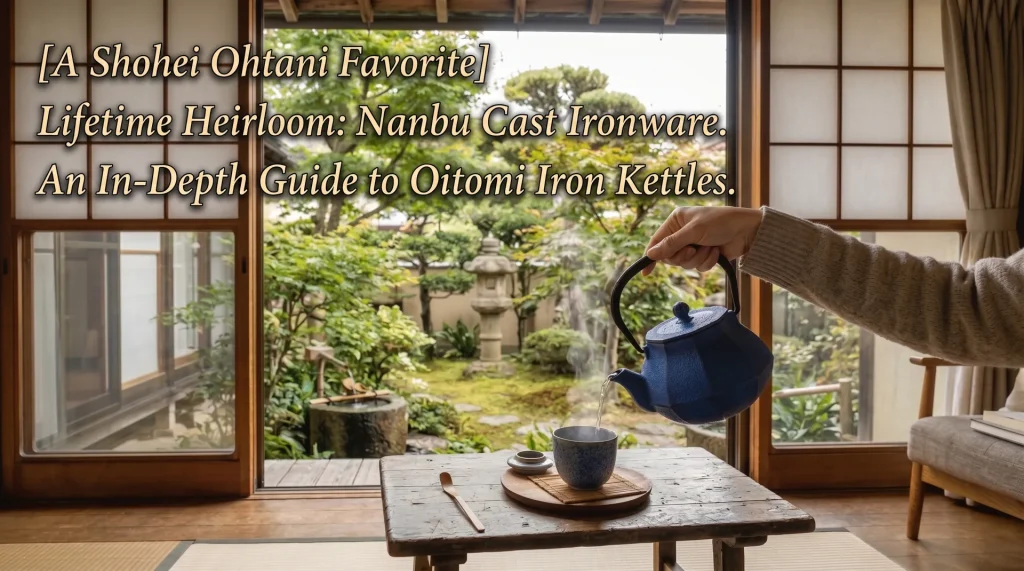
"Which Nanbu Tekki brand does Shohei Ohtani use?"
"I'm looking for a beautiful colored iron kettle — how does it perform and what do people say about it?"
The answers lead to one place: Oitomi, a cast iron workshop in Oshu City, Iwate Prefecture — one of Japan's oldest and most storied Nanbu Tekki makers.
Rooted in 900 years of Mizusawa casting tradition and founded over 170 years ago, Oitomi produces iron kettles in vivid colors that look equally at home on a contemporary dining table or in a Scandinavian-style room — a rare harmony of deep tradition and modern design that has attracted international attention.
The ferrous iron (Fe²⁺) that dissolves into water boiled in an Oitomi kettle also has scientifically documented health benefits — something more and more people are discovering.
This guide covers the full picture: the Ohtani connection, real user feedback, the science of iron absorption, and the three Oitomi pieces you can't go wrong with.
Quick Reference: Oitomi Nanbu Tekki Product Lineup
| Type | Features | Use | Size Range |
|---|---|---|---|
| Oitomi Iron Kettle (Tetsubin) | Direct flame safe · releases absorbable iron · beautiful color finishes | Boiling water · hot water for tea · morning white water | 0.5–1.2L (1–3 person) |
| Oitomi Sukiyaki Pan | Thick cast iron for even heat · locks in flavor | Sukiyaki · braises · stir-fry | 20–24cm (2–4 person) |
| Oitomi Cast Iron Teapot (Kyusu) | Interior enamel-lined · rust-resistant · no iron release | Pouring tea (direct flame NOT safe) | 0.3–0.6L (1–2 person) |
| Cast Iron Frying Pan | Seasons over time · far-infrared effect | Stir-fry · sauté · deep-fry | 20–28cm (general use) |
1. What Is Oitomi? Japan's Cast Iron Brand Loved by Shohei Ohtani
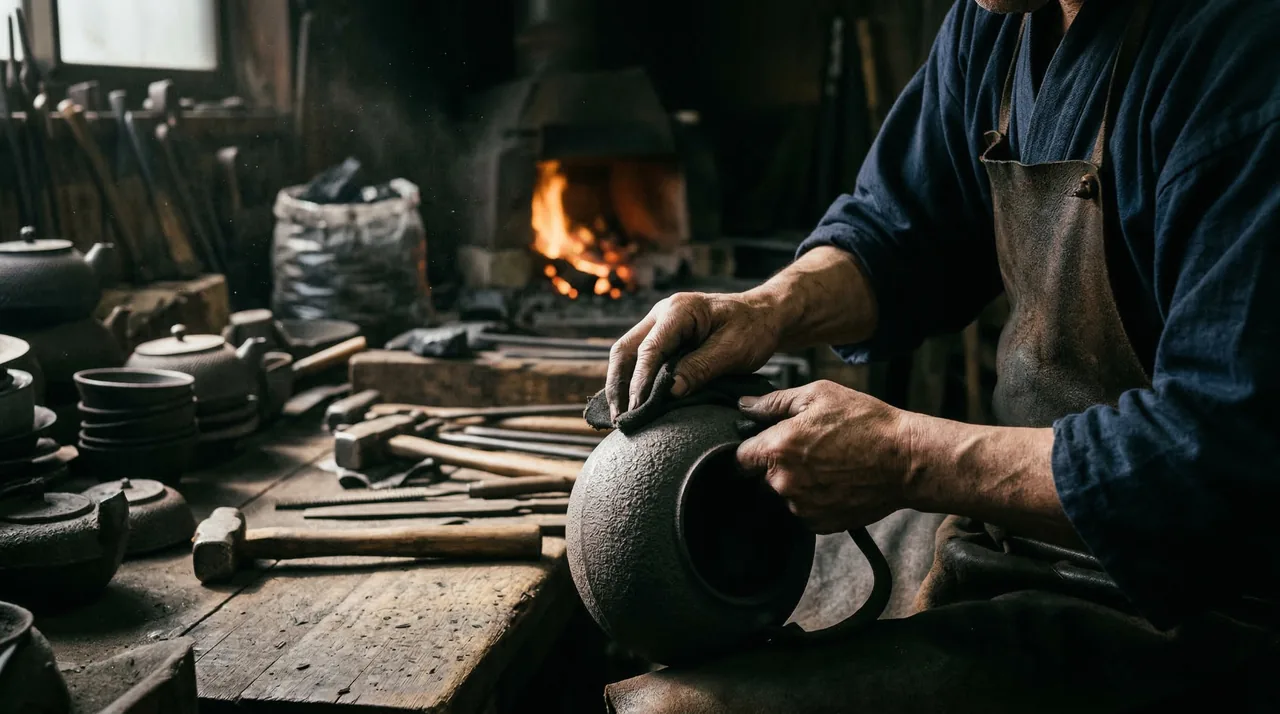
Full In-House Production from Oshu City, Iwate — No Shortcuts
Oitomi is a Nanbu Tekki (Southern Iron) maker based in Mizusawa, Oshu City, Iwate Prefecture. In an era when most workshops outsource at least some production steps, Oitomi is one of the rare workshops that handles everything in-house: design, casting, finishing, and coloring. Every craftsperson's eye touches every stage, which is how pieces with no compromises get made.
Color: The First Thing That Surprises You
Nanbu Tekki is typically associated with weighty black iron. What makes Oitomi immediately striking is its rejection of that expectation — in the form of vivid, refined color.
Deep lapis blue (瑠璃色, ruriiro), fresh young-grass green, pale cherry blossom — these Japanese traditional hues feel timeless while sitting naturally on a modern dining table or beside Scandinavian wood furniture.
Oitomi regularly exhibits internationally and has carved out a position as both traditional craft and art for everyday living.
2. 900 Years of History: The Mizusawa Casting Tradition and Oitomi's Legacy
Owning an Oitomi piece means connecting to one of Japan's oldest metalworking traditions. "Nanbu Tekki" as a name refers to cast iron made in both Morioka and Mizusawa — the two regions were unified under this shared name in 1959.
Mizusawa Casting: Born in the Heian Period
The casting tradition in Oshu City's Mizusawa district traces back roughly 900 years to the late Heian Period. Fujiwara no Kiyohira — the lord who built Hiraizumi's golden Chuson-ji temple — invited foundry craftspeople from what is now Shiga Prefecture to the area to produce iron implements for daily life and military use. The region's abundant iron sand, charcoal, and fine clay from the Kitakami River basin provided the perfect conditions for the craft to take root and develop its own character over centuries.
Founded 1848 — Over 170 Years of Continuous Craft
In this history-rich setting, Oitomi was founded in the late Edo period — 1848 (the first year of Kaei). For more than 170 years the workshop has passed down the lineage of Mizusawa iron casting, evolving with each era while maintaining the depth of that accumulated craft.
Today, Oitomi's younger craftspeople carry the workshop forward while sharing their work through social media — bridging a 170-year-old tradition with a global audience, including one very famous baseball player.
3. Which Oitomi Kettle Does Ohtani Use?
Oitomi became internationally famous when images of Shohei Ohtani's locker — featuring a strikingly blue iron kettle — circulated online. Fans worldwide asked the same question: "What is that beautiful blue kettle?"
The Deep Blue "Miyabi" — Ohtani's Reported Choice
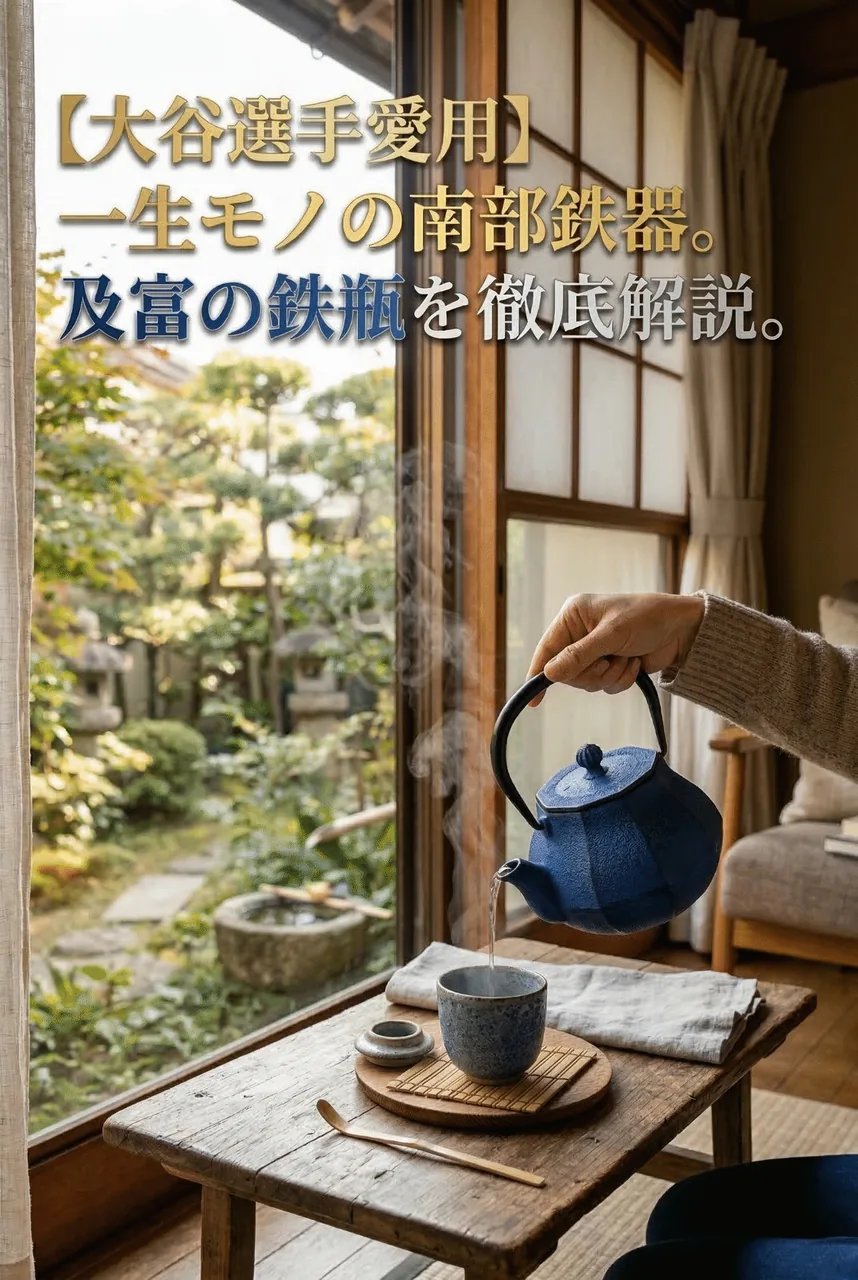
The kettle identified in Ohtani's locker is believed to be Oitomi's "Miyabi" (瑠璃色 / lapis blue) model — a deep, vivid blue that is visually close to Dodger Blue.
Miyabi features a rounded, gentle silhouette with the traditional arare (hailstone) pattern — a beloved motif in Nanbu Tekki. It strikes the balance between charming and elegant that has made it one of Oitomi's signature pieces.
That a world-class athlete uses an iron kettle to boil his daily white water — for the mineral-rich, smooth hydration it provides — has reintroduced the centuries-old wellness practice of tetsubin (iron kettle) water to a global audience.
Oitomi Miyabi Tetsubin (Blue / Various Colors)
- Style
- Round silhouette with traditional arare (hailstone) surface pattern
- Colors
- Lapis blue (most sought-after), black, and other colorways
- Capacity
- 0.4L–1.0L range; ideal daily companion for morning white water
⚠ High Demand — How to Buy Safely
The "Ohtani effect" has driven sustained demand for Oitomi's kettles, particularly the blue Miyabi — waitlists of several months are not uncommon. Be cautious of resellers asking inflated prices. Purchase only from authorized retailers or the official Oitomi online shop.
4. The Science: Why Ferrous Iron (Fe²⁺) from Cast Iron Is So Effective
The health practice of boiling water in an iron kettle isn't nostalgia — it has clear scientific backing.
5–6× More Absorbable Than Plant-Based Iron
The body absorbs iron in two forms: ferric iron (Fe³⁺, non-heme iron found in spinach and vegetables) and ferrous iron (Fe²⁺, found in meat and fish). Research published by the Japan Society of Cooking Science found that 80–95% of the iron that dissolves from Nanbu Tekki into water is ferrous iron (Fe²⁺) — the form the intestinal wall absorbs most efficiently.
Ferric iron from plant sources must first be converted inside the body before it can be absorbed, limiting uptake to around 2–5%. Ferrous iron from your Oitomi kettle skips that conversion and absorbs directly — at rates of roughly 15–25%, or 5–6× higher than dietary plant iron.
The daily habit of drinking white water boiled in an iron kettle is a gentle, cumulative way to support iron intake without supplements or digestive stress.
Science-Backed Tips to Maximize Iron Extraction
- Pair with vitamin C: Drinking lemon water or tea alongside your iron-enriched water boosts intestinal iron absorption further.
- Simmer longer: Rather than removing the kettle the moment it boils, allow a gentle simmer for 15–20 minutes. The longer the iron is in contact with hot water, the more ferrous iron dissolves.
- For cast iron pans: Cooking with acidic or salty ingredients (vinegar, miso) dramatically increases iron release from the metal into your food.
5. No Enamel Lining Means Iron — How Oitomi's Traditional Kiln-Firing Works
If iron supplementation is your goal, the most important thing to understand is the structural difference between a tetsubin (iron kettle) and a kyusu (iron teapot).
Enamel-Lined Teapots Release No Iron
Most compact iron teapots used for pouring tea have an interior coated in enamel (glass-fused finish) to prevent rust and tea staining. The glassy surface is easy to maintain, but because water never contacts bare iron, no iron is released. For iron supplementation, you need a kettle with no enamel lining — a true tetsubin.
Why an Unlined Kettle Doesn't Rust: The Kiln-Firing Technique
The obvious follow-up question: if there's no protective enamel, won't the iron rust immediately?
This is where Oitomi's traditional technique, kamayaki (kiln-firing / kinki dome), comes in. After casting, the raw iron is fired at approximately 900°C in a charcoal kiln, producing a dense blue-grey magnetite (Fe₃O₄) oxide layer across the entire interior surface. This layer acts as a rust barrier while remaining porous enough at a microscopic level to allow ferrous iron to dissolve into water — precisely the combination ancient craftspeople discovered and modern science has explained.
At Oitomi, this technically demanding kiln-firing step — where temperature control error can crack the piece — is performed entirely in-house by experienced hands.
6. Real User Reviews: What People Love (and What to Watch For)
Thinking about buying but unsure how it actually lives day-to-day? Here are real-world reactions from Oitomi owners.
Positive Feedback: "The Water Tastes Rounder" / "Works with Nordic Interiors"
"Water from an electric kettle always has a faint chlorine smell. Oitomi water is noticeably rounder and almost sweet. Iron absorbs residual chlorine, which is part of what makes it so smooth. I drink it every morning and it's become my ritual." (woman, 40s)
"Bought the Swallow Pot. It's Nanbu Tekki but somehow very modern — I leave it on the counter next to the pour-over coffee setup and it doesn't feel out of place at all. The Nordic vibe works perfectly." (man, 30s)
Common Concern: "It's Heavy" — and What to Do About It
"It's heavier than I expected. I bought the 1L model, and when it's full, one-handed pouring is genuinely hard."
[Solution]
The weight is inherent to cast iron's thermal mass — it's what makes the heat retention (and the water quality) so good. If wrist strain concerns you, choose a smaller model in the 0.5–0.8L range. A 0.5L kettle is light enough to use one-handed and produces two cups of hot water at a time — perfectly sized for a solo daily ritual. Oitomi's compact lineup is well-suited to this.
7. The 3 Oitomi Pieces You Can't Go Wrong With
From Oitomi's full range, these three stand out as ideal first purchases and exceptional gifts.
Recommendation 1: The Modern Design Icon — "Swallow Pot"
A tetsubin that captures Oitomi's design ethos perfectly. The sharp, swallow-inspired spout and minimal form make it feel like a contemporary object — yet it pours with the precision needed for pour-over coffee as well as tea. Works beautifully in both Western and Japanese spaces. Functional, handsome, and deeply practical.
- Design
- Swallow-inspired sharp spout; streamlined modern profile
- Use
- Boiling water for tea, pour-over coffee, daily white water
- Iron release
- Yes — no interior enamel lining
Recommendation 2: The Ohtani Model — "Miyabi" (Black / Blue / More)
The famous Miyabi series — the lapis blue version went viral, but the traditional black and other colors are equally refined. The rounded, approachable silhouette with arare patterning combines warmth and dignity. Available in 0.4L–1.0L sizes. The right scale for everyday morning white water.
- Design
- Round body with arare (hailstone) surface pattern; multiple color options
- Best color
- Lapis blue is the most sought-after; black and other hues also available
- Iron release
- Yes — no interior enamel lining
Recommendation 3: For Daily Tea — "Hisago" and Other Teapots
Hisago (gourd shape) and other Oitomi cast iron teapots make extremely popular gifts. These are kyusu (teapots) with interior enamel lining — they won't release iron into your tea, but they're also nearly rust-proof and hold heat beautifully. Nanbu Tekki's superior heat retention keeps your tea warm far longer than ceramic or glass. Ideal for anyone who wants cast iron's thermal performance without the maintenance demands of an unlined tetsubin.
- Design
- Hisago (gourd-shaped) and other classic kyusu forms
- Interior
- Enamel-lined — rust-resistant, no iron release, direct flame NOT safe
- Best use
- Pouring tea, keeping tea warm; excellent gift choice
8. Proper Care: Building Scale Deposits and Long-Term Maintenance
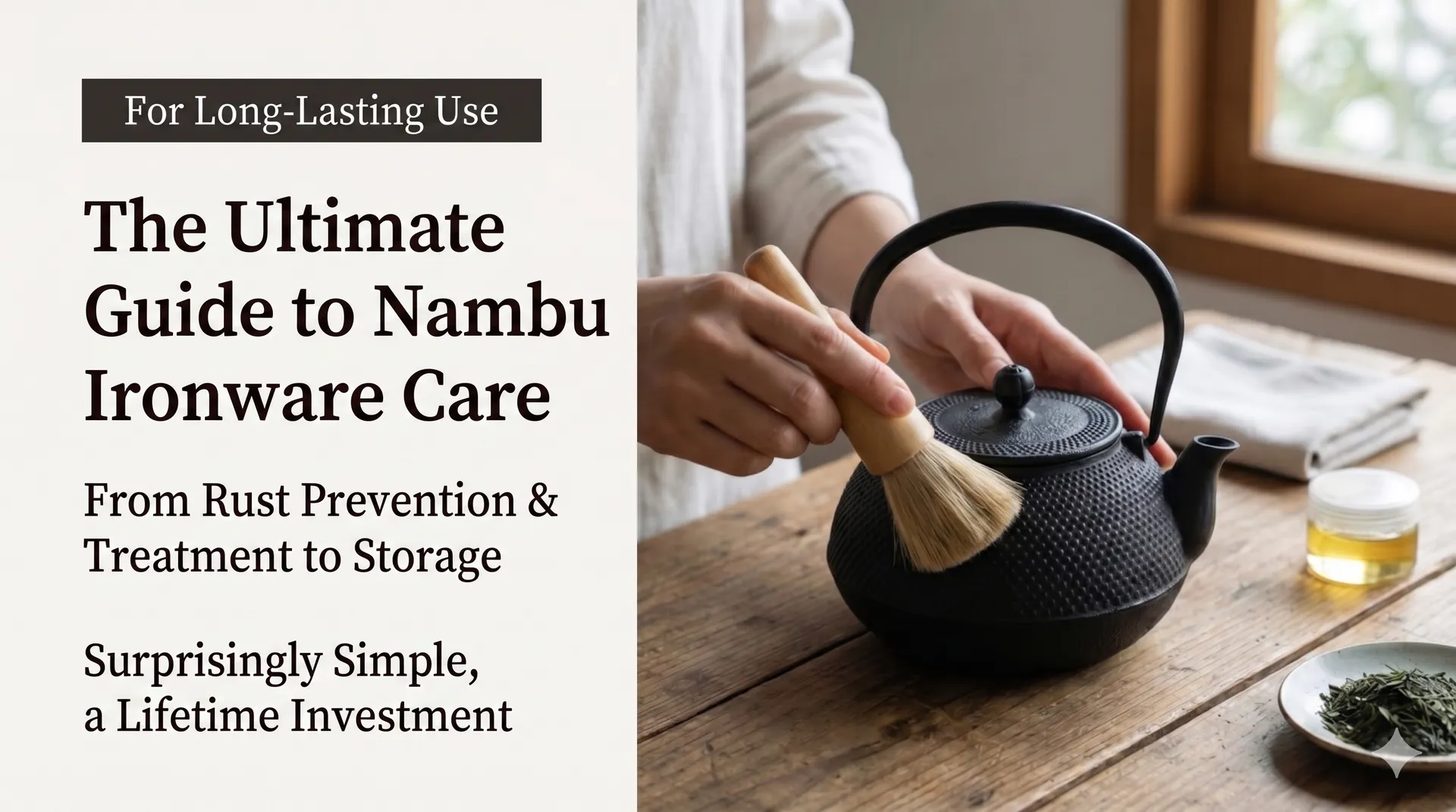
An Oitomi tetsubin (unlined) cared for correctly can last not just a lifetime but generations. The rules are simple — just two.
- Never touch, scrub, or wash the interior (no brush, no soap — ever)
- After every use: empty the water immediately, remove the lid, and dry over low heat or residual warmth until fully dry
The Critical First Month: Hard Water Scale Deposits
The key to a long-lived tetsubin is establishing a layer of natural scale deposits (yuka) on the interior in the first month of use. Simmer hard mineral water (brands like Evian from the store work well) every day during this period.
The calcium and magnesium in hard water crystallize on the inner walls as a white coating. This natural mineral layer forms a barrier between the iron and the water, preventing rust while simultaneously making the water taste even smoother. The rule: never let water sit and cool inside the kettle — that is how you grow clean, protective scale.
If Rust Appears: The Green Tea Recovery Method
If the water starts smelling or tasting strongly metallic, the interior may have developed rust. Don't panic — it's recoverable.
Add green tea leaves and simmer for 20–30 minutes. The tannins in green tea react with the iron to form a black tannin-iron compound that coats the surface, stopping rust progression and restoring clean-tasting water.
Tetsubin Care & Rust Removal: A Complete Guide to Scale Deposits and the Green Tea Treatment
Frequently Asked Questions
How is Oitomi different from other Nanbu Tekki brands?
Two things stand out: full in-house production and the color palette.
In an industry that increasingly relies on outsourced steps, Oitomi handles everything — design, casting, kiln-firing, and coloring — in their Oshu City workshop. Their vivid traditional-color finishes (lapis blue, young grass green, cherry blossom pink) that blend seamlessly into modern interiors are genuinely unlike anything else in the market.
What makes ferrous iron (Fe²⁺) from the kettle special?
It absorbs 5–6× more efficiently than plant-based iron.
Ferrous iron doesn't require stomach-acid conversion before intestinal absorption. Studies suggest absorption rates of 15–25%, vs. around 2–5% for non-heme iron from vegetables. For women, athletes, and anyone watching iron levels, a daily cup of kettle water is an effective, gentle supplement.
There are white spots inside my kettle. Should I clean them off?
Absolutely do not clean them — those are scale deposits (yuka), which are exactly what you want.
Crystallized calcium and magnesium from your water form a natural mineral coating that protects the iron and softens the water's flavor. The whiter and thicker it gets, the better your kettle is performing. This is the goal.
Does it come in gift packaging?
Yes — Oitomi products come in presentation boxes suitable for gifting as-is.
Popular for weddings, housewarmings, and parents' milestone birthdays. Authorized retailers typically offer gift wrapping on request.
Does it work on an IH (induction) cooktop?
Depends on the model — always check the product specs before purchasing.
IH compatibility requires a flat bottom and sufficient thickness to handle induction heat. Many of Oitomi's smaller, traditionally-shaped kettles are designed for direct gas flame only. If you cook on IH, make this the first thing you confirm.
If it rusts badly, can it be repaired?
Yes — Nanbu Tekki is a tool passed down through generations, and repair is possible.
If the green tea method doesn't resolve severe rust or water leakage, historic foundries like Oitomi can perform paid "re-firing" (kiln-firing rust treatment) on a case-by-case basis. Unlike disposable cookware, a Nanbu Tekki kettle can be restored and continue its life.
Final Thoughts: Start Your Tea Time with an Oitomi Kettle
The global spotlight that Shohei Ohtani brought to Oitomi illuminated something that has been true for 170 years: the value of craft that combines scientific benefit, breathtaking beauty, and daily usefulness all at once.
Every morning, the Oitomi kettle hisses quietly on the stove. You pour the smooth, iron-enriched water into your cup. That small ritual — a few minutes of deliberate, unhurried attention — is what the best tools make possible.
Find your Oitomi. Let it become part of your mornings.
Nanbu Tekki: How to Choose the Best Brands of Japanese Cast Iron
Tetsubin Care & Rust Removal: Scale Deposits, Green Tea Treatment, and More