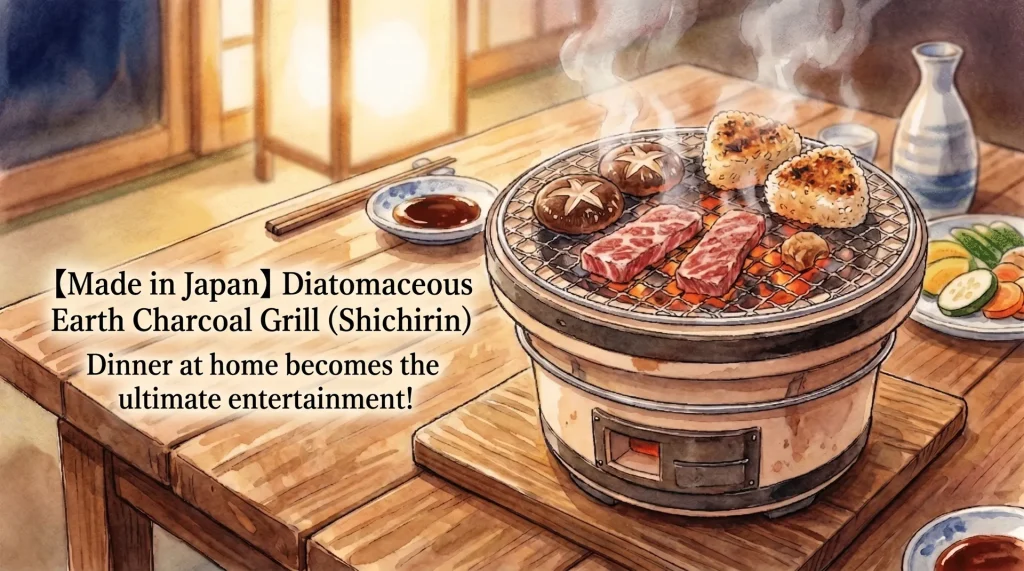
Want to turn an ordinary weeknight dinner into something the whole family will remember?
The answer is a Japanese diatomite shichirin (charcoal grill) — a tabletop ceramic brazier handcrafted by artisans in regions like Noto, Ishikawa, and Mikawa, Aichi.
"Isn't charcoal grilling dangerous indoors?" you might wonder. With the right tool — specifically a 珪藻土 (diatomite) shichirin that comes with a wooden stand — and two simple safety rules, you can safely use it right on your dining table.
The far-infrared heat from the charcoal, amplified by the diatomite itself, transforms budget supermarket beef and shiitake mushrooms into something that tastes like a high-end restaurant. While the charcoal crackles and the family gathers around the grill, watching food sizzle together — that's a dinner no one forgets.
From our series: This article is part of our "Lifetime Kitchen Tools" guide collection.
Quick Reference: Shichirin Materials at a Glance
| Material | Heat Retention | Weight | Durability |
|---|---|---|---|
| Diatomite (mainstream) | ◎ Exceptional insulation & heat retention | ○ Light to medium | ○ Avoid sudden cooling or impact |
| Red clay | ○ Good heat retention | △ Somewhat heavy | ○ Stronger than diatomite |
| White clay | △ Moderate heat retention | ○ Light | △ Prone to cracking |
| Black clay (Noto-style) | ◎ Best heat retention of all | △ Heavy | ◎ Most durable, longest lifespan |
1. Why Japanese Diatomite? The Science of Far-Infrared Heat
Hardware stores carry plenty of cheap imported shichirin and metal BBQ grills. But if you want something safe, enjoyable, and long-lasting at home, a pure Japanese-made diatomite shichirin from Noto or Mikawa is in a different league entirely.
Far-Infrared Heat: The Secret to Unbeatable Flavor
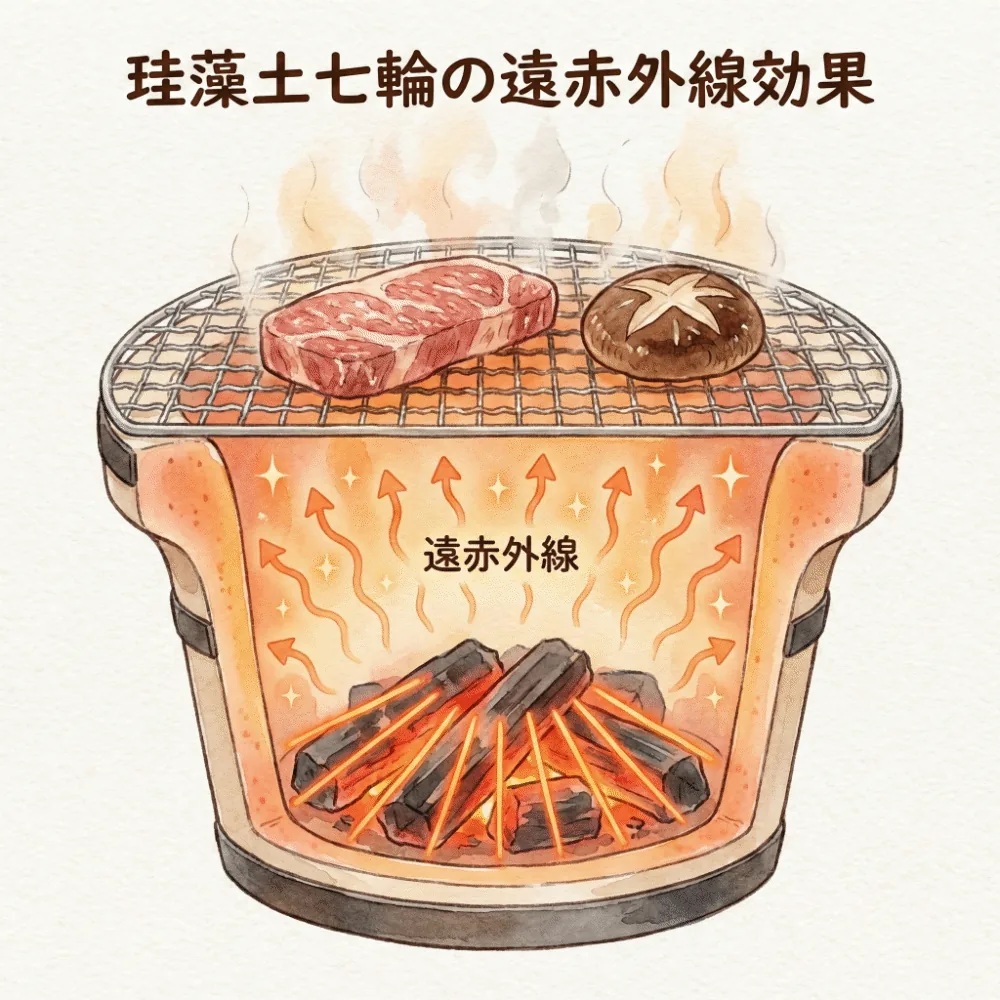
The defining advantage of a Japanese diatomite shichirin is the combination of outstanding insulation and far-infrared radiation.
Metal grills lose heat to the surrounding air almost immediately. Quality Noto diatomite, once warmed, holds powerful heat inside with very little charcoal. More importantly, the heated diatomite itself radiates far-infrared energy in all directions (Planck's law), surrounding food with efficient electromagnetic heat from every angle.
Near-infrared seals the surface quickly while far-infrared vibrates molecules deep inside, generating frictional heat that locks in juices — producing that iconic crispy-outside, juicy-inside result.
Over 1,000 Years of Craftsmanship: Hand-Carved from the Earth
The Noto Peninsula in Ishikawa Prefecture is one of Japan's largest diatomite deposits. Archaeological evidence shows this material was used as fireproof insulation in salt-production kilns as far back as the Kofun and Nara periods — over 1,000 years ago.
Today, skilled artisans still hand-carve shichirin using chisels from veins 30 meters underground. This kiri-dashi (cut-and-carved) method is the only way to preserve the nano-scale porous air pockets formed by ancient plant plankton — and that structure is precisely what gives modern diatomite its magical insulating and heat-retaining performance.
2. Our Top Pick: Pure Japanese-Made Diatomite Shichirin
A Japanese artisan-made diatomite shichirin is beautiful on the table and perfectly suited to Japanese-style meals. Here is the classic tabletop model that's easiest to find online and most practical for home use.
Pure Japanese Diatomite Shichirin — Round with Wooden Stand
A timeless Japanese classic. Beautiful enough to be the centerpiece of your table.
Hand-fired by artisans in Noto or Mikawa using pure domestic diatomite. The brass hoop and traditional washi paper finish give it a refined, authentic look that elevates any dining table.
For tabletop use, always choose a model that includes a wooden stand — it protects your table from the intense heat from below.
The round form is the classic choice, ideal for a family of 3–4 gathered around grilling beef and vegetables together.
3. Two Rules for Safe Indoor Charcoal Grilling
"Charcoal indoors sounds dangerous…" — it doesn't have to be. Follow two simple rules and you'll find that lighting and cleaning up charcoal is surprisingly easy and safe.
Rule 1: Always Use a Wooden Stand — and Ventilate
When using a shichirin indoors, ventilation and table protection are the two most critical things.
To prevent carbon monoxide buildup, use it directly under a kitchen exhaust fan, or open windows wide for strong airflow.
The bottom of the diatomite body gets extremely hot. Never place it directly on the table — always use the included wooden stand or a thick trivet.
Rule 2: Extinguish Charcoal in a Fire-Extinguishing Pot
After your meal, never pour water on still-glowing charcoal. The sudden temperature change can crack the diatomite body.
Instead, use tongs to transfer remaining charcoal into a hikeshi-tsubo (fire-extinguishing pot), close the lid, and cut off the oxygen — safe and done. The cooled charcoal (called keshi-sumi) can be reused as a fire-starter next time, making this process remarkably eco-friendly.
4. What to Grill: Yakitori, Shiitake, Rice Balls & More
Once you have a shichirin, your ordinary weeknight dinner transforms into something special. Here are the best foods to try over charcoal.
| What to Grill | Why It's Incredible over Charcoal |
|---|---|
| Budget beef & yakitori |
[Charcoal smoke is the ultimate seasoning] Dripping fat hits the charcoal, vaporizes, and rises back up to coat the meat with a smoky aroma that turns supermarket cuts into something that tastes like a premium yakiniku restaurant. |
| Shiitake & vegetables |
[Umami juice wells up inside] Far-infrared heat penetrates vegetable cells slowly and evenly. Flip a shiitake upside-down and watch the umami liquid pool in the cap. A pinch of salt is all you need. |
| Rice balls & mochi |
[Crispy outside, piping hot inside] Brush with soy sauce little by little as they toast. Kids love to help, and the hands-on process makes this a natural, engaging food education activity for the whole family. |
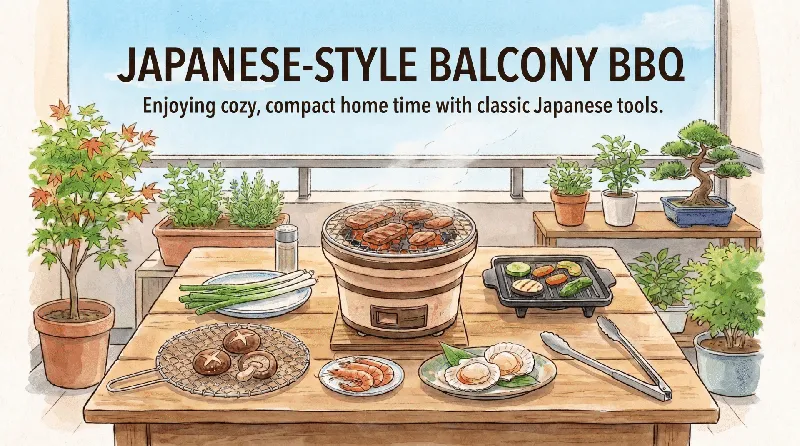
🍡 Thinking about outdoor charcoal grilling on your balcony? Check this out:
Frequently Asked Questions
Can I use a shichirin on an apartment balcony?
It depends on your building's rules and local regulations. Many apartments prohibit open-flame use, including charcoal, on balconies. Check with your building management before use. If permitted, always consider smoke and odor impact on neighbors, and confirm fire safety equipment is nearby.
Starting charcoal sounds difficult. Any tips for beginners?
A firelighter plus a chimney starter is the fastest route.
Place a firelighter cube under the charcoal in the chimney starter, set it on a gas burner, and wait 2–3 minutes. Even beginners get reliable results this way. For the easiest start, use formed charcoal (ogatan) rather than binchotan — it ignites far more easily.
Isn't diatomite shichirin fragile?
The main risks are impact from dropping and sudden temperature changes.
As long as you never pour cold water on it during or right after use, a diatomite shichirin can last for decades. Japanese-made models fired by skilled artisans have consistent material quality and excellent durability.
How much charcoal should I use?
Fill the inside to about 70–80% of its height.
Too little and the fire dies mid-meal; too much and excessive heat transfers to the outside of the body, which can be dangerous. Start conservatively and add charcoal as needed. For tabletop use, 2–3 pieces of formed charcoal is a good starting point.
What's the difference between a mass-produced shichirin and a hand-carved Noto one?
The manufacturing method creates a completely different level of insulation and durability.
Inexpensive "nerimono" (molded) shichirin found at hardware stores are made by pulverizing diatomite, mixing it with binders, and pressing it in a mold. This process collapses the microscopic air pockets, significantly reducing insulation — the outer body gets hot quickly and charcoal burns through faster.
A hand-carved kiri-dashi shichirin preserves those air pockets perfectly, meaning less charcoal consumption and a body that stays cool enough to touch safely on the sides.
Can I wash it with dish soap?
Absolutely not. Water is the enemy of diatomite.
Diatomite has countless microscopic pores — washing it allows water to soak deep inside, causing serious deterioration. If wet diatomite is then heated, rapidly expanding steam can split it in two with a loud crack.
For cleaning, wait until it's completely cool, then wipe the surface quickly with a tightly wrung-out damp cloth, or brush off residue with a dry tawashi (scrub brush). Nothing more.
5. Final Thoughts: Gathering Around the Fire
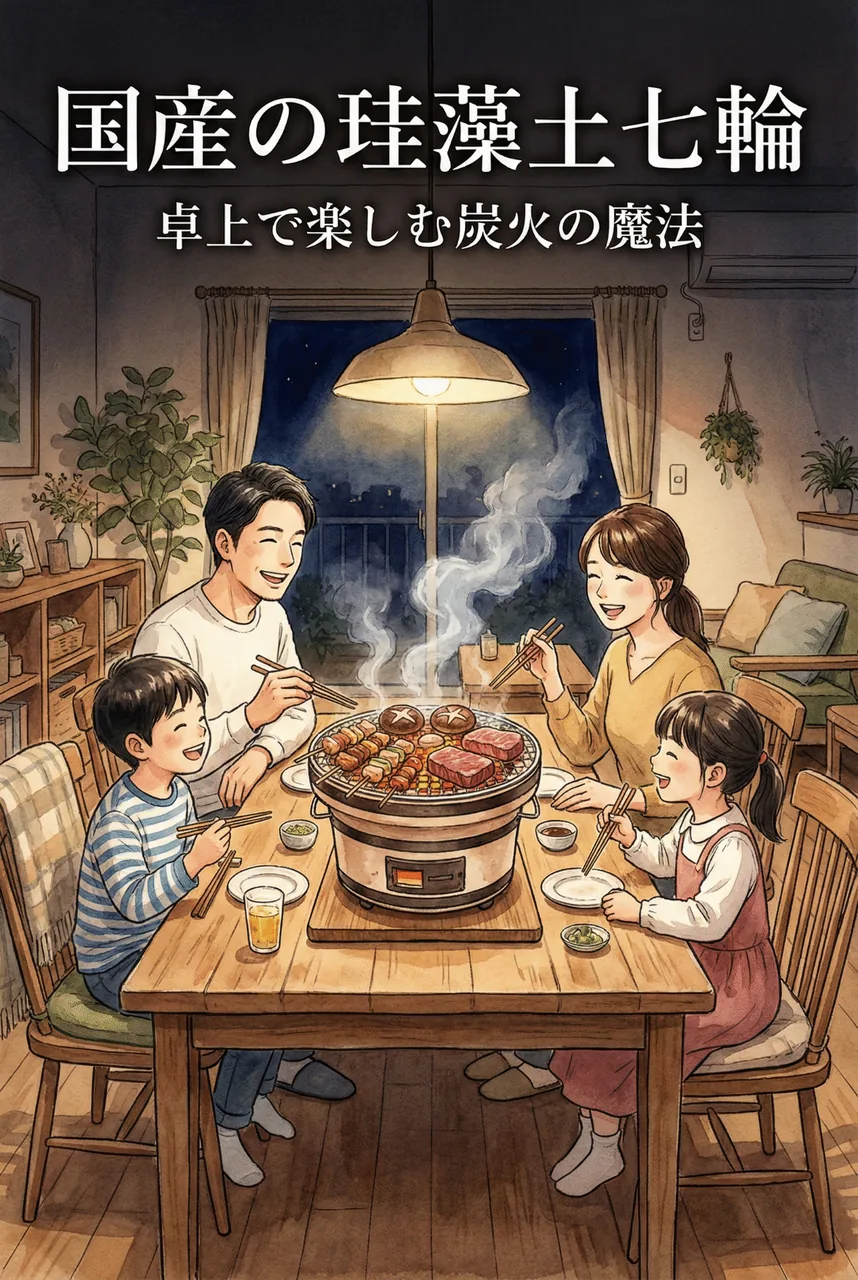
A home-cooked dinner is wonderful. But add a shichirin, and the dining table itself becomes the kitchen.
"Is the beef done yet?" "The shiitake is releasing juice!" — everyone gathered around the grill, listening to the crackle of charcoal, peeking at what's sizzling.
The warmth of fire, the shared anticipation of food cooking — this primitive ritual leaves a lasting impression, especially on children who grow up with these sensory memories of family dinners.
A lifetime diatomite shichirin, hand-fired from earth by Japanese artisans.
This weekend, turn off the TV and start the most delicious entertainment your kitchen table has ever seen.
Kamenoko Tawashi: Japan's Beloved Scrub Brush for Cast Iron and More
Nanbu Tekki: Japan's Best Cast Iron Brands, Compared and Reviewed