
"Can I put this in the microwave?"
"Arita-yaki and Hasami-yaki look similar — what's actually different?"
If you've ever hesitated over a beautiful piece of Japanese pottery at a craft market or a shop in Kyoto, you're not
alone. Japan's ceramics divide into two fundamental categories — stoneware (tōki) and
porcelain (jiki) — and each has a distinct character, a different feel in the hand, and
its own set of foods it shows off best.
The short answer: if you want something you can use freely every day without worry, choose porcelain like
Hasami-yaki. If you want a bowl that makes simmered winter dishes look like they came from a Japanese
inn, choose stoneware like Mashiko-yaki.
But knowing why — the geology of each region, the history behind each kiln town — turns ceramics from tableware into
something that changes how you eat. This guide maps the major Japanese pottery regions and shows you exactly which
dishes each one was made for.
Quick Reference: Stoneware vs. Porcelain at a Glance
| Feature | Stoneware (tōki) | Porcelain (jiki) |
|---|---|---|
| Raw material | Clay (earth) | Ceramic stone (ground rock) |
| Feel & weight | Thick, warm, earthy | Thin, hard, smooth |
| Microwave | Use with caution (absorbs water, can overheat) | Generally fine (avoid gold/silver decoration) |
| First use | Conditioning (medome) recommended | Wash and use immediately |
| Key regions | Mashiko, Shigaraki, Bizen | Arita, Hasami, Mino |
| Best for | Simmered dishes, miso soup, café-style food | Western food, breakfast plates, sashimi, salads |
1. Stoneware vs. Porcelain — The Core Difference
The material and firing temperature determine everything about how a piece of ceramic behaves — its weight, its
texture, how it sounds when you tap it, and which foods it suits.
Start here before anything else.
Earth vs. Stone
| Feature | Stoneware (tōki) | Porcelain (jiki) |
|---|---|---|
| Material | Clay | Ground ceramic stone |
| Texture | Thick, warm. Absorbs moisture. | Thin, hard. Non-porous (glassy smooth). |
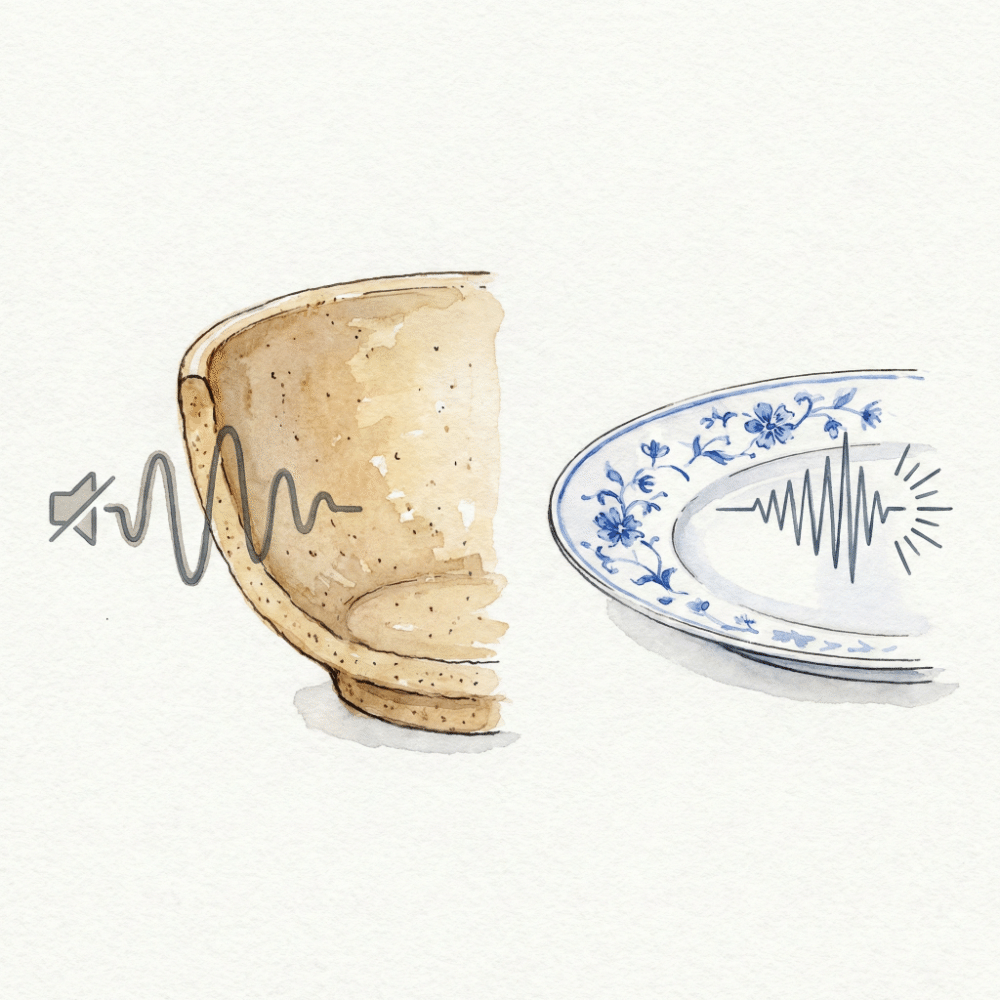
| Sound when tapped | "Thunk" (dull, earthy) | "Ting" (high, metallic ring) |
| Light | Opaque — no light passes through | Translucent — thin walls glow in light |
Easy test at a shop:
Flip the piece and look at the unglazed foot ring (kōdai) at the base. If it's rough and
earthy-colored, it's stoneware. If it's smooth and white, it's almost certainly porcelain.
2. The Three Major Ceramic Regions — Mino, Seto & Arita
Japan has dozens of named ceramic traditions, but three regions account for the vast majority of what you see on
Japanese tables every day.
Understanding these three is understanding the backbone of Japanese ceramics.
The Three Regions at the Core
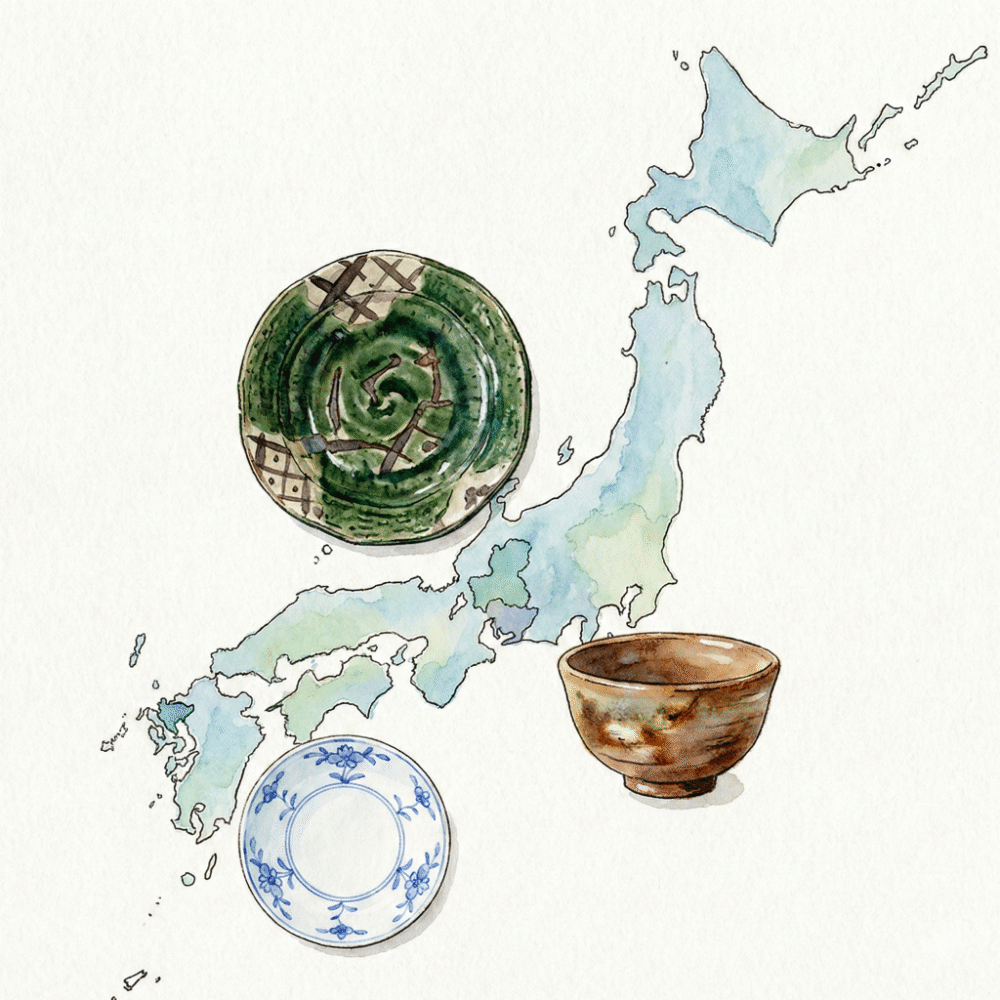
- Mino-yaki (Gifu Prefecture):
Over 50% of all tableware used in Japan comes from Mino. It encompasses an enormous range of styles — from the bold green oribe glaze to the soft white shino — and it is the region that most quietly shapes daily Japanese eating. - Seto-yaki (Aichi Prefecture):
The word setomono (瀬戸物) literally became the Japanese word for "pottery" — testament to how central Seto's thousand-year history has been. Uniquely, Seto produces both stoneware and porcelain, making it one of the most versatile kiln regions in the world. - Arita-yaki (Saga Prefecture):
The birthplace of Japanese porcelain. When kaolin deposits were discovered here in the early 17th century, Japan's first true porcelain was fired — and the resulting blue-and-white ware was eventually exported to Europe under the name "Imari," where it influenced Delftware and Meissen alike.
3. Porcelain Regions — Arita & Hasami for Everyday Plates
Northern Kyushu sits above some of Japan's finest ceramic stone deposits — ideal for firing porcelain.
The region's clean, non-porous surfaces resist oil and stain, and they suit the visual freshness of Western-style
plating.
Arita-yaki (Saga) — Special Occasions and Sashimi Plates
Arita porcelain's translucent white clay and sharp cobalt-blue sometsuke designs make it feel like tableware and art simultaneously. Best for celebratory spreads — New Year's osechi dishes, sashimi presentations, anything you want to make look special. Modern producers like 1616/arita japan also offer minimal, undecorated Arita pieces that work beautifully with European-style plating.
- Material / Type
- Porcelain (jiki) — kaolin stone-based
- Made in
- Arita, Saga Prefecture, Japan
- Best for
- Special occasions, sashimi, elegant plating
- Price range
- $20–$80 per piece
Hasami-yaki (Nagasaki) — Everyday Stacking Porcelain
Made in the town neighboring Arita, Hasami ware has always been "the people's ceramic" — designed for daily use rather than display. Pieces stack cleanly, chip-resist well, and wear gracefully. Brands like Hakusan Toki produce Hasami ware that pairs as easily with Scandinavian cutlery as with Japanese chopsticks.
- Material / Type
- Porcelain (jiki) — stackable, durable
- Made in
- Hasami, Nagasaki Prefecture, Japan
- Best for
- Daily use, breakfast plates, versatile pairing
- Price range
- $15–$50 per piece
4. Stoneware Regions — Mashiko & Shigaraki for Warmth and Wabi
The thickness of stoneware insulates food longer — a hot dish served in a Mashiko bowl stays warm well into the
meal.
And the earthy tones of stoneware glazes make "brown food" — simmered meats, root vegetables, miso dishes — look
more beautiful than any white plate could.
Mashiko-yaki (Tochigi) — Mingei Stoneware for Simmered Dishes
Mashiko's characteristic thick forms and deep brown or black glazes (kaki-yu, nuka-shiro) embody the mingei ideal of beauty in everyday utility. Best for nikujaga, braised burdock root, pork miso soup in a deep bowl. Matte-glazed Mashiko pieces have become the defining aesthetic of the Japanese "home café" table setting.
- Material / Type
- Stoneware (tōki) — thick, earthy, insulating
- Made in
- Mashiko, Tochigi Prefecture, Japan
- Best for
- Simmered dishes, miso soup, café-style home meals
- Price range
- $20–$60 per piece
Shigaraki-yaki (Shiga) — Donabe Clay Pot for Rice
One of Japan's Six Ancient Kilns, Shigaraki clay is exceptionally fire-resistant — ideal for cooking vessels that go directly onto heat. The reddish-brown fire marks are a record of the kiln's atmosphere, each piece unique. Rice cooked in a Shigaraki donabe clay pot has a quality that a metal rice cooker simply cannot replicate — individually tender grains with a lightly crisp bottom crust (okoge).
- Material / Type
- Stoneware (tōki) — fire-resistant, porous
- Made in
- Shigaraki, Shiga Prefecture, Japan
- Best for
- Rice cooking, donabe hot pot, direct heat cooking
- Price range
- $40–$120
5. The Six Ancient Kilns — Bizen's Unglazed Magic
Japan's Roku-koyō (六古窯) — the Six Ancient Kilns — are the oldest continually operating ceramic traditions
in the country.
Bizen, Tokoname, Tamba, Echizen, Seto, and Shigaraki. Among them, Bizen-yaki stands apart for a
specific and verifiable reason: it changes how beverages taste.
The Bizen Effect — Why Beer and Coffee Taste Different
Beer:
Bizen ware's surface is covered in microscopic irregularities — tiny ridges from the unglazed clay's natural
texture. When beer is poured into a Bizen mug, these ridges act like nucleation points, generating finer, more
persistent foam with a creamier texture than you would get in a glass.
Coffee:
The porous clay absorbs some of the volatile compounds responsible for coffee's sharper, more astringent notes —
effectively softening the cup without adding anything. Coffee brewed or served in Bizen ware frequently tastes
rounder and more balanced.
Fish dishes and flowers:
Bizen's natural absorption also keeps flower water from stagnating — a reason it has been prized as a vase
medium for centuries. The same property makes it ideal for grilled fish: the clay absorbs excess moisture from
the surface of the plate rather than letting it pool, keeping the dish drier and crisper for longer.

6. Pairing Dishes to Ceramics — Three Rules That Work
"Which plate should I use for this dish?"
Think of it the way you think about getting dressed — coordinate by material, leave room to breathe, and learn to
enjoy the imperfections.
Three Rules Worth Knowing
- Match material to temperature (or intentionally contrast it):
Warm, simmered food → warm-feeling stoneware. Cold salads and raw fish → cool, clean porcelain or glass.
This is the baseline. Once you know it, you can break it deliberately — cold silken tofu on dark Bizen stoneware is a striking contrast that works precisely because you are subverting the expected pairing. - Leave 30% of the plate empty:
A plate piled to the edges looks rushed, regardless of how good the ceramic is. Mound the food toward the center and let the plate breathe around it — that margin is what distinguishes restaurant plating from everyday home serving. - Appreciate kannyu (crackle glaze) as the vessel's biography:
Fine hairline cracks in stoneware glazes — called kannyu (貫入) — are not damage. They form during cooling as the glaze and clay contract at different rates. Over years of use, tea, broth, and wine slowly seep into these cracks and stain them, creating an accumulating map of every meal the piece has participated in. In Japanese aesthetics, this is called "growing the vessel's scenery" (keshiki wo sodateru).
When a Piece Breaks — Kintsugi as an Alternative to the Bin
No matter how carefully you handle them, ceramics eventually break. Throwing away a piece you love — especially
one by an artist you admire, or one connected to a memory — feels wrong.
The traditional Japanese answer is kintsugi (金継ぎ): repairing the break with urushi lacquer and
dusting the seams with gold powder, so the crack becomes a new feature of the piece rather than evidence of
damage.
Both stoneware and porcelain can be kintsugi-repaired at home with beginner kits — the results range from
functional to genuinely beautiful.
7. Microwave, Dishwasher & Conditioning — Care by Type
A few rules keep your ceramics lasting. Most are simple once you know which category a piece belongs to.
Care Differences: Stoneware vs. Porcelain
| Care Task | Stoneware (tōki) | Porcelain (jiki) |
|---|---|---|
| First use | Conditioning (medome)
recommended. Simmer in rice-wash water to seal pores. |
Wash and use immediately. |
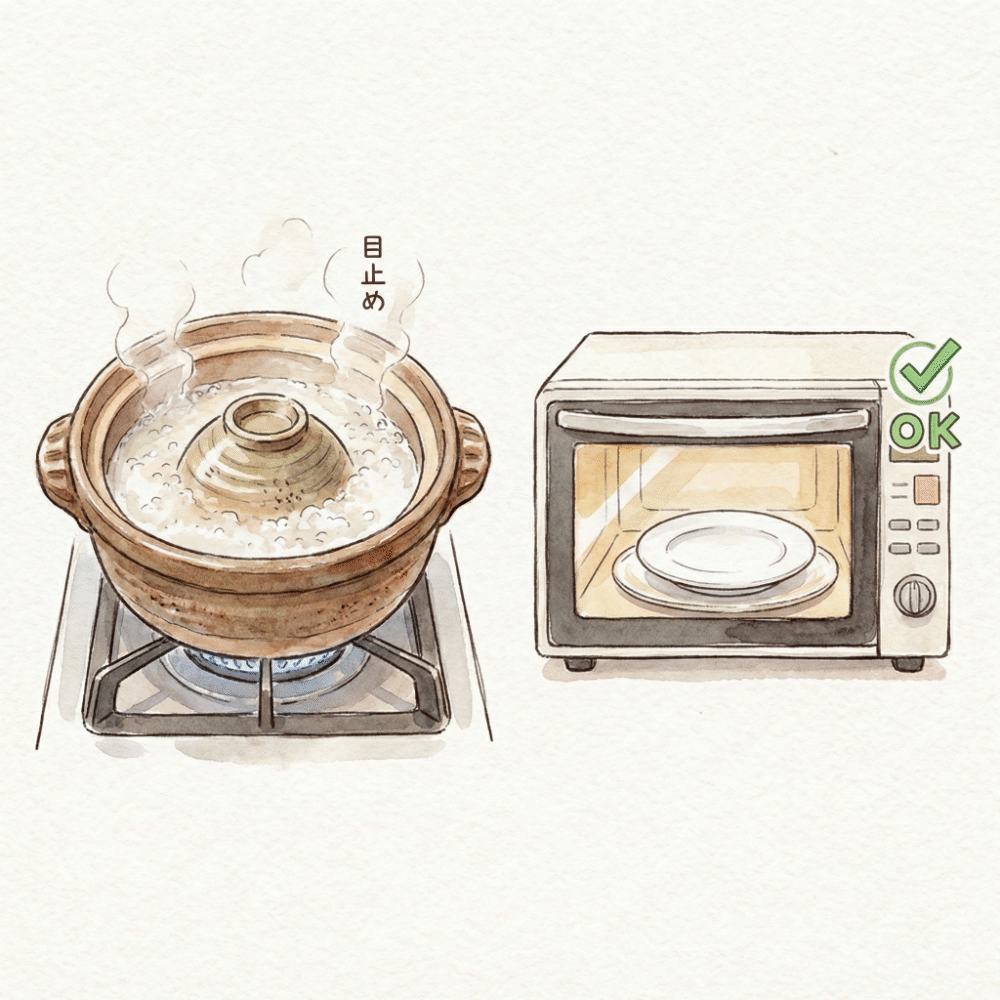
| Microwave | Use with caution. Absorbed water can heat up and crack the piece at high temperatures. | Generally safe. Avoid pieces with gold or silver decoration. |
| Dishwasher | Not recommended — water pressure can chip the unglazed foot ring and cause micro-cracks. | Generally fine. |
| Bleach | Do not use — bleach penetrates the clay and is very difficult to remove. | Effective for removing tea stains. |
Medome (conditioning) for stoneware: place the piece in a pot, submerge in rice-wash water, bring to a gentle simmer for 20 minutes, and let cool in the water. The starch fills micro-pores in the clay, reducing staining and odor transfer during use.
8. Frequently Asked Questions
I want to make gratin in the oven. Which ceramics are safe to use?
Only pieces explicitly labeled "heat-resistant" (耐熱) — not standard stoneware or porcelain.
Regular ceramics crack under the rapid temperature changes of an oven. For oven cooking, look for pieces made from
the same coarse, fire-resistant clay used in Iga-yaki or Shigaraki donabe cooking pots — they are specifically
made to handle direct heat and oven temperatures. Purpose-made ceramic gratin dishes are clearly labeled.
My stoneware has developed mold. What do I do?
Treat with baking-soda water boiling, then dry in full sun for several days.
Stoneware's absorbent clay makes mold possible if pieces are stored damp. Simmer the piece in water with a
spoonful of baking soda for 20 minutes to kill the mold, then set it in direct sunlight for two to three days
until completely dry. When storing, slip a sheet of newspaper between stacked pieces — the paper absorbs excess
moisture.
A favorite piece broke. Can it be repaired?
Yes — kintsugi (金継ぎ) is exactly for this.
Kintsugi uses urushi lacquer as an adhesive and gold powder to decorate the seam, transforming the break into a
new visual feature of the piece. Both stoneware and porcelain can be kintsugi-repaired, and beginner-friendly
simplified kits are widely available for home use.
The foot ring scratches my table. How do I fix that?
Sand the foot ring smooth, or use a felt pad.
Stoneware and unglazed pieces often have rough foot rings that scratch lacquered or wooden table surfaces. Rub two
pieces together at their bases, or use fine-grit sandpaper on the foot ring until it no longer catches.
Alternatively, a self-adhesive felt pad on the base works immediately.
Are any stoneware pieces dishwasher-safe?
A small number of modern pieces are, but hand washing remains the standard recommendation.
Some contemporary Mashiko-yaki producers now label certain pieces as dishwasher-safe — however, the water pressure
and detergent can still chip unglazed foot rings and accelerate the wear of glazed surfaces over time. For any
piece by an individual potter or anything you care about keeping, hand wash.
Final Thoughts: The Right Bowl Makes the Meal
The same food tastes different depending on what it is served in. This is not a romantic exaggeration — the
weight of the bowl in your hand, the color contrast of the glaze with the food, the heat retained in thick clay:
all of these change the experience of eating.
A busy morning calls for a clean Hasami porcelain plate that takes no thought to maintain.
A slow autumn evening calls for a Mashiko bowl with braised root vegetables.
And a weekend beer, finally, deserves the creamy foam that a Bizen mug quietly generates.
The ceramics of Japan were shaped by the geology of specific places, by craftspeople who inherited and refined
specific techniques. When you eat from them, you are in some small way connecting to all of that.
Start by visiting a ceramics shop and picking up whatever draws your hand. Then find out where it came from.

Kintsugi Kits: Repair Broken Ceramics at Home with Gold & Lacquer
Japanese Lacquerware (Urushi) Guide: Wajima, Yamanaka & How to Care