"The synthetic fragrance air freshener gives me a headache."
"I can't fall asleep properly even when I'm exhausted."
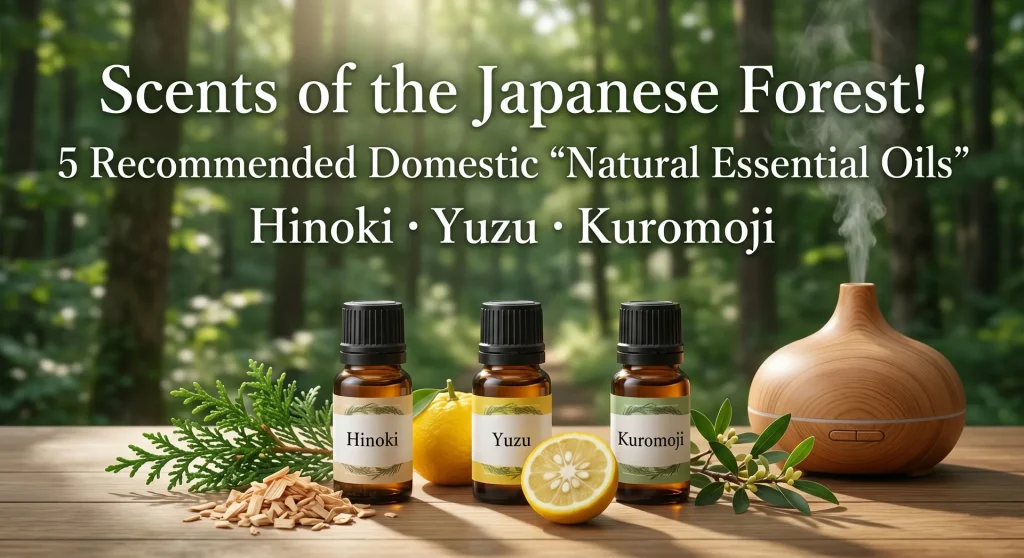
Japanese forests produce essential oils that exist nowhere else. Hinoki cypress
(Chamaecyparis obtusa), grown in the mountains of Yoshino and Kiso, contains phytoncide
compounds that research has linked to measurable reductions in cortisol and blood pressure.
Yuzu — the citrus that has no Western equivalent — produces an oil between lemon, grapefruit,
and mandarin with a warm, round quality. Kuromoji (Japanese spicebush) has been called
"Japanese rosewood" because it shares the same linalool content as rose essential oil.
This guide covers five Japanese essential oil picks — hinoki, yuzu, kuromoji, and hakka
Japanese mint — with notes on why each is different from its closest Western equivalent and
how to use them.
Quick Reference: Japanese Essential Oils (Wa-Seiyuu)
| Oil | Character | Best moment |
|---|---|---|
| Hinoki (Japanese cypress) | Deep forest; phytoncides; calming | Before sleep; bath; evening wind-down |
| Yuzu | Warm citrus; floral undertone; uplifting | Morning start; winter; low mood |
| Kuromoji (Japanese spicebush) | Floral-woody; linalool-rich; rare | Deep relaxation; hospitality space |
| Hakka (Japanese mint) | Piercing menthol; sharper than peppermint | Focus; summer; congestion |
1. Natural vs Synthetic — Why It Matters

The difference your nose can't always detect
The vast majority of products sold with "aroma" in their name contain synthetic fragrance
(manufactured from petrochemical compounds). These can smell pleasant, but they contain no
active botanical compounds.
A 100% natural essential oil contains dozens of volatile compounds that act on the limbic
system — the brain region governing emotion, memory, and the autonomic nervous system — within
0.2 seconds of inhalation. Hinoki phytoncides have been measured in multiple Japanese forestry
studies to reduce salivary cortisol and increase NK cell activity. This is not the case with
synthetic "hinoki fragrance."
The price difference between natural and synthetic is significant. The reason: to extract 10ml
of yuzu essential oil requires approximately 3–5 kg of yuzu zest. Harvesting happens by hand
in Japan's steep mountain orchards. The cost is a function of this labour, not markup.

2. How to Identify Authentic Essential Oil
Check for the Latin name
The simplest authentication check: a genuine essential oil always lists the botanical
Latin name on the label. For hinoki: Chamaecyparis obtusa. For yuzu:
Citrus junos. For kuromoji: Lindera umbellata.
A product that says "hinoki scent" but lists only "fragrance" or "parfum" as an ingredient
is synthetic. A product listing the Latin name plus extraction method (steam distillation /
cold press) and plant part used (heartwood / leaves / peel) is genuine.

3. Hinoki Cypress Oil — Picks
Hinoki is Japan's most iconic timber and scent. The heartwood contains concentrations of alpha-pinene and hinokitiol — the phytoncides that produce the proven calming effects associated with forest bathing (shinrin-yoku). The finest hinoki grows slowly in the mountains of Yoshino (Nara) and Kiso (Nagano/Gifu); density determines compound concentration.
Incense (インセント) — Yoshino Hinoki Essential Oil (AEAJ Certified)
Extracted by steam distillation from Yoshino-grown hinoki — the same forest that supplied timber for Horyuji Temple and Ise Jingu. Japan Aromatherapy Environment Association (AEAJ) display standard certified: an independent quality and safety verification that few Japanese essential oil products carry. The density of Yoshino hinoki's phytoncides is considered exceptional even by Japanese standards. A few drops in a diffuser produces the weighted, calm quality of deep forest rather than the lighter "wooden" note of lower-grade hinoki oils.
- Latin name
- Chamaecyparis obtusa
- Origin
- Yoshino, Nara Prefecture
- Certification
- AEAJ display standard compliant
- Best use
- Before sleep; bath; evening room diffusion
@aroma — Japanese Design air (Yoshino Hinoki + Yuzu Blend)
@aroma creates the ambient scent environment for Japan's best luxury hotels and resorts — the "that hotel always smells good" phenomenon is frequently their work. Their Japanese Design air series blends yoshino hinoki and yuzu into a composition that reads as refined and welcoming rather than simply wood-scented. This is less about botanical therapy and more about spatial quality: the blend creates a specific atmosphere. Produces the impression of a well-considered Japanese hospitality space.
- Type
- Professionally blended essential oil (hinoki + yuzu base)
- Known for
- Used in luxury hotel lobbies and ryokan across Japan
- Best use
- Entrance hall; living room; when receiving guests
4. Yuzu Oil — Picks
Yuzu (Citrus junos) is a Japanese citrus with no direct Western equivalent. The scent sits between lemon, grapefruit, and tangerine with a characteristic floral warmth missing from all three. Japan's highest-quality yuzu comes from Kochi Prefecture — the Shimanto river basin area is particularly prized. Yuzu is associated in Japan with winter solstice bathing (yuzu-yu) and with the warmth and welcome of hospitality.
NAGOMI AROMA — Kochi Shimanto Yuzu Essential Oil (Steam Distilled)
Yuzu zest from Kochi's Shimanto basin, extracted by steam distillation rather than cold pressing. The distinction matters practically: cold-pressed citrus oil contains bergapten (a furanocoumarin that causes photosensitivity — skin contact followed by UV exposure can cause pigmentation). Steam distillation removes this compound, making the oil safe for bath use and skin application. The Shimanto valley yuzu has a warmer, rounder quality than standard production yuzu.
- Latin name
- Citrus junos
- Origin
- Shimanto basin, Kochi Prefecture
- Extraction
- Steam distillation (photosensitivity-free)
- Best use
- Bath (safe for skin); winter mornings; mood lift
5. Kuromoji Oil — Picks
Kuromoji (Lindera umbellata / Japanese spicebush) is best known as the material for high-end Japanese tea ceremony toothpicks — the fragrant wood is used in kaiseki dining as a utensil that scents the breath after a meal. As an essential oil, it contains exceptionally high linalool concentrations — the same compound that gives rose and lavender their floral quality. The result is a woody-floral combination unique to this Japanese plant: clean and green, then floral and warm, then fading with a resinous base. Rare, expensive, and worth it.
Seikatsu no Ki (Tree of Life) — Kuromoji (黒文字) Essential Oil
Seikatsu no Ki (生活の木) is Japan's largest specialist aromatherapy retailer, with over 100 shops nationally and significant international distribution. Their kuromoji oil is one of the most accessible quality versions of this rare material — sourced from domestic production, verified by AEAJ standards. The tree's branches are harvested carefully to preserve the plant; the limited annual yield keeps supply constrained and price high. Once experienced, most people find no other single oil quite satisfying — the linalool richness gives a depth that standard lavender can't reach.
- Latin name
- Lindera umbellata
- Key compound
- Linalool (same as rose and lavender)
- Best use
- Deep evening relaxation; meditation; hospitality spaces
6. Hakka Japanese Mint Oil — Picks
Hakka (Mentha arvensis) is the Japanese variety of field mint. At its peak, the Kitami region of Hokkaido produced 70% of the world's mint oil supply. The menthol content of hakka is higher than Western peppermint, producing a piercing, clear coolness rather than peppermint's softer freshness. Used for concentration, summer cooling, nasal congestion, and insect deterrence. The most versatile of the four Japanese oils — as effective in a mask or spray as in a diffuser.
Kitami Hakka Tsusho — Hakka Oil (Hokkaido)
The Kitami Hakka Tsusho company has been processing Hokkaido hakka since the region's production peak. Their hakka oil is the standard Japanese product in this category — widely used domestically in cooking, pharmacy, and aromatherapy. Available in bottle and spray formats. The spray version is the most practical for everyday use: a spray on a handkerchief, into a room, or on a mask edge delivers immediate clarity. International shipping available through their English-language website.
- Latin name
- Mentha arvensis
- Origin
- Kitami, Hokkaido
- Best use
- Focus; summer cooling; nasal congestion; insect deterrence; cooking
7. Diffusers, Stones & How to Use Each Oil
Aroma stone or wood (small space — bedside)
Unglazed ceramic or porous wood pieces absorb a few drops of oil and release scent slowly into a 1-2 metre radius. No heat, no electricity. Place a hinoki-scented stone on a bedside table — the scent is gentle enough for undisturbed sleep. Refresh with 2-3 drops every few days.
Ultrasonic diffuser (living room — wider space)
Uses ultrasound vibration to atomise water + a few drops of oil into fine mist. Adds mild humidification. For @aroma blends and hinoki in a larger room, this is the most effective distribution method. Add 3-5 drops to water; run in 30-60 minute cycles rather than continuously.
Bath use (yuzu — safe when steam-distilled)
Mix 5-10 drops of steam-distilled yuzu oil into a tablespoon of salt or milk before adding to bathwater. Do NOT add oil directly to the water — it floats as undiluted oil on the surface and makes direct skin contact. Salt or milk disperses it. Steam-distilled yuzu is specified because it's photosensitivity-free; cold-pressed versions should not be used on the skin.
8. Frequently Asked Questions
Can I apply essential oil directly to skin?
No — never apply undiluted essential oil to skin. Essential oils are highly concentrated plant extracts; undiluted skin contact typically causes irritation or chemical burn. For skin application (massage, bath, etc.), dilute to 1% or less in a carrier oil (jojoba, sweet almond, coconut). For a bath, mix with salt or milk first. Inhalation through a diffuser or stone is the safest route and requires no dilution.
Is it safe to use essential oils around cats or birds?
Cats cannot metabolise the monoterpenes in many essential oils — their livers lack the specific enzymes required. Even airborne concentrations from diffuser use can accumulate to toxic levels in cats. Do not diffuse essential oils in any space where cats live or sleep. Birds are also sensitive to airborne oil compounds. Dogs are generally more tolerant but diffuse in ventilated spaces only. For households with cats or birds, use in rooms the animals cannot access, with thorough ventilation.
How do I make a yuzu bath at home?
Use steam-distilled yuzu oil (not cold-pressed). Mix 5-10 drops into a tablespoon of natural salt (fine sea salt or bath salts) and stir the salt into the running water as the bath fills. This disperses the oil evenly rather than leaving it as an undiluted film on the surface. Alternatively, mix into unsweetened milk. A full yuzu fruit in the bath is the most traditional approach — clean, slice, and float two or three fruits in the water.
How long does an essential oil last once opened?
Citrus oils (yuzu): 6 months after opening, stored in a cool dark location. Tree oils (hinoki, kuromoji): 1-2 years. All essential oils oxidise with air exposure — an oxidised oil loses therapeutic properties and can cause skin sensitisation. Store bottles upright, away from direct sunlight, at room temperature or cooler. Refrigeration prolongs life but may cause cloudiness (which dissipates at room temperature).
How do I identify a genuine essential oil vs synthetic fragrance?
Check the label for: (1) Latin botanical name (genuine oils always include this), (2) plant part used (heartwood / leaves / peel), (3) extraction method (steam distillation / cold press / CO2). If the label says only "fragrance," "parfum," or "aroma" as the ingredient without a Latin name, the product contains synthetic fragrance, not essential oil. The AEAJ (Japan Aromatherapy Environment Association) display standard certification provides independent quality verification for Japanese oils.
Is it safe to use around pregnant women or infants?
Diffused essential oils at low concentrations in well-ventilated spaces are generally considered safe for inhalation during pregnancy and around infants over 3 months. However, some oils (including hakka/menthol) should be used at reduced concentrations around infants under 2 years. Direct skin application of undiluted oil is inadvisable for anyone. If in doubt, consult a healthcare provider — particularly during the first trimester of pregnancy, when caution with any aromatic compound is recommended.
Final Thoughts: Japan's Forests in a Bottle
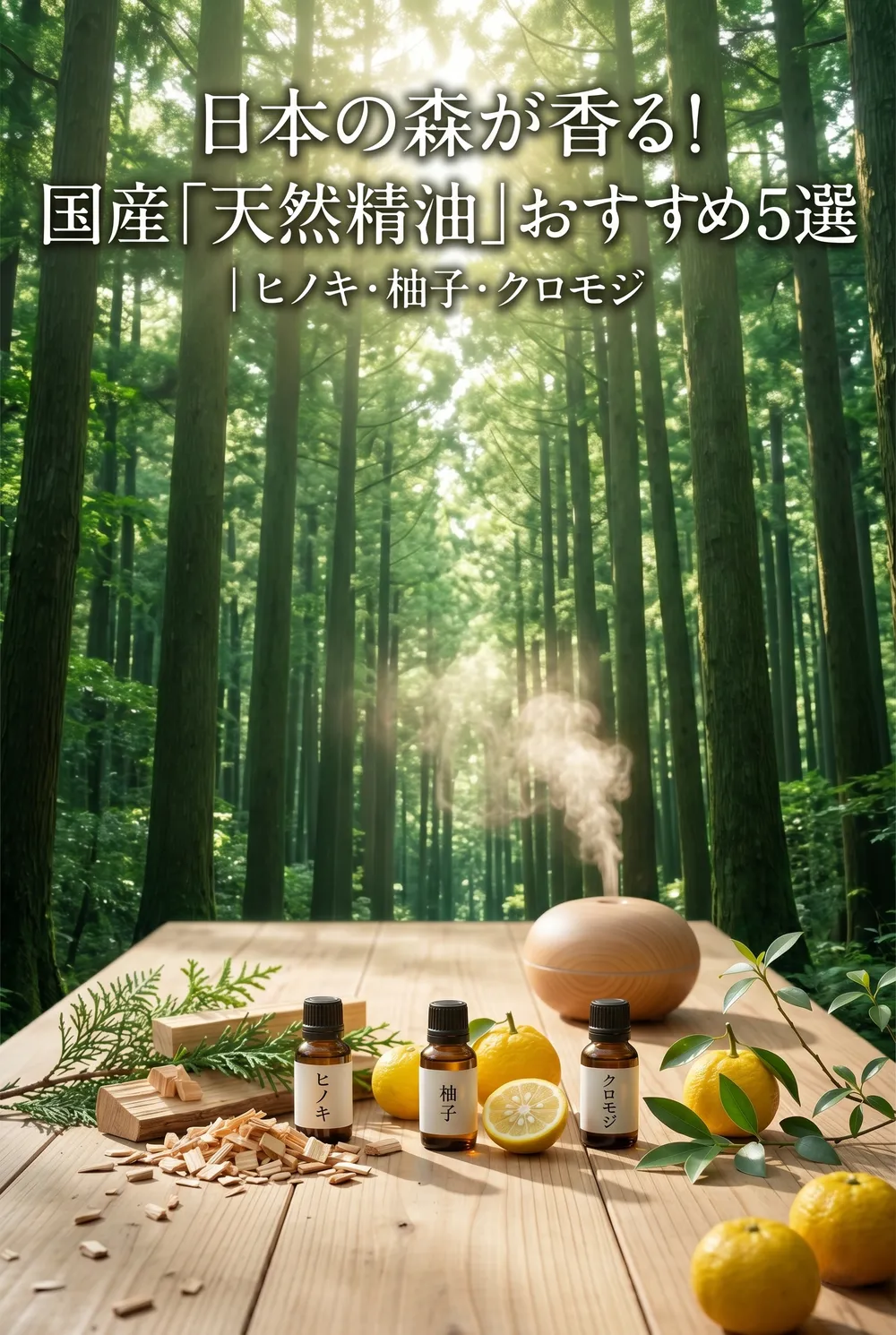
Japan's essential oils aren't just aromas — they're forest chemistry. The phytoncides in
Yoshino hinoki, the linalool in Shimanto kuromoji, the menthol in Hokkaido hakka — these
are measured, studied compounds with documented effects on the autonomic nervous system.
Coming home to hinoki in the evening diffuser is a small thing. Opening a bottle of
Shimanto yuzu in the morning is a small thing. But these small things, repeated daily,
are how a home acquires a particular quality of atmosphere — one that becomes associated,
over time, with specific feelings and specific places. That's what these oils are for.
Japanese Bath Additives: Onsen Minerals, Hot Spring Salts & Natural Blends
Japanese Incense Guide: Awaji, Kyoto Brands & How to Burn