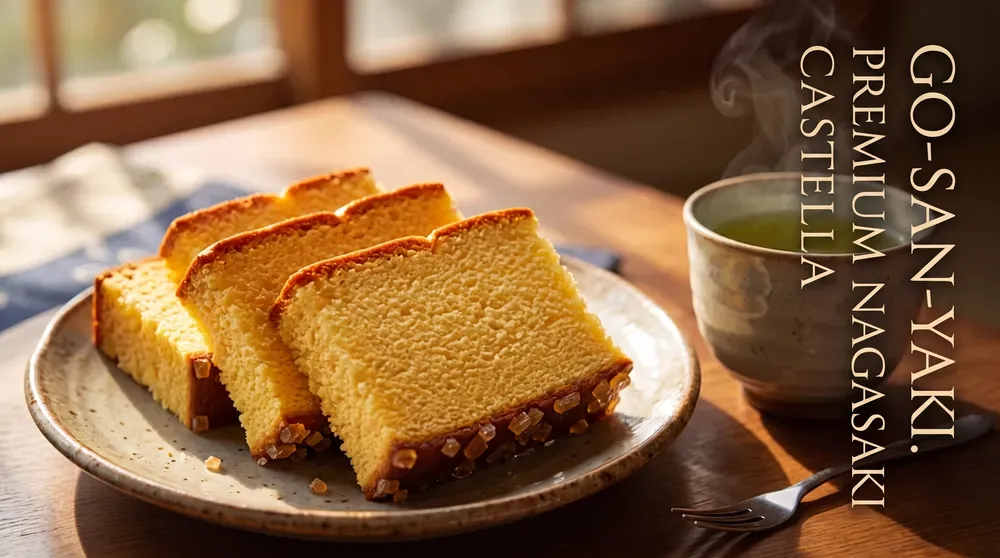
Cut a slice of good castella and you will find a layer of undissolved sugar crystals
across the bottom, crunching under the knife. In a Western bakery that would be a fault —
somebody did not mix the batter properly.
Here it is the point. The coarse sugar is added deliberately before baking, and
the heavy grains sink through the batter during a long slow bake. The crunch at the bottom
is how you tell a real one.
The cake itself is Portuguese — brought to Nagasaki by traders in the 1500s as
pão de Castela, bread from Castile. Japan then changed three things about it, and
you can taste all three.
Quick Reference: Not the Sponge Cake You Know
| Castella | Western sponge | |
|---|---|---|
| Butter | None. Starch syrup instead | Usually central |
| Raising agent | None — beaten egg only | Baking powder |
| Flour | Bread flour — denser | Cake flour |
| The bottom | Crunchy sugar layer | Nothing |
| Keeps | About two weeks sealed | Days |
| It is moist without fat, which is the thing people cannot place when they first eat it. There is no butter in there at all. | ||
The Sugar at the Bottom
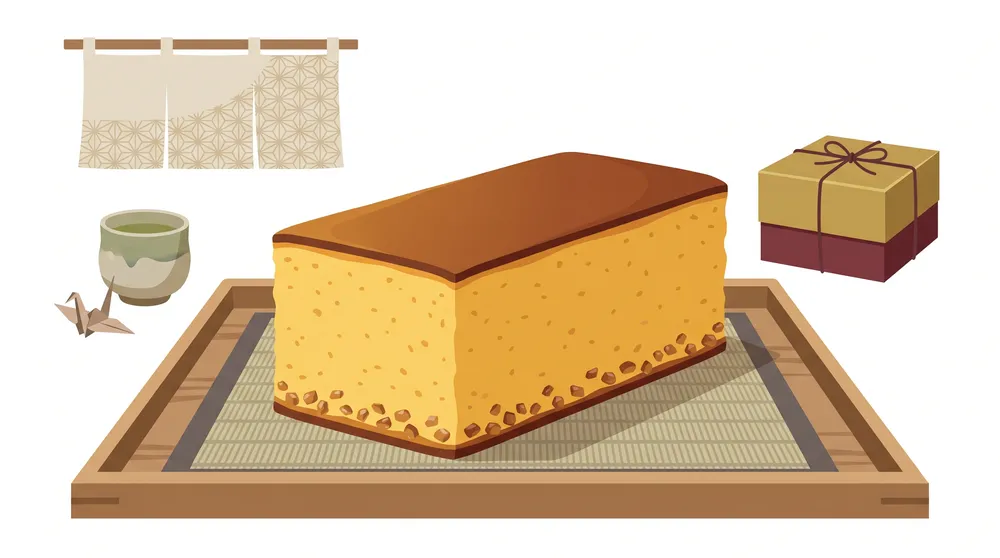
Zarame is coarse crystalline sugar, and in castella it is stirred into the batter before the loaf goes into the oven. The crystals are heavier than the batter, so over a long bake they settle to the bottom — and because they are coarse and the bake is slow, they do not entirely dissolve on the way down.
So the layer is a record of the bake. A castella with a good crunchy base was
baked slowly enough for the sugar to travel and survive.
Cheap castella often has none — either because no zarame was used, or because
the bake was fast and hot enough to dissolve it. Running a knife across the bottom and
hearing it is a genuine quality check, not a piece of folklore.
It is entirely edible and you are supposed to eat it. The contrast is the whole idea: a very soft, moist crumb sitting on a thin band of crunch, so every mouthful has both.
Do not scrape it off, and do not send it back. If you were making castella at home and it came out like that, you would have got it right.
Why Japanese — Three Changes to a Portuguese Cake
Portuguese traders reached Japan in the sixteenth century, and Nagasaki was where they stayed — for a long stretch it was the only port where Europeans were permitted at all. They brought a sponge cake called pão de Castela, and its closest surviving Portuguese relative is pão-de-ló.
Japanese bakers then modified it over several generations, and the changes are specific enough to list.
- Butter out, mizuame in. Starch syrup replaced the fat, which is why castella is moist and slightly chewy rather than rich — and why it stays moist for days, since syrup holds water in a way butter does not.
- Cake flour out, bread flour in. The higher protein gives a denser, springier crumb with a distinct pull to it. It is closer to a very fine bread than to a Victoria sponge.
- Zarame added at the bottom, for the texture contrast described above.
And one thing they did not add: any chemical raising agent. Castella has no baking powder and no soda. Every bit of its height comes from air beaten into whole eggs, which is why the batter is beaten for a very long time and why the loaf is baked slowly in a deep frame.
The result is a cake that is moist with no fat in it at all, and that is the
thing people cannot identify on first taste.
It reads as rich, so the brain looks for butter and does not find it. What it is
finding instead is a great many egg yolks and a syrup that will not let go of its water.
Gosanyaki: Five Parts Yolk to Three Parts White
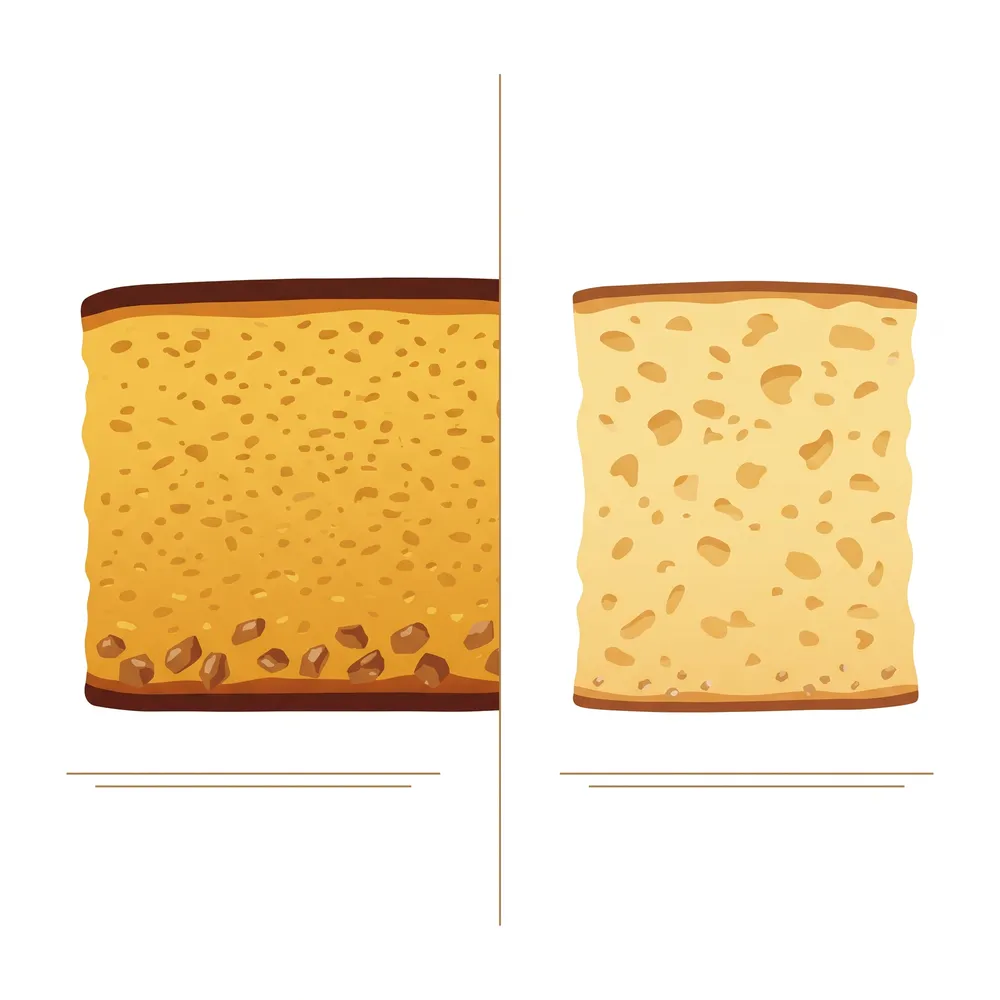
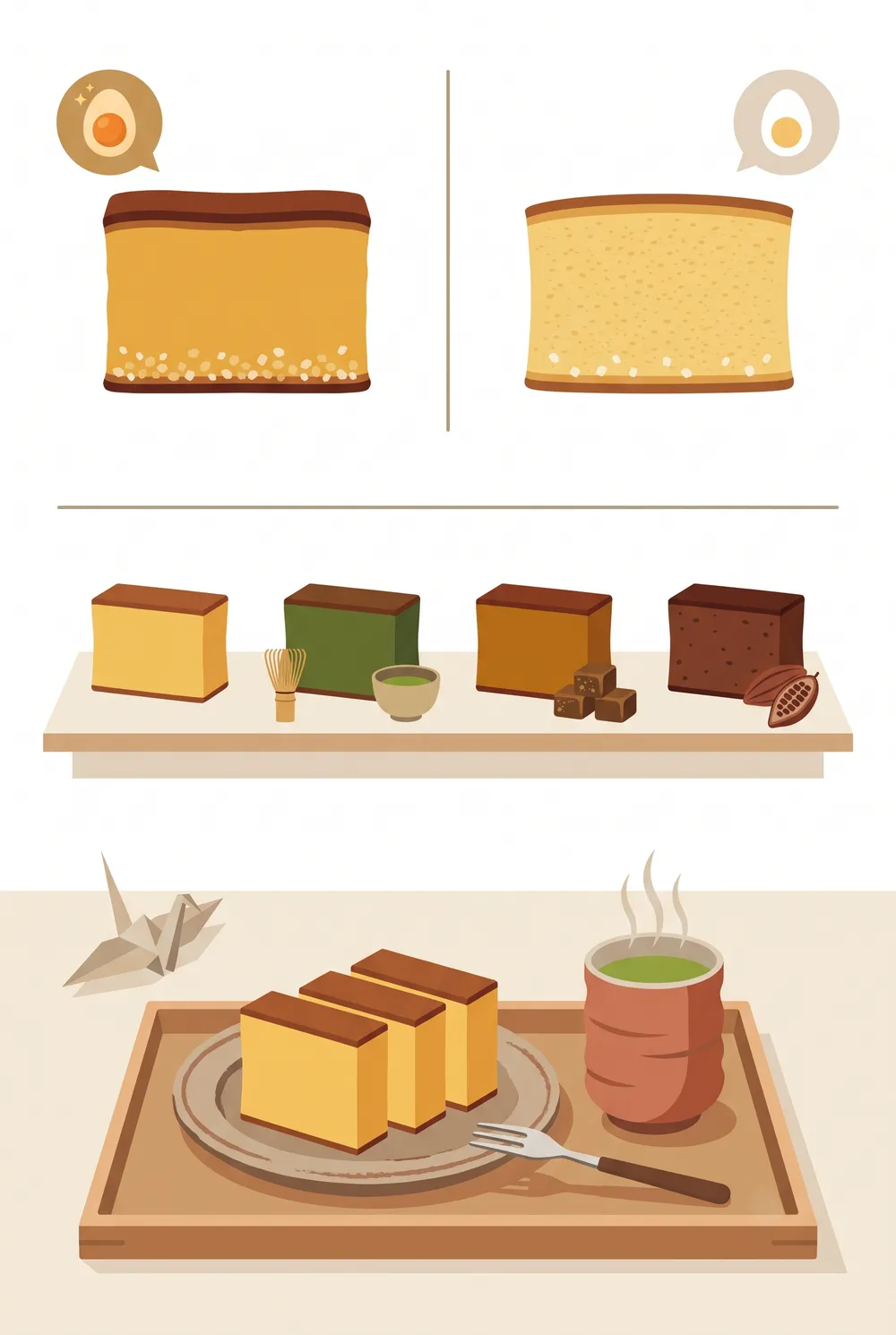
The premium grade is called gosanyaki, and the name is the recipe. Go is five and san is three: five parts egg yolk to three parts white, against the roughly equal proportions a normal loaf uses.
More yolk means more fat and more colour and much less structure to work with, because it is the whites that hold the air. That is why it is difficult — the batter is heavier and less willing to rise, and getting it to bake evenly takes an experienced hand.
The result is deep yellow, denser, and noticeably richer. It is the version sold in a presentation box, and it costs accordingly.
The method is documented from the Tokugawa and Meiji periods, so modern
gosanyaki is a reconstruction of an old technique rather than a marketing tier invented last
decade.
It was once called gomi castella — "five tastes" — meaning it was
reckoned to go beyond the five recognised tastes of sweet, bitter, sour, salty and umami.
Which is a considerable claim for a sponge cake, and tells you how it was
regarded.
Buy standard castella first. Gosanyaki is better, but it is better in a direction you can only judge once you know what the ordinary version tastes like — and the ordinary version is very good.
⚠ Two Weeks, and Two Weeks of Shipping
Castella keeps about two weeks unopened at room temperature. That is remarkable for a cake with no preservatives, and it is entirely down to the syrup.
It is also almost exactly how long it takes to reach you. Shipping from Japan runs around seven to fourteen days, so a loaf that leaves Nagasaki with a fortnight on it can arrive with very little left.
Fukusaya — founded in Nagasaki in 1624 and still making castella by hand — will not send
it to you. Their own position is that the product is perishable and that overseas
shipping takes too long, so they ship within Japan only.
The oldest and most respected maker has looked at the arithmetic and declined.
That is worth taking seriously rather than treating as an obstacle to route around.
What does ship is the industrially made version, packed in individually wrapped slices with a longer dated life, and it is genuinely good. It is simply not the same object as a hand-made loaf eaten three days after baking.
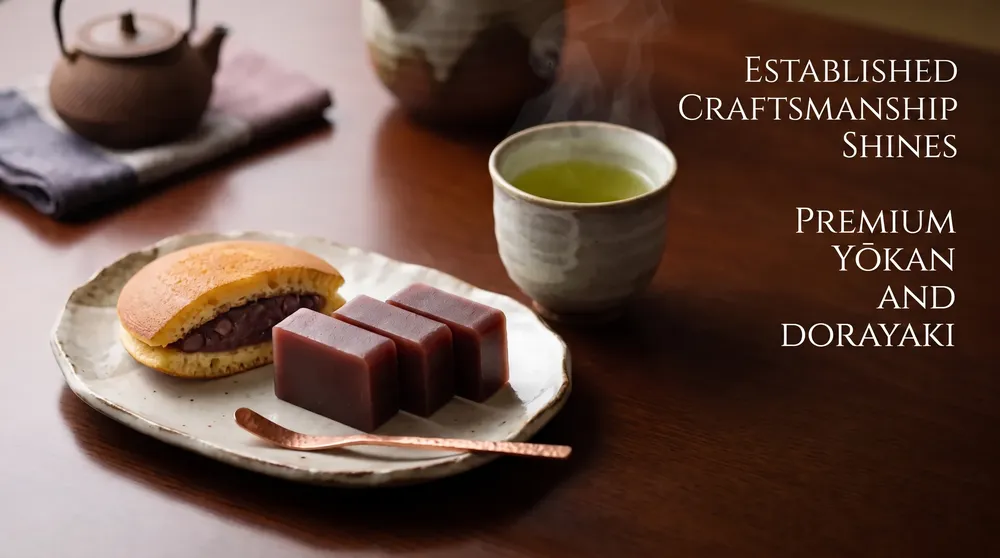
For context, this sits between two other Japanese confections. Yokan keeps for a
year and posts anywhere without difficulty. Fresh dorayaki lasts days and cannot travel at
all.
Castella is the awkward middle: it can be shipped, but only just — which is
why the answer depends entirely on which maker you buy from.
What to Buy
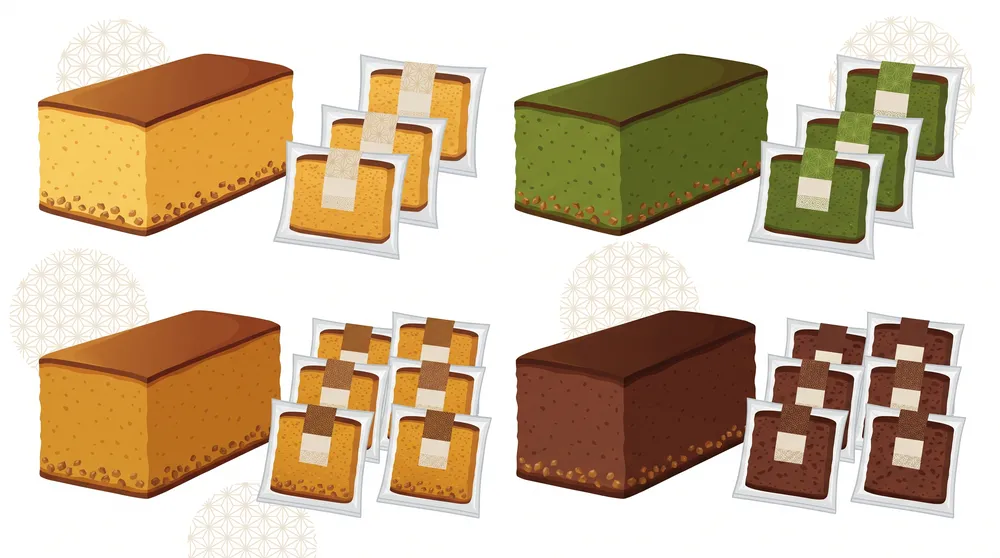
Individually wrapped slices — the version that travels
Bunmeido is the large maker whose castella actually reaches other countries,
sold in boxes of wrapped slices in plain and matcha, and shipped from Japan in about one to
two weeks.
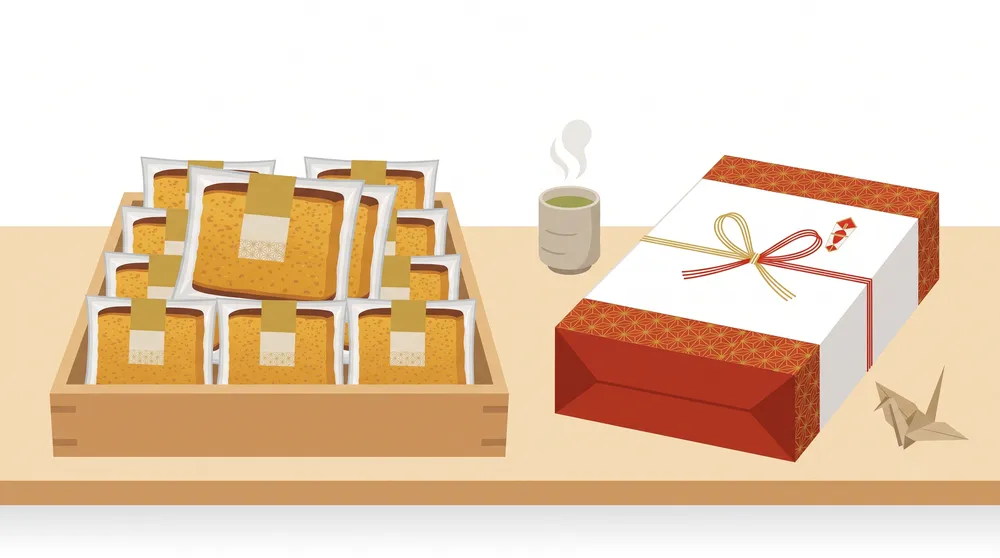
Individual wrapping is the practical advantage — once a whole loaf is cut,
it dries out within a day or two, whereas wrapped slices keep until you open each one.
- Format
- Individually wrapped slices
- Flavours
- Plain, matcha, honey
- Shipping
- 7–14 days from Japan
- Keeps
- Check the printed date on arrival
Perfect for: A first taste, and for anyone who will not finish a whole loaf quickly.
The one to eat in Nagasaki
Fukusaya has been making castella in Nagasaki since 1624, still by hand, and their loaves in the distinctive box are what Japanese people mean when they talk about castella as a gift.
They ship domestically only, for the reason given above. Their English pages are worth reading before a trip, and the Nagasaki shop is the reason to make one.
And the local secret: the offcuts
Castella is baked in a large frame and the edges are trimmed off to give the loaf its
clean sides. Those trimmings — kiriotoshi — are sold in bags at a fraction of
the price.
It is exactly the same cake, in irregular pieces, and it is what people in
Nagasaki buy for themselves while buying the boxed loaf for somebody else.
Look for it if you are ever in a Japanese confectioner.
How to Eat It, and Where Not to Keep It
- Do not refrigerate it. Cold firms the crumb and dulls the flavour. Room temperature in a cool dark place is the intended state, and the texture is at its best around three to four days after baking.
- Keep it sealed. Once a loaf is cut it dries within a day or two — wrap the cut face tightly against the cake rather than leaving it in a loose bag.
- Cut it thick, with a warmed knife. Two to three centimetres. Thin slices lose the contrast between the soft crumb and the crunchy base, which is the whole construction.
- Green tea is conventional and coffee is better than you would expect. The cake is sweet and has no fat to coat the palate, so a bitter drink cuts it cleanly.
- It freezes well if you must. Wrap slices individually; thaw at room temperature rather than in a microwave, which drives out the moisture the syrup is holding.
Frequently Asked Questions
Is the gritty layer at the bottom normal?
It is the mark of a good one. Coarse sugar is added to the batter before baking
and sinks during a long slow bake without fully dissolving.
Eat it. The contrast between the crunch and the soft crumb is the point of the
cake, and cheap castella often has no crunch at all.
Is castella a Japanese or a Western sweet?
Both, in a way that Japanese has a word for. It arrived from Portugal in the
sixteenth century and belongs to nanban-gashi — sweets of foreign origin — but it has
been made and altered in Nagasaki for four hundred years.
In practice it is sold and given as a Japanese confection, and its Portuguese
relatives taste noticeably different now.
Why is there no butter in it?
Because Japanese bakers replaced it with mizuame, a starch syrup. The
syrup keeps the crumb moist far longer than butter would, which is why the cake keeps for two
weeks.
It is also why castella tastes rich without tasting fatty, and why it does not
go stale in the way a buttery sponge does.
What makes gosanyaki different?
Five parts egg yolk to three parts white, where an ordinary loaf uses roughly
equal proportions. More yolk gives a deeper colour and a denser, richer crumb.
It is harder to bake, because the whites are what carry the air, so it is made by
experienced hands and priced accordingly.
How should I store it?
Sealed, at room temperature, out of the light — not in the fridge. Two weeks
unopened; one to two days once you have opened it.
Refrigeration will extend it by about a week but firms the texture, so freeze
slices instead if you need longer.
Is it good for children and older people?
Unusually so. It is soft, moist without being greasy, and needs no chewing to
speak of — the crunchy base is thin enough not to be an obstacle.
It contains eggs, wheat and a lot of sugar, and traditional recipes contain
nothing else worth flagging, but check the packaging on flavoured versions.
Final Thoughts: A Borrowed Cake, Kept Better
Portugal brought a sponge cake to Nagasaki and then largely forgot about it. Japan took out the butter, put in syrup and coarse sugar, swapped the flour, and has been baking it in the same city for four hundred years.
The result keeps for two weeks without preservatives, is moist with no fat in it, and has a band of crunch at the bottom that most people assume is a mistake.
Buy wrapped slices if you are ordering from abroad, keep it out of the fridge, and cut it thick. And if you get to Nagasaki, buy the offcuts for yourself.
Yokan: Japan's 500-Year-Old Energy Bar
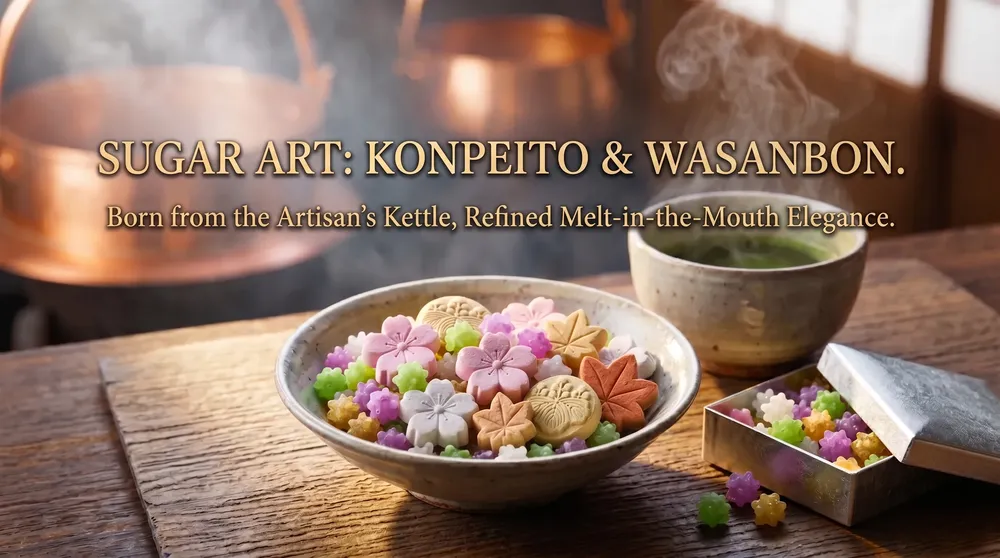
Edible Jewels: Premium Japanese Konpeito and Wasanbon