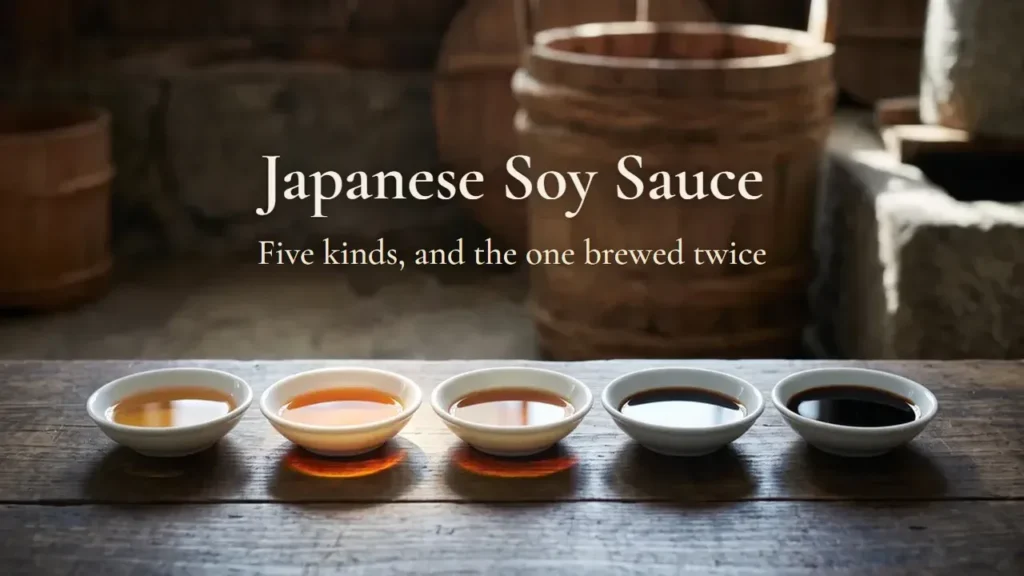
Soy sauce is something most of us use every day without ever being taught how to choose it. A Japanese store shelf holds koikuchi, usukuchi, tamari, saishikomi and shiro, and few people can explain the difference.
There are also a few widespread mistakes. Usukuchi, the "light" soy sauce, is saltier than regular dark soy sauce. It looks gentler, but the light part is only the color. And "nama shoyu" on a label can mean two different things depending on how it's read.
This guide covers the five Japanese soy sauce types, how to read the label, the breweries that still ferment in wooden vats, two that you can buy outside Japan, and how to keep an opened bottle tasting fresh.
Quick Reference: The Five Japanese Soy Sauces
| Type | Main region | Character | Best for |
|---|---|---|---|
| Koikuchi (dark) | All over Japan | Balanced aroma, color and umami | Everything. The default |
| Usukuchi (light) | Tatsuno, Hyogo | Pale, but saltier than koikuchi | Clear soups, simmered dishes |
| Tamari | Aichi, Mie, Gifu | Mostly soybeans; thick, deep umami | Sashimi, teriyaki, rice crackers |
| Saishikomi (double-brewed) | Yamaguchi, Shimane, Shodoshima | Brewed with soy sauce instead of brine. Rich | Sashimi, cold tofu: for pouring |
| Shiro (white) | Hekinan, Aichi | Mostly wheat; amber and sweet | Chawanmushi, quick pickles |
The breweries are in chapter 4 ▾; what you can buy abroad is in chapter 6 ▾.
1. Why Japanese: Five Kinds, and the Usukuchi Mistake
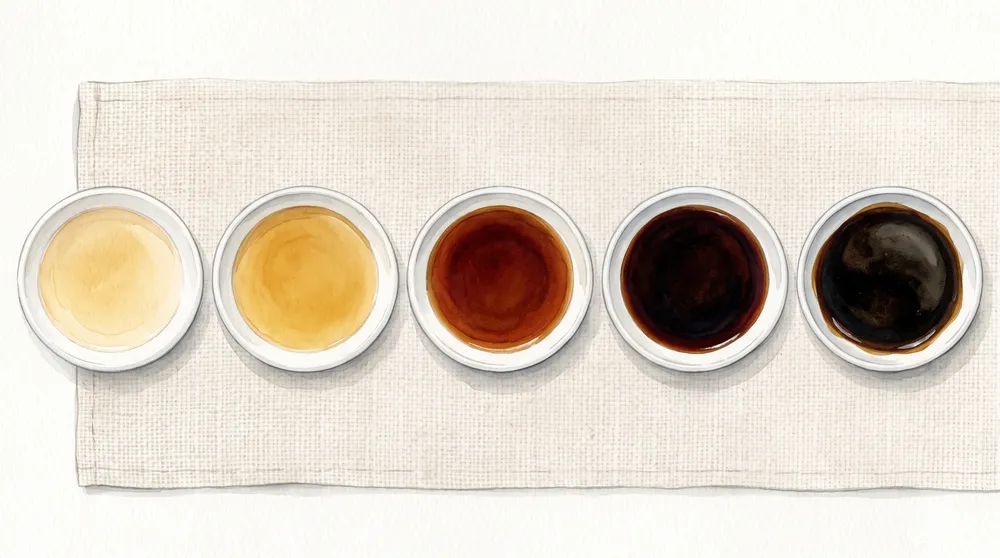
Japan's food standards (JAS) divide soy sauce into five types: koikuchi, usukuchi, tamari, saishikomi and shiro. Koikuchi accounts for roughly 80% of what is sold; it is what most people simply call soy sauce.
The differences come mainly from the ratio of soybeans to wheat and from the moisture in the mash. Tamari uses mostly soybeans and very little wheat, so it is thick and deep in umami. Shiro uses mostly wheat, so it is pale and sweet.
Usukuchi doesn't mean "low salt"
This is the biggest misunderstanding. Usukuchi is generally saltier than koikuchi. More salt is used during brewing to hold fermentation back and keep the color pale. Only the color is light. Cooks in Kyoto use usukuchi in clear soups and simmered vegetables so the ingredients keep their color, not to cut salt. For less salt, choose a bottle labeled reduced-salt (減塩).
Saishikomi: soy sauce brewed with soy sauce
Normally koji is mixed with brine. Saishikomi replaces the brine with finished raw soy sauce, so it is brewed, in effect, twice, with nearly double the ingredients and time. The result is dark, thick and concentrated. It is a specialty of western Honshu and Shodoshima, and since heat dulls it, it shines poured over sashimi or cold tofu.
2. Reading the Label: Honjozo, Blended, Whole or Defatted Soybeans
After the type, look at the production method, printed near the ingredients on the back. It largely sets the price.
· Honjozo (本醸造): soybeans, wheat, salt and koji only, fermented by microbes over time. Six months to a year, sometimes several years.
· Kongo jozo (混合醸造): amino acid liquid is added during fermentation, shortening the time.
· Kongo (混合): amino acid liquid is added to finished soy sauce. The shortest process.
Blended doesn't mean bad. It brings out sweetness and umami, and in Kyushu the sweet blended styles are the local taste. Think of it as a different target, not a lower rank.
Whole soybeans or defatted soybeans
Some labels say 丸大豆 (whole soybeans), others 脱脂加工大豆 (defatted soybeans, with the oil pressed out). That isn't a ranking either. Whole soybeans give a mellow roundness from their oil; defatted soybeans ferment evenly and bring umami forward. Well-known breweries choose either.
3. "Nama Shoyu" Has Two Meanings
The characters 生醤油 can be read two ways, and they mean different things.
· Nama shoyu: soy sauce that hasn't been heat-treated. It is finely filtered instead of pasteurized, has a bright aroma and a lighter color, but its enzymes are still active, so it changes faster and must be refrigerated after opening.
· Ki-joyu: soy sauce with nothing else added. It has nothing to do with heat treatment; rich soy sauces sold for sashimi or egg-on-rice are often in this group.
Check the reading or the description. The character 生 alone doesn't tell you which is meant.
4. Choosing by Brewery: Wooden-Vat Soy Sauce
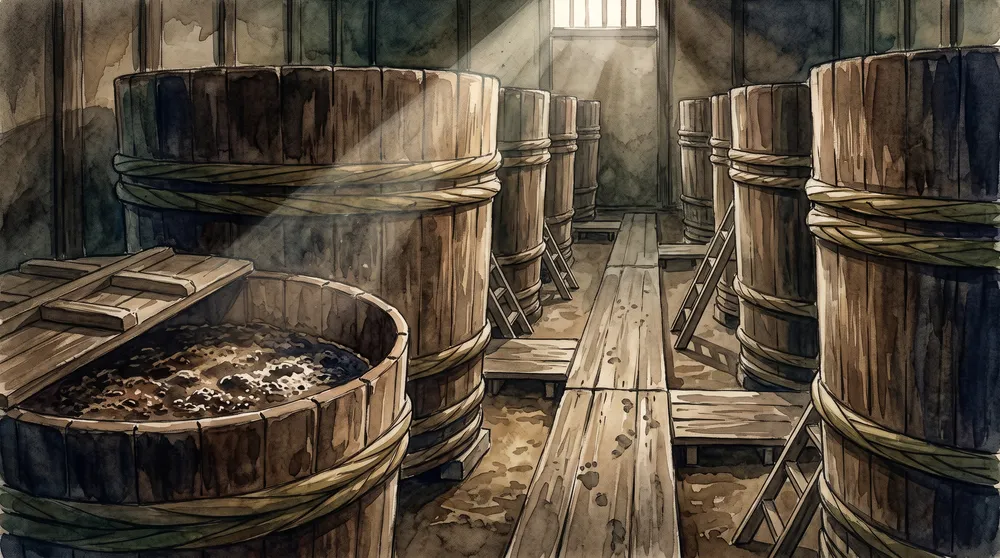
All soy sauce was once fermented in wooden vats, kioke. Today stainless steel and FRP tanks are the norm, and wooden-vat soy sauce is said to be only a few percent of the total, because almost no craftsmen are left who can build the vats.
Wooden vats aren't a guarantee of better flavor; tank-brewed soy sauce can be excellent. But each brewery's own microbes settle into the wood, so the same ingredients taste different from one house to the next. That difference is what you're choosing.
Inoue Shoyu (Okuizumo, Shimane): a small brewery that kept its wooden vats
A long-established brewery that narrows down both ingredients and method. Its flagship, Inoue Koshiki Joyu, is aged long in wooden vats, and the aroma is distinctly its own. It also makes rich, saishikomi-style soy sauce for pouring. Production is small, and it isn't stocked everywhere even in Japan. Sold in Japan.
Hita Shoyu (Hita, Oita): Kyushu's sweet style
Kyushu soy sauce is known for sweetness, and each brewery gets there differently. Hita's is designed for both sashimi and simmered dishes, an easy first taste of Kyushu if you're used to standard koikuchi. It also makes miso. Sold in Japan.
Kawamura Shoyu (Yamaguchi): saishikomi, made small
Yamaguchi is known for saishikomi soy sauce. Brewing again with raw soy sauce instead of brine takes nearly twice the work and ingredients, and concentrates the umami. Pour it on sashimi or tofu; keep a koikuchi for cooking. Sold in Japan.
Yamaroku Shoyu (Shodoshima, Kagawa): Tsuru Bishio
A Shodoshima island brewery that ferments in wooden vats. Tsuru Bishio is its saishikomi, made with Japanese whole soybeans and aged in barrels for up to four years: dark, sweet and deep. It's one of the few wooden-vat soy sauces you can buy outside Japan (see chapter 6).
Keep two bottles
Brewery soy sauce costs more than everyday soy sauce. The practical answer is two bottles: an easy-to-find honjozo koikuchi for cooking, and a brewery bottle for pouring. Heat drives off aroma, so good soy sauce is wasted in a stew, while a few drops on cold tofu or sashimi show every difference.
5. Refrigerate After Opening
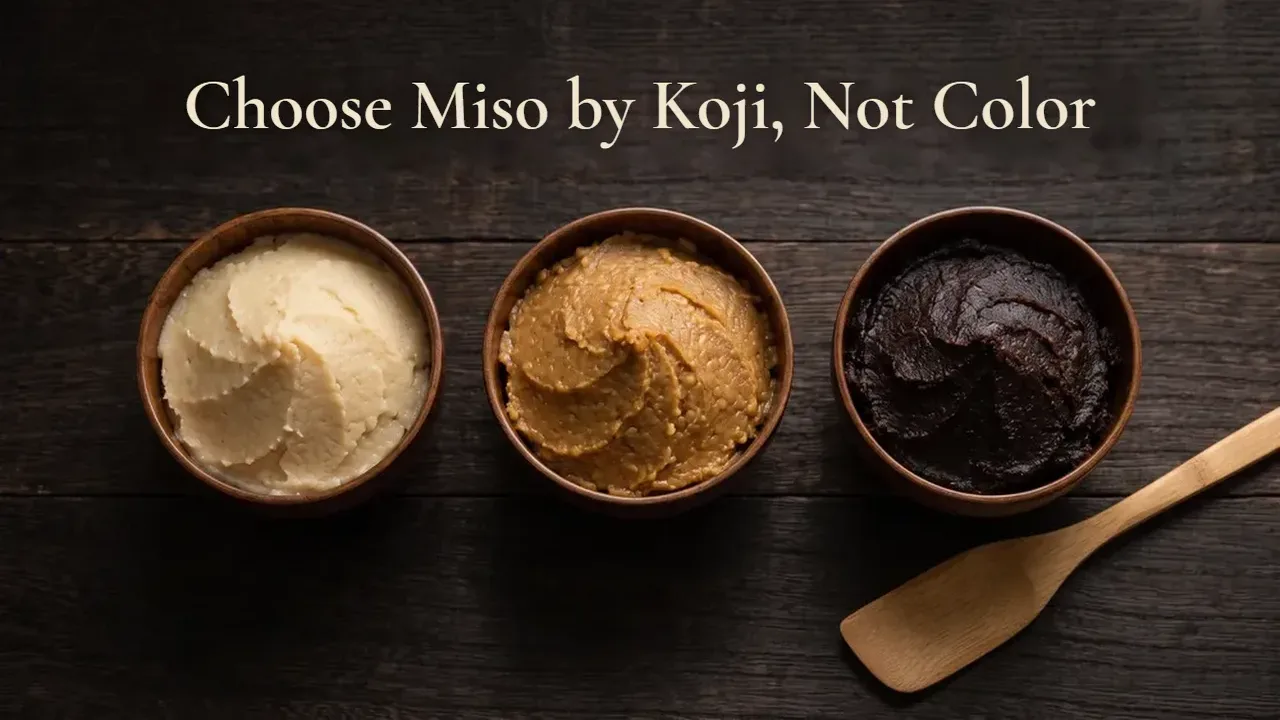
Few people realize that soy sauce starts to oxidize the moment it's opened. It darkens, loses aroma and turns harsh. It doesn't spoil, so the change is easy to miss.
Keep it in the fridge after opening; that alone slows the change a great deal. At room temperature in summer, you can see the color change within about a week.
Aim to finish a bottle within about a month of opening. A small bottle used up is better than a big one stretched over half a year, which is why brewery soy sauce often comes in 150–200 ml (5–7 oz) bottles. Double-walled airtight bottles slow the change further, as long as you don't decant them.
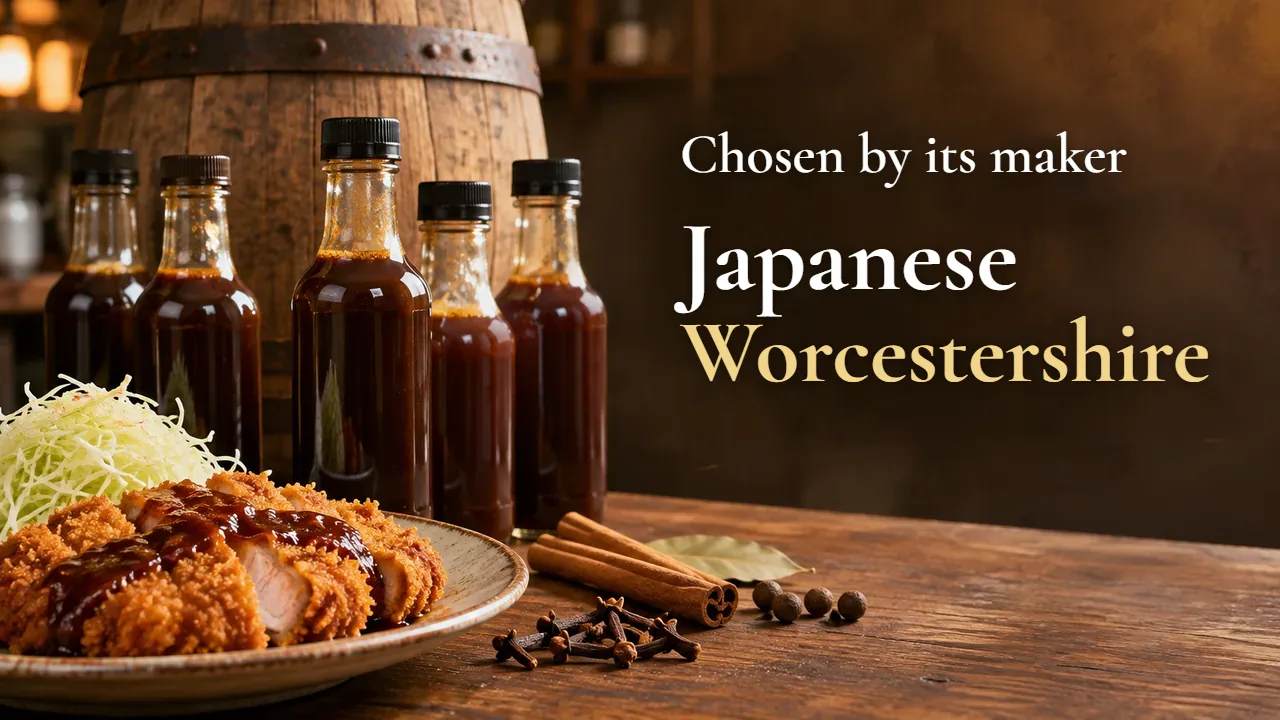
6. Buying Japanese Soy Sauce Outside Japan
Of the breweries above, only Yamaroku's Tsuru Bishio was on Amazon.com. Soy sauce from Japanese brands is sold everywhere, but some of it is brewed outside Japan, so check for "Product of Japan" or "Made in Japan" on the label.
Yamaroku Tsuru Bishio (Shodoshima)
A wooden-barrel saishikomi aged up to four years. Dark and sweet, for pouring rather than cooking: sashimi, cold tofu, egg on rice. The 5 oz (150 ml) bottle fits the one-month rule.
Yamaroku Tsuru Bishio, 4-Year Barrel-Aged Soy Sauce 5 oz (Shodoshima)
Loading product details…
Shibanuma Shiho no Shizuku Nama Shoyu
Nama shoyu in the first sense: not heat-treated. From Shibanuma Shoyu in Ibaraki, with a bright aroma and a lighter color. Keep it in the fridge once opened.
Shibanuma Shiho no Shizuku Nama Shoyu 300 ml
Loading product details…
At a Japanese grocery store, these words help:
· 濃口 / 淡口 / たまり / 再仕込み / 白 — koikuchi / usukuchi / tamari / saishikomi / shiro
· 本醸造 — honjozo; 丸大豆 — whole soybeans
· 木桶仕込み — brewed in wooden vats; 減塩 — reduced salt
7. Frequently Asked Questions
I want less salt. Should I switch to usukuchi?
No, it works the other way. Usukuchi is generally saltier than koikuchi; only its color is light. Choose a bottle labeled reduced-salt (減塩), or simply use less: dip from a small dish instead of pouring.
Can I use soy sauce past its best-before date?
Unopened, yes: the date is about flavor, not safety, and soy sauce is salty. Once opened it oxidizes regardless of the date. If it has darkened and lost its aroma, use it for cooking.
There's a white film floating on my soy sauce.
It's most likely a surface yeast that forms when soy sauce sits exposed to air. It isn't harmful, but the flavor has clearly declined. Refrigeration prevents it; if it appears, it's time for a new bottle.
Which soy sauce is best for tamago kake gohan (raw egg on rice)?
Saishikomi or tamari. Both have enough depth to stand up to the egg. Soy sauces sold specifically for egg-on-rice are usually sweetened with dashi; to taste pure soy sauce, try saishikomi.
Why are wooden vats so rare?
Because almost no one can build them anymore. A soy sauce vat can be over 2 m (6.5 ft) across, and many in use are more than a century old. When one breaks, it can't easily be replaced. Still, the vat is about each brewery's character, not a guarantee of quality.
Why is Kyushu soy sauce sweet?
There are several explanations, such as a fit with eating raw fish, the warm climate, and sugar arriving easily through Nagasaki. None is settled. What is certain is that in Kyushu, sweet soy sauce is simply normal soy sauce, and it makes simmered dishes notably round.
Final Thoughts: Color and Salt Are Unrelated
If you remember one thing: usukuchi is saltier, not milder.
Then read the label once. Honjozo or blended, whole or defatted soybeans: neither is better, but you'll learn which taste you prefer.
And keep two bottles: one for cooking, one for pouring. A few drops of good soy sauce on cold tofu is where the difference shows.
Japanese Rice Vinegar: 5 Breweries, from Fujisu to Kurozu
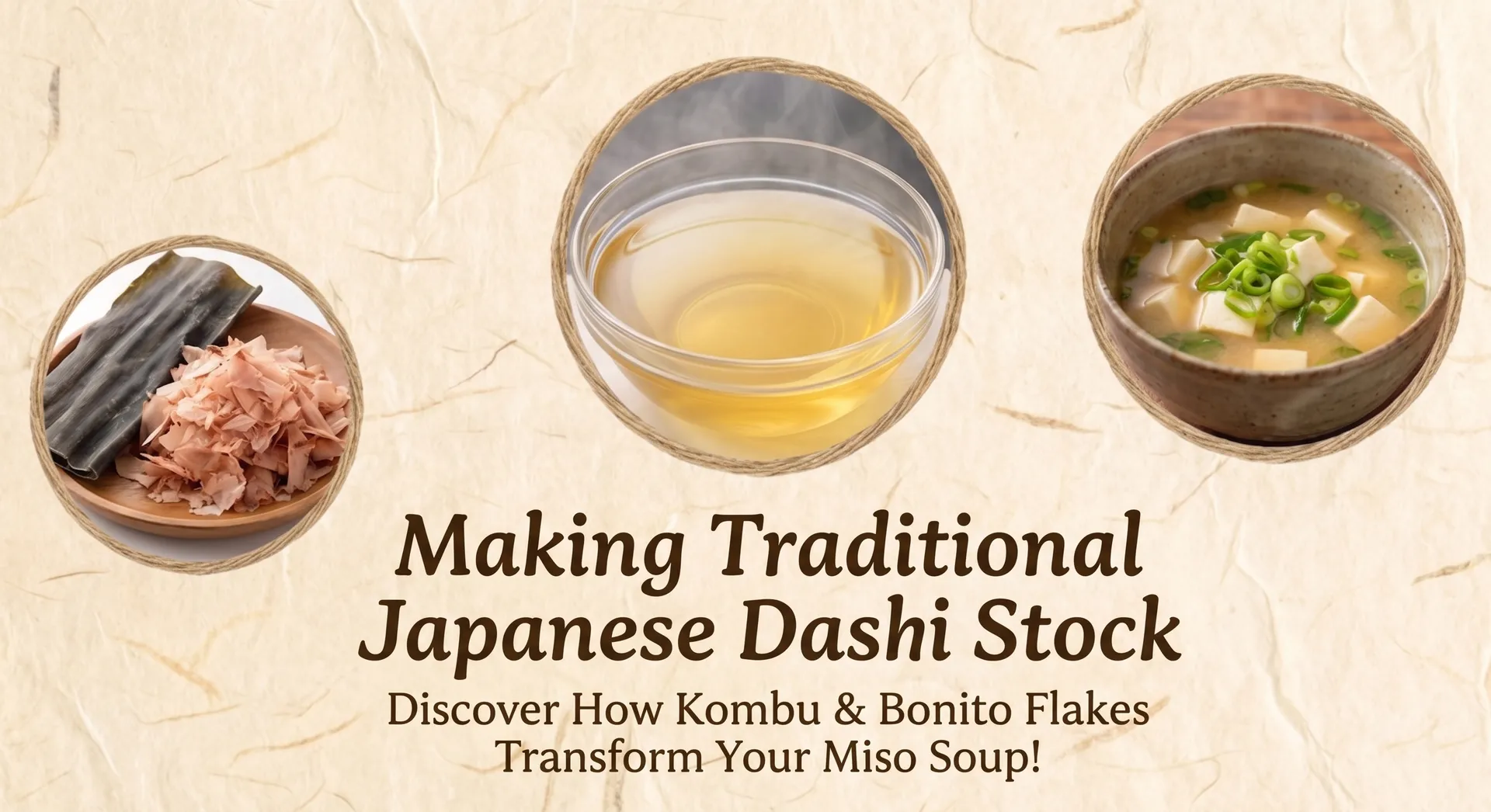
How to Make Japanese Dashi: Kombu & Katsuobushi in 4 Steps