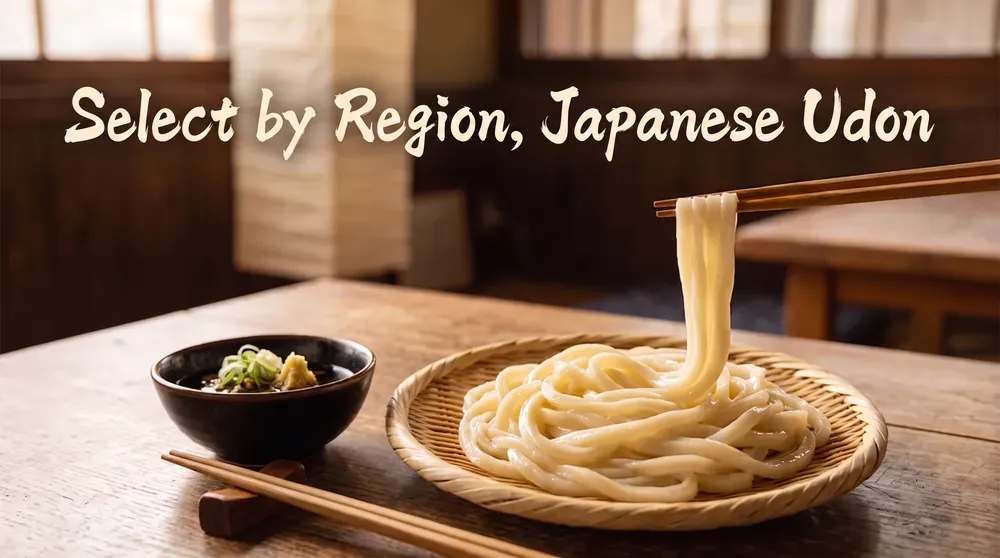
Most people outside Japan have met exactly one udon — the thick white
vacuum-packed kind, springy and mild, sold in every Asian supermarket.
Dried regional udon is a different category, and it splits in two. Some are
rolled flat and cut, which produces square-edged noodles with real chew. Others are drawn out by
hand using oil, which produces round strands that are smooth rather than chewy.
Both are udon and they are not trying to do the same thing.
One island even makes them with camellia oil and then tells you not to rinse them.
We will come to that.
Quick Reference: Chew or Smoothness
| Region | Method | What you get |
|---|---|---|
| Sanuki (Kagawa) | Rolled and cut | The chew. Thick, square-edged, dense |
| Inaniwa (Akita) | Hand-stretched | Thin, slightly flat, silky |
| Goto (Nagasaki) | Hand-twisted, camellia oil | Round, firm and springy at once |
| Mizusawa (Gunma) | Rolled and cut | Very white, firm, translucent |
| Himi (Toyama) | Hand-stretched | Soft and elastic rather than firm |
| Kishimen (Aichi) | Rolled and cut | Wide flat ribbons — barely reads as udon |
| Decide on texture before you decide on region. Cut noodles give you something to bite; stretched ones give you something that slides. | ||
Cut or Stretched: The Choice That Matters
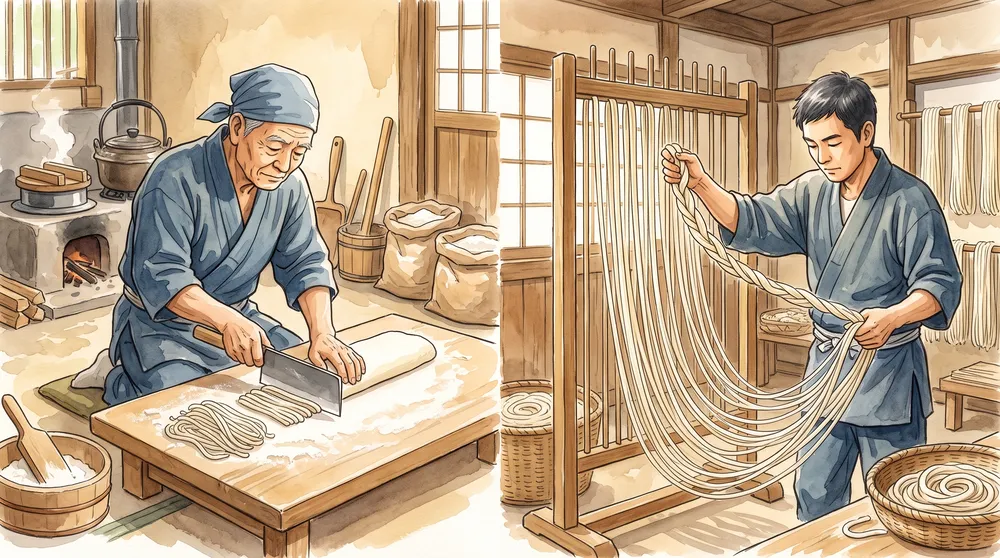
Teuchi — rolled and cut. The dough is kneaded hard, rested, rolled flat and sliced. The strands come out with square edges, and the working of the dough builds the gluten structure that produces koshi — the resistant, springy bite Sanuki is famous for.
Tenobe or te-yori — stretched and twisted. The dough is drawn out repeatedly, using oil to stop the strands sticking. The result is round in cross-section and much smoother, and it is judged on nodogoshi — how it feels going down — rather than on how it feels being chewed.
These are different goals, not different quality levels. Sanuki is not doing Inaniwa badly, and vice versa.
English-language writing about udon has settled on "Sanuki, thick and chewy" as the
standard, which is a bit like deciding that all bread should be sourdough.
If you want something to chew, buy a cut noodle. If you want something that
slides — better cold, better with a light dipping sauce — buy a stretched one.
That decision matters more than which prefecture it came from.
Why Japanese — Six Regions, Six Answers
Udon is flour, salt and water. That is the entire ingredient list, and it is why the regional differences are so large: with nothing to hide behind, the method is the product.
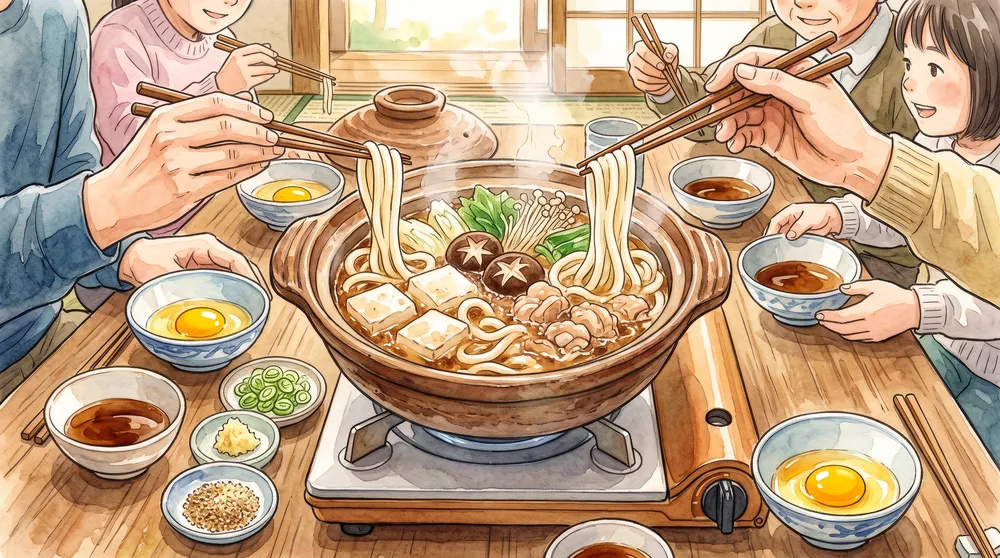
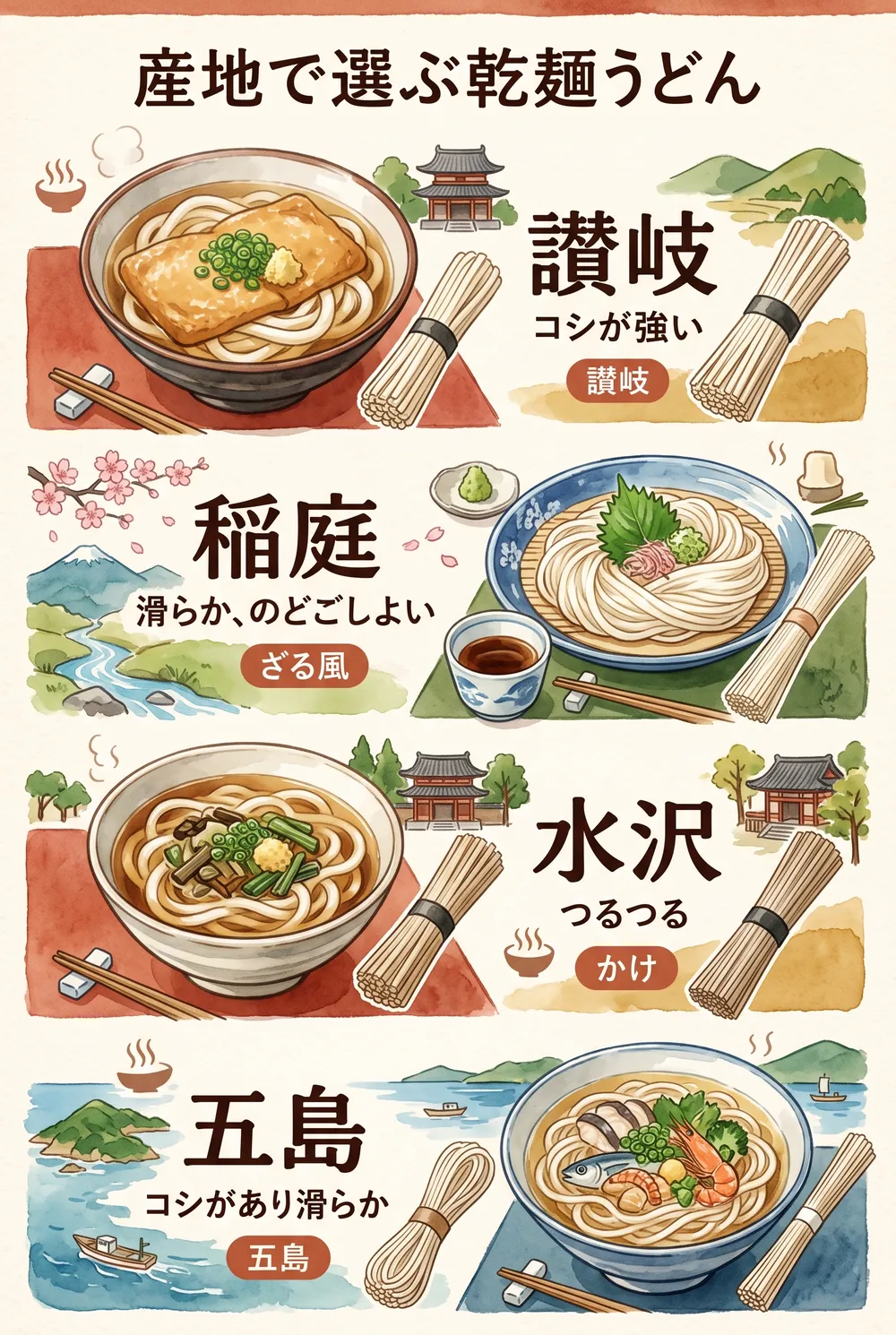
- Sanuki, Kagawa — the benchmark. Thick, square-edged and emphatically chewy. Kagawa eats more udon per head than anywhere else, and the local way to eat it is kamatama: hot noodles straight from the pot, a raw egg, a splash of soy. The heat cooks the egg into a sauce.
- Inaniwa, Akita — the elegant one. Hand-stretched, thin and slightly flattened, best served cold where its smoothness is the whole point.
- Mizusawa, Gunma — the pale one. Strikingly white and almost translucent when cooked, with a clean firm bite.
- Himi, Toyama — the soft one. Hand-stretched and deliberately elastic rather than firm. Proof that chew is not the only ambition.
- Kishimen, Aichi — the outlier. Wide flat ribbons, barely recognisable as udon, with far more surface for broth to cling to.
- Goto, Nagasaki — the one with oil in it. Which needs its own section.
Japan's "three great udon" is a real phrase and the third place is disputed — Sanuki and Inaniwa are on every list, and the third is variously Mizusawa or Goto depending on who is writing. Take it as a sign that the third slot is genuinely contested rather than as a ranking.
Goto: Camellia Oil, and the Pot on the Table
The Goto Islands sit about 100 km west of Nagasaki, and they grow camellias. Camellia oil is the islands' other product — the one Japanese women have used on their hair for centuries.
Goto udon is made with flour, water, salt and that same camellia oil. The oil goes in during the hand-twisting, and it does something specific: it protects the strand from the heat of the water, which is why the noodle stays firm and springy through a longer boil than it should survive.
The technique is called te-yori — hand-twisting — and it is claimed to go back over a thousand years, along the old trade routes that made these islands a landing point for things arriving from the continent.

⚠ Jigoku-daki: the one time you do not rinse
Every other guide on this site tells you to rinse Japanese noodles in cold water after boiling. Goto is the named exception, and it is worth knowing why.
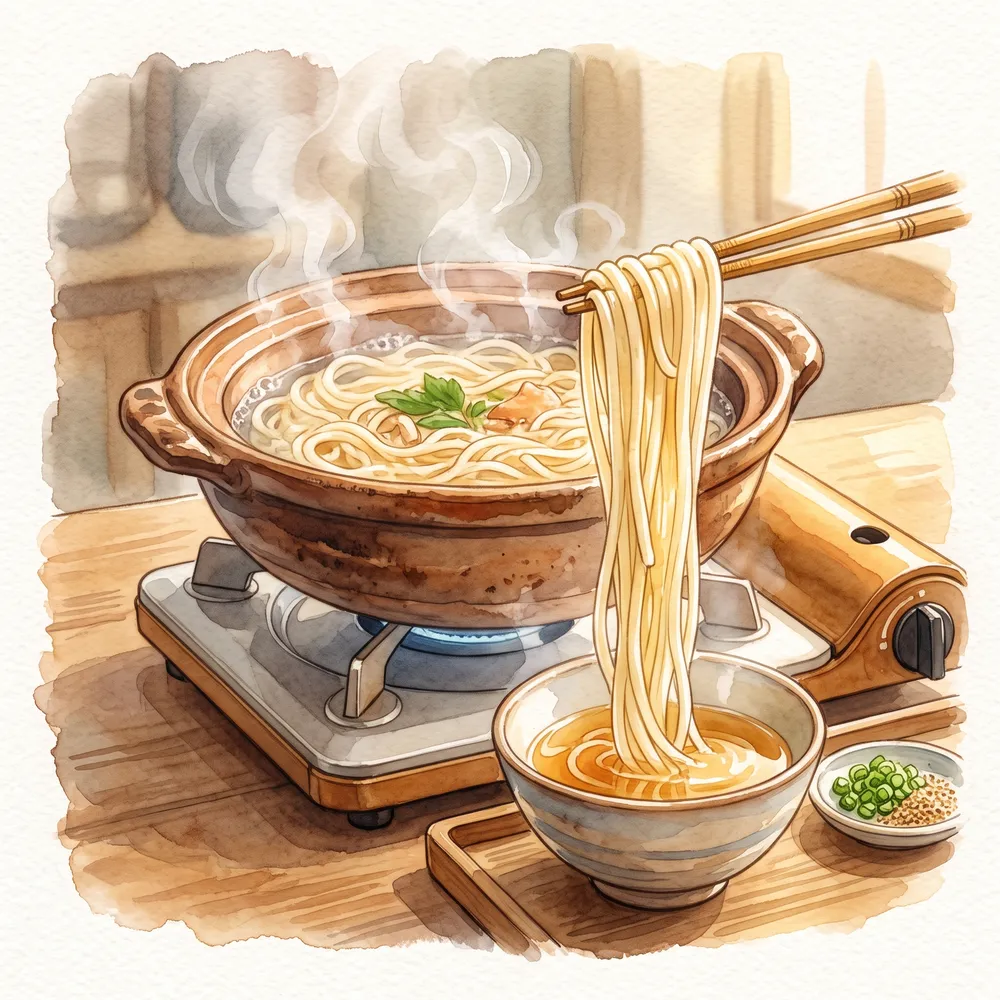
In jigoku-daki — "hell boiling" — the pot of boiling water comes to the table
with the noodles in it, and everyone lifts them straight out of the pot into a dipping
sauce. No draining, no rinsing, no cooling.
The sauce is ago dashi, made from dried flying fish, which is lighter
and cleaner than bonito and stands up to noodles arriving still dripping.
The camellia oil is what makes this work — the noodles hold their texture
sitting in hot water instead of turning to porridge.
Cooking It
- A lot of water, and no salt. Udon dough already contains salt — adding more to the pan gives you salty noodles.
- Dried udon takes longer than you expect, often eight to twelve minutes for thick Sanuki-style, and much less for thin stretched noodles. Read the packet, then taste.
- Rinse in cold water and rub the strands to strip the surface starch — except for a jigoku-daki, which is the whole point of that dish.
- For a hot bowl, warm the rinsed noodles through in hot water for a few seconds before adding broth. Do not skip the rinse just because the dish is hot.
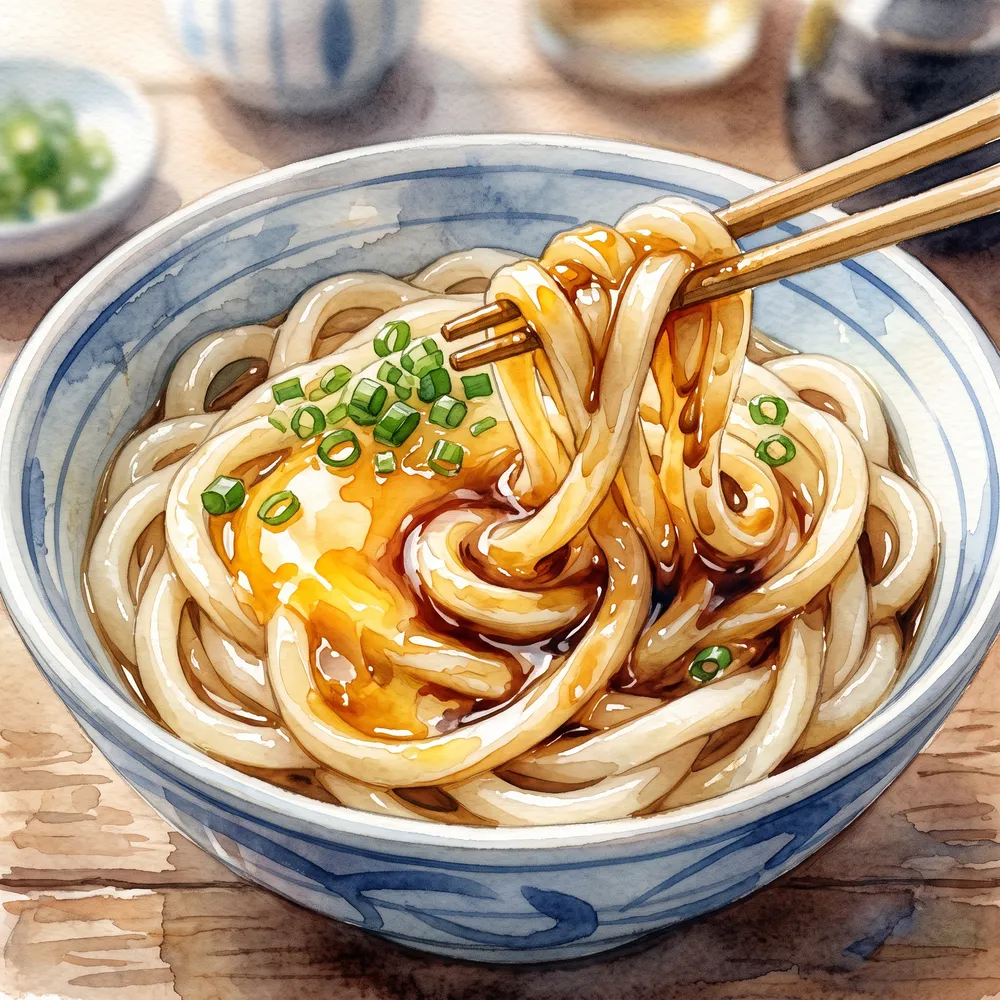
- For kamatama, do not rinse. Drain the hot noodles, put them straight onto a raw egg with a little soy, and toss — the residual heat cooks the egg into a sauce. Use eggs you are happy to eat raw.
Cold is not the lesser option. Inaniwa and other stretched udon are at their
best chilled with a dipping sauce, where the smoothness is the entire experience.
Thick cut udon is better hot, where the chew works against a broth. Matching the
noodle to the temperature is most of getting this right.
What to Buy
Goto udon — the most distinctive, and the easiest to find
Round, thin-ish, firm and springy, made with camellia oil. It is the one
regional udon with an English-language presence of its own, and it is forgiving to cook
because the oil is doing some of the work for you.
Try it as a jigoku-daki first — pot on the table, sauce in bowls — because
that is the dish it was designed around and it is genuinely fun to serve.
- Method
- Hand-twisted with camellia oil
- Origin
- Goto Islands, Nagasaki
- Texture
- Firm and springy; round strand
- Serve
- From the pot, with ago dashi
What to look for on a packet
- The region — Sanuki, Inaniwa, Goto, Mizusawa, Himi. Unlabelled "udon" tells you nothing about texture.
- The method — teuchi (cut) or tenobe / te-yori (stretched). This decides the mouthfeel.
- The thickness, if given. Thick suits hot broth; thin suits cold dipping.
- Whether sauce is included. A first purchase with mentsuyu in the box saves a second order.
We have not verified English-language sellers for Sanuki, Mizusawa or Himi individually,
and Inaniwa is covered in our dried noodle guide with the same caveat.
These do turn up in Japanese grocers and specialist importers — so look for the
place name on the packet rather than chasing a brand.
The region is the specification.
Frequently Asked Questions
What is the difference between cut and stretched udon?
Cut udon is rolled flat and sliced, giving square edges and a chewy bite.
Stretched udon is drawn out by hand using oil, giving round strands that are smooth rather than
chewy.
They are aiming at different qualities — koshi, the resistance, versus
nodogoshi, the way it goes down.
What are Japan's three great udon?
Sanuki and Inaniwa are on every list; the third place is contested, usually
between Mizusawa in Gunma and Goto in Nagasaki.
Treat it as a sign of genuine regional rivalry rather than a settled ranking.
Why is there oil in Goto udon?
Camellia oil, grown on the islands, is worked in during the hand-twisting. It
stops the strands sticking as they are drawn out — and it protects the noodle from the heat of the
water while it cooks.
That is what lets it sit in a boiling pot at the table without going soft.
What is jigoku-daki?
"Hell boiling" — the pot of boiling water is brought to the table with the noodles in
it, and everyone lifts them straight out into a dipping sauce.
It is the one Japanese noodle dish where you do not rinse, and the sauce is
ago dashi, made from dried flying fish.
Should I salt the cooking water?
No — udon dough already contains salt. Use plenty of plain water so the
temperature does not drop when the noodles go in.
Then rinse in cold water and rub the strands to remove surface starch, unless
you are making kamatama or a jigoku-daki.
How long does dried udon keep?
A long time — cool, dark, dry and away from strong smells. It is one of the
easiest Japanese foods to post and to store.
Unlike hand-stretched somen it does not improve with age, so buy what you will
get through rather than stockpiling.
Final Thoughts: Pick the Texture First
Flour, salt and water, and six regions that disagree completely about what to do with them. With an ingredient list that short, the method is the entire product.
Decide whether you want to chew it or feel it slide, buy accordingly, and stop treating Sanuki's chew as the standard everyone else is failing to reach.
And if you only try one unfamiliar thing, make it a jigoku-daki. A pot of boiling water on the table, camellia oil in the noodles, flying fish in the sauce — and for once, no rinsing.
Japanese Soba: Usually Not Gluten-Free, and Why
Japanese Dried Noodles: The Ones That Improve with Age