Japan's SG mark is not ASTM F2236, and it is not EN 13209. Three separate
certification regimes, none of which recognises the others.
That matters more here than in any other category on this site, because a baby
carrier holds a child off the ground. A Japanese carrier certified to the Japanese standard has
simply not been through the American or European test programme — which is not the
same as being unsafe, and is also not nothing.
Japanese carriers do genuinely do some things better — they are cut for smaller
adults, they take back-carrying seriously, and some open at the front. This guide covers both halves
honestly.
Quick Reference: The Three Certifications
| Where | Standard | Weight range |
|---|---|---|
| United States | ASTM F2236 — mandatory (16 CFR 1226) | 3.2–22kg (7–45 lb) |
| European Union | EN 13209-2 (soft carriers) | Up to 15kg |
| Japan | SG mark (Consumer Product Safety Assoc.) | Per product certification |
| ⚠ None of these transfer. An SG-marked carrier has not been tested to ASTM or EN, and vice versa. Check what your specific carrier actually holds. | ||
⚠ Certification Does Not Cross Borders
In the United States, soft infant carriers are covered by a mandatory federal safety standard. Not a voluntary guideline — 16 CFR Part 1226, which incorporates ASTM F2236. Carriers manufactured after 22 February 2025 must meet the ASTM F2236-24 revision.
The European Union works through EN 13209 — part 1 for framed back carriers, part 2 for soft carriers — designated as harmonised standards. EN 13209-2 covers soft carriers up to 15kg.
Japan operates the SG mark, issued by the Consumer Product Safety Association, through either lot-by-lot certification or registration of the manufacturing plant with type confirmation.
What this means when you buy
- They are three separate programmes with no mutual recognition. A carrier holding the SG mark has not been submitted to ASTM or EN testing, and an ASTM-certified American carrier has not been submitted for SG.
- The weight limits are not even the same. ASTM covers up to 22kg; EN 13209-2 stops at 15kg. A carrier's stated maximum depends on which regime it was tested under, which is worth knowing before you use one to the printed limit.
- Untested is not the same as unsafe. Japanese carriers are made to a real standard by established manufacturers, and the SG programme is not a formality. But you should know which certification a specific product actually holds rather than assuming it holds yours.
- Some Japanese makers do certify for export. If a carrier is sold through normal retail in your country, it will generally carry the local certification — the gap opens when you import directly.
The practical rule: look for the certification mark on the product, not on the country. "Made in Japan" tells you where it was manufactured. It tells you nothing about which safety programme it passed, and those are separate questions.
Positioning: The Part That Actually Injures Babies
Certification covers the product. Positioning is on you, and it is where the real risk sits — for a newborn, the danger is not the carrier failing but the airway closing.
⚠ Chin off chest, always
A baby whose chin is pressed onto its own chest can have its airway obstructed, and
a young infant may not have the neck control to lift its head clear.
You should be able to fit a finger's width under the chin. Check it every time you
put them in, and check again after they fall asleep — that is when the head drops.
TICKS — the standard English-language checklist
- T — Tight. The carrier holds the baby against you. Slack lets them slump.
- I — In view at all times. You can see the face without moving fabric.
- C — Close enough to kiss. The head is at your chin height, not down at your waist.
- K — Keep chin off chest. A finger's width of clearance.
- S — Supported back. The back is supported in its natural position, not curled forward.
The M-position, for hips
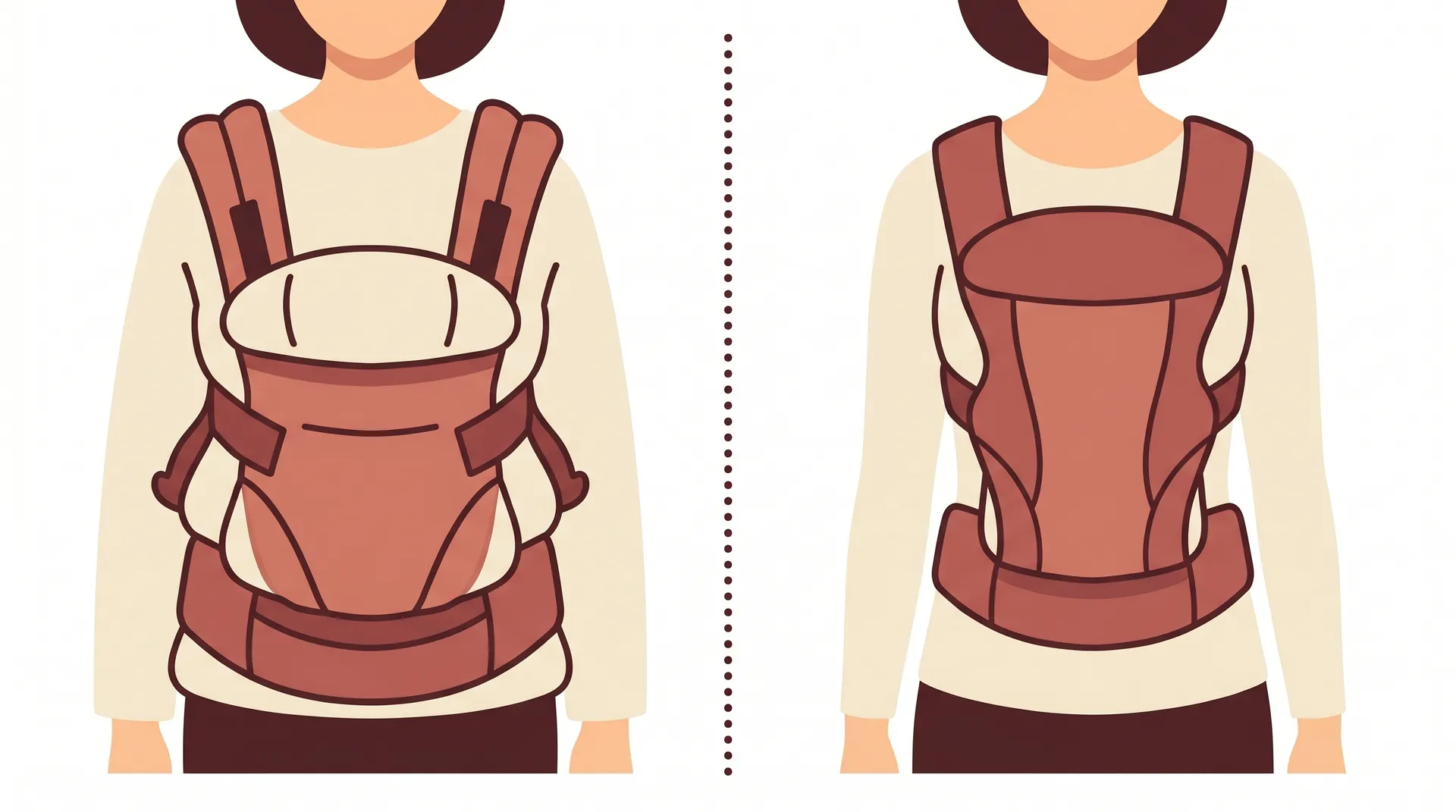
The baby's knees should sit higher than its bottom, with the thighs supported to the
knee joint — the legs make an M shape when seen from the front.
What this avoids is the "dangling" position, where the baby hangs by the crotch
with the legs straight down and nothing under the thighs. Healthy hip development
depends on the joint sitting properly in the socket, and a narrow-based carrier does not
support that.
The width of the seat panel is what determines this, so it is a product
question as well as a technique one.
Why Japanese — Three Real Design Differences
These are not aesthetic differences. They are three specific things Japanese makers design for that Western ones generally do not.
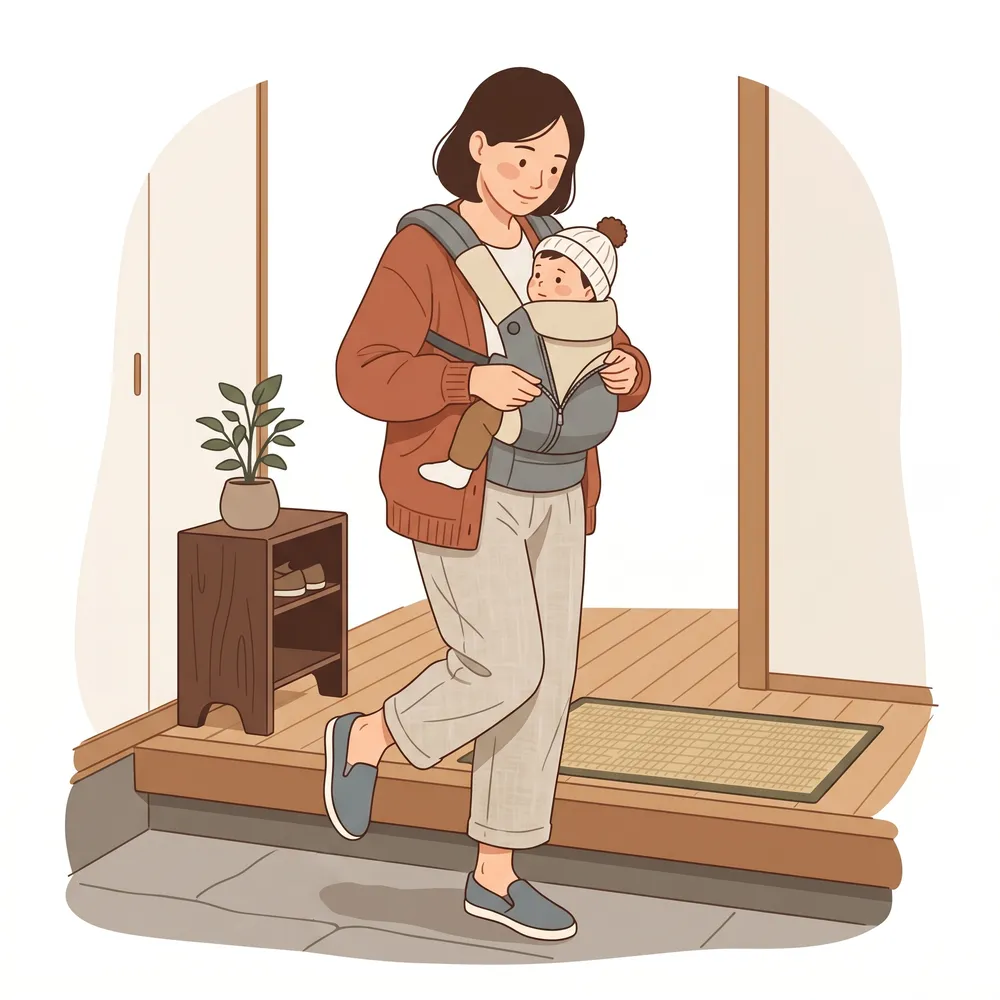
1. They are cut for smaller adults
Western carriers are sized for a Western frame, and the adjustment range often runs out before it fits a smaller wearer. Straps sit wide of the shoulders, the waist belt does not tighten far enough, and the baby ends up lower than "close enough to kiss."
Japanese carriers start from a smaller baseline. If you have been sizing down and still finding carriers too big, this is a real reason to look at them — and it is a safety point, not a comfort one, since a carrier that cannot be tightened properly cannot hold the baby in the right position.
2. Back-carrying is a primary function, not an afterthought
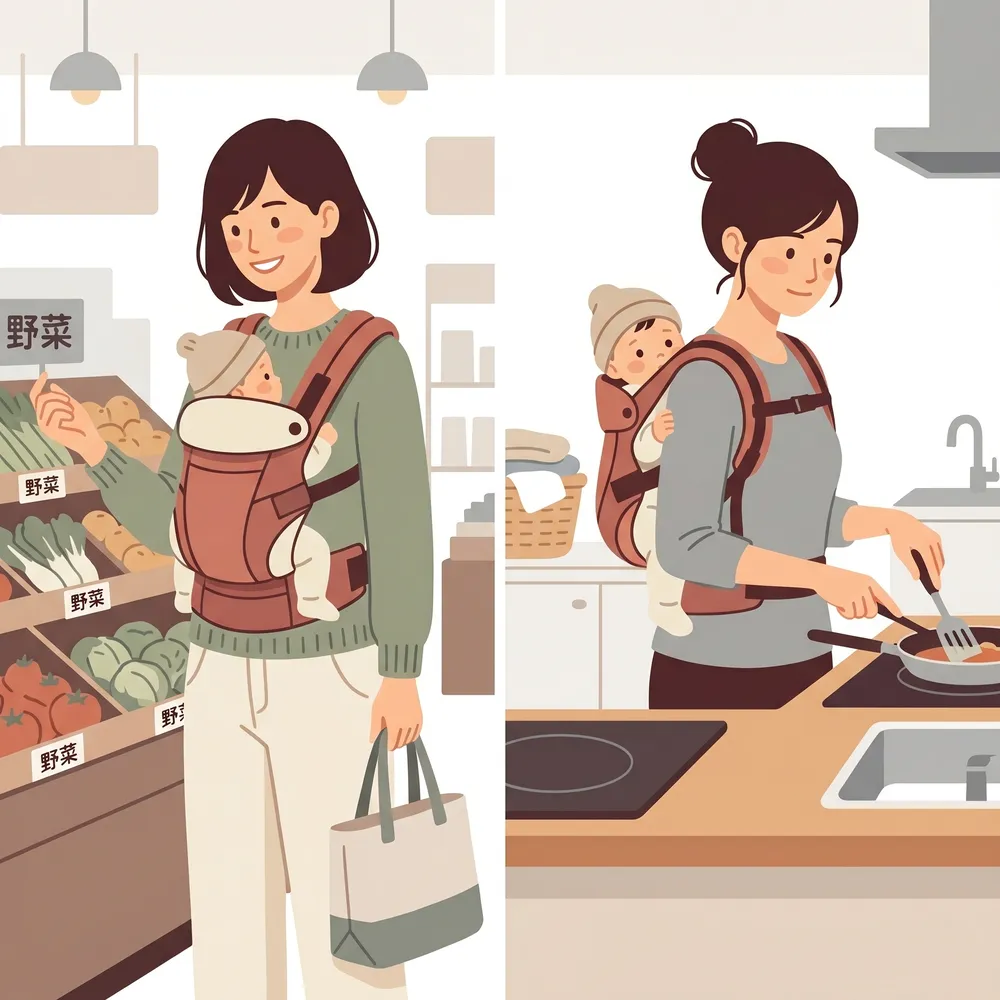
Onbu — carrying on the back — is the traditional Japanese method, done while working, and it remains common. Some Japanese carriers are designed around it rather than offering it as a secondary mode.
The practical difference is your hands and your field of view. A baby on your front is between you and everything you are doing. On your back, you can cook, wash up, and see the floor. Western carriers usually permit back-carrying; Japanese ones are frequently optimised for it.
3. Some open at the front
A conventional carrier is a pouch you must lower the baby into from above, which is awkward alone and genuinely difficult with a sleeping child.
Front-opening designs unfasten at the side or front, so the carrier opens like a jacket, the baby is placed in, and it closes around them. You never lift the child over your own head. For a solo parent, this is the kind of design decision that changes whether the thing gets used.
Choosing by How You Will Use It
Picture the situation you will be in most often, and buy for that rather than for the full list of features. Carriers are compromises and the compromise should favour your actual day.
- Mostly at home, with your hands full — prioritise back-carrying and easy solo fitting. A front-opening design earns its price here.
- Mostly out, on and off transport — prioritise speed of putting on and taking off, and how small it packs. A carrier that takes two minutes to fit gets left at home.
- Hot climate — mesh panels are not a luxury. A baby held against your chest is being warmed by you as well as the weather.
- Shared between two adults of different sizes — check how quickly the straps adjust. Buckle-and-webbing systems reconfigure faster than anything requiring rethreading.
- From newborn — check whether an insert is required and whether it is included. Many carriers are not usable from birth without one, and the head and neck support is the reason.
Try one on with weight in it before buying, if you possibly can. A carrier that
feels fine empty in a shop feels different with 8kg in it after twenty minutes, and fit varies
enormously between torsos.
This is the one product category where ordering unseen is genuinely a gamble —
and where the returns policy is worth reading before you order.
How to Buy One
We are not going to link you to a specific Japanese carrier, and the reason is the whole
point of this article.
We could not confirm which of the Japanese makers hold ASTM or EN certification,
and in a category where the product suspends an infant, "probably fine" is not an
acceptable standard for a recommendation. A shopping link here would contradict everything
above it.
What to check, in order
- 1. Which certification does this specific product hold? Look for the mark on the product and its documentation — ASTM F2236 if you are in the US, EN 13209-2 in the EU, SG in Japan. Ask the seller directly if it is not stated.
- 2. What is the stated weight and age range, and under which standard? The maximum differs by regime, so the number alone is not enough.
- 3. Is it usable from newborn, and does that need an insert? Check whether the insert is included or sold separately.
- 4. How wide is the seat panel? This determines whether the M-position is possible at all — it is a hardware question, not a technique one.
- 5. Can you return it? Fit is individual and cannot be assessed from a photograph.
Where to buy
Buy through normal retail in your own country wherever possible. A Japanese carrier that a domestic retailer stocks has generally been certified for that market — which resolves the entire problem above without you having to investigate anything.
If you are in Japan, buy in a shop and try it on. Baby goods stores fit carriers with weighted dolls, which is worth more than any specification.
⚠ Do not buy a used carrier from an unknown seller. Webbing degrades with UV, buckles crack, and stitching fails invisibly — and you cannot see the history. Recalls also exist in this category, and a second-hand item may be one.
Washing and Keeping It
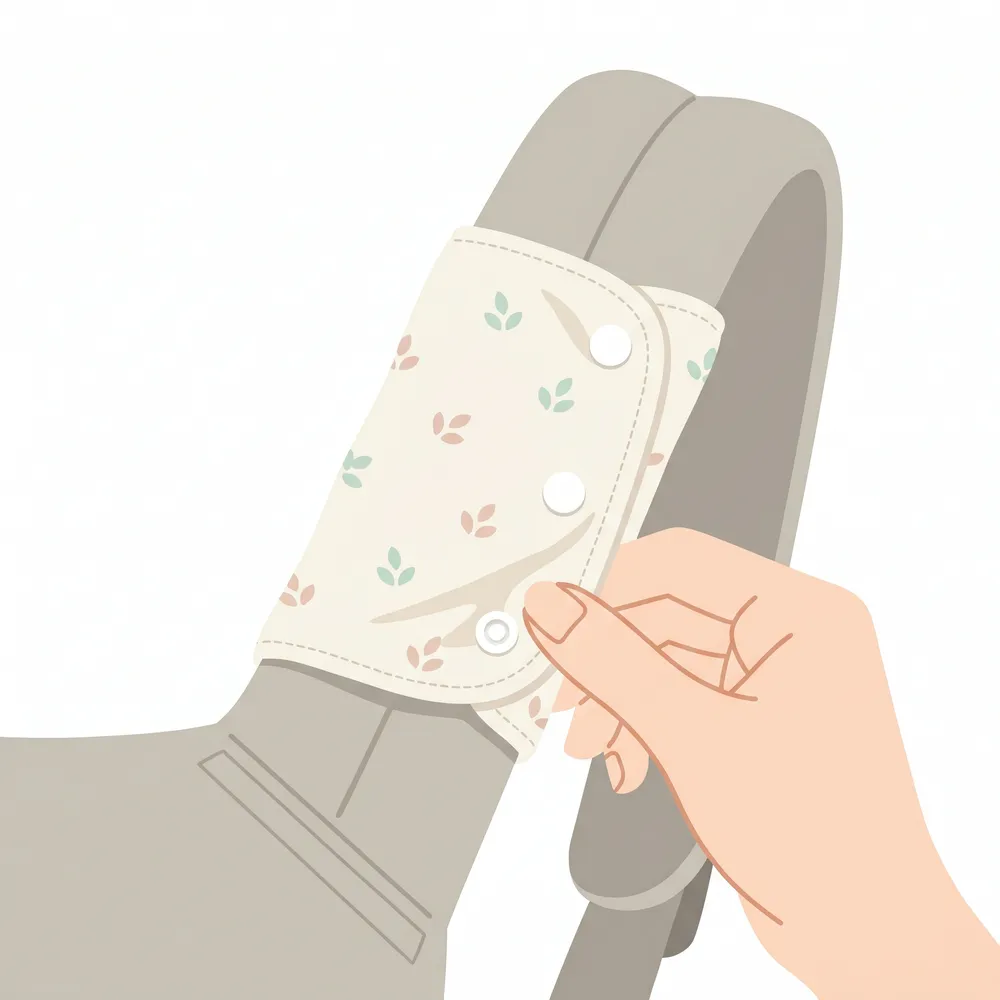
- Use drool pads and wash those, not the carrier. Repeated washing degrades webbing and padding faster than anything else, and the strap is the load-bearing part.
- Follow the maker's instructions exactly. This is not a garment — buckles and webbing have specified washing conditions for a reason.
- Never tumble dry. Heat weakens synthetic webbing and warps buckles. Dry flat in shade.
- Check the stitching and buckles before every use. Ten seconds. Look at the load-bearing seams, and listen for the click when each buckle closes.
- Store out of sunlight. UV is what degrades webbing, and a carrier left on a car parcel shelf ages faster than one used daily.
Frequently Asked Questions
Is a Japanese baby carrier legal to use where I live?
Using one yourself is generally a separate question from whether it can be sold there.
In the US, soft carriers sold must meet ASTM F2236 under 16 CFR Part 1226; the EU uses
EN 13209-2.
Japan's SG mark is a different programme and does not substitute for either. Check
what your specific carrier holds, and prefer buying through retail in your own country.
Does the SG mark mean it is unsafe elsewhere?
No. It means it was tested to a different standard. The SG programme is a real
certification run by Japan's Consumer Product Safety Association, not a label anyone can print.
What it does not tell you is whether the product would pass ASTM or EN, because it
was never submitted. Those are separate questions and both are worth knowing.
What is the single most important safety check?
Chin off chest. A baby whose chin is pressed to its own chest can have its airway
obstructed, and a young infant may lack the neck control to lift clear.
You should be able to fit a finger's width under the chin — check when you put them
in, and again once they fall asleep, because that is when the head drops.
Why do Japanese carriers suit smaller wearers?
They are designed from a smaller baseline, so the adjustment range covers frames
that Western carriers run out of room for.
This is a safety point rather than a comfort one: a carrier that will not tighten
properly cannot hold the baby high and close, which is exactly what the positioning rules require.
When can I start back-carrying?
Follow the carrier's own instructions — the minimum varies by product and is usually
later than front-carrying. Neck and trunk control is the limiting factor.
The real reason to care about back-carrying is that Japanese makers design for it
rather than treating it as a secondary mode, which shows in how the weight sits once you can use it.
Can I order one online without trying it?
You can, and it is the one category where we would advise against it if there is any
alternative. Fit varies enormously between torsos and a carrier feels entirely different
with 8kg in it.
If you must order unseen, read the returns policy first, and try it indoors with
the tags on before using it outside.
Final Thoughts: Look at the Mark, Not the Country
"Made in Japan" tells you where a carrier was manufactured and nothing about which safety programme it passed. Those are separate facts, and in this category the second one is the one that matters.
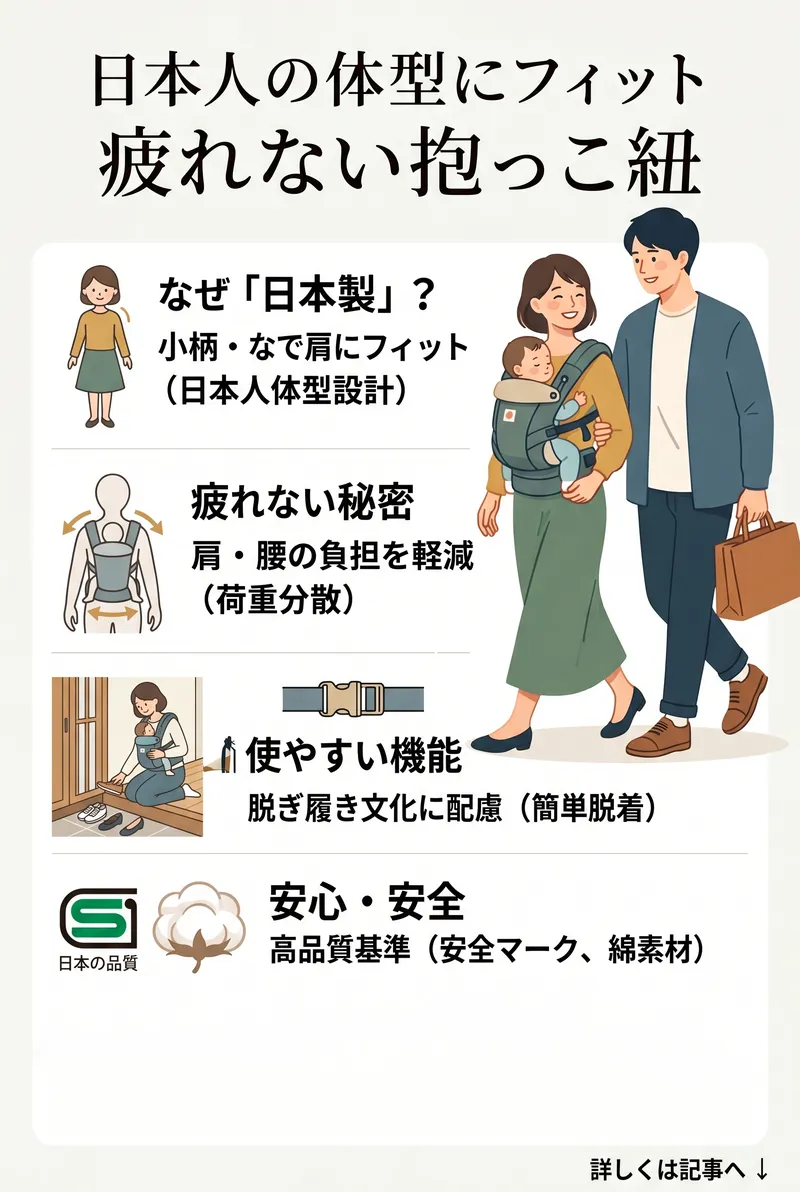
The design advantages are real — smaller sizing, back-carrying done properly, and front-opening designs that let you avoid lifting a sleeping baby over your head. If Western carriers have never fitted you, these are worth investigating.
But buy through retail in your own country if you can, so the certification question answers itself. And whatever you buy: chin off chest, knees above bottom, close enough to kiss.
Japanese Babywear: Cotton, Seams and Sizing
Randoseru: The Japanese School Bag, and the Adult Version