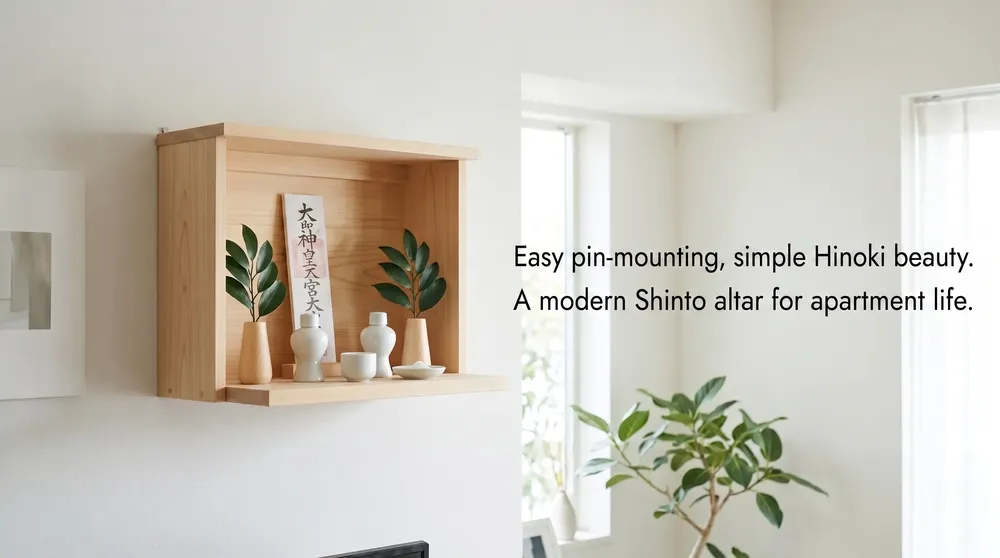
A kamidana is a shelf where kami are venerated in the home. Modern ones are
beautiful objects — hinoki, minimal, designed to hang on an apartment wall without looking out of
place beside anything else you own.
But the shelf is not the thing. What is venerated is the ofuda, a
talisman received from a shrine and kept inside. Without one, a kamidana is furniture.
That matters because ofuda are genuinely difficult to obtain outside Japan — there
is no mail-order system, and that is deliberate. This guide covers what you would actually need,
where the realistic routes are, and how these are placed and cared for.
Quick Reference: What You Need
| Item | Essential? | Notes |
|---|---|---|
| Ofuda | Yes — the only one | Received from a shrine, not bought online |
| The kamidana itself | No | A respectful high place will do |
| Offerings vessels | No | Rice, salt, water; sake on occasions |
| The kumo character | If someone lives above | "Cloud" — so only sky is overhead |
| Placement: above standing eye level, facing south or east. Not above a doorway, not backing onto a lavatory wall. | ||
The Ofuda Is the Point — and the Hard Part
The ofuda is the only essential item on a kamidana. If you have no ofuda, you have no
kami on your kami shelf.
Everything else — the shelf, the miniature torii, the little porcelain vessels — is
housing and hospitality for that one object.
An ofuda is a tablet, usually of wood or thick paper, inscribed with the name of a kami and consecrated at a shrine. It is received, not purchased — you make an offering and the shrine gives it to you. The distinction sounds like semantics and is not; it shapes how the whole thing works.
The most widely kept is the Jingū Taima, the ofuda of the Grand Shrine of Ise, distributed through shrines across Japan. Households commonly keep that alongside an ofuda from their local shrine.
Why you cannot simply order one
There is no official mail-order system, and this is intentional. Jinja Honchō, the association of Shinto shrines, discourages postal distribution — the ofuda is meant to be received in person at a shrine you have visited.
So the realistic routes are limited, and it is better to know that now than to buy a kamidana and discover it afterwards:
- Receive one at a shrine in Japan. This is the intended way, and it is straightforward if you are visiting — shrines distribute to visitors without regard to nationality.
- Hawaii has several Shinto shrines, including Hawaii Kotohira Jinsha and the Daijingu Temple of Hawaii, which distribute ofuda and omamori to those who come.
- Tsubaki Grand Shrine of America long served this role on the mainland. It closed its Washington State site in 2023 and relocated to British Columbia, and shipping outside Canada is currently limited. Check its present status before relying on it.
- Ask someone who is going. Common in practice, though an ofuda is properly received by the person who will keep it.
And it is renewed every year
Ofuda are replaced annually, usually around the new year, and the old one is
returned to a shrine to be burned rather than thrown away.
For someone living outside Japan this is the real difficulty — not obtaining the
first one, but the yearly cycle afterwards. It is worth thinking about before you begin rather
than after.
Can a non-Japanese person keep a kamidana?
A fair question, and the relevant facts are these. Shinto has no conversion process and no membership — there is nothing to join and nothing to renounce. Shrines distribute ofuda to whoever comes to receive them. And the head priest of the Tsubaki shrine in America was an American, widely reported as the first non-Japanese person to be ordained as a Shinto priest.
What is worth deciding honestly is which thing you are doing. Buying a modern kamidana as a piece of hinoki joinery for your home is entirely reasonable, and it is a beautiful object. Keeping one as what it is means obtaining an ofuda and maintaining it. Both are fine. Confusing the two is the thing to avoid.
Why Japanese — Hinoki, and Why It Is Not Decorated
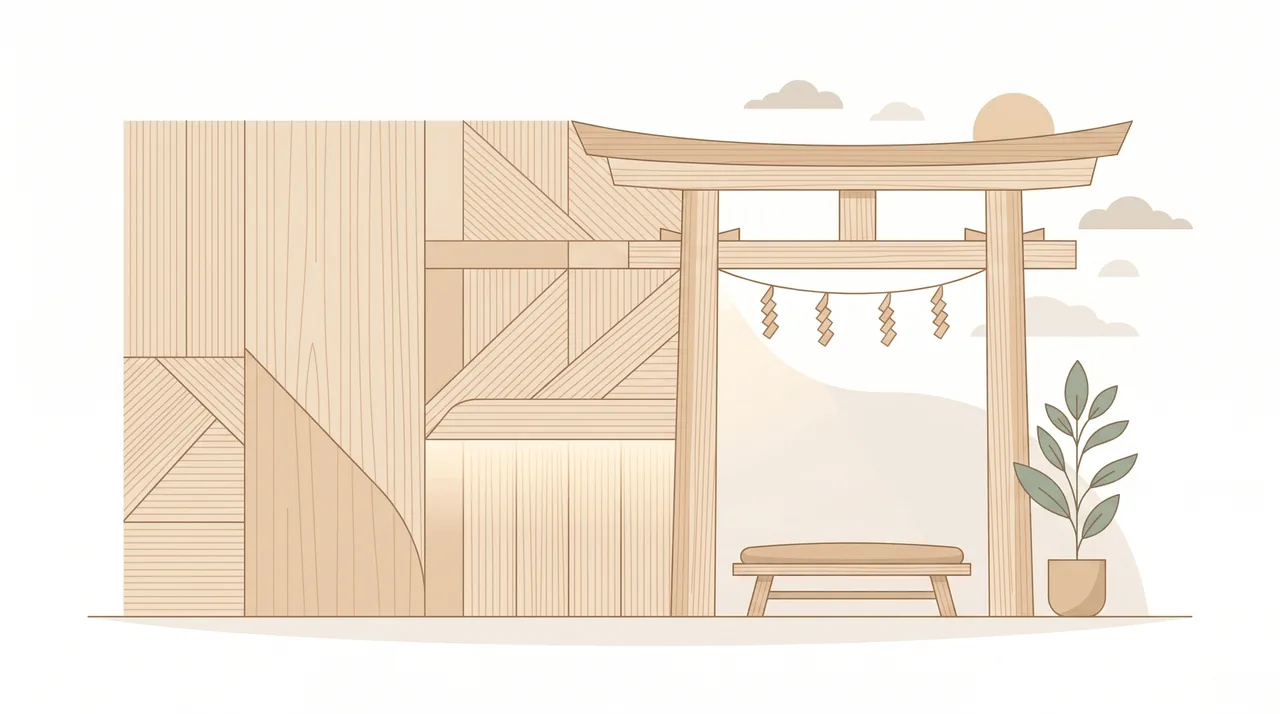
Kamidana are made of hinoki — Japanese cypress — and left unfinished. No stain, no lacquer, no varnish. The pale, close grain and the resinous citrus smell are the whole aesthetic, and both fade over years into something quieter.
Hinoki is the timber of the Grand Shrine of Ise, whose buildings are dismantled and rebuilt in new hinoki every twenty years. Using the same wood at domestic scale is not a coincidence — it is the point of continuity between a national shrine and a shelf in a flat.
The absence of decoration is deliberate rather than minimalist styling. Purity
in Shinto is closer to plainness and freshness than to moral cleanliness — new wood,
clear water, white paper, unpolished rice.
Which is exactly why modern kamidana work so well in contemporary rooms. The
restraint that makes them suit a plain white wall is not a design update; it was already there.
Modern designs solve a real problem
Traditional kamidana are substantial pieces requiring a proper shelf and roof beam. Modern ones are shallow wall-mounted panels — often just a board, a ledge and a suggestion of a torii — because most Japanese homes no longer have anywhere to put the traditional kind.
The abbreviation is accepted practice, not a compromise sold to tourists. What the modern designs keep is the part that is fixed: a clean, high, undisturbed place to keep an ofuda.
Placement: The Rules That Matter
- Face it south or east. The ofuda should look toward the midday sun or the sunrise — meaning the kamidana is mounted on a north or west wall.
- Above standing eye level. You should have to look up, never down. This is the rule people most often get wrong when fitting one into a small room.
- Not above a doorway. Constant traffic and vibration make it an unsettled place.
- Not on a wall backing onto a lavatory.
- Not directly facing a Buddhist altar. Facing each other means turning your back on one while addressing the other. In the same room, side by side, is fine.
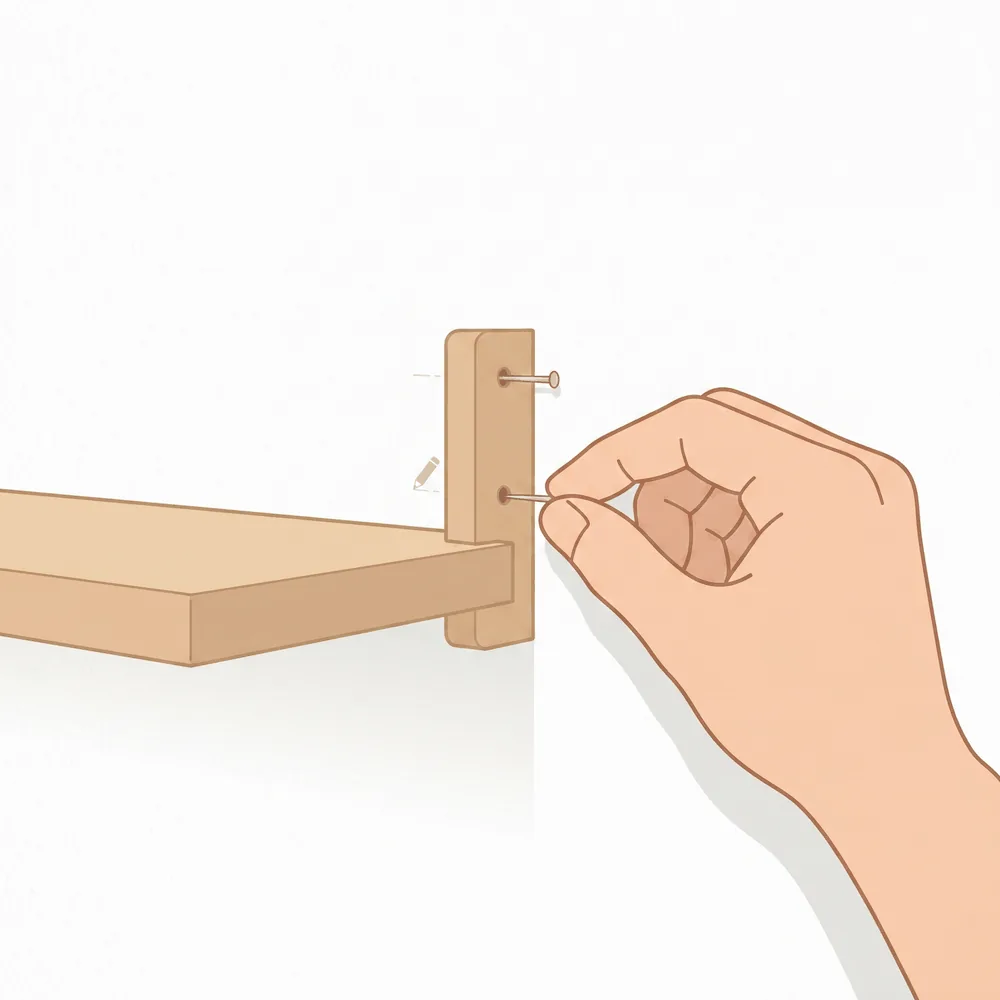
- Mount it properly. Wall construction differs by country — find the studs or use fixings rated for your wall type. A kamidana falling off the wall is the outcome every one of these rules exists to avoid.
The cloud character: one word that rewrites a ceiling
Nothing should be above a kamidana. In a house, that is satisfied by putting it on the top floor. In an apartment with neighbours overhead, it cannot be.
The solution is to fix a piece of paper bearing the character 雲 — kumo,
"cloud" — to the ceiling directly above the shelf, declaring that what lies above is
sky.
It is a beautifully economical piece of thinking: the constraint is not
engineered around, it is answered symbolically, with one character. Printed sheets are sold for
the purpose, and writing it yourself is also normal.
What to Buy
These are Japanese makers selling primarily to the domestic market, so expect Japanese-language sites and to need a forwarding service. What you are choosing between is proportion and joinery, not features.
Kamidana no Sato (Shizuoka Mokko)
A Shizuoka woodworking company and the best-known name in modern kamidana. Their
flat, panel-style designs reduce the form to a board and a ledge, which is
what makes them sit comfortably on a plain wall.
Three-door and single-door versions — the three-door type is for households
keeping the Ise ofuda, a local shrine ofuda and a third together.
- Material
- Japanese hinoki, unfinished
- Style
- Wall-mounted panel, very shallow
- Sizes
- Single and three-compartment
- Market
- Japanese domestic; forwarding needed
- Price range
- $120–$400
Perfect for: An apartment wall, and anyone who wants the modern form done by the maker that defined it.
Designs that keep the torii
Some modern kamidana keep a miniature torii gate at the front while
simplifying everything behind it. The torii is not structural or required — it is a marker of
threshold, the same signal it gives at the entrance to a shrine.
Choose this if the fully abstracted panel feels too much like a shelf to you.
It is a legitimate middle position and a common one.
- Form
- Wall-mounted, with a small torii
- Material
- Hinoki, unfinished
- Depth
- Shallow enough for a hallway
- Note
- The torii is optional in every sense
Perfect for: Households who want the object to read clearly as what it is.
On buying the ofuda
We have not linked anywhere to obtain an ofuda, and that is deliberate. It is not
merchandise — it is received at a shrine, in exchange for an offering, and it is not something to
be sold through a shopping link.
The routes are in the section above. The shelf is the part with a price.
Offerings, and What Daily Practice Looks Like
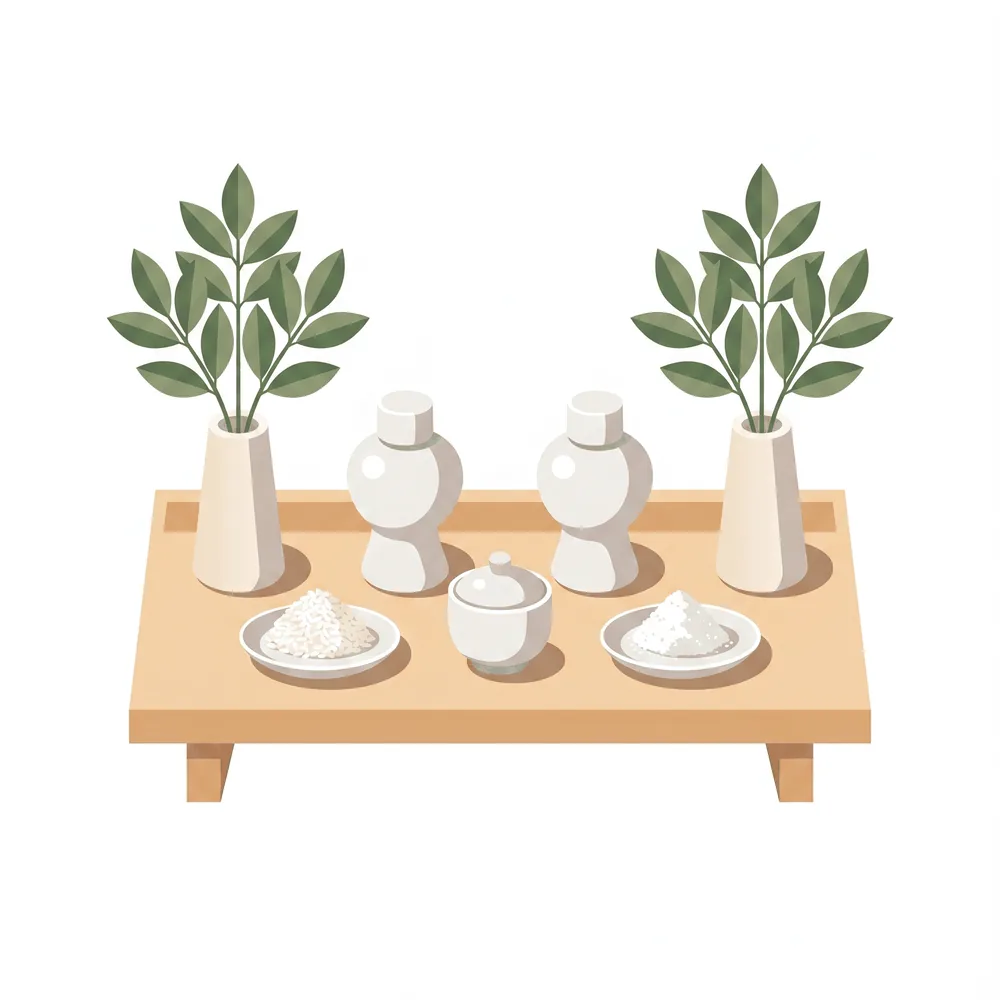
The standard daily offering is three things: rice, salt and water, in small vessels, arranged in front of the ofuda. Sake is added on special days. That is genuinely all of it.
- Fresh water each morning is the core habit. Rice and salt are changed less often — commonly on the 1st and 15th of the month.
- The greeting is two bows, two claps, one bow. Standing, briefly, before you start the day.
- Modern vessel sets are scaled down to match a shallow shelf, and using them is normal practice rather than a shortcut.
- Keep it clean and keep it dusted. More than any rule of arrangement, an untended kamidana is the thing to avoid — this is a category where neglect reads worse than simplification.
After a death in the family
When a household is in mourning, the kamidana is closed — the doors shut, or the front
covered with a sheet of white paper — and daily veneration is suspended for roughly fifty
days.
This is not because death is evil but because Shinto treats it as a state of ritual
impurity that passes with time. After the period, the paper comes down and practice
resumes. It is one of the clearest illustrations of what purity means here: not morality, but
condition.
Frequently Asked Questions
Do I need an ofuda, or is the kamidana enough?
The ofuda is the only essential item. Without one, the shelf is furniture —
there is nothing being venerated.
The reverse is not true: an ofuda kept respectfully in a clean, high place is
complete practice even with no kamidana at all. If you can only have one, have the
ofuda.
How do I get an ofuda outside Japan?
With difficulty, and there is no mail-order system — Jinja Honchō discourages
postal distribution because an ofuda is meant to be received at a shrine in person.
The realistic routes are a visit to Japan, or one of the Shinto shrines in Hawaii.
The Tsubaki shrine that served mainland North America relocated to Canada in 2023, so check its
current status rather than assuming.
Can a non-Japanese person have a kamidana?
Shinto has no conversion and no membership, and shrines distribute ofuda to
whoever comes to receive them. The head priest of the Tsubaki shrine in America was himself
American.
The honest question is which thing you are doing — keeping a religious object, or
buying a fine piece of hinoki joinery. Both are reasonable; treating the second as the first is
not.
What if someone lives on the floor above?
Fix a paper bearing the character 雲 ("cloud") to the ceiling above the kamidana,
declaring symbolically that only sky lies overhead.
This is standard practice in Japanese apartments — printed sheets are sold for it, and writing
the character yourself is equally normal.
How do I dispose of an old ofuda?
You do not — you return it to a shrine, where old ofuda are ritually burned. They
are replaced annually, usually around the new year.
Never put one in household waste. If you are outside Japan and returning it is
impossible, keep it respectfully until you can, and ask a shrine what they advise.
Which way should it face, and how high?
Facing south or east — so mounted on a north or west wall — and
above standing eye level, so that you look up rather than down.
Avoid above a doorway, avoid a wall shared with a lavatory, and do not place it
directly facing a Buddhist altar. Side by side in the same room is fine.
Final Thoughts: Decide Which Thing You Are Buying
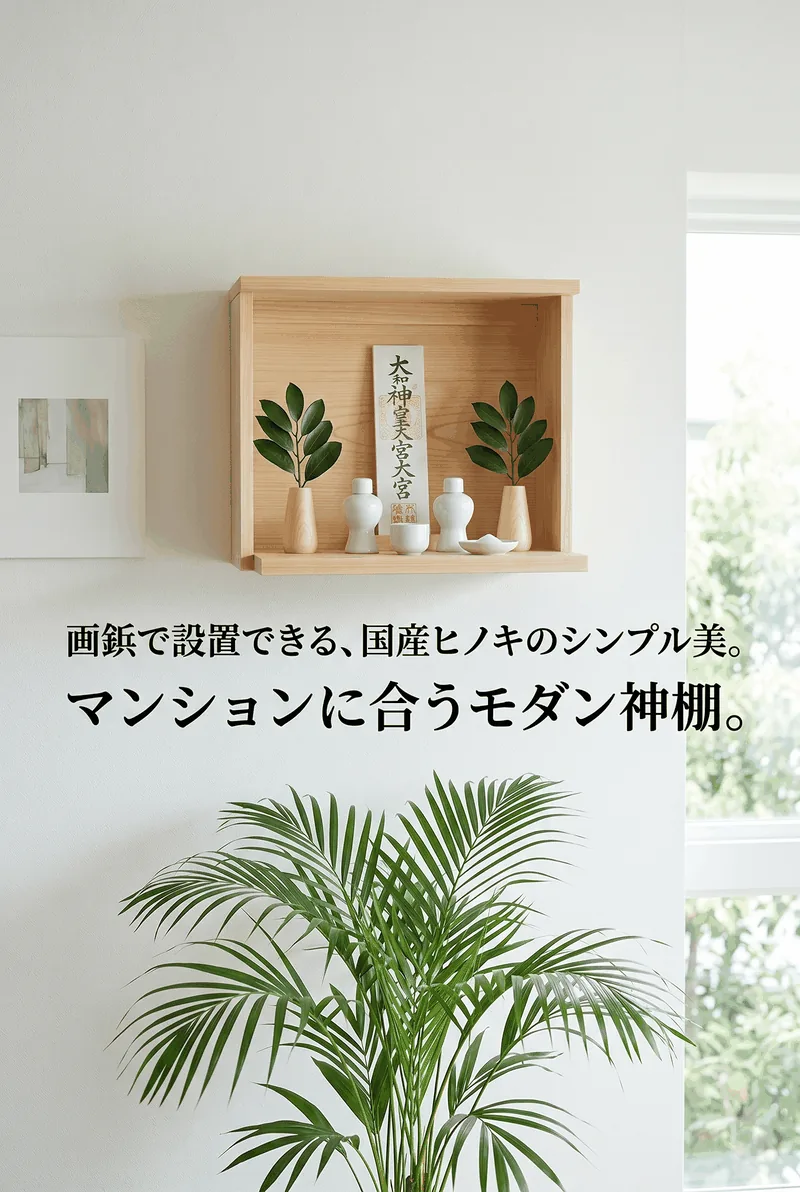
Modern kamidana are among the most quietly impressive objects Japan makes — unfinished hinoki, joined precisely, reduced to almost nothing, and still unmistakably what they are. As woodwork alone they earn the wall.
But the shelf was always the container. The ofuda is the reason it exists, and obtaining one outside Japan is genuinely hard — by design, because it is meant to come from a shrine you stood in front of.
Both choices are honourable. Only the confusion between them is worth avoiding. And if you do keep one, the practice is small: fresh water in the morning, two bows, two claps, one bow.
Japanese Incense: Scent as a Daily Practice
Warousoku: The Candle Made From Tree Wax