You already know Japanese waterstones are the standard. King, Shapton and Naniwa are what the
sharpening world uses, and you are not here to be convinced of that.
You are here because the numbers on the box do not mean what you think they mean.
A Japanese #1000 is not an American 1000-grit. The two scales agree at the coarse end and
then diverge sharply as they get finer — which is why a "5000" stone from one
maker feels nothing like a "5000" from another.
This guide covers the three things that actually decide whether you enjoy sharpening or give up on
it: which grit to buy first, whether your stone needs soaking, and what angle your
particular knives want. That last one is not 15 degrees for most readers of this page.
Quick Reference: Japanese Whetstone Grits (JIS)
| Stone | JIS grit | What it does | Do you need it? |
|---|---|---|---|
| Coarse arato |
#120–#600 | Repairs chips and resets a badly damaged edge | Only if you have actual damage |
| Medium nakato |
#800–#1500 | Creates the edge. This is real sharpening | Yes. If you buy one stone, buy this one |
| Finishing shiage |
#3000–#8000 | Refines and polishes an edge that is already sharp | Nice, not necessary. It cannot fix a dull knife |
| These are JIS numbers, used on Japanese waterstones. They are not the same scale as the ANSI or FEPA grits printed on Western abrasives — see the next section before you compare stones from different countries. | |||
Grit Numbers Are Not Interchangeable
This is the single most confusing thing about buying sharpening stones, and almost no product
page explains it.
There are at least three grit scales in circulation, and they all use similar
numbers that mean different things. JIS is the Japanese standard and is what your waterstone
uses. ANSI is American. FEPA is European, and it splits further into FEPA P for sandpaper and
FEPA F for grinding media.
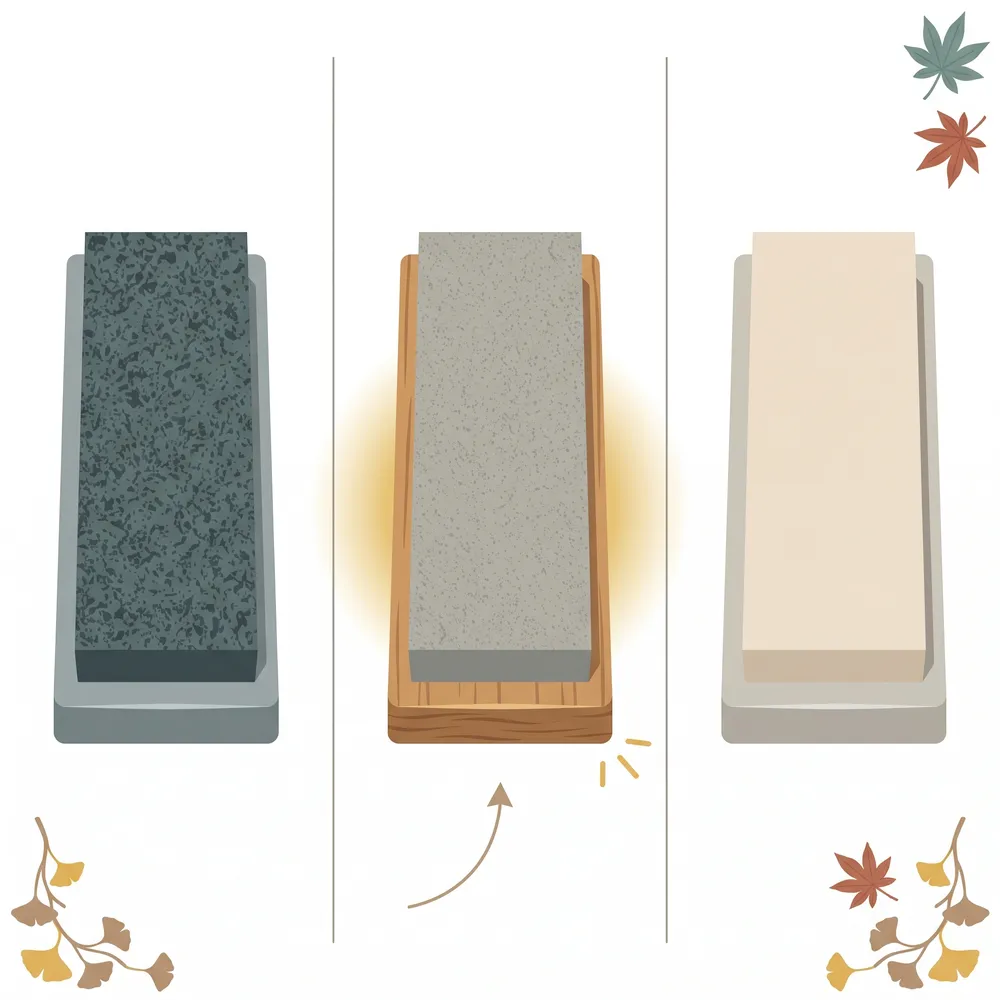
Here is what that costs you in practice. At the coarse end the scales roughly agree. A 120 is a 120 more or less anywhere. But as the particles get finer the standards pull apart fast. In the range where abrasive particles are about 5 to 7 microns across — the same physical grit — one scale calls it 5000, another calls it 1000, and a third calls it 800.
So when a forum post tells you a "3000-grit" finishing stone was disappointing, that sentence carries no information unless you know which scale they meant.
The rule that keeps you out of trouble
Only compare grit numbers within one manufacturer's own range, or convert to microns, which is an actual physical measurement rather than a label. A Shapton #1000 and a King #1000 are close enough to treat as equivalent because both use JIS. A #1000 waterstone and a 1000-grit sheet of American sandpaper are not remotely the same thing.
Why Japanese Waterstones?
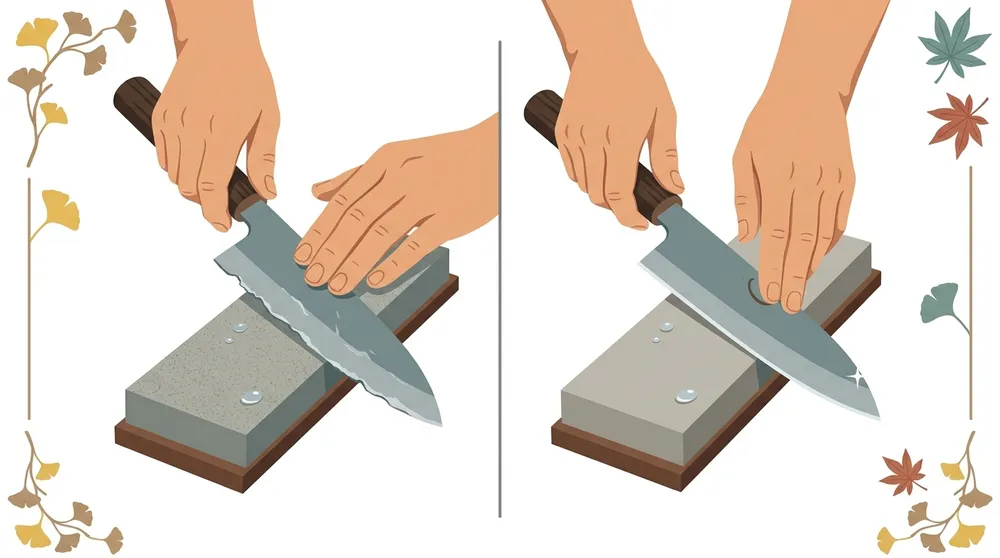
Japan did not invent sharpening stones. What Japan built was an industry where stones were developed alongside the knives they were meant to sharpen — very hard, very thin edges that a coarse or unevenly graded stone would simply wreck.
The practical differences against the alternatives:
- Against oilstones (Arkansas, India): waterstones cut faster and release fresh abrasive as they wear, producing a slurry that does part of the polishing. They also wear faster, which is the trade — you get speed and you give up flatness.
- Against diamond plates: plates stay flat forever and cut hard steels effortlessly, but they cannot produce a refined finishing edge and they feel dead under the hand. Many people own a diamond plate for flattening their waterstones and sharpen on the stone.
- Against pull-through sharpeners: these scrape metal away at a fixed angle with carbide teeth. They will make a knife cut tonight and they will shorten its life. If you own a knife worth sharpening, this is not the tool.
Consistency of particle size is the thing you are actually paying for. A cheap stone with unevenly graded abrasive leaves deep scratches at a grit where it should not, which is why an edge off a bargain stone can feel rough at #3000.
Soak or Splash — Getting This Wrong Damages the Stone
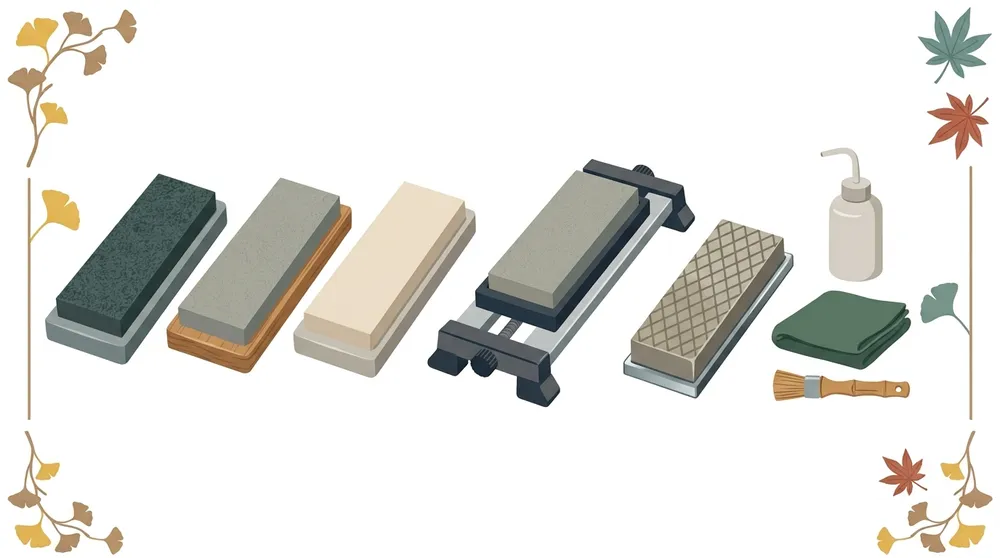
English-language advice tends to say "soak your stone" as though it applied to all of them. It does not, and the two families behave differently enough that swapping the routine causes real problems.
| Soaking stones | Splash-and-go stones | |
|---|---|---|
| Typical makers | King, most traditional stones | Shapton (Kuromaku), many ceramics |
| Before use | Submerge 10–15 min, until bubbles stop | Splash water on the surface. Start |
| Feel | Softer, more slurry, more forgiving | Harder, faster, more feedback |
| If you get it wrong | Used dry, it glazes and stops cutting | Left submerged, it can degrade or crack |
Do not store a soaking stone in water permanently either, however convenient it seems. If it freezes, water trapped in the pores expands and splits the stone. This ends more waterstones than sharpening ever does.
Rinse the swarf off after use, shake the water out, and let it dry somewhere with air movement and out of direct sun.
Which Stone to Buy First
Ordered by what most people reading this should actually buy. All of these are stocked on Amazon.com — Japanese waterstones are one of the few Japanese craft categories where availability outside Japan is genuinely good.
King KW-65 #1000/#6000 — buy this one if you are buying one
The default first waterstone for about forty years, and still the right answer. One side does the work at #1000, the other refines at #6000. King stones are soft and forgiving, which sounds like a compromise but is exactly what you want while you are still learning to hold an angle — the stone gives feedback instead of skating.
- Grit
- #1000 / #6000 (JIS), combination
- Type
- Soaking — 10–15 minutes before use
- Feel
- Soft, generous slurry, very forgiving
- Made in
- Japan (Matsunaga Stone)
- Price range
- $40–$60
Perfect for: Anyone who has never used a waterstone. It wears faster than a ceramic, and that is a fair price for how much easier it is to learn on.
Shapton Ha no Kuromaku set — if you want speed and no soaking
Kuromaku means "the power behind the throne", and these are what a lot of professional sharpeners reach for. Ceramic, hard, fast, and splash-and-go — wet the surface and start. The hardness means less dishing, so you flatten less often, but it also means the stone tells you immediately when your angle wanders.
- Grit
- #1000 + #5000 + #8000 (JIS), three separate stones
- Type
- Splash-and-go — never soak these
- Feel
- Hard, fast cutting, lots of feedback
- Made in
- Japan
- Price range
- $130–$200 for the set
Perfect for: Someone who already sharpens and is upgrading, or who knows they will not tolerate a 15-minute soak before every session.
Naniwa Combi #1000/#3000 — the middle path
Naniwa sits between the other two: harder and faster than King, softer and cheaper than Shapton. The #3000 finishing side is more useful for kitchen knives than a #6000 or #8000, because a very highly polished edge is slippery on tomato skin. For food prep, a slightly toothier edge bites better and lasts longer.
- Grit
- #1000 / #3000 (JIS), combination
- Type
- Ceramic, brief soak or splash
- Feel
- Medium hardness, fast, controlled
- Made in
- Japan (Naniwa Abrasive)
- Price range
- $55–$85
Perfect for: Kitchen knives specifically. If your knives are for cooking rather than woodworking or shaving, this pairing makes more sense than chasing #8000.
King #220 — only if something is actually chipped
A coarse stone removes metal alarmingly fast. That is the point when you have snapped a tip or rolled an edge on a bone, and it is a liability the rest of the time. Do not buy this as your first stone. Buy it the day you damage a knife.
- Grit
- #220 (JIS)
- Type
- Soaking
- Use for
- Chip repair, re-profiling a bevel, reviving a neglected knife
- Made in
- Japan
- Price range
- $25–$40
Perfect for: Rescue work only. You must follow it with a #1000 or the edge will be coarse enough to tear rather than cut.
You also need something to flatten the stone
A flattening plate is not an accessory, it is part of the system — see the section below for why. Options are a dedicated flattening stone, a coarse diamond plate, or loose silicon carbide grit on glass. Any of the three works. Budget for one at the same time as the stone, not later.
The Angle Depends on Your Knife, Not on Japan
Every Japanese sharpening guide will tell you 15 degrees. That advice is correct for Japanese knives, and it is wrong for the knives most readers of this page own.
| Your knife | Angle per side | Why |
|---|---|---|
| German / Western Wüsthof, Henckels, Victorinox |
about 20° | Softer steel around 56 HRC. A thinner edge folds over |
| Japanese double-bevel gyuto, santoku |
about 15° | Harder steel, 60–63 HRC, supports a thinner edge |
| Japanese single-bevel yanagiba, deba, usuba |
Front only, flat back | The back is not sharpened at all beyond removing the burr |
Sharpening a German knife at 15 degrees does not make it sharper for longer. It makes it chip. The steel is not hard enough to hold an edge that thin, so it rolls or micro-chips on the board and you end up sharpening more often, not less.
How to find the angle without a gauge
Twenty degrees is roughly half of forty-five, which is itself half of ninety. Stand the blade vertically on the stone, tilt it halfway down, then halfway again — that is close to 22 degrees and perfectly usable for a Western knife.
For fifteen degrees on a Japanese knife, the traditional cue is a stack of two coins under the spine. Two US quarters or two euro cents give roughly the right gap on a standard gyuto. Slide the coins out once you have the feel of it — the goal is to train your hands, not to sharpen on top of coins.
The rest of the motion
- Work in sections. Divide the edge into three or four zones and do each in turn rather than sweeping the whole blade.
- Pressure on the push, light on the return. Ten to twenty strokes per zone.
- Feel for the burr. Run a fingertip off the edge — never along it — on the opposite side. A faint wire catching your skin means that zone is done.
- Chase the burr the whole length before you flip the knife. No burr means you have not reached the apex, and no amount of finishing stone will fix that.
- Remove the burr with a few very light alternating strokes, then a pass on the finishing side.
Flattening Is Not Optional
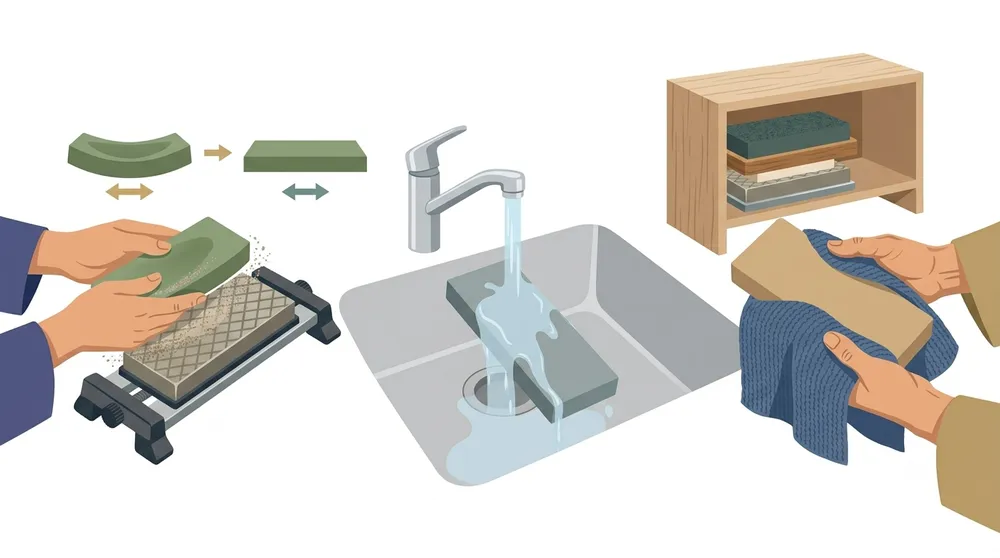
Waterstones cut by shedding abrasive. That means they wear, and they wear most where you sharpen most — the centre. Within a few sessions the surface is a shallow dish.
On a dished stone the blade cannot sit at a constant angle. You will feel it as inconsistency: one part of the edge comes up sharp, another never quite does, and you assume it is your technique. Most people who conclude they "can't sharpen" are working on a concave stone.
Flatten before each session, or at least whenever a straightedge shows daylight in the middle. It takes under a minute. Draw a pencil grid on the stone face first — when the grid is gone, the surface is flat.
Two more things that stop the frustration
Hold the stone still. A stone that slides is a stone you cannot keep an angle on. A rubber base, a damp cloth, or a proper holder all work.
Do not chase very high grits early. A well-executed #1000 edge outperforms a sloppy #8000 edge every time, because sharpness comes from the two bevels meeting cleanly — not from polish. Polish is what you add once they already meet.
Frequently Asked Questions
If I buy only one stone, which is it?
A #1000 medium stone, or a #1000/#6000 combination. The #1000 does the actual sharpening. Coarse stones only repair damage and finishing stones only refine an edge that is already sharp — neither can substitute for the middle.
Is a Japanese #1000 the same as a 1000-grit American stone?
No. JIS, ANSI and FEPA are separate scales. They are close at coarse grits and
diverge sharply as they get finer — at around 5–7 microns of particle size, the same abrasive is
labelled 5000 on one scale, 1000 on another and 800 on a third.
Compare within a maker's own range, or convert to microns.
Can I sharpen my German knives on a Japanese waterstone?
Yes, and they will love it — just use about 20 degrees per side, not 15. The stone does not care what knife you put on it. The angle does. Western steel is softer and needs a slightly more obtuse edge to survive a cutting board.
Do I have to soak the stone?
It depends on the stone, and getting it wrong causes damage. King and most traditional stones soak for 10–15 minutes. Shapton Kuromaku and similar ceramics are splash-and-go and should never be left submerged — prolonged soaking can degrade them. Never store any stone in water where it might freeze.
How often should I sharpen?
For home cooking, once or twice a month is a reasonable rhythm. The test is
behavioural, not scheduled: if the knife slides off a tomato skin instead of biting, or you find
yourself pressing, it is time.
Light and frequent beats heavy and rare — you remove less steel overall.
Can I sharpen ceramic or powder-steel knives on these?
Powder steels yes, ceramic no. Very hard powder metallurgy steels (SG2, ZDP-189) sharpen on waterstones but cut slowly — a diamond plate for the coarse work saves time. Ceramic blades are harder than the abrasive in most waterstones and need diamond.
Final Thoughts: One Stone, Kept Flat
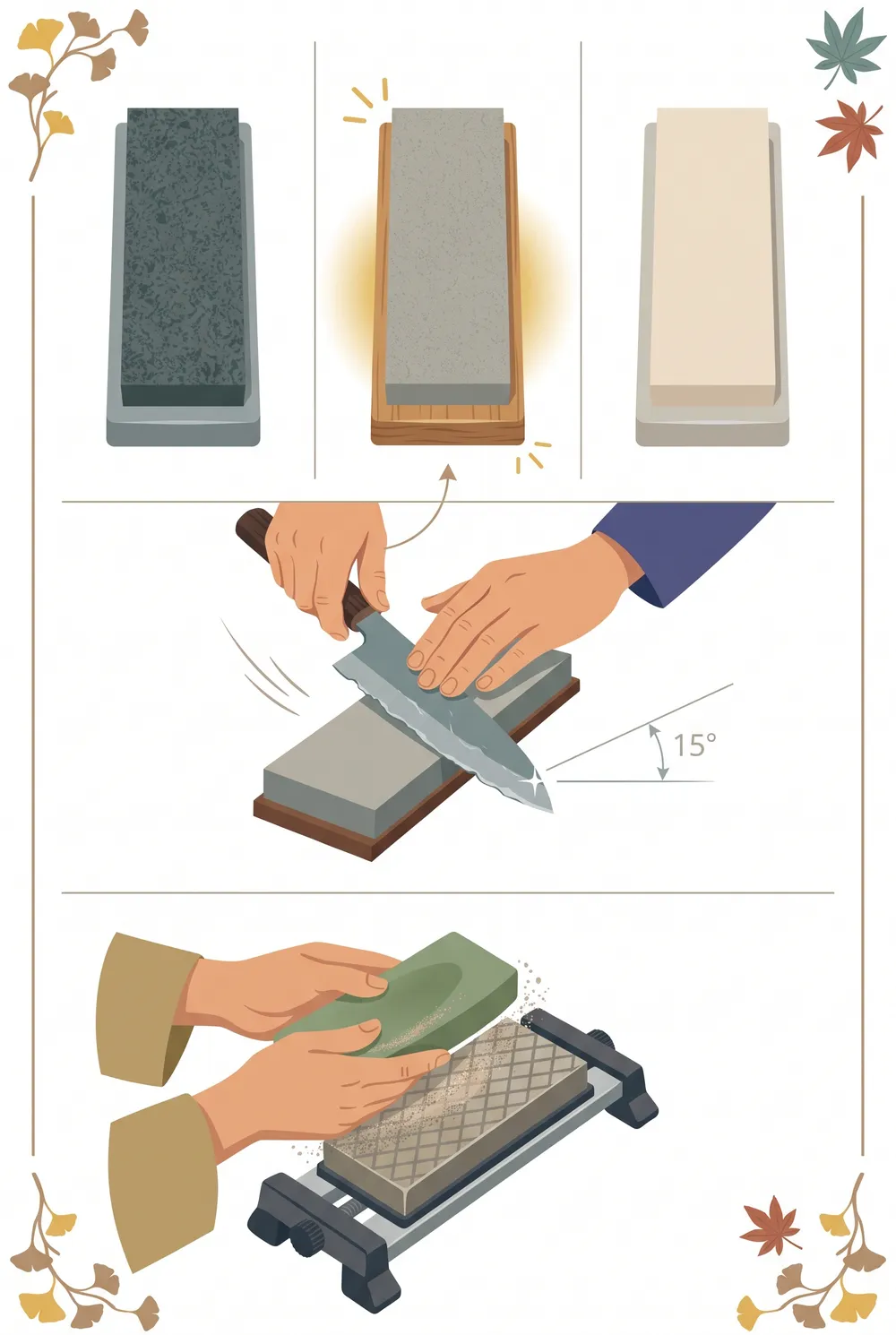
Nearly every sharpening problem traces back to one of three things, and none of them is the stone being insufficiently expensive. The grit number meant something different than you assumed. The stone was dished. The angle was wrong for that knife.
Buy one #1000, buy something to flatten it with, and use the angle your knives were ground at — 20 degrees for German steel, 15 for Japanese. Chase the burr all the way along before you flip the blade.
Do that and a $50 stone will keep every knife in your kitchen sharper than a drawer full of gadgets ever did — for the next twenty years.
How to Sharpen a Japanese Knife

Japanese Kitchen Knives: Brands and Types