Tsuyahime
White brilliance and luster, elegant sweetness and umami. A branded rice nurtured by Yamagata.
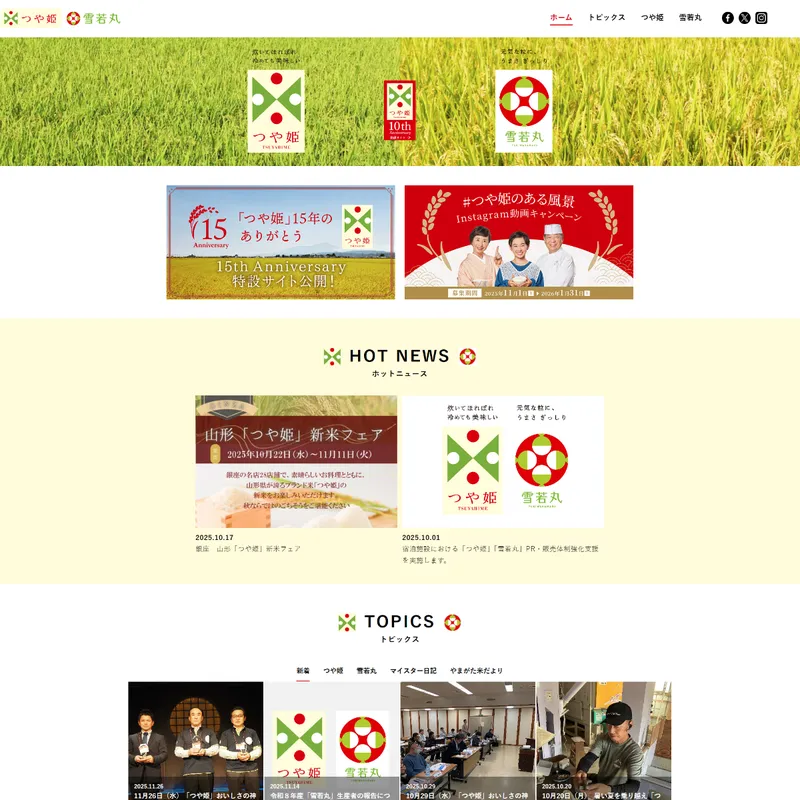
"Tsuyahime" is a branded rice that Yamagata Prefecture advanced cultivation of from Heisei 10 (1998), born after about 10 years of development. Grain size, white brilliance, aroma, and stickiness are all well balanced — and the beauty of the finished rice stands out, as the character. To secure quality, producer certification and shipping standards are set — and production is limited to organic cultivation rice and special cultivation rice. Without wavering, protecting "deliciousness" while being delivered nationwide.
Why We Love It
The "whiteness" and "luster" of the cooked rice first catch the eye — and with the first mouthful, elegant sweetness and umami quickly spread — "Tsuyahime" is a type of branded rice that hits especially those who love plain white rice. The point of continuing to protect quality even with producer certification and shipping standards by protein content rate — also reassurance for those who want to "properly choose" their daily staple. With onigiri and shio musubi, the more you don't add extra seasoning, the more the goodness comes out.
PROFILE About the Company / Workshop
Yamagata Prefecture has accumulated rice-making history against the background of water systems nurtured by primeval beech forests and a climate blessed with four-season temperature differences. "Tsuyahime" is a branded rice born from the lineage of "Kameno-o" — which became the root of modern Japan's good-tasting rice — based on the wisdom and techniques inherited in that land.
Cultivation began in Heisei 10 (1998), and over about 10 years, while repeating selection and testing, was finished aiming to be "the top brand rice representing Yamagata." As introduced — results surpassing "Koshihikari" in taste tests at the cultivation site were obtained — this is a variety refined from the development stage with the axis of "deliciousness."
The biggest appeal is the luster of cooked rice, good grain alignment, and the whitely brilliant appearance. In the Japan Grain Inspection Association's taste sensory test, evaluations like "has luster," "white," "has sweetness," "has umami," and "grains are firm" are shown — and the point of obtaining "Special A" every year in the taste ranking since debut is introduced.
Also, "Tsuyahime" is also characterized by confirming visual beauty with research. In materials from Yamagata Prefecture Agricultural Comprehensive Research Center, in comparison with multiple varieties, sensory value and whiteness degree of whiteness were the highest — and in wavelength analysis, blue spectral reflectance being high is said to be the factor for "white brilliance." As a result, this connects to presence as the rice that "first catches the eye" at the dining table.
Supporting the brand are rules for protecting quality and on-site techniques. Producers are limited to farmers certified by the promotion headquarters head (the prefectural governor) — and the policy of limiting cultivation to organic cultivation rice and special cultivation rice is shown. Furthermore, as Yamagata's unique shipping standard, the system of taste-checking and only shipping those with protein content rate 6.4% or less (dry weight 7.5%) as "Tsuyahime" is clear.
"Tsuyahime" is the home's staple — while also having an aspect spoken of as Yamagata's cultural symbol. Through networks of dealers and providers, CMs and events, and anniversary projects — activities to deliver "the joy of white rice" continue — gaining support as a branded rice that directly accompanies daily dining tables.
The "Kameno-o" lineage and about 10-year cultivation period
"Tsuyahime (Yamagata No. 97)" was born from a lineage inheriting the DNA of the rice "Kameno-o" — said to be the ancestor of modern Japan's good-tasting rice. From Heisei 10 (1998) at Yamagata Prefectural Agricultural Experiment Station Shonai Branch (now Yamagata Prefecture Agricultural Comprehensive Research Center Paddy Agriculture Research Institute), cultivation advanced — and over about 10 years, refined aiming for "outstandingly delicious rice."
Luster, whiteness, grain alignment. High evaluation in taste sensory tests
For "Tsuyahime," results surpassing "Koshihikari" in taste tests are introduced. In the Japan Grain Inspection Association's taste sensory test — for appearance: "has luster," "grains are aligned," "white"; for flavor: "has sweetness," "has umami" — such evaluations are shown. The point of obtaining the highest "Special A" rating every year in the taste ranking since debut also backs the brand rice strength.
Verifying the reason for "white brilliance" with research data
In research by Yamagata Prefecture Agricultural Comprehensive Research Center, in comparison with multiple varieties, "Tsuyahime's" whiteness (sensory value and whiteness degree) came out the highest. In spectral reflectance analysis, blue reflectance being high is said to be the factor making cooked rice look whitely brilliant. Not ending visual beauty in only "sensation" — being able to speak with measurement and verification is Tsuyahime-like.
Systems protecting deliciousness with producer certification and shipping standards
"Tsuyahime" sets strict requirements from the entrance — production by farmers certified by the promotion headquarters head (the prefectural governor) in suitable cultivation areas, limited to "organic cultivation rice" and "special cultivation rice." Furthermore, as Yamagata's unique shipping standard, the system of conducting taste checks and only shipping those with protein content rate 6.4% or less (dry weight 7.5%) as "Tsuyahime" is clearly shown.
LINKS Official Links / Social Media
- Official Website https://www.tuyahime.jp/tsuyahime/
- Online Shop https://www.tuyahime.jp/tsuyahime/shop/buy/
- Contact Form https://www.tuyahime.jp/contact/
- X (Official) https://x.com/y_tsuyahime
- What is Tsuyahime? https://www.tuyahime.jp/tsuyahime/about/
- Variety Characteristics https://www.tuyahime.jp/tsuyahime/about/characteristic/
- Where to Buy https://www.tuyahime.jp/tsuyahime/shop/buy/
- Where to Eat https://www.tuyahime.jp/tsuyahime/shop/eat/
- "Tsuyahime" — Promise from the Producing Region (10th Anniversary Site) https://10th-anniversary.tuyahime.jp/promise/promise.html
- CM / Movies https://www.tuyahime.jp/tsuyahime/about/cm/
- Contact https://www.tuyahime.jp/contact/