Shirayuki Fukin
Everyday cloths born from kaya netting — keeping their whiteness.
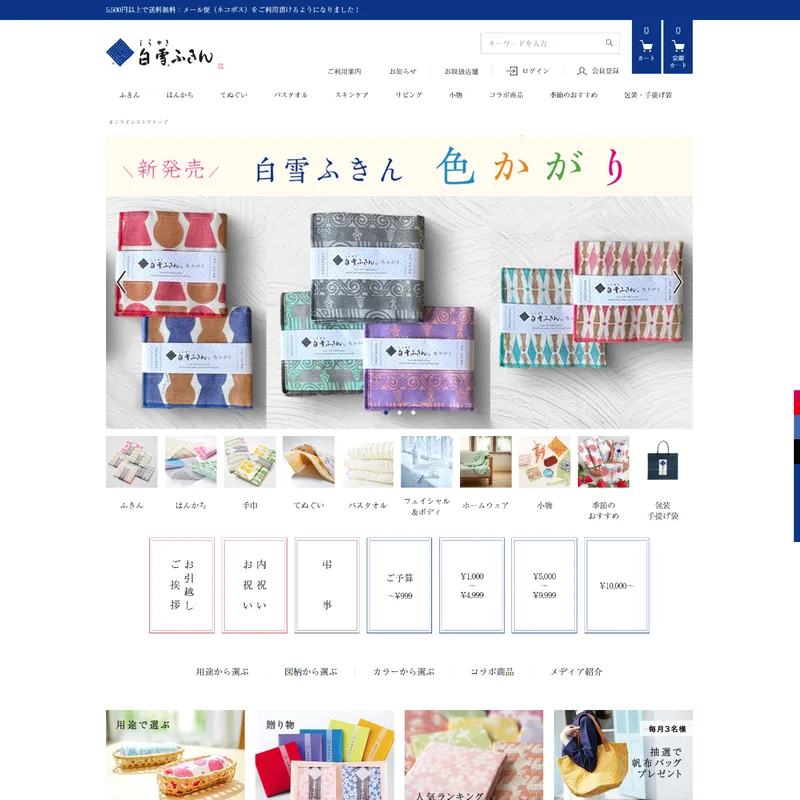
Based in Nara, Shirayuki began with traditional mosquito-net (kaya) weaving and introduced "Shirayuki Fukin" in 1965. Open-weave kaya cloth is layered to create a wipe that dries quickly yet stays durable. By combining rayon (regenerated from wood pulp), cotton, and hemp, the brand offers a cloth that feels light in the hand and practical around the kitchen and wash area. It can move roles over time — from guest oshibori to dishcloth and counter wipe — and can be kept clean with chlorine bleach. The history of being offered as "purification cloth" to Todai-ji Temple speaks to the trust placed in this fabric.
Why We Love It
If I were styling a kitchen shoot, I'd start by rinsing off the starch and letting one cloth "break in." In the morning it's perfect for dishes — water disappears and the cloth dries fast. For guests, fold it into a neat oshibori; a Yuzen pattern feels like a tiny seasonal accessory. Later, I'd demote it to counter duty, refresh it with chlorine bleach, and finally use it as a last-step cleaning rag. That graceful handoff is part of the charm.
PROFILE About the Company / Workshop
Founded in Nara on December 1, 1956 as Kakitani Textile, the business first produced mosquito nets and then expanded nationwide. In 1965 it commercialized the kaya dishcloth under the name "Shirayuki Fukin." The company later established Shirayuki Fukin Co., Ltd. in 2012 and changed its name to Shirayuki Co., Ltd. in 2020.
Kaya fabric is an open-weave plain cloth. Shirayuki uses rayon, cotton, and hemp to tune feel and performance. Rayon regenerated from wood pulp absorbs well and tends to resist lingering odors; it's also supple and easy to wring. Hemp is valued for durability and increased strength when wet, while layered construction supports both toughness and quick drying.
The standard Shirayuki Fukin blends cotton and rayon for a soft hand that grows gentler with use. Hemp-blend pieces stay crisp and low-lint, making them handy for glass or lacquerware. Since 2001, the brand has also offered Yuzen-dyed fukin — starting with a cherry-blossom motif — combining a dyed face with a plain kaya back.
Beyond dishcloths, the range includes handkerchiefs, tenugui, bath and body items, and homewear; in 2002 it also introduced "Uruoi Towel" and "Squalane Uruoi Towel." The headquarters and workshop gallery are at 5-85 Minamikidera-cho, Nara (weekday hours 10:00-16:00; closed weekends/holidays). Capital is 100 million yen (as of Apr 30, 2021), with 25 employees including part-timers (as of Apr 2024), and the company also accepts OEM inquiries.
Layered kaya cloth, fast to dry
Shirayuki Fukin is made by layering open-weave kaya fabric. It grabs water and grime quickly, then dries fast, which helps keep daily routines light. With use, the cloth softens and becomes easier to wring.
Rayon, hemp, cotton — chosen for balance
The lineup uses rayon, hemp, and cotton depending on purpose. Rayon (from wood pulp) is valued for absorbency, moisture release, and being less prone to holding odors. Hemp adds strength — especially when wet — while cotton brings everyday familiarity.
Use it, reassign it, use it again
Start with oshibori or dish drying. When it gets tired, move it to counter wiping, and finally to cleaning rags. Because stains rinse out easily and chlorine bleach is allowed, it's satisfying to keep the cycle going.
Yuzen patterns, made for everyday hands
Yuzen-dyed options pair a patterned face with a plain white kaya back. Skilled artisans dye motifs like the "Four Seasons of Japan" series, turning a small cloth into a quiet accent. Even patterned pieces can be refreshed with bleach.
PRODUCTS Featured Products & Services
Contains promotional content

Shirayuki Fukin (1 sheet)
A kaya dishcloth made with 50% cotton and 50% rayon, approx. 30x35 cm. For dish drying, counter wiping, and hand towels. Uses sweet-potato starch sizing; rinse it off with hot water before first use. Chlorine/oxygen bleach is allowed within the specified dosage/time. Do not use a tumble dryer.

Shirayuki Fukin (hemp blend, 1 sheet)
50% cotton, 35% rayon, 15% hemp, approx. 30x35 cm. Designed for extra durability with a crisp hand and low lint, suitable for glass or lacquerware. Bleach is allowed within the specified dosage/time. No tumble dryer.

Yuzen-dyed Fukin "Deer" (1 sheet)
Two-sided construction: a Yuzen-dyed face (60% rayon / 40% cotton) and a plain white kaya back (50% cotton / 50% rayon), approx. 30x40 cm. Works as a dishcloth or folded as an oshibori. Rinse off starch sizing before use. Bleach is allowed within the specified dosage/time. No tumble dryer.

Squalane Uruoi Towel (Regular)
A squalane-finished towel for face, body, and hair. 100% cotton; it states an 85% potency retention after 50 washes. Softener is not recommended; do not use bleach or a tumble dryer.