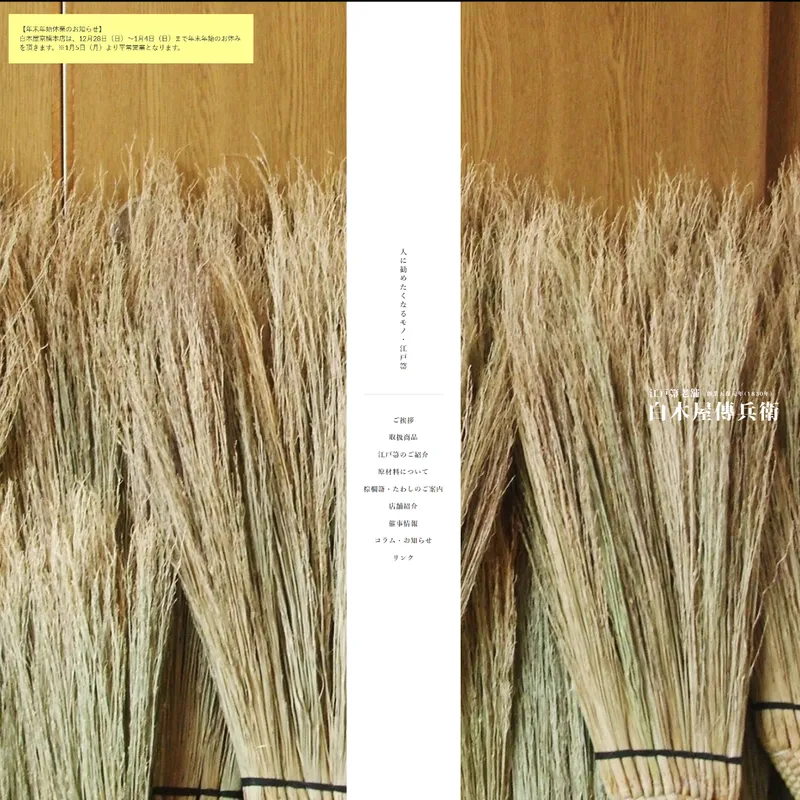
Sweep with Edo style. Traditional Edo brooms from Kyobashi, Tokyo, since 1830.|Shirokiya Denbei
Where a palm broom sweeps as if stroking, an Edo broom flicks dust off with "stiffness."
Even without applying force, the bounce of the grass itself draws in dust in a satisfying way.
That lightness turns cleaning into something rhythmic — almost a sport.
The bounce of grass that sweeps off quickly
In 1830 (Tenpo 1), late Edo period, Shirokiya Denbei was founded in Ginza as a tatami-facing shop. As tatami spread, the shop pursued "a tool that sweeps quickly without damaging tatami" and completed its distinctive "Edo broom." Where Kansai used soft "shuro" (palm), the Edo broom uses "broom corn" — a grass-family plant. The light, brisk sweeping feel that draws on the stiffness and bounce of the grass was loved by impatient Edo people, and continues to evolve today as a "tool for living" that powerfully sweeps carpets and flooring as well.
Why "Shirokiya Denbei" Is Chosen | 3 Reasons
Plant-derived "broom corn"
The material of the Edo broom is broom corn, a grass-family plant. Because the fibers are thick and balance "stiffness" with "suppleness," they powerfully scrape out dust caught in tatami weave and hair tangled in carpet. The ultimate eco-tool — the tips wear with use, and eventually it returns to soil as a garden broom.
A "harimi" that doesn't know static
A paper dustpan made by laminating thick paper and finishing it with persimmon tannin (kakishibu) — a natural insect repellent and water-resistant coating. Because it doesn't generate static the way plastic does, you avoid the annoyance of collected dust clinging to the dustpan. Its thin lip fits the floor perfectly.
The aesthetics of weaving
The method — craftspeople bundle and grade broom corn, then weave it carefully one stalk at a time — hasn't changed since founding. Light, durable, and visually beautiful, hung on the wall it has a presence as an interior piece in itself.
Editor's Note
The strongest pairing is the "Bushou broom" (Lazy broom) with the "Harimi (Large)." What impresses me most is the harimi. Because it's made of paper, it fits the floor perfectly and doesn't miss even fine powder. And unlike plastic, no static — collected dust slides smoothly into the trash. Once you know that stress-free feeling, you can't go back to other dustpans.
Edo Wisdom for Daily Life | 5 Editor's Picks
From an authentic long-handle broom woven by craftspeople, to a compact hand broom suited to modern homes, and the famous supporting cast — the "harimi."
Edo Broom (Tokujou) Long Handle
Sweep elegantly without bending. The finest sweeping feel, in one piece.
A long-handle broom that uses a generous amount of carefully selected, high-grade broom corn. Because the handle is long, you can clean in a comfortable, straight-backed posture. The tip is densely packed and the touch on tatami is very gentle. Ideal for sweeping a spacious tatami room or living room.
For cleaning tatami, flooring and carpet. For someone who wants to treasure it as a lifetime tool.
Edo Broom "Bushou Nagae" (Long Handle)
Even "lazy people" want to clean with it. The No. 1 all-rounder for ease of use.
A popular model named for the fact that "even lazy people can sweep quickly and easily." Slightly lighter than the Tokujou by adjusting the amount of grass — handles smoothly with one hand. Excellent balance of price and performance, and the most often chosen "first Edo broom."
For a quick sweep every morning. As the main cleaning tool on days you don't want to pull out the heavy vacuum.
Harimi (Large / Small)
The pleasure of dust sliding cleanly off. A kakishibu-finished paper dustpan.
The best partner for an Edo broom. Made of washi paper and a bamboo frame, coated with kakishibu for strength. The greatest feature is "no static." Gathered lint and hair slide down into the trash with a smoothness that surprises. Light and elegant in form — a hidden masterpiece of Shirokiya Denbei.
Pair "Large" with a long-handle or hand broom; "Small" with a tabletop or small broom.
Otegaru Broom
A short-handle compact model that fits modern life.
A hand broom with a shortened handle, in a size that goes anywhere for storage. Excellent at nimble cleaning — corners of stairs, under a dining table, gaps in furniture. The tip is angled to make it easier to fit the floor.
For a one-room apartment, or as a dedicated second-floor sub-broom. Can be hung on the wall together with a Harimi (Large).
Small Broom for the Table
Eraser dust on the desk, bread crumbs — sweep them off in a flash.
A tabletop size beautifully woven with small broom corn. The spring is still alive, firmly flicking out dust from keyboard gaps and fine particles on the table. Useful for keeping the desk area for remote work in order.
For cleaning study desks, dining tables and shelves around the entryway. Excellent for cleaning a coffee grinder too.
Summary: A "lightness" no vacuum cleaner has.
On a day when even pulling out the heavy vacuum from the closet feels like too much, with an Edo broom you can pick it off the wall and tidy the room in a few minutes.
Even late at night, with no noise to worry about and no electricity used, you arrange the room at your own rhythm.
Shirokiya Denbei's tools make that kind of "free cleaning" possible.
- Company
- Shirokiya Denbei Co., Ltd.
- Founded
- 1830
- Address
-
3-9-8 Kyobashi, Chuo-ku, Tokyo 104-0031, Japan
Google Map - Tel
- +81-3-3563-1771
- Business
- Manufacturing and sales of Edo brooms, feather dusters, harimi and more
愛用者の声・口コミ
口コミを投稿するには、ログインが必要です。
まだ口コミはありません。最初の愛用者の声を投稿しませんか?