
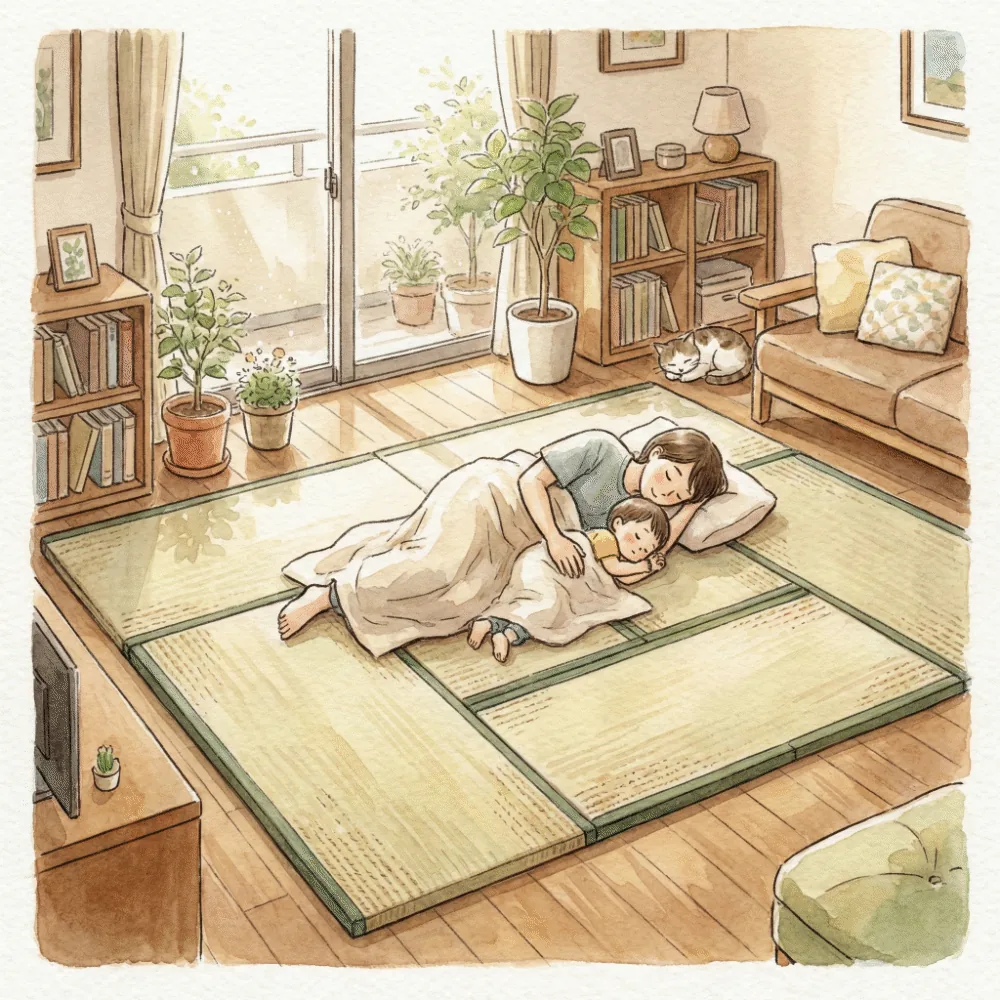
Hardwood floors are easy to clean and look sharp — but there are moments when you just want to lie down on the floor and stretch out.
A nap spot for a baby. Relief from a cold floor in winter. The pleasure of sitting on the ground without a chair.
All of that is possible again with Japanese-made "unit tatami" (modular tatami tiles) and igusa (rush grass) rugs.
"Tatami = old-fashioned" — that idea is finished. Borderless Ryukyu-style tatami in charcoal gray or warm beige, and igusa rugs woven with patterns that look like textile art, blend into modern interiors without a second thought.
This guide introduces the best domestic igusa products for your floor — pieces that are calming, healthy, and built to last.
Feature series: This article is part of the "Japanese-Made Household Essentials" series.
1. Why Tatami Mats? Creating a Comfort Zone on Hardwood Floors
Tatami offers things carpets and regular rugs simply cannot.
Gentle cushioning and noise dampening — ideal for children and naps
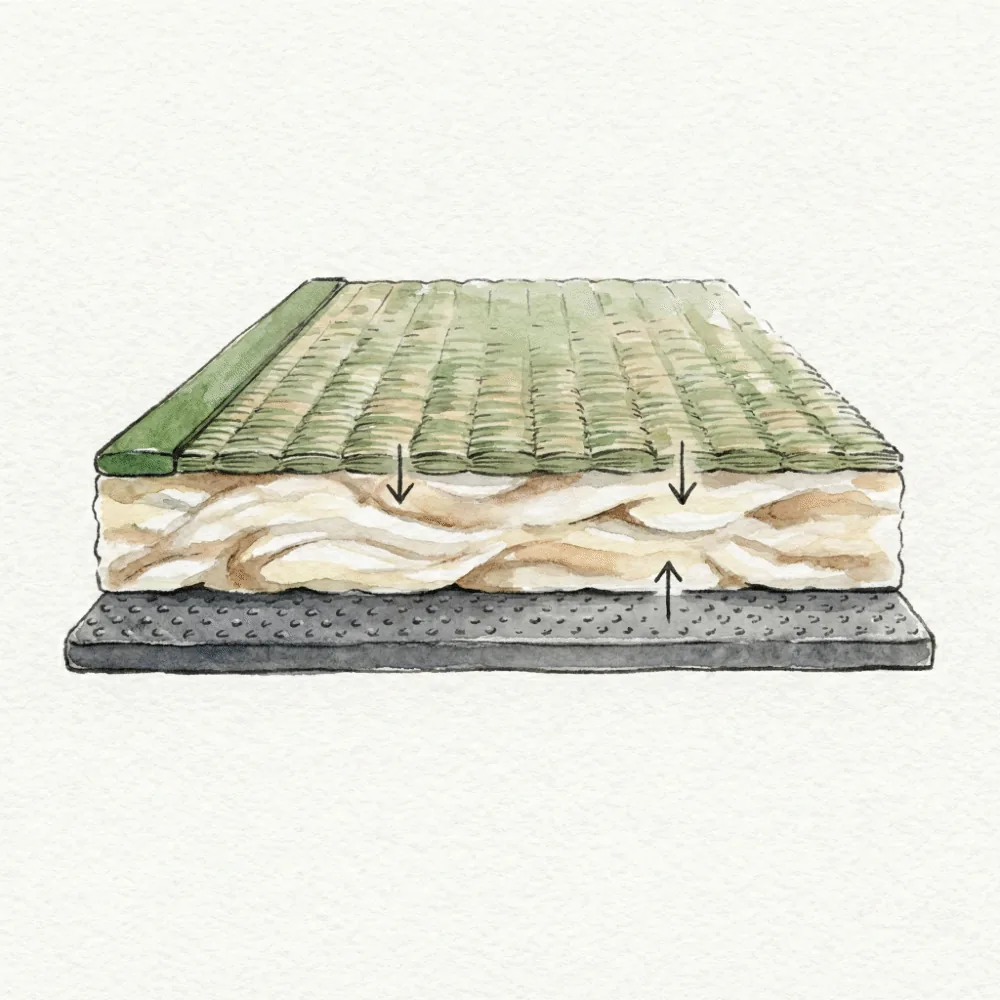
Tatami is densely packed with air, giving it a soft, resilient cushion. Sitting on a hardwood floor for long gets uncomfortable; on tatami you can sit for hours and lie down for a nap without thinking about it.
Thicker unit tatami tiles also absorb impact sound significantly — blocks falling, children jumping — making them a thoughtful choice in apartments where noise travels downstairs.
2. The Power of Domestic Igusa: Air Purification and Natural Aromatherapy
The cheap tatami sold at home improvement stores and the genuine article are not the same material.
A natural air conditioner: absorbs excess humidity, cleans the air
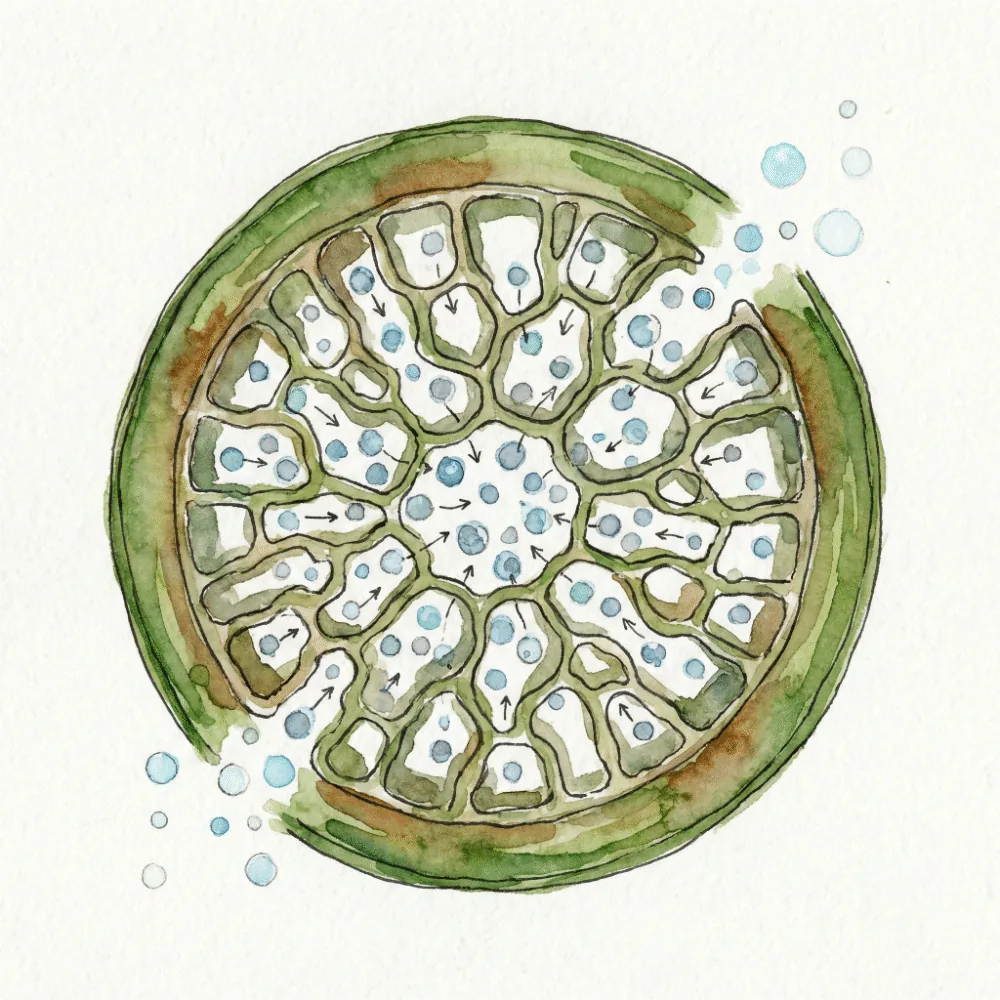
Domestic igusa (rush grass), grown mainly in Kumamoto and Fukuoka in Kyushu, has thicker, tougher stalks and a sponge-like interior fiber compared to Chinese-grown equivalents.
That sponge structure absorbs excess humidity from the room and releases it when the air dries out — a natural humidity regulator.
Igusa also absorbs and breaks down formaldehyde and nitrogen dioxide — the compounds linked to sick building syndrome — functioning as a passive air purifier.
Forest bathing in your own home: phytoncide and vanillin in igusa scent
The scent of fresh igusa contains phytoncide — the same relaxing compound found in forest air — plus vanillin, a sweet fragrance found in vanilla.
A tatami mat in the room doesn't just look calming. The scent itself actively reduces stress.
3. Recommended Tatami Mat: IKEHIKO "Prado" — Modern Borderless Ryukyu Design
IKEHIKO Corporation, headquartered in Okawa, Fukuoka — Japan's leading manufacturer of igusa products.
IKEHIKO (イケヒコ) — "Prado" Unit Tatami
Design award winner. Eight colors to suit any interior.
The Prado overturns the assumption that tatami must be green — it comes in eight colors including charcoal gray, beige, and deep navy, each striking without being loud.
The borderless (heri-nashi) Ryukyu-style design has clean edges that disappear into modern, Scandinavian, and minimalist interiors without friction.
All igusa used is pure domestic Japanese rush grass from Kyushu.
The underside is finished with a non-slip coating — no sliding on hardwood floors, no matter how active things get.
4. Recommended Igusa Rug: EMOOR "KIHACHI" — Foldable Rush Grass, Kyushu Grown
EMOOR is a well-established Japanese home textile brand with a strong track record on Amazon.com.
EMOOR (エムール) — Tatami Rug KIHACHI
Kyushu rush grass, foldable design, water-repellent finish.
The KIHACHI rug is woven from genuine rush grass grown in Kyushu, southern Japan — the same region that supplies the finest domestic igusa. Thick-stalked, tightly woven, and smooth underfoot.
A urethane foam filling gives it real cushioning — comfortable for sitting directly on the floor, reading, or stretching out.
The water-repellent surface treatment means accidental spills wipe off cleanly, making it practical for living rooms and children's play areas alike.
It folds flat for storage or moving — a genuine advantage over rigid tatami tiles in smaller spaces.
5. How to Choose: Thickness and Non-Slip Backing Matter Most
Appearance is only part of the story — check these specs before buying.
For cushioning: choose at least 0.6 inches (1.5 cm) thick
Thin tatami tiles (under 0.4 in / 1 cm) exist, but for real sitting comfort and noise absorption, look for tiles with internal cushioning at 0.6–0.8 inches (1.5–2 cm).
The slight step up from the floor actually adds to the effect — creating the feeling of a small elevated "tatami corner" without any construction work.
Non-slip rubber backing: stays put even through vacuuming
Non-slip backing is essential on hardwood or laminate floors.
Look for tiles with full-surface non-woven fabric backing or integrated joint connectors — they won't shift when children run across them or when you push a vacuum cleaner over them.
6. Care Guide: Vacuum Along the Grain, Air Out in Shade Twice a Year
Igusa is a living material. Treat it well and it will treat you well.
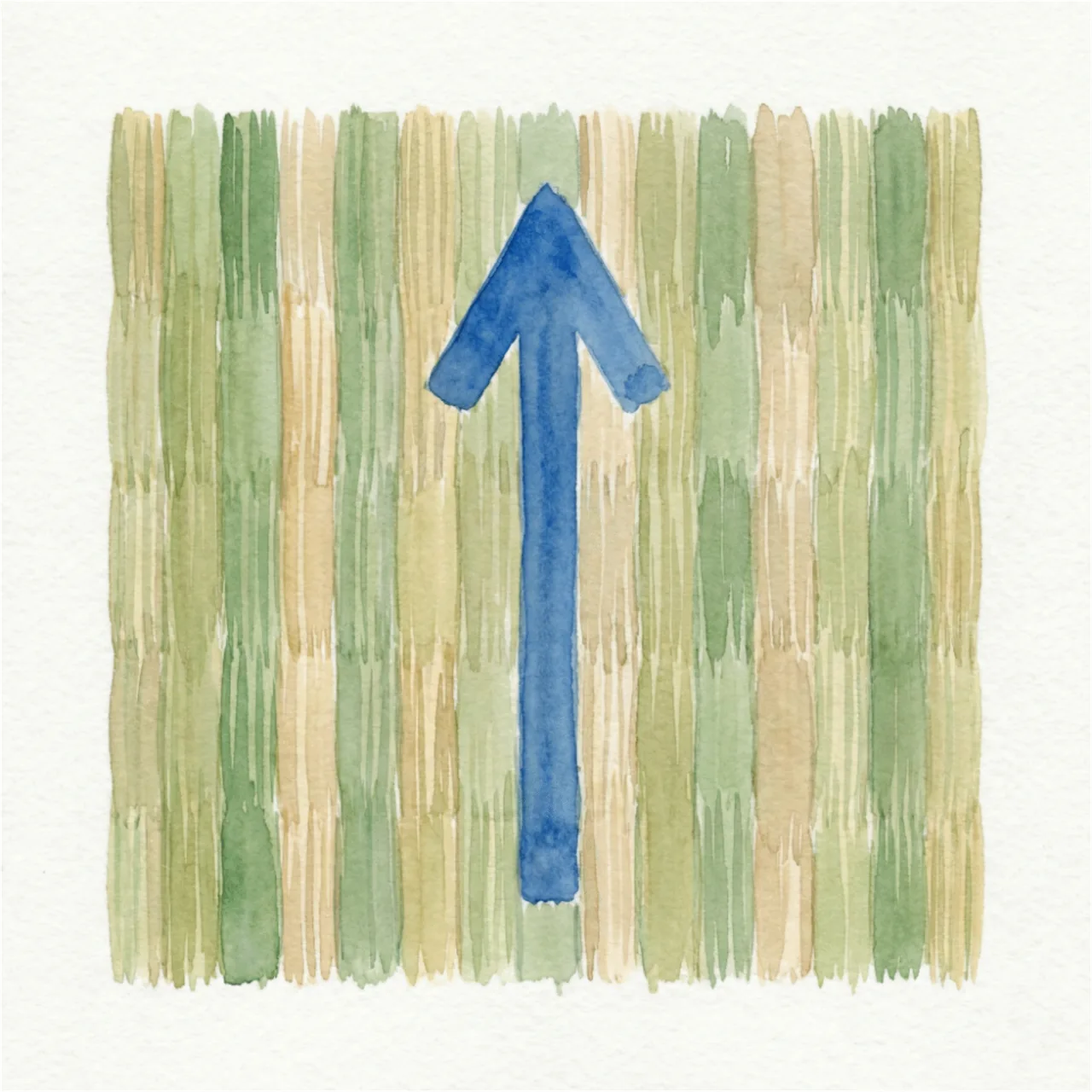
Vacuum slowly, always along the grain of the weave
Regular vacuuming is fine, but always move the nozzle along the igusa grain (the woven direction), never against it.
Vacuuming against the grain breaks individual stalks and pushes dust deeper into the gaps.
For damp cleaning, use a dry cloth only — wet wiping encourages mold.
Air out in shade twice a year to release trapped humidity
On a dry, breezy day, take your tatami or rug outside and let it ventilate in the shade for several hours.
Direct sun causes rapid, uneven fading — always shade only.
This simple step extends the life of the piece dramatically.
7. Frequently Asked Questions
What should I do if mold appears?
Dry it completely first, then brush out mold and wipe with rubbing alcohol.
Air-dry in shade until completely dry. Brush or vacuum away visible mold, then wipe gently with rubbing alcohol on a cloth and allow to dry again.
Prevention is far easier: ventilate the room regularly. Mold needs stagnant humid air — disrupt that and mold loses its foothold.
Can I put heavy furniture on tatami tiles?
It causes permanent denting — use load-spreading pads under furniture legs.
Igusa fibers are resilient but not invincible under sustained point load. Furniture legs compress the fibers permanently.
If you must place a table or sofa on tatami, put cork pads, wooden boards, or large rubber feet under each leg to spread the weight.
There's a muddy-looking powder on my new tatami. Is it defective?
No — this is "sen-do" (dye soil), a protective coating applied to the igusa.
Natural soil is applied to fresh igusa to prevent color change and preserve the scent. It's entirely normal.
Before first use, wipe it off gently with a dry cloth until no more powder transfers. Do not use a wet cloth.
Can a robot vacuum (like a Roomba) work on tatami?
Models that can handle the tile edge step can manage it, but the rotating brush may damage the surface.
A 0.6 in (1.5 cm) step is manageable for most robot vacuums, but the rotating brush moves against the igusa grain unpredictably and can fray the surface over time.
The safest approach is to either exclude the tatami area or disable the brush function for that zone.
It's turned yellow/amber. Can I get it back to green?
No — but that's exactly the right outcome for quality igusa.
Fresh igusa starts green, moves through pale gold, and settles into amber. That's not deterioration — it's the natural aging of a high-quality material.
Poor-quality igusa turns a dull, muddy brown. Good domestic igusa turns the amber color you see in antique lacquerware — and reversible tatami tiles let you flip to the fresh side when you want a change.
Final Thoughts: A Country That Takes Its Shoes Off — Breathe Deeply on Tatami
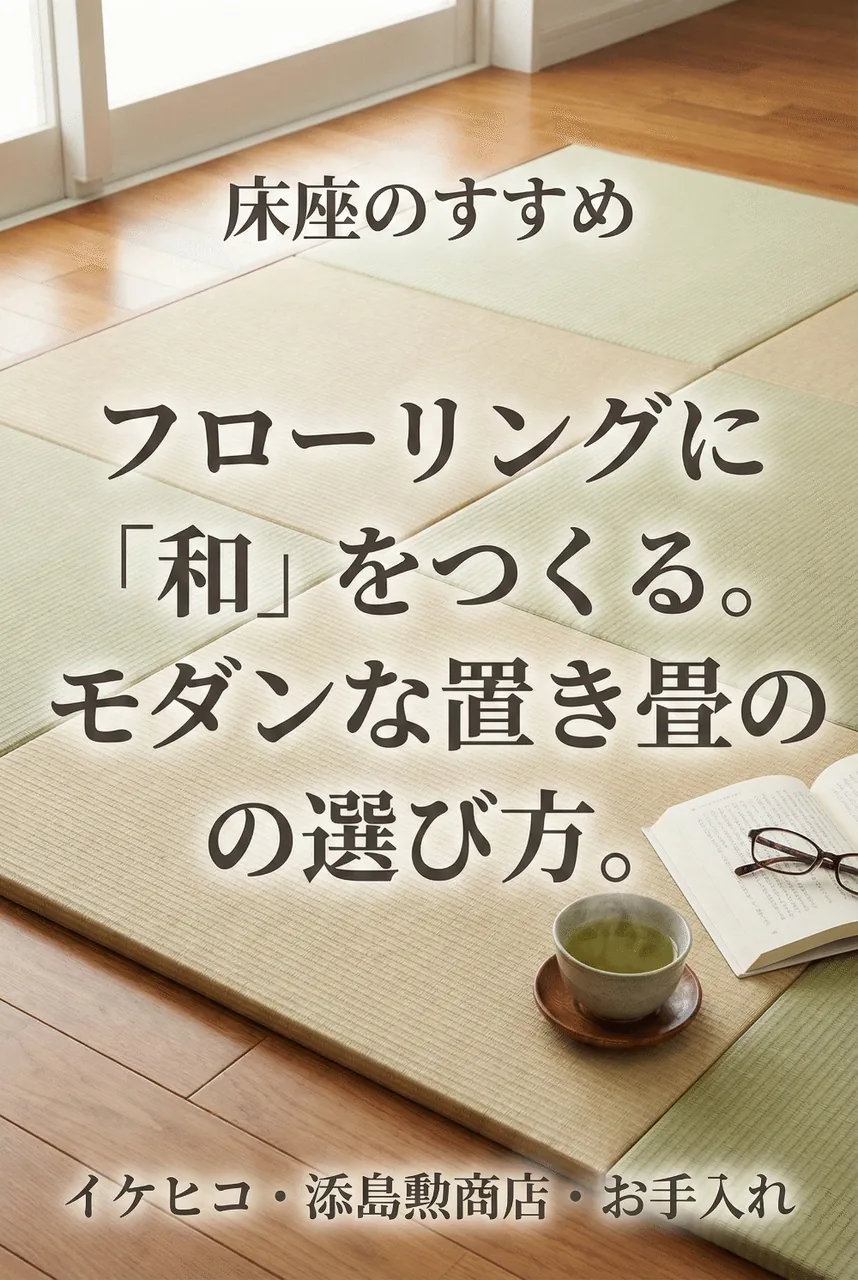
Japanese people feel at home on tatami not just from nostalgia.
The scent of igusa, the yielding softness underfoot, the way it quietly manages humidity — all of this signals to every sense: this is a safe place to rest.
The practicality of hardwood floors and the comfort of tatami are not mutually exclusive.
Unit tatami gives you both.
Take your shoes off, lie down flat on tatami, and breathe. That's a luxury that doesn't require much at all.