Ooya Seisakusho
A copper grater that brings aromas forward from the very first tooth.
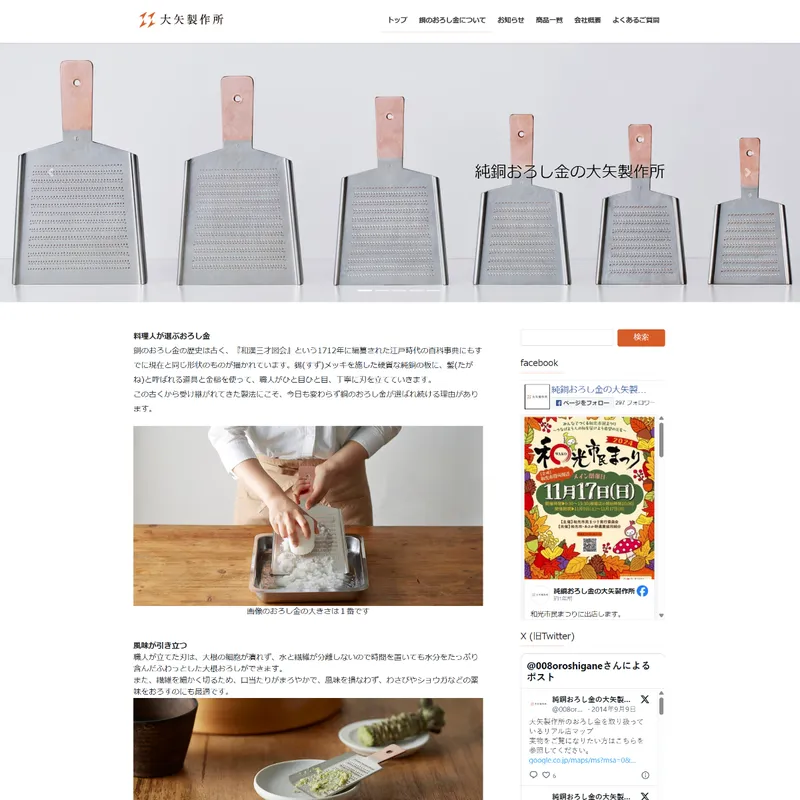
A classic copper grater can change the mood of a kitchen in an instant. Ooya Seisakusho makes pure copper graters with a tin-plated surface, and each tooth is raised by hand with a chisel and hammer. The brand explains that this helps keep daikon-oroshi fluffy and juicy, and it also works well for aromatics like apples, yamaimo, wasabi, ginger, yuzu, and garlic. Teeth are made to be slightly uneven in spacing and height — a touch that lets you grate smoothly with light force. There are double-sided and single-sided paddle shapes, small condiment graters for the table, and box-style sets with a tray and drainer. Sizes run from No.1 to No.6. When the teeth wear down over years of use, paid re-sharpening is also available.
Why We Love It
If you want one piece to cover the basics, start with the double-sided paddle model — daikon on the coarse side, aromatics on the fine side. The coarse side handles daikon and apples; the fine side handles wasabi, ginger, yuzu, garlic, and yamaimo — switching keeps the cooking flow smooth. For meals at the table, a small condiment grater (paddle, crane, or turtle shape) lets you grate just what you need right before serving. If you prefer extra stability and easier grating, try the box-style set with its tray and drainer. The paddle shape comes in sizes No.1-6 — so you can choose by usage amount and storage space. And when the teeth feel tired after years of use, the paid re-sharpening service is a good option to keep it in rotation.


PROFILE About the Company / Workshop
Ooya Seisakusho Co., Ltd. manufactures and sells copper graters. The company is based in Wako, Saitama (351-0113). Established in 1949 (Showa 24). Representative director is Mr. Shigeki Ooya, with capital of 10 million yen and 4 employees. The history lists opening a copperware shop "Doutora" in Asakusa, Tokyo in 1928, reopening in Ikebukuro, incorporating in 1973, and relocating to Wako in 1981.
The signature process — raising teeth on a hard pure copper plate with tin plating using a chisel and hammer — is the old-style method. The same shape is depicted in the Edo-period encyclopedia "Wakan Sansai Zue" (compiled in 1712), it's said. Even when the teeth look aligned at first glance — there are devices making spacing and height subtly uneven — letting you grate smoothly with light force is the strength. Daikon tends to finish fluffy with moisture, and aromatics can be used without losing flavor, it's said.
The classic paddle shape is prepared in double-sided (front: for daikon / back: for aromatics) and single-sided (for daikon). The coarse side suits daikon and apples; the fine side suits wasabi, ginger, yuzu, garlic, and yamaimo. Sizes range from No.1 to No.6 — with total length stepping from 30.0cm to 19.0cm. For condiments — in addition to small paddle shape, crane shape and turtle shape are also assembled — size friendly for bringing directly to the table. The box-style set pairs receiving tray with drainer, prepared in small and large sizes.
When teeth wear down with long use, paid "re-sharpening" is supported — removing old teeth and raising new ones. Inquiries and orders are basically guided to email, form, or fax — no phone number is listed. Closed Saturdays, Sundays, and holidays, with notice that replies may be delayed. Also listed in groups like the Edo Traditional Craft Cooperative — with delivery records to knife shops, mail-order, and co-ops also mentioned.
Tin-plated copper, teeth raised by hand
Tin plating on pure copper, then teeth are raised one by one with a chisel and hammer. It's a traditional build, but it's described in very practical terms: less crushing of ingredients and tends to produce daikon-oroshi rich with moisture. For aromatics too, the fibers are cut finely, leading to a mellower mouthfeel.
One board, two jobs
The double-sided model is designed for switching roles mid-cook. One side (coarse) is for daikon or apple, the other side (fine) for aromatics such as wasabi, ginger, yuzu, garlic, and yamaimo. Paddle sizes are offered from No.1 to No.6 — smallest 19.0cm total length, largest 30.0cm. Choose by usage amount and bowl size.
A subtle "unevenness" leading to lightness
Even when the teeth look neatly aligned, their spacing and height are intentionally slightly uneven. The way they catch changes with each grating motion, so you don't have to turn the daikon many times. Progressing with light force is also one of Ooya Seisakusho's strengths. There's also the idea that fiber and moisture are less likely to separate.
Table sizes, box sets, and re-sharpening
For small condiment use — in addition to paddle shape, also crane shape and turtle shape are prepared. The box-style set pairs grater with receiving tray and drainer — said to allow stable, fast, and easy grating with little force. Furthermore, paid "re-sharpening" of teeth is also available. The antibacterial effect of copper is also mentioned — also suiting those who want to use cleanly.