Hokkaido Rice LOVE
A "daily feast" called Hokkaido rice — polished by snow-country wisdom and the scale of the land.
Hokkaido Rice LOVE is the brand information platform shared by the Hokkaido Rice Sales Expansion Committee. With cultivated area and harvest volume among the top in Japan, Hokkaido has cultivated diverse rice varieties — from the main "Nanatsuboshi" to the premium "Yumepirika" — that accompany dining tables. Through cooperation among growers, JAs, Hokkaido Prefecture, and Hokuren, the committee delivers Hokkaido rice as something "easy to choose and easy to continue" — through building taste standards, quality and safety initiatives, and food education and recipe proposals.
Why We Love It
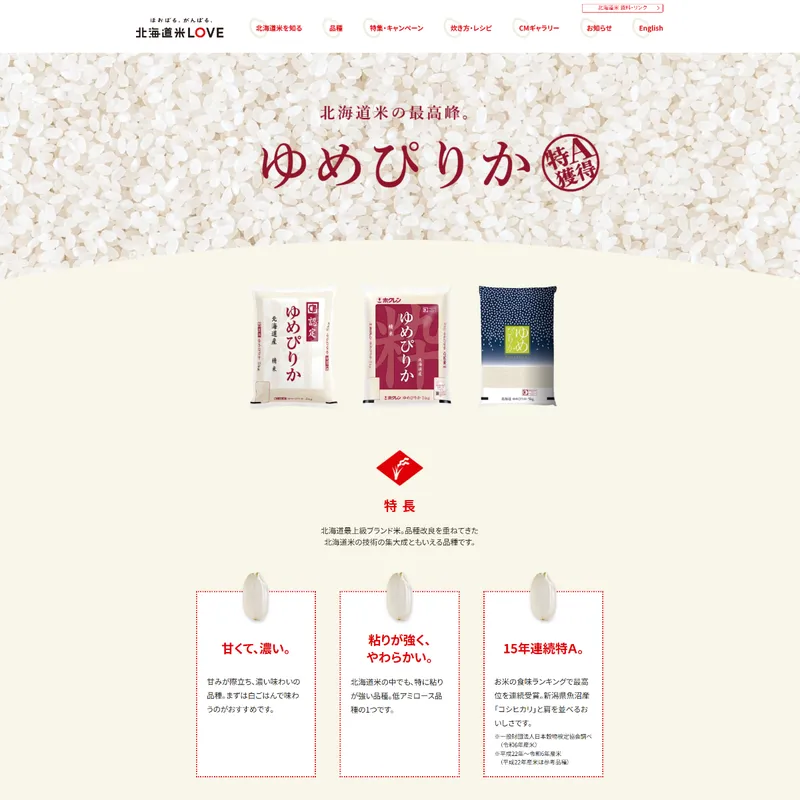
The appeal of Hokkaido rice lies in "abundant varieties" and "carefully built standards." For daily meals, the main variety "Nanatsuboshi" — pairing with any side dish. For special plain rice, "Yumepirika" — with standout sweetness and stickiness. Furthermore, including glutinous rice and sake rice, being able to speak of "Hokkaido rice" with a single connected line — that's what I feel is the producing region's underlying strength.
PROFILE About the Company / Workshop
Hokkaido rice farming begins when signs of snowmelt start appearing, after the long winter. To stably grow delicious rice in the cool climate, variety improvement and cultivation techniques have been refined — and Hokkaido has now become known as one of Japan's leading rice regions.
Within wide Hokkaido, the Sorachi and Kamikawa regions are areas with particularly high harvests. Cultivation matched to each region's natural conditions, with production on vast areas, connects to "the power to deliver stably." Behind Hokkaido rice you can pick up daily is this scale and accumulation.
On flavor, "building taste standards" is the characteristic of Hokkaido rice. Sharing quality thinking starting with protein values, standards and cultivation points are organized by variety. For Yumepirika, the "Yumepirika Contest" — where growers compete in technique and taste — is also held, with the polished producing region's power connecting to brand trust.
In the area of safety and reassurance too, standard building is concrete. "Hokkaido Rice Anshin Net" — guaranteeing quality through unified cultivation standards, cultivation history management, and voluntary inspections, granting marks to subject rice — is one system for "visualizing" the reassurance needed for daily staples.
Meanwhile, Hokkaido rice farming also faces the challenge of sustainability. Amid increasing burden from cultivated area expansion and aging of growers, initiatives toward work labor-saving and productivity improvement are advancing — including high-density seeding that reduces nursery boxes, direct seeding that skips pre-planting work, and smartphone-managed remote water-supply devices.
And Hokkaido rice is not just a story of regular rice. Hokkaido is also known as a major producer of glutinous rice, with varieties grown to be chosen by use. For sake rice too, varieties like "Ginpu," "Suisei," and "Kitashizuku" are developed — expanding into the sake-making world under the concept "rice and water both from Hokkaido." From daily meals to a celebratory cup — Hokkaido rice quietly broadens food culture's range.
A rice-producing region supporting stable supply with top-class cultivated area and harvest volume
Hokkaido is one of Japan's representative rice-producing regions, with cultivated area and harvest volume both at top-class national levels. In FY 2023 (Reiwa 5) Hokkaido ranked 2nd after Niigata, with vast producing areas supporting daily dining tables. The Sorachi and Kamikawa regions have the largest harvests — landscapes of paddies extending as far as the eye can see represent Hokkaido's rice-growing scene itself.
Systems protecting "taste standards" — Yumepirika's protein value of 7.4% or less
Focusing on protein values said to influence rice taste, Hokkaido rice has advanced quality standard-building by variety. For example, "Yumepirika" sets a basic standard of milled-rice protein at 7.4% or less — clear standards maintaining quality. The "Hokkaido Rice New Brand Formation Council" (growers, JAs, Hokkaido) sets standards and cultivation initiatives, and the certification mark is granted only to those clearing strict conditions.
From main Nanatsuboshi to new faces — a "choosable" Hokkaido rice variety lineup
The most cultivated Hokkaido rice is "Nanatsuboshi" — the main variety occupying about half of Hokkaido rice cultivated area, followed by "Yumepirika." Furthermore, with varieties like "Kitakurin" — strong against rice diseases and aiming for stable production while reducing pesticides — the strength of Hokkaido rice is being able to choose by taste, cultivation, and use.
Visualizing safety and reassurance — initiatives like "Hokkaido Rice Anshin Net"
In Hokkaido, growers, JAs, and Hokuren together advance safety and reassurance initiatives. "Hokkaido Rice Anshin Net" is a mark granted to rice subject to unified cultivation standards, cultivation history management, and voluntary inspections such as pesticide residue testing and cadmium testing. Because it's food eaten daily, the stance of delivering standards and inspections in "visible form" is maintained throughout.
LINKS Official Links / Social Media
- Official Website https://www.hokkaido-kome.gr.jp/
- Online Shop https://www.hokuren-greenplus.jp/
- Contact Form https://www.hokkaido-kome.gr.jp/iroiro/
- X (Official) https://twitter.com/hokkaidomailove
- About Hokkaido Rice (Rice-Making Basics) https://www.hokkaido-kome.gr.jp/about/komedokoro/
- Pursuing Taste (Quality Standards / Initiatives) https://www.hokkaido-kome.gr.jp/about/elaboration/
- Sustainable Rice Farming (Labor-Saving / ICT) https://www.hokkaido-kome.gr.jp/about/sustainable/
- Variety: Yumepirika https://www.hokkaido-kome.gr.jp/variety/yumepirika/
- Variety: Kitakurin https://www.hokkaido-kome.gr.jp/variety/kitakurin/
- Hokkaido Rice Resources & Links (Brochures, Materials, Applications) https://www.hokkaido-kome.gr.jp/iroiro/