
You drink miso soup directly from the bowl — lips touching the rim, every single morning.
In Japanese cuisine, soup is the only dish eaten this way.
That's why the material matters. A plastic bowl feels cool against your lips and lets heat escape quickly. A real wooden bowl stays warm in your hands, holds heat longer, and feels completely different on contact.
"But wooden bowls seem like so much work to maintain..."
That's no longer true. Modern nano-coating technology has produced dishwasher-safe wooden soup bowls that retain the warmth and texture of natural wood. And at the other end of the spectrum, traditional lacquerware can be professionally restored and passed down for generations.
This guide helps you find the right bowl for your table.
Quick Reference: Soup Bowl Materials & Finishes at a Glance
| Comparison | Natural Wood × Hon-Urushi (True Lacquer) | Natural Wood × Urethane / Nano-Coat | Resin (Plastic) |
|---|---|---|---|
| Feel & Heat Retention | Exceptional — warm and smooth on the lips | ◎ Natural wood warmth preserved | △ Feels slightly cold |
| Dishwasher Safe | ✕ Hand-wash only | ◎ Most models compatible | ◎ Compatible |
| Durability & Repair | Repairable — can last decades | ○ Long-lasting | △ Degrades over time |
| Price Range | Higher (Wajima-nuri, Echizen shikki) | Mid–high (Kishu urushi, Sonobe) | Inexpensive |
| Best For | Lifetime ownership, gifts, serious collectors | Busy households, families with children | Budget-first priority |
1. How to Choose a Soup Bowl That Lasts a Lifetime
Beyond appearance, understanding the thermal properties of materials and the chemistry of different finishes will help you find a bowl that genuinely fits your life.
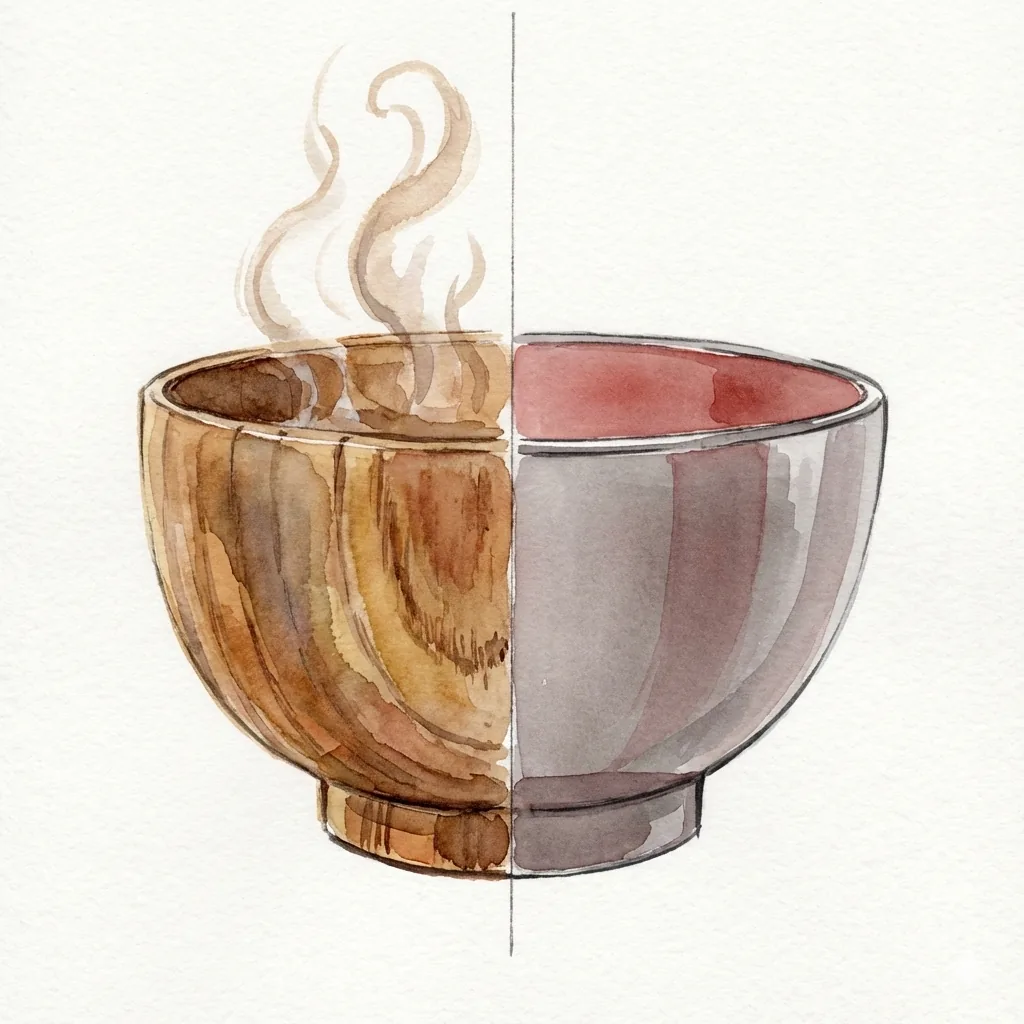
① Choose by Material: Natural Wood vs. Resin (Thermal Conductivity)
The clear recommendation is a bowl carved from natural wood.
Wood has a porous cellular structure filled with air — its thermal conductivity is just 0.1–0.2 W/m·K, making it an excellent natural insulator. When you fill a wooden bowl with miso soup at around 80°C, the outside stays comfortable to hold, heat is retained longer, and the rim feels gently warm against your lips rather than scorching or cold.
Cheaper ABS resin bowls and "moku-go" (compressed wood powder) bowls are durable, but neither matches natural wood for insulation or tactile quality.
② Choose by Finish: Traditional Lacquer vs. Dishwasher-Safe Coating
Hon-urushi (true lacquer): Derived from the sap of the urushi tree, hon-urushi is a powerful natural polymer. It is highly resistant to acids, alkalis, and salt — and scientific studies have confirmed its strong antimicrobial properties. The surface has a deep, moist luster that develops character with age. The tradeoff: hand-wash only.
Urethane and nano-coating: The modern mainstream. Silicon-based glass compounds are reduced to nanoscale particles (one-billionth of a meter) and infused into the wood fiber itself, hardening into a protective layer. This preserves the natural grain and feel of the wood while dramatically increasing water and heat resistance — and many of these bowls are fully dishwasher-safe.
2. Best Japanese Soup Bowls: 5 Picks for 2025
From stylish dishwasher-safe wooden bowls to traditional lacquerware built to outlast you, these are the Japanese-made shiruwan worth owning.
#1 — Kishu Urushi (Wakayama) / Nano-Coat Dishwasher-Safe Wooden Bowl
A modern wooden bowl. Looks natural, survives the dishwasher.
The answer for anyone who wants a real wooden bowl without the hand-washing commitment. A proprietary glass nano-coating preserves the natural grain entirely while delivering outstanding durability and stain resistance. The practical choice for busy households — and one of the most popular wooden bowl picks among working families.
Features: Dishwasher-safe, natural wood grain, nano-coating finish
#2 — Sonobe Sangyo (Kanagawa) / Meiboku-wan (Precious Wood Bowl)
A Good Design Award winner with a shape you'll want to hold every morning.
Carved from Japanese hardwoods — cherry, maple, zelkova — this bowl has a rounded, cup-like silhouette that feels natural cradled in both hands. The shape bridges Japanese and Scandinavian aesthetics beautifully, making it equally at home with Western dishes. A long-selling design that has earned genuine devotion from people who cook seriously.
#3 — Gato Mikio Store (Ishikawa) / TSUMUGI
Where tradition meets minimalism. The refinement of a kaiseki restaurant at home.
Turned on a lathe using the advanced Yamanaka-nuri technique from Ishikawa Prefecture, these bowls are remarkably thin-walled and precise in silhouette. The rim is so smooth and fine that ordinary soup tastes elevated — a genuine change in experience. For anyone who believes the bowl is part of the cooking.
#4 — Echizen Shikki (Fukui) / Kenro (Heavy-Duty) Soup Bowl
Built for daily use. The lacquerware that holds up to real family life.
Echizen (Sabae) holds the #1 share of commercial-use lacquerware in Japan — bowls made tough enough for restaurant kitchens. Techniques like "nuno-kise" (fabric-reinforcement at the rim, the most vulnerable part) mean these bowls survive daily use by an entire family without babying. Durable without sacrificing the warmth of real lacquer.
#5 — Wajima Kirimoto (Ishikawa) / Wajima-Nuri Soup Bowl
The pinnacle of Japanese lacquerware. A bowl to pass down to your grandchildren.
Wajima-nuri goes through over 100 individual processes — the result is both extraordinary in durability and deeply warm in feel. The price reflects the craft, but Wajima bowls can be professionally re-lacquered when they eventually show wear, restoring them to like-new condition. Across a lifetime of use, the cost per day becomes negligible. This is what "lifetime ownership" actually means.
3. Caring for Wooden Bowls & Lacquerware: Simpler Than You Think
Lacquerware has a reputation for being fussy — but it really isn't.
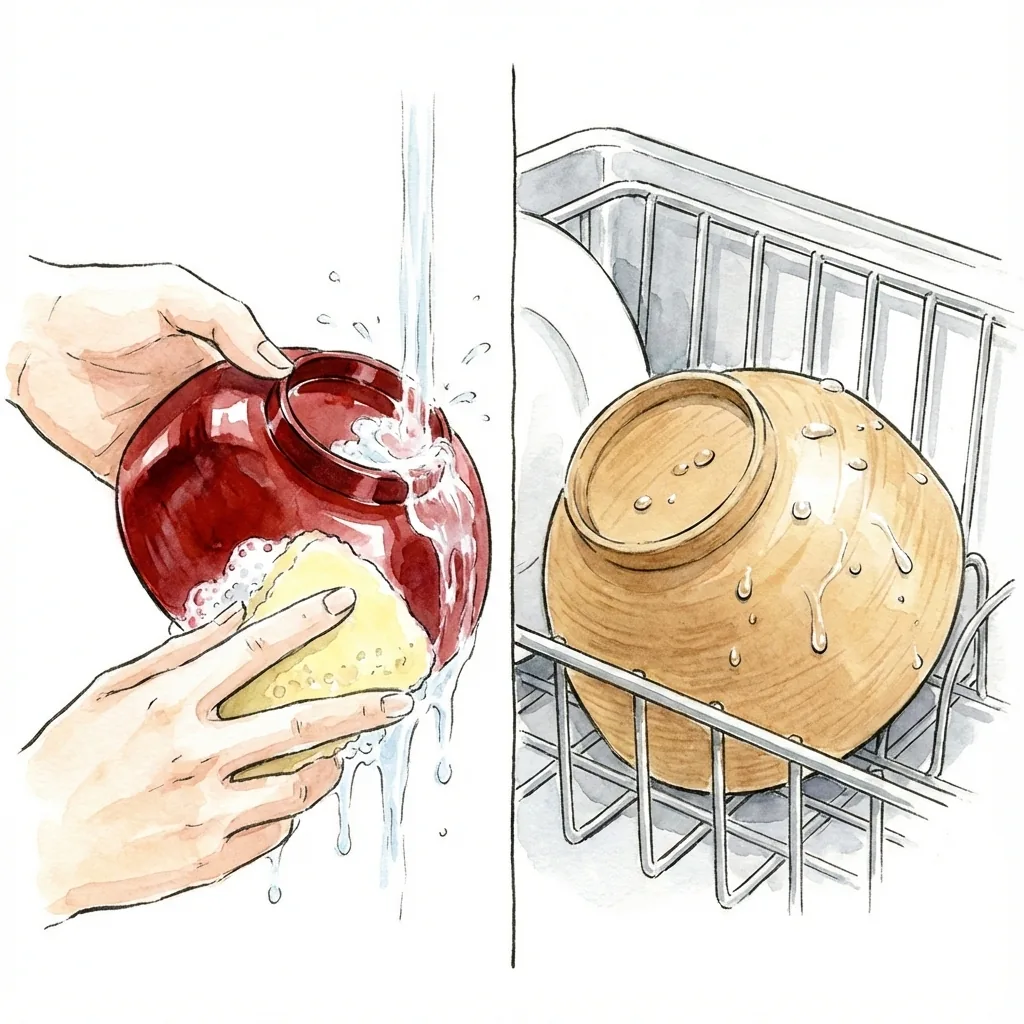
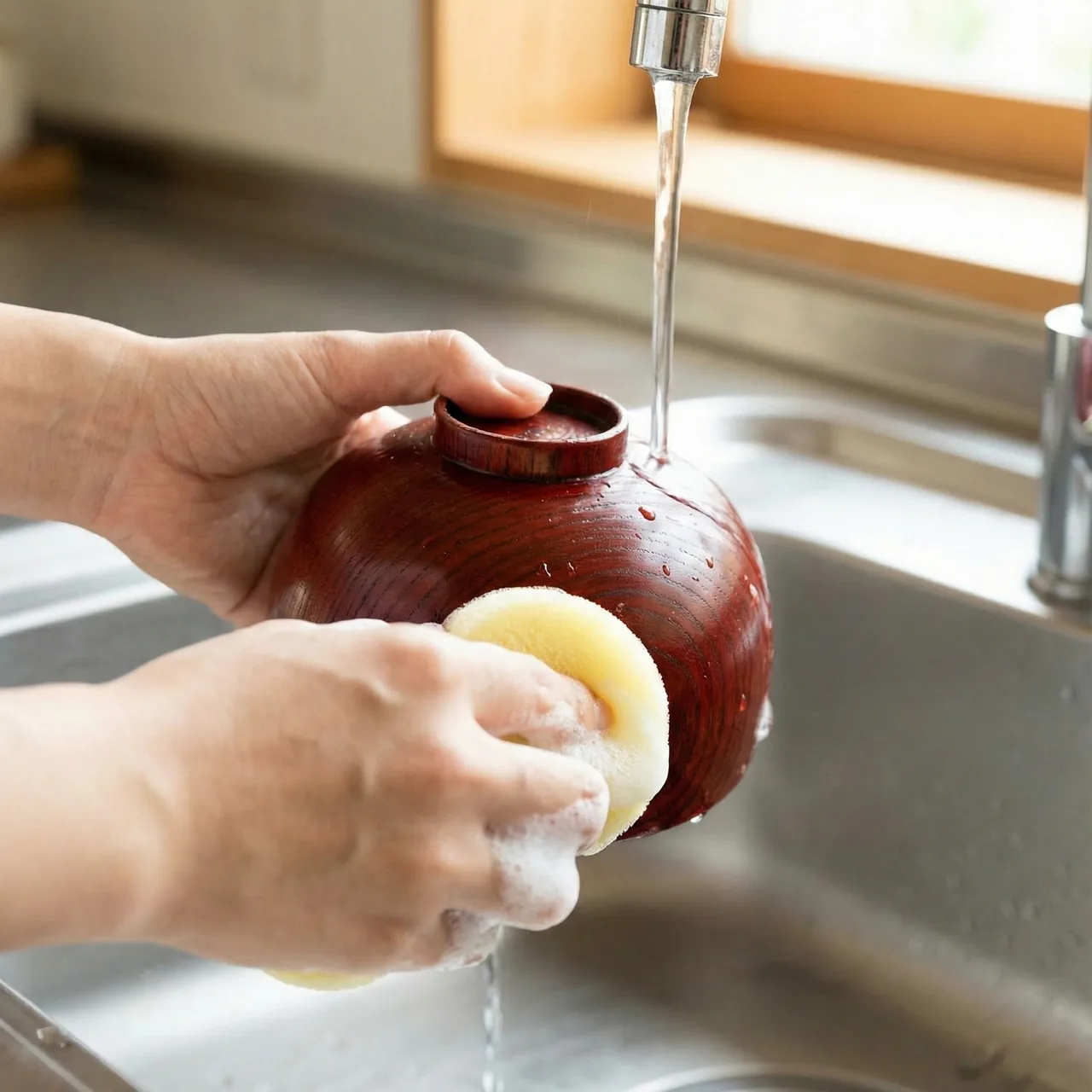
Basic cleaning is simple: mild dish soap and a soft sponge is all you need.
Two things to avoid:
1. Soaking: Leaving wooden bowls submerged in water causes the wood to absorb moisture and warp over time.
2. Abrasive scrubbers or scouring powder: These scratch the surface coating and shorten the bowl's life significantly.
4. Frequently Asked Questions
Can I reheat soup in the bowl in the microwave?
No — not with natural wood bowls. (Exceptions apply only to products specifically labeled microwave-safe.)
Natural wood contains trace moisture in its cellular structure. When exposed to microwave radiation, that moisture heats rapidly, expands, and can cause the bowl to crack or the lacquer/urethane coating to blister and peel from the inside out. Always reheat soup in a pot and pour it into the bowl.
Why can dishwasher-safe wooden bowls handle machine washing when regular ones can't?
Nano-coating technology — silicon-based glass compounds bonded into the wood at the molecular level.
Products labeled "nano-coat" use silicon-based glass compounds reduced to nanoscale particles (one-billionth of a meter) that penetrate deep into the wood's cellular channels and harden in place. The wood still breathes, but the surface gains high resistance to water, heat, and abrasion — enough to withstand the hot water and strong detergents used in home dishwashers.
The new lacquerware has a strong smell. What should I do?
Wiping with diluted vinegar or storing in a rice container are both effective.
New lacquerware sometimes carries the scent of urushiol and other volatile compounds in raw urushi. To reduce it: wipe gently with a cloth dampened with a few drops of food-grade vinegar; bury the bowl in a container of dry rice for a few days (rice absorbs odors naturally); or leave it in a well-ventilated shaded area for several days. The compounds are not harmful.
The lid is stuck on my soup bowl. How do I open it?
Gently press the sides of the bowl, or warm the exterior with lukewarm water.
When hot soup is ladled in and a lid placed on top, the air inside cools and contracts as the soup cools, creating a near-vacuum that seals the lid shut (this is Boyle's Law in action). Don't pull hard. Instead, press both sides of the bowl with your palms to slightly flex the rim and let air in — or set the bottom half of the bowl in lukewarm water (~40°C) to re-expand the air inside. The lid releases easily.
Can I use bleach to remove stains?
Never — neither chlorine-based nor oxygen-based bleach should be used.
Strong alkaline chemicals break down the molecular bonds in lacquer and urethane coatings, causing the surface to dissolve, discolor, or peel. In practice, the dense coating on quality wooden bowls prevents staining from penetrating — gentle cleaning with warm water and mild dish soap is sufficient to keep them hygienic.
When is it time to replace a bowl? Can lacquerware be repaired?
When the rim chips or raw wood shows through — but true lacquerware can be professionally restored.
When the urethane coating on a mid-range bowl wears through and bare wood becomes exposed, moisture penetrates and the wood darkens — that's the signal to replace it. However, high-quality lacquerware (Wajima-nuri and similar) can be taken to a craftsman for re-lacquering, which restores the bowl to new condition. "Repair and use for life" is what genuinely distinguishes fine lacquerware from everything else.
5. Final Thoughts: It's Just a Bowl — Until It Isn't
Three times a day, 365 days a year.
Over ten years, you'll bring a soup bowl to your lips more than 10,000 times — making it the most intimate tool in your kitchen.
Investing in a bowl you genuinely love is one of the highest-return upgrades you can make to your daily meals.
Find yours — and then make the miso soup worthy of it.

Japanese Chopsticks: Paired Sets & 5 Best Japanese-Made Picks

Japanese Lacquerware Guide: Wajima vs. Yamanaka & Best Picks