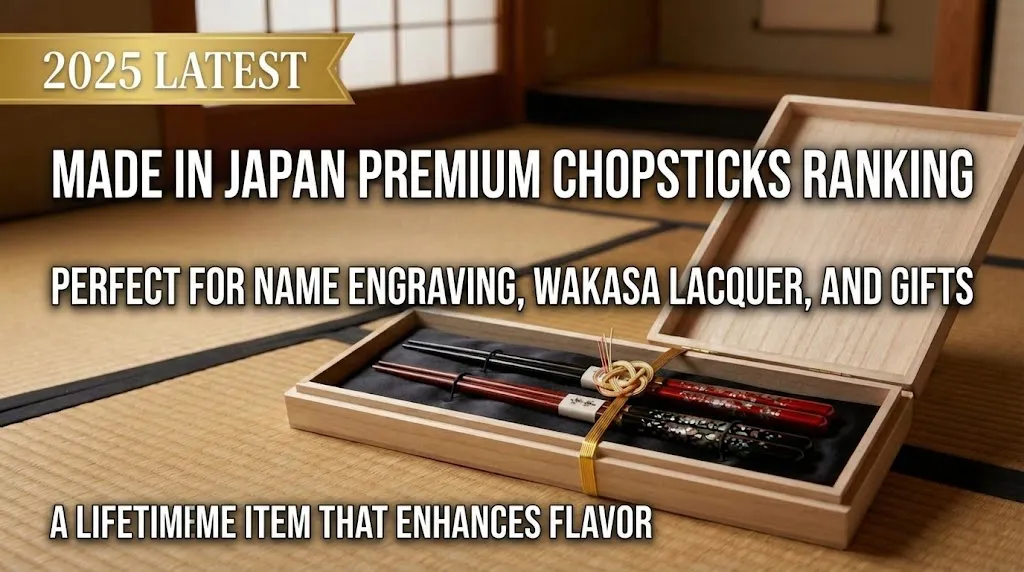
Chopsticks touch your lips at every meal — which means they're more intimately involved in the eating experience
than any other utensil.
Here's something most people don't realize: the flavor and texture of Japanese food can be subtly diminished by
thick chopstick tips.
The wider the tip, the more your lips and tongue feel the tool instead of the food.
This guide covers Japan's finest chopstick makers — from lifetime pieces for yourself to the personalized paired
sets (meoto-bashi) treasured as wedding gifts and anniversary presents.
Quick Reference: Japanese Premium Chopsticks by Region
| Feature | Wakasa-nuri (Fukui) | Edo Wood (Tokyo) | Wajima-nuri (Ishikawa) |
|---|---|---|---|
| Character | Radiant shell-inlay (raden) beauty | Ebony / rosewood functional beauty; ultra-fine tip | Natural lacquer; moist, warm hand-feel |
| Best for | Gifts, pair sets, paulownia box presentation | Daily personal use; noodle lovers | True lacquer devotees; lifetime pieces |
| Name engraving | ◎ (most makers offer it) | At select shops | Consult the workshop |
| Dishwasher | ✕ (hand wash recommended) | ✕ (heat drying can crack) | ✕ (hand wash required) |
| Ideal buyer | Gift-givers, anniversaries, weddings | Function-first, minimalist aesthetic | Lacquerware lovers, traditional craft enthusiasts |
1. How to Choose: What Makes Great Chopsticks
Appearance matters, but understanding what makes chopsticks perform well will lead you to a far more satisfying choice.
① Tip Fineness — the Physics of Flavor
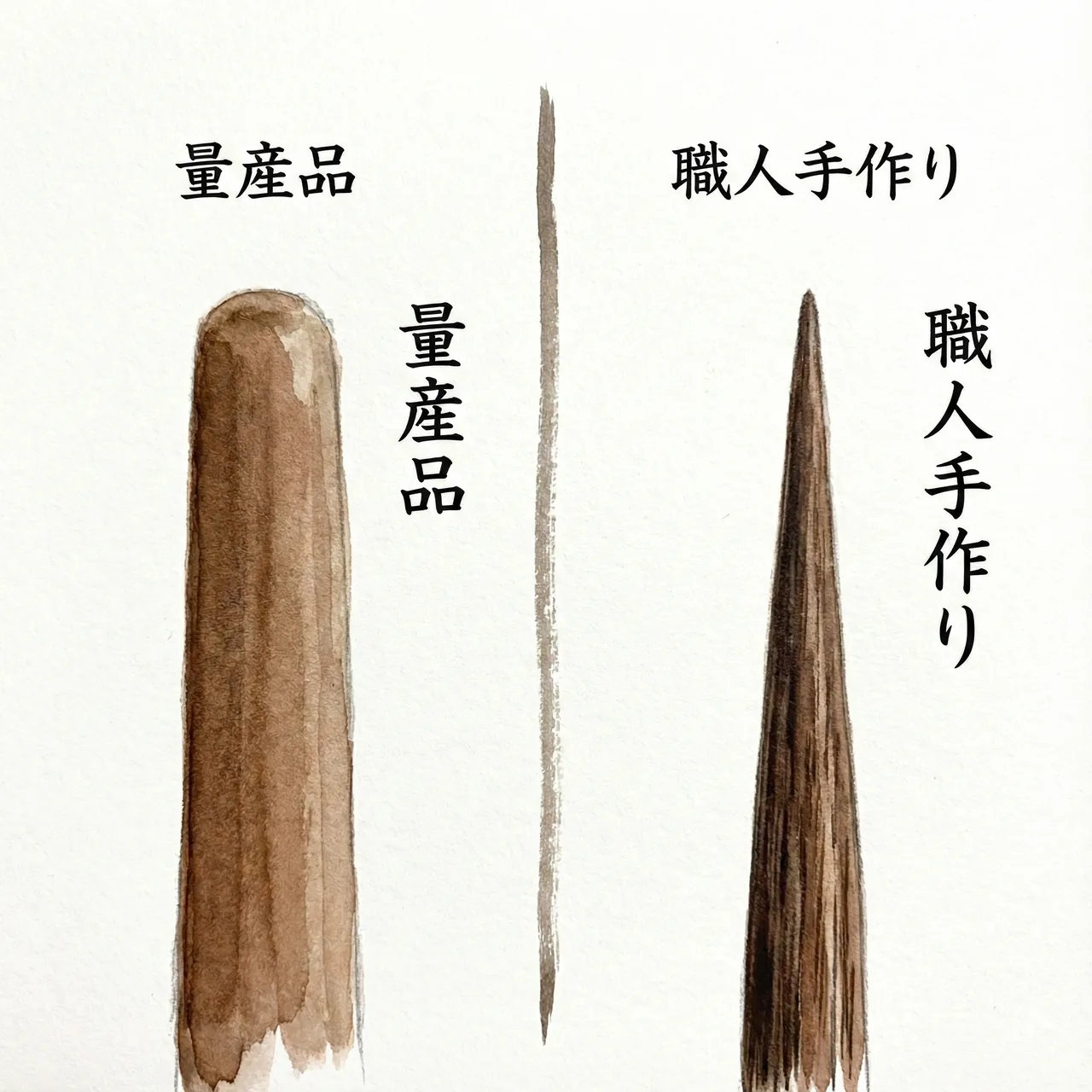
The defining feature of a great pair of chopsticks is how finely the tip is tapered.
When a craftsman sharpens the tip to a fraction of a millimeter, the contact area with your lips and tongue
becomes negligibly small — which means your mouth registers the food itself (its temperature, texture, flavor)
rather than the tool.
Put physically: pressure equals force divided by area. A sharper tip concentrates the gripping force on a
smaller point, meaning small slippery items — salmon roe, beans, tiny fish bones — stay put without effort.
This is why Japanese professionals say that better chopsticks make food taste better.
② Choosing by Region and Style
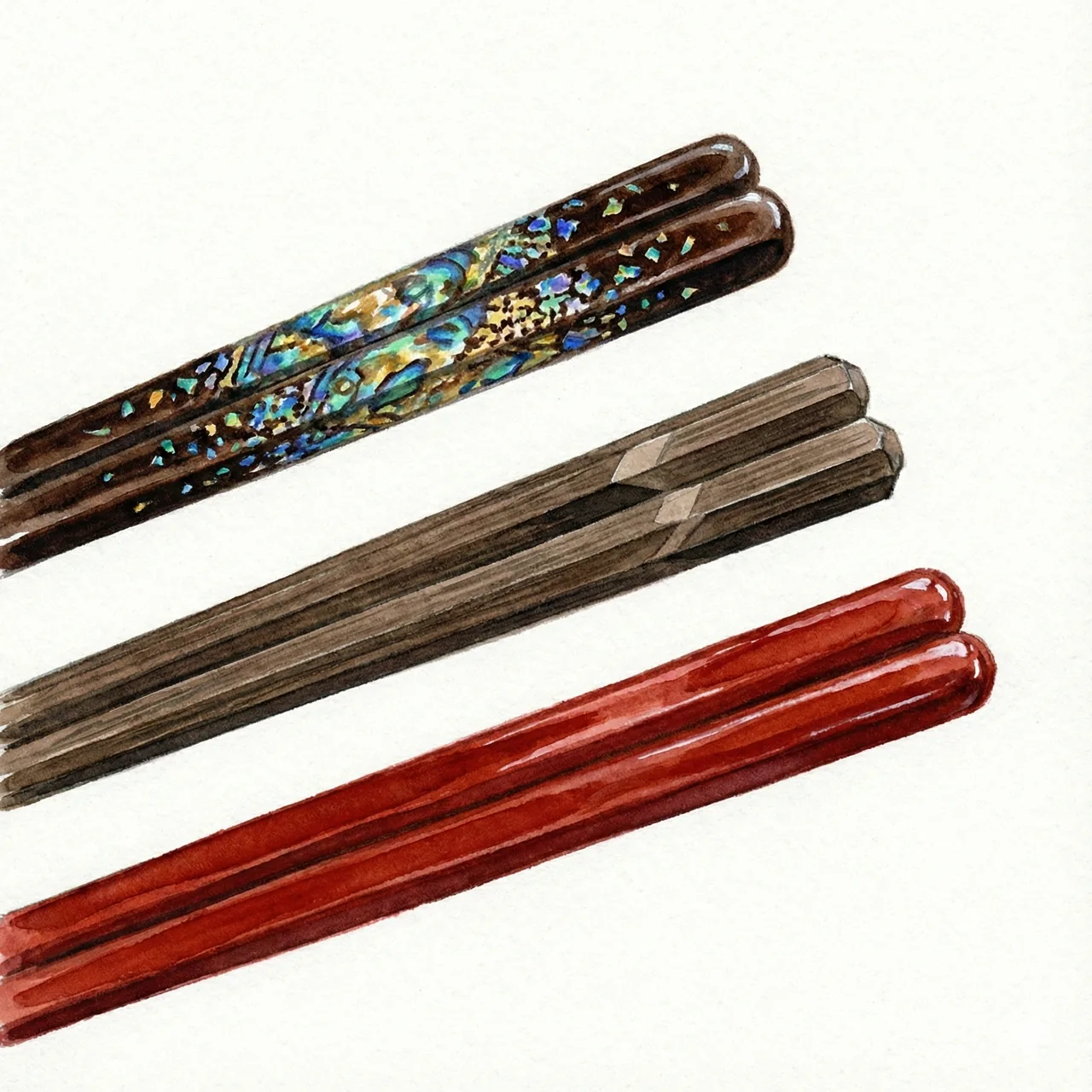
Wakasa-nuri (Obama City, Fukui): Japan's leading chopstick-producing region, accounting for
roughly 80% of domestic market share. Shell, egg shell, and gold powder embedded in layers of lacquer produce
the distinctive raden (mother-of-pearl inlay) patterns. Durable and visually stunning.
Edo Wood (Tokyo): Hard woods — ebony, rosewood — carved by craftsmen into heptagonal or
octagonal cross-sections that grip naturally in the hand. Pure functional elegance. Particularly loved by
noodle-obsessed eaters.
Wajima-nuri (Wajima, Ishikawa): Lacquer as an art form. A hand-feel like polished silk and a
durability — with proper care and occasional restoration — that outlasts any other finish.
③ For Gifts: Name Engraving and Paulownia Box
Meoto-bashi (pair chopsticks) carry a dual symbolism in Japan: two sticks supporting each other — a metaphor for
a couple — and "hashi" (橋), meaning bridge, suggesting "never going hungry."
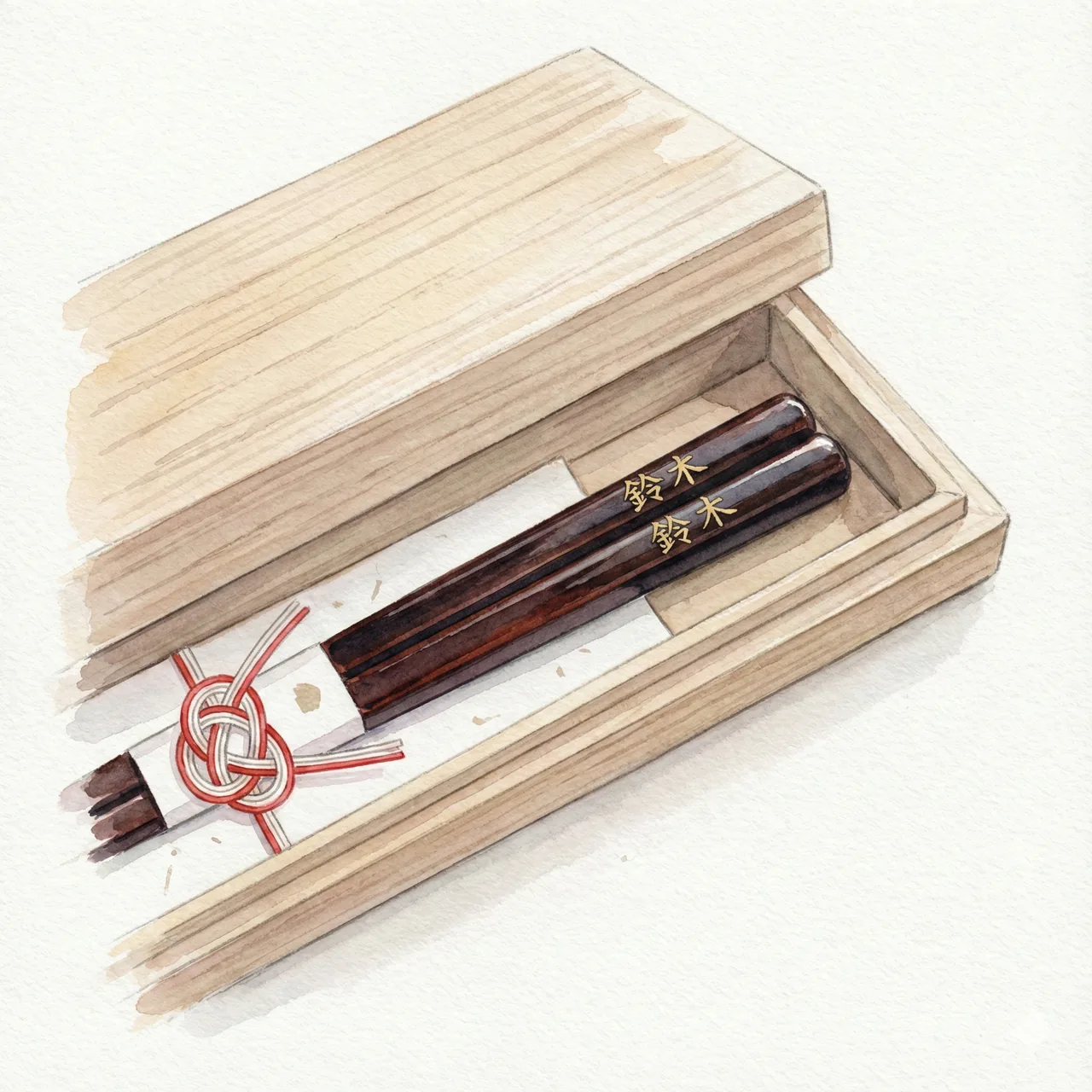
Having a name engraved makes the set uniquely personal. A set presented in a lacquered paulownia (kiri) wood box
is one of the most classic Japanese wedding and anniversary gifts — combining meaning, craft, and presentation
in a single gesture.
2. Top 5 Japanese Chopstick Brands
From Wakasa-nuri gift sets to modern dishwasher-safe urushi lacquer, these are the Japanese chopstick makers worth knowing.
[No.1] Wakasa-nuri, Fukui / Issou — Raden Shell Inlay
The gold standard of gift chopsticks. Shell-inlay beauty that looks like jewelry.
The finest from Obama (Fukui) — Japan's chopstick heartland. Shells and gold powder are embedded into layers of
lacquer, then ground back to reveal the pattern: a depth and luminosity that photographs can barely capture.
Issou's paulownia-box pair sets are among the most frequently chosen wedding and parent-gift chopsticks in Japan.
Highlights: Raden decorative inlay, gift box included, name engraving available
Wakasa-Nuri Lacquered Chopsticks — Ginmai Cherry Blossom, Paulownia Gift Box
Hand-crafted Wakasa-nuri lacquered chopsticks with a cherry blossom ginmai design, made in Obama City, Fukui using traditional raden-inspired techniques. Presented in a handcrafted wood gift box. Made in Japan.
View on Amazon[No.2] Tokyo / Daikokuya — Edo Wood Chopsticks
The pinnacle of functional beauty. Once you use them, you can't go back.
Built on the belief that "chopsticks are tools," Daikokuya's craftsmen carve each pair from hard woods — ebony,
rosewood, macaranduba — one at a time.
Heptagonal and octagonal cross-sections seat naturally in the fingers.
The ultra-fine tip grips tofu without breaking it.
The preferred choice of noodle enthusiasts and those who want performance over decoration.
Daikokuya Premium Heptagonal Wooden Chopsticks — Edo Wood, Made in Japan
The genuine article from Tokyo's Daikokuya — heptagonal cross-section hardwood chopsticks crafted by a 25-year veteran craftsman. A single pair is carved, sharpened, and lacquered entirely by hand. Made in Japan.
View on Amazon[No.3] Fukui / Hyozaemon — Lacquered and Dishwasher-Safe
Natural lacquer only where your mouth touches — and still dishwasher-safe.
Hyozaemon's founding principle: the tip — the part that enters your mouth — uses only natural urushi lacquer.
Their proprietary technique extends this commitment to dishwasher compatibility.
A gift for a young family, a busy two-income household, or anyone who wants genuine Japanese craft in their daily
routine without the hand-wash obligation.
Kasyou Studio URUSHI KENKO Chopsticks — 2 Pairs, Dishwasher Compatible
Urushi lacquered chopsticks that are genuinely dishwasher-safe. Red and black luxury pair set — authentic Japanese lacquer craftsmanship for busy everyday life. Made in Japan.
View on Amazon[No.4] Kyoto / Kochosai Kosuga — Bamboo Chopsticks
Bamboo's natural spring. Modern palette. Surprisingly versatile at any table.
Using carefully selected bamboo, these chopsticks carry the characteristic "give" of the material — fine enough to
feel almost fragile, yet resilient.
The wide range of contemporary colors means they look as natural at a Western table as a Japanese one.
Perfect for everyday use and excellent for lunch boxes.
Hashikura Matsukan Kyoto Kiyomizu Meishi Bamboo Chopsticks — Couple Set, Made in Japan
Premium natural bamboo couple chopsticks from Kyoto's Kiyomizu heritage. Square lacquer finish, vermilion and black — presented in a paulownia gift box. The springy bamboo feel of genuine Kyoto craft. Made in Japan.
View on Amazon[No.5] Wajima, Ishikawa — Chinkín Crane Pair
The crane — symbol of a lasting union — rendered in chinkín gold engraving.
Chinkín is a technique in which fine grooves are cut into lacquer and filled with gold leaf — extraordinarily
delicate work that can only be done by hand.
Using only natural lacquer throughout, these Wajima pieces have a hand-feel unlike any other: moist, warm, and
unmistakably alive.
For a gift that says "for life."
Wajima Urushi Lacquered Chopsticks & Rest Set — Sakura, Gift Box, Made in Japan
Wajima urushi lacquered chopsticks in a red sakura pattern, paired with a Kurashiki ribbon chopstick rest, presented in a gift box. Natural lacquer finish from Wajima, Japan's lacquerware capital. Made in Japan.
View on Amazon3. Once You Have Great Chopsticks — Try These Foods
With a fine pair in hand, try testing them on something small and slippery.
What used to take effort simply stays put — and you'll feel the difference immediately.
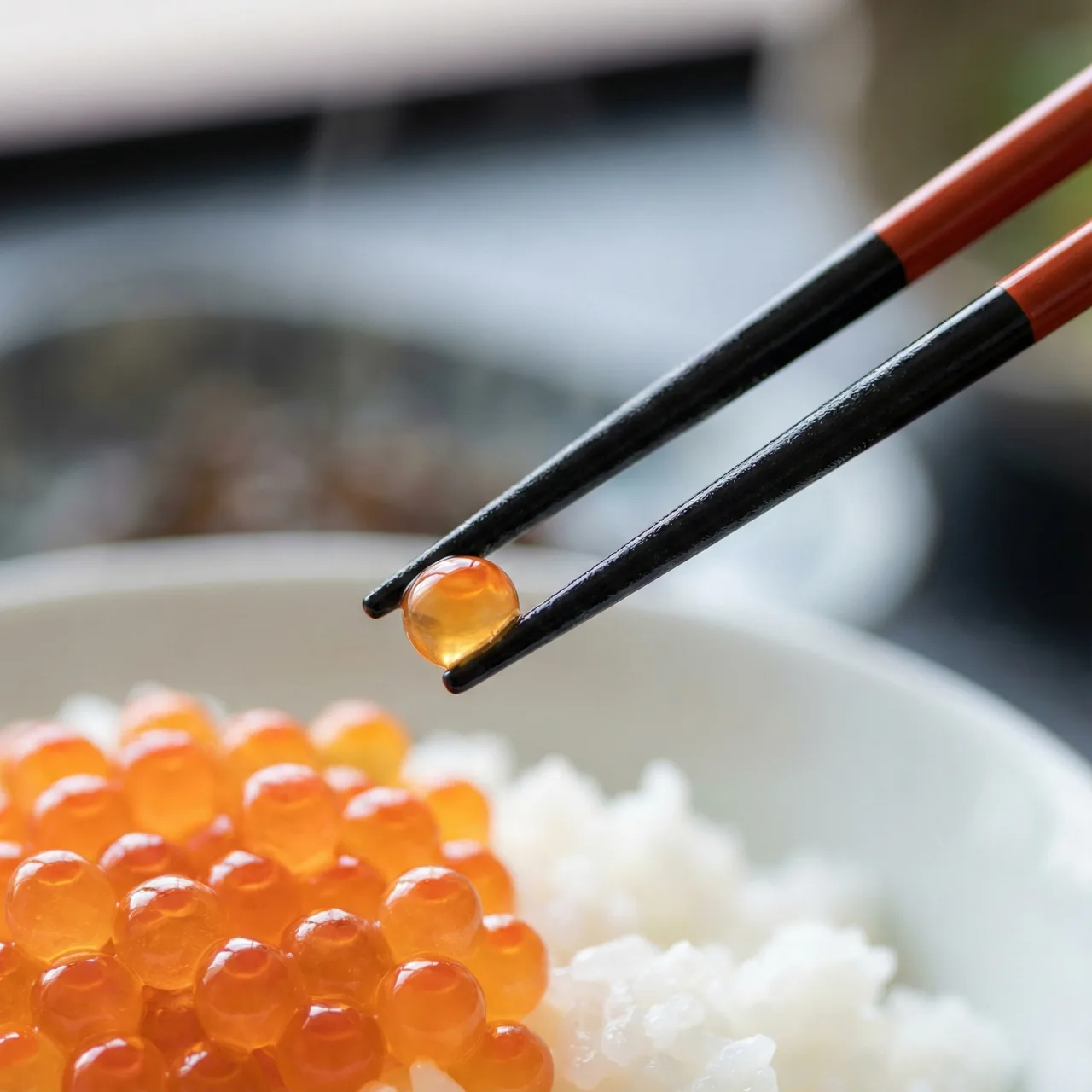
The Pleasure of Picking Up a Single Salmon Roe with a Fine Tip
With great chopstick tips that close precisely, picking up individual pieces of salmon roe (ikura), beans, or
tiny dried sardines becomes effortless.
For that first "test grip," why not try it with a truly exceptional Japanese rice accompaniment?
Great Chopsticks Deserve a Great Bowl
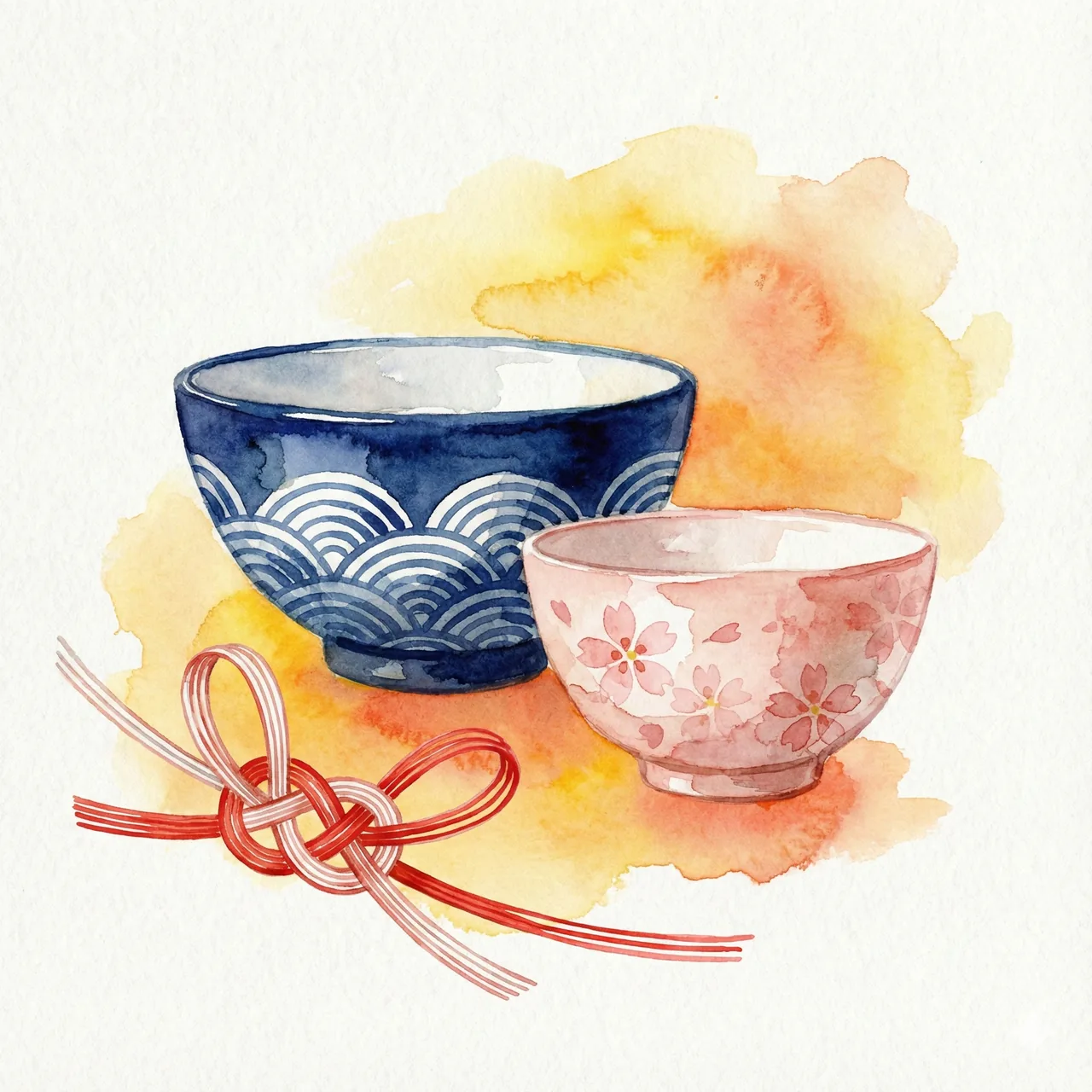
If your rice bowl is still plastic, that's the next thing to upgrade.
A fine pair of chopsticks and a quality Japanese rice bowl — together, they complete the Japanese table.
4. Frequently Asked Questions
When should I replace my chopsticks?
The general guideline is every year. Replace when the lacquer wears through to bare wood.
Chopsticks touch your lips and teeth at every meal — they're consumables. There's an old Japanese custom of
starting the new year with fresh chopsticks ("hashi wo orosu"), treating them as a ritual renewal.
Practical signs it's time: the lacquer at the tip has worn through to bare wood, tooth marks have accumulated,
or the tip has discolored white or black.
Can premium chopsticks go in the dishwasher?
Only use the dishwasher if the product is explicitly marked dishwasher-safe.
Natural wood and genuine lacquer cannot withstand the high-pressure water and heat-drying of a dishwasher.
Within a few cycles, the wood warps and the lacquer or raden decoration peels.
If you want them to last, hand washing is the only way.
How should I wash and care for them?
Wash gently in warm water with mild detergent, then wipe dry immediately.
Never soak chopsticks — even briefly leaving them in water causes the wood to swell and crack.
Use a soft sponge, rinse, then dry immediately with a cloth before air-drying.
This is the single most important thing you can do to extend the life of lacquered or wooden chopsticks.
How long does name engraving take?
Typically 1–2 weeks. Order with time to spare.
Whether done by laser or by hand, custom engraving rarely ships same-day — some makers send them back to their
workshop for finishing.
Many offer a choice of typeface (cursive, block, Roman letters) and color.
For wedding gifts or milestone anniversaries, plan to order at least two weeks before you need them.
What's a reasonable budget for a pair chopstick gift?
For friends: $25–$70. For parents or a special anniversary: $100+ is appropriate.
Wakasa-nuri pair sets in a paulownia box start in the $25–$50 range and still make an impressive gift.
Top-grade Wajima-nuri (hon-urushi, hand-finished throughout) runs $150–$300 or more.
For a 5th anniversary (wood anniversary), parents' milestone birthdays, or silver anniversaries, the higher
range is consistently chosen as a lifetime gift.
Why does a finer tip actually make food taste better?
Because it stops the tool from interfering with the tongue's sense of touch.
Human lips and tongue are extraordinarily sensitive. When the chopstick tip is sharpened to the finest possible
degree, the "foreign object" sensation disappears from the eating experience — your brain receives only the
temperature, softness, and flavor of the food directly.
A sharper tip also grips without crushing: sashimi stays intact, tofu doesn't break, the texture you worked to
create survives the journey from bowl to mouth.
5. Final Thoughts: A Tool for Tasting
Chopsticks don't just carry food to the mouth — they're the final instrument of tasting.
Because they touch your lips at every meal, the material they're made from and the precision of their craft
genuinely matter.
Choose them with the same care you'd choose anything that's with you every day.
The meal you eat with a great pair of chopsticks will taste, just slightly but unmistakably, better.
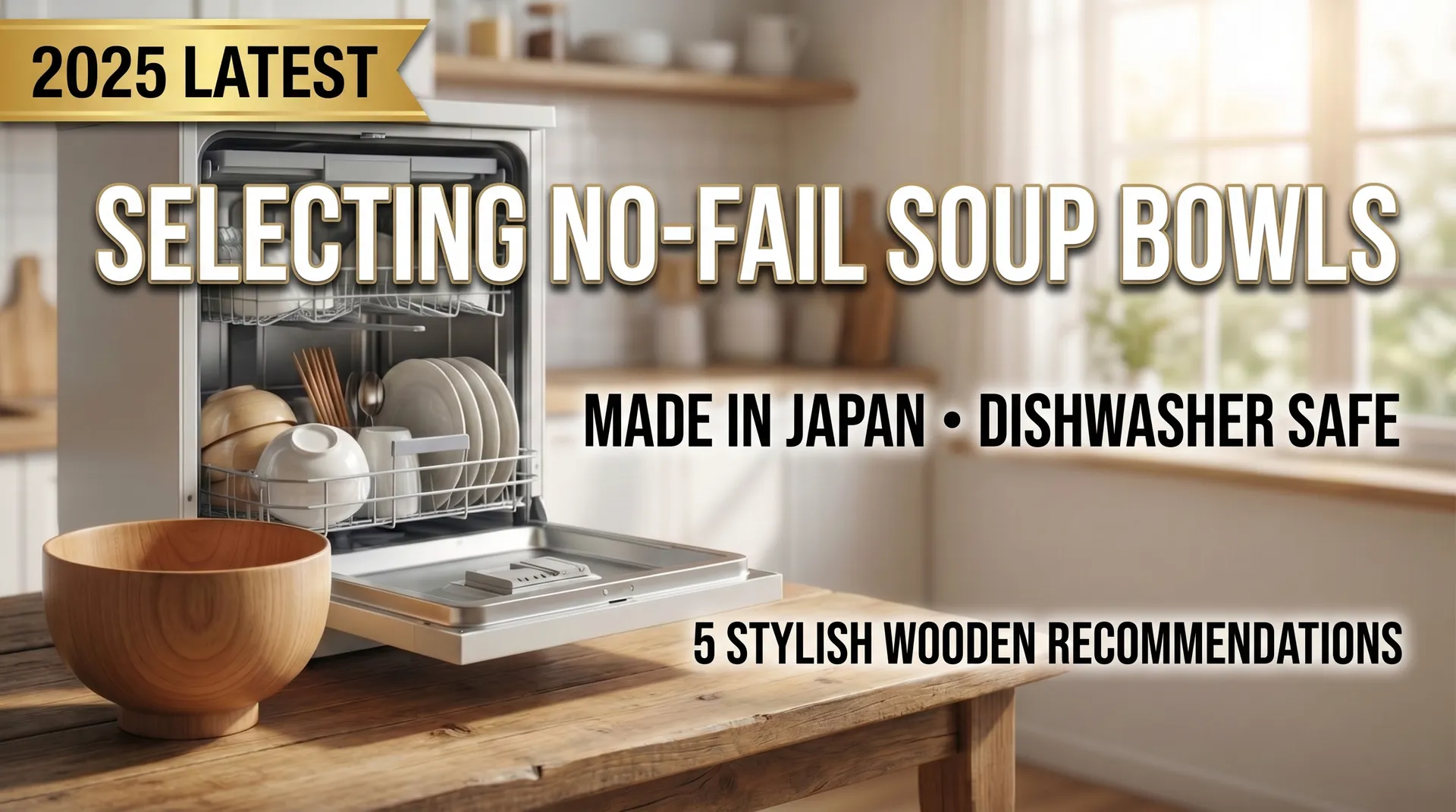
Japanese Soup Bowls — Top 5 Picks from Dishwasher-Safe to Hon-Urushi
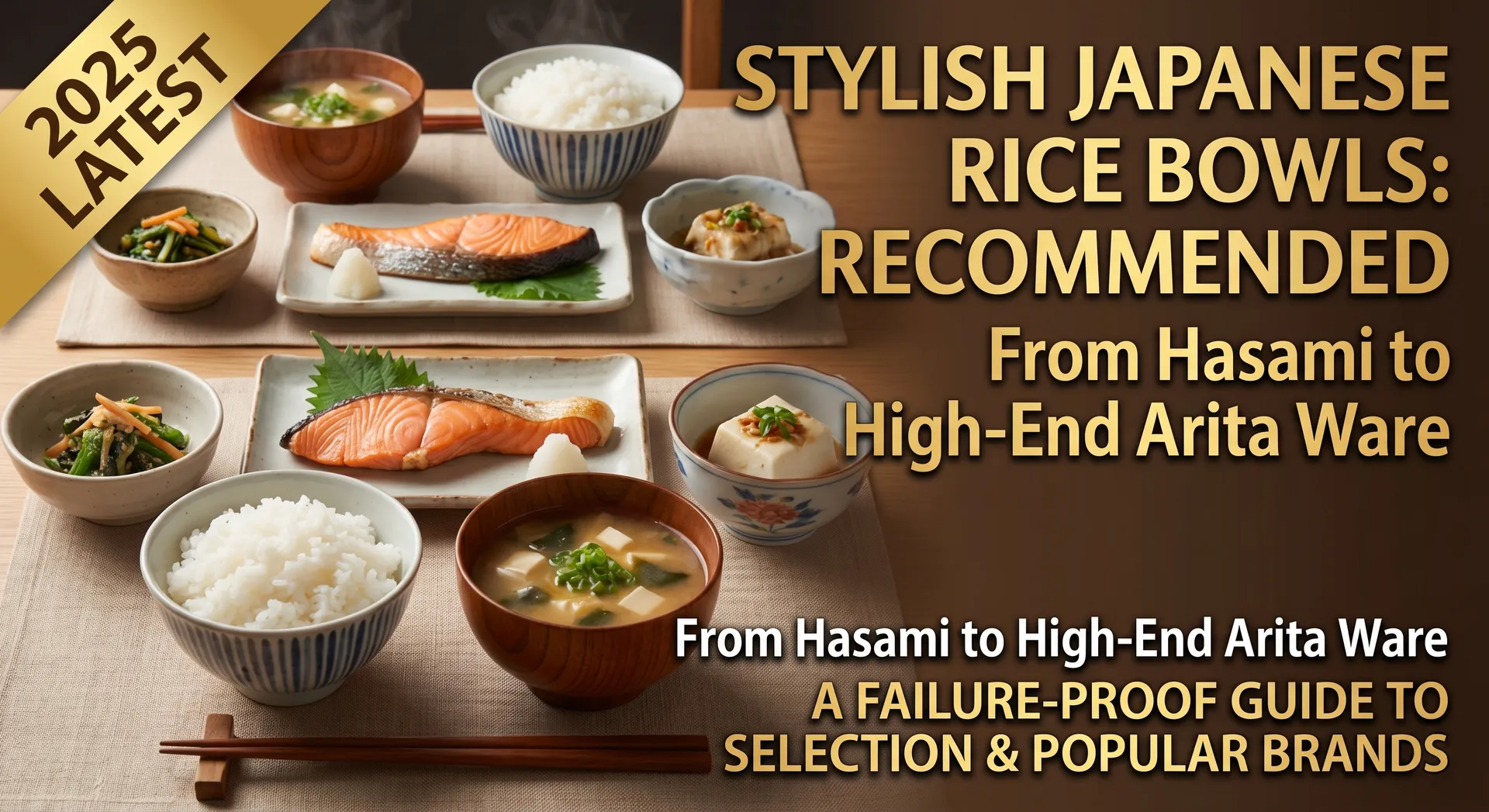
Japanese Pair Rice Bowls (Meoto-Chawan) — Top 5 Picks in Arita and Mino Ware