Brass (黄銅 / 真鍮) is an alloy of copper and zinc. Newly polished, it has a warm gold colour.
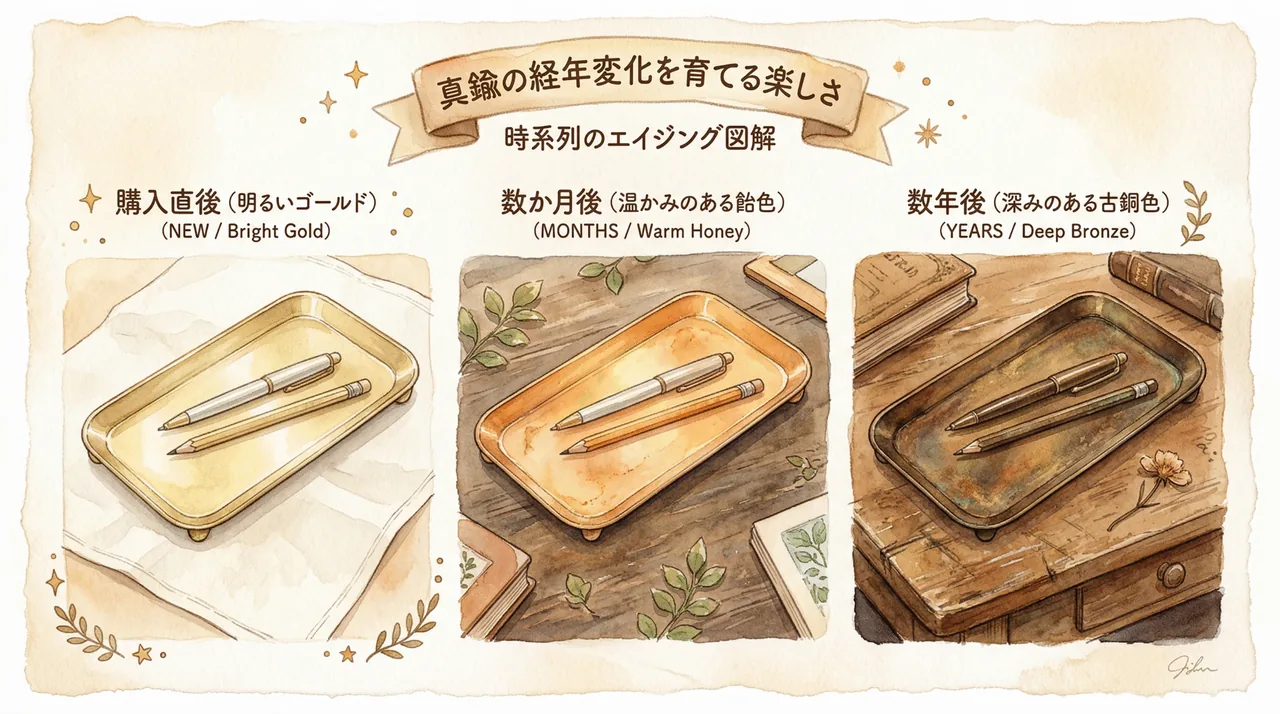
Left in contact with air and hands, it gradually oxidises — first to a honey amber, then over
years to a deep antique bronze. Every object ages differently based on how it's handled, which
surfaces get touched most, where it lives.
This patina is not deterioration. It's the reason people buy brass rather than chrome or plastic.
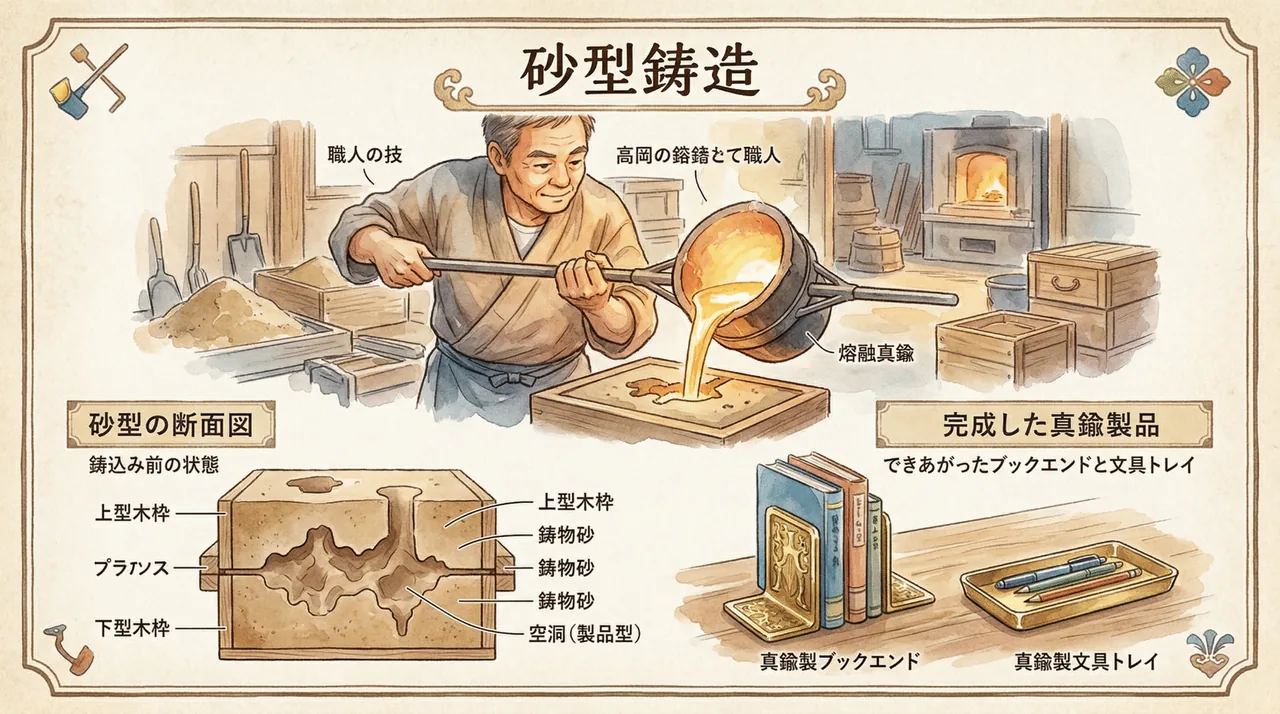
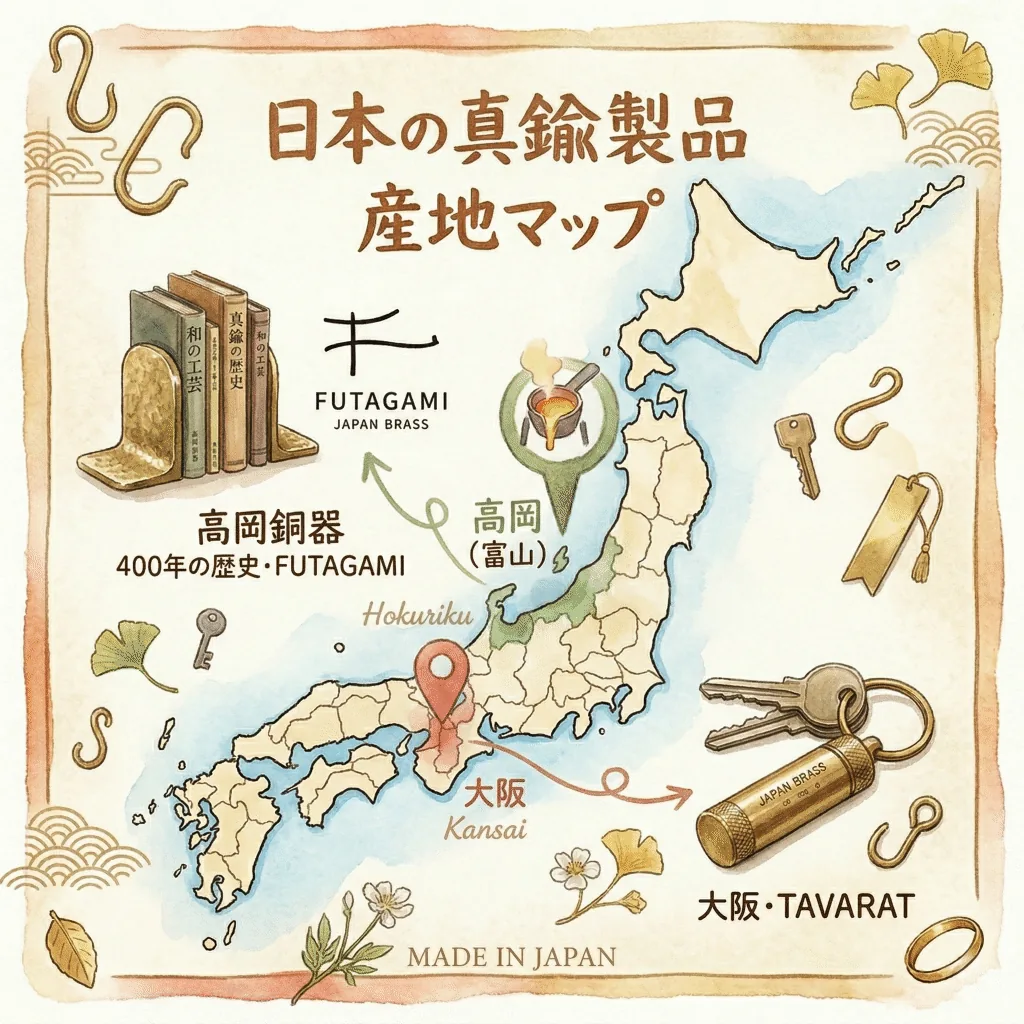
Takaoka (富山県高岡市) has been Japan's metalworking capital since 1609, when seven casters were
invited to the city by the lord of Kaga Domain. FUTAGAMI (二上 / 株式会社二上), founded in 1897,
originally made Buddhist altar pieces in Takaoka's sand-casting tradition. Designer Oji Masanori's
2009 collaboration brought that same craft to everyday objects: bookends, desk trays, paperweights,
hooks. Most are available on Amazon.com internationally.
This guide explains the material, the craft tradition, and the six picks worth knowing.
Quick Reference: Japanese Brass Accessories — Six Picks
| Product | Brand / Origin | Type | Best for |
|---|---|---|---|
| FUTAGAMI Brass Desk Tray (Large) | Takaoka, Toyama | Desk organiser | Daily contact — fastest to develop patina |
| FUTAGAMI Brass Paperweight (Square) | Takaoka, Toyama | Paperweight / desk object | Desk presence; handles and ages well |
| FUTAGAMI Zenmai Wall Hooks (set of 2) | Takaoka, Toyama | Wall hooks | Kitchen, entryway, bedroom — permanent display |
| FUTAGAMI Brass Tape Dispenser | Takaoka, Toyama | Desk tool | Daily-use desk object; single-hand operation |
| TAVARAT Brass Toothpick Case (key ring) | Osaka, Japan | Portable carry piece | Pocket patina — fastest aging through handling |
| Takaoka Doki Brass Single-Stem Vase | Takaoka, Toyama | Bud vase / interior object | Table or entryway; 400-year craft tradition |
1. Why Japanese Brass Stands Apart
Brass objects are made globally, in enormous quantities, at many price points. Japanese brass — particularly Takaoka sand-cast brass — is different in ways that become apparent the moment you handle it.
| Quality dimension | What it means in practice |
|---|---|
| Sand-cast surface texture | Takaoka craftspeople pour molten brass into sand molds. The result is a subtly irregular, almost granular surface that machine-pressed brass cannot replicate. It feels different to hold. |
| Finishing precision | Cast edges are filed and polished by hand. The contact surfaces — base feet, rim edges — are refined so there's no sharpness or catching. This is where cheap brass and expensive brass diverge most obviously. |
| Alloy purity | Higher purity Cu-Zn alloy oxidises more evenly, producing a uniform amber patina rather than blotchy colour changes. |
| Patina quality | Good Japanese brass ages to a warm, consistent amber. Poor brass develops irregular dark spots or a dull grey rather than warm gold-brown tones. |
2. Brass: The Patina That Makes It Personal
Brass (真鍮, shinchuu) is a copper-zinc alloy. Fresh from casting or polishing, it has a
bright gold-adjacent colour. Exposed to air and human touch, it oxidises gradually:
Weeks–months: slight warming of the tone, slight dulling of the shine.
Six months–a year: a honey amber develops, particularly in areas most touched.
Several years: a deep antique bronze tone, with bright highlights where handling
continues to polish the high points.
Every piece ages differently depending on where it lives and how it's used. A desk tray that
gets 50 items placed in it daily ages faster than one used occasionally. A pocket key ring develops
intense patina on the contact surfaces within months.
This individual character is the reason people seek out brass over materials that don't change.
The object becomes yours in a way that a polished steel or lacquered wood object never fully does.
3. Six Picks: FUTAGAMI, TAVARAT & Takaoka Doki
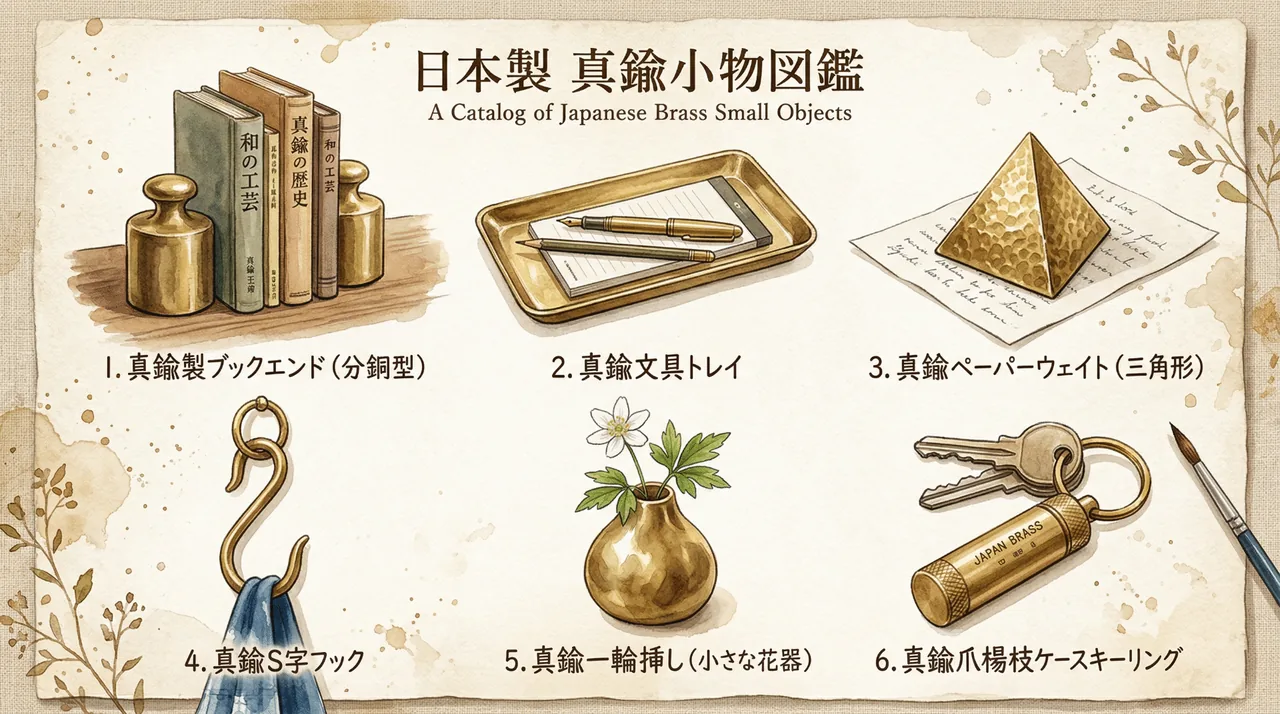
No.1 — FUTAGAMI Large Brass Stationery & Pen Tray
The pen tray is FUTAGAMI's most-handled object — cards, pens, clips, keys go in and out of it multiple times a day. That contact frequency means it develops patina faster than almost any other brass object. The velvet-padded underside protects the desk surface. Sand-cast from Takaoka brass. The large size handles a full working set of stationery. Available directly on Amazon.com.
- Material
- Sand-cast brass, felt base, made in Takaoka, Japan
- Best for
- Daily-use desk object; fastest patina development through regular handling
No.2 — FUTAGAMI Solid Brass Paperweight (Square)
A paperweight that doubles as a desk object. The square form is simple and the weight is substantial — it holds papers flat without effort. Sand-cast Takaoka brass with the characteristic slightly irregular surface texture. Pick it up to pin a paper, set it back down — the handling develops the patina on its upper face while the base stays comparatively fresh, creating a two- tone aging effect. Available directly on Amazon.com.
- Material
- Solid sand-cast brass, made in Takaoka, Japan
- Best for
- Desk presence; paper management; sculptural desk object
No.3 — FUTAGAMI Zenmai Diamond Brass Wall Hooks (Set of 2)
These wall hooks come in pairs — designed to sit beside each other on a wall, holding coats, bags, or keys. The diamond-cross-section form is distinctive without being decorative in a fussy way. Sand-cast Takaoka brass: the hooks age in place over years, developing patina at the contact points where things are hung and removed. A permanent installation that improves with time. Available directly on Amazon.com.
- Material
- Sand-cast brass, made in Takaoka, Japan
- Best for
- Kitchen rail, entryway, bedroom — hanging bags, coats, keys
No.4 — FUTAGAMI Brass Tape Dispenser (Small)
A tape dispenser that works with one hand — the weight of the brass base holds the unit still while you draw and tear tape. Sand-cast Takaoka construction. Practically, it handles the same task as a ¥500 plastic dispenser. The difference is that this one sits on the desk as a considered object, not an afterthought, and improves over years of use. Available directly on Amazon.com.
- Material
- Sand-cast brass, made in Takaoka, Japan
- Best for
- Daily desk tool that earns its place through regular handling
No.5 — TAVARAT Brass Toothpick Case (Key Ring)
Osaka-based TAVARAT makes men's accessories from Japanese brass — money clips, bangles, key cases. Their toothpick holder key ring is the fastest-aging brass object in this guide: it lives in a pocket or on a key ring, pressed against other objects, handled dozens of times daily. Within months, the contact surfaces develop an intense amber patina while the recessed areas stay lighter — a micro-contrast that develops uniquely on every piece. Four toothpicks fit inside. Available at TAVARAT's official store.
- Material
- Solid brass (無垢真鍮), made in Japan
- Best for
- First brass carry piece; fastest-developing patina through pocket wear
No.6 — NOUSAKU Brass Bud Vase (Takaoka)
From NOUSAKU, founded in Takaoka in 1916 — the same metalworking tradition that produces FUTAGAMI's objects, but a different maker. A small bud vase (一輪挿し) in solid brass, finished with NOUSAKU's traditional antiqued patina (gold-brown or black-brown), intended for one flower or branch. The weight and form stabilise it on a table or shelf; the brass ages further in place as light and air do their work over years. A functional object that also works as small-scale sculpture.
- Material
- Solid brass, traditional antiqued patina, made in Takaoka, Toyama
- Best for
- Table or entryway; seasonal single flower display; long-aging patina object
4. The Takaoka Metalworking Tradition
400 years of continuous production
In 1609, the lord of Kaga Domain invited seven casters to Takaoka to supply metalwork for
the new castle town. The production tradition they established never stopped. Today, Takaoka
produces roughly 90% of all Japanese copperware and bronze ware — Buddhist temple bells, municipal
statues, architectural fittings, and the everyday objects covered in this guide.
The sand-casting technique central to Takaoka's identity involves pressing a pattern into packed
sand to create a mold, then pouring molten metal. The sand leaves a distinctive micro-texture on
the cast surface. When FUTAGAMI designer Oji Masanori chose to keep this texture rather than polish
it away, he made the craft process visible in the finished object — which is part of why FUTAGAMI
objects are valued.
FUTAGAMI vs Takaoka Doki
"Takaoka Doki" (高岡銅器) is the regional designation — the name for metalwork produced in Takaoka. FUTAGAMI (二上) is one specific company within that tradition, founded in 1897. Both make brass objects; the Takaoka Doki designation certifies regional origin and craft standards. FUTAGAMI's objects have a more design-forward contemporary identity; traditional Takaoka Doki pieces (flower vases, incense burners, decorative objects) follow older forms and aesthetics.
5. Care, Cleaning & Living With Patina
Letting it age — the standard approach
The default relationship with brass is to let it age. The oxidation process is self-protective — the patina layer slows further oxidation. There's nothing to do except use the object. Touch it, handle it, let the oils from your hands do their work.
Polishing back to bright — if you want to
If you prefer the bright gold of new brass: apply a small amount of brass-specific cleaner (or toothpaste as a mild abrasive) to a soft cloth and rub gently. Rinse thoroughly with water, dry immediately and completely. The brass will return to bright — and begin aging again from that point. Repeat as often as you like.
Verdigris (green oxidation)
If the brass is exposed to prolonged moisture — a flower vase left with standing water, a piece kept in a humid bathroom — green verdigris (緑青, rokusho) may form. This is copper carbonate, not harmful in the amounts found on household objects. It can be removed with a soft brush and diluted white vinegar, then rinsed and dried. After removal, keep the object drier going forward.
6. Brass as a Gift
Brass objects are strong gift choices because they're functional, long-lasting, and carry a time dimension that most gifts don't: they become more personal as time passes. The recipient doesn't just receive an object — they receive something that will record their ownership.
| Budget range | Suggested items |
|---|---|
| Under $50 | FUTAGAMI hooks, TAVARAT toothpick case, small tray |
| $50–100 | FUTAGAMI desk tray set, paperweight, tape dispenser |
| Gift presentation | FUTAGAMI ships with quality packaging suited to gifting. The desk tray set comes in a set of three, which makes a strong visual first impression when opened. |
The "growing" quality of brass — the idea that "this will become more yours with time" — makes it particularly fitting as a gift for graduations, new jobs, marriages, and birthdays.
7. Frequently Asked Questions
What's the best first brass object to buy?
The TAVARAT toothpick key ring is the best introduction to brass patina — it's inexpensive, you handle it dozens of times a day, and you'll see genuine colour change within a few months. For desk use, the FUTAGAMI small tray develops quickly from daily contact and costs less than the larger pieces. Either way, choose something you'll actually interact with daily — the patina only develops through use.
Is verdigris (green oxidation) harmful?
In the trace amounts that form on household brass objects, no. Verdigris is copper carbonate, and historical concern about its toxicity was based on ingesting it in significant quantities — not incidental skin contact. Clean it off if it bothers you aesthetically (diluted vinegar works), and keep the object drier going forward to slow its return.
What's the difference between brass and copper?
Copper (Cu) is pure metal — reddish-orange, excellent antibacterial properties, somewhat soft. Brass is a copper-zinc alloy — more golden-yellow, harder and more workable, ages to amber rather than the darker verdigris that pure copper develops. For everyday objects, brass is generally preferred because it machines and casts more precisely and ages more evenly. Copper is used for cookware (pots, tamago pan) where its thermal properties and antimicrobial surface are the key advantages.
Can I stop the patina from forming?
Yes — apply a thin coat of clear lacquer or Renaissance Wax to the surface. This creates a barrier between the brass and air, significantly slowing oxidation. Some FUTAGAMI pieces are sold in lacquered versions. The trade-off: lacquered brass won't develop the same living patina. If you want the object to change over time, buy the unlacquered version. If you want it to stay bright, buy lacquered.
Is FUTAGAMI the same as Takaoka Doki?
Takaoka Doki (高岡銅器) is the regional designation — copperware made in Takaoka, Toyama. FUTAGAMI (二上) is a specific company within that tradition, founded in 1897. All FUTAGAMI objects are Takaoka Doki; not all Takaoka Doki objects are FUTAGAMI. The regional designation covers a range of producers from traditional temple bell makers to the contemporary design-forward studio work FUTAGAMI is known for.
Can I use a brass vase with water directly?
Yes, but prolonged standing water inside brass will cause the interior to oxidise more rapidly and can accelerate verdigris formation. Two practical approaches: insert a small glass tube (test tube) inside the brass vase to hold water while keeping it separate from the metal, or empty and dry the vase after each use. Many Takaoka brass vases include a glass insert for exactly this purpose.
Final Thoughts: Objects That Record Their Use
Most objects depreciate with use. Brass appreciates. The desk tray you buy this year will
look better in five years — more amber, more warm, more visibly yours — than it does when
it arrives.
Takaoka craftspeople have been working this material for 400 years. FUTAGAMI figured out
how to make that craft relevant to a desk in 2025 without losing any of the substance that
makes it worth caring about. The results ship from Amazon.
Japanese Pearl Jewelry: Mikimoto, Tasaki & the Formal Occasion Tradition
Japanese Wind Chimes: Nanbu Tekki, Edo Glass & Etchu Doki