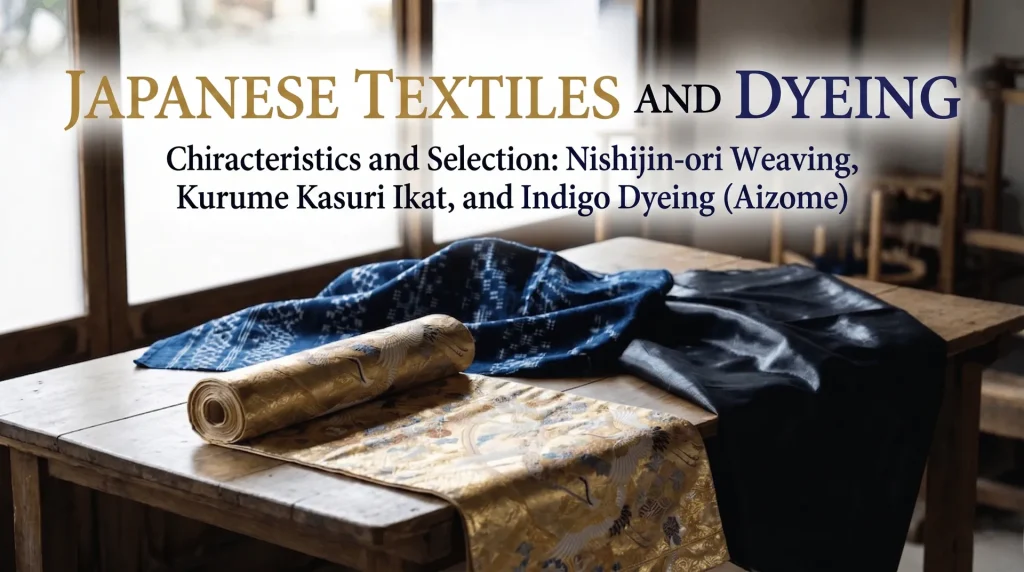
"I want to try wearing a kimono — but how do I choose?"
"Is it really bad manners to wear tsumugi to a wedding?"
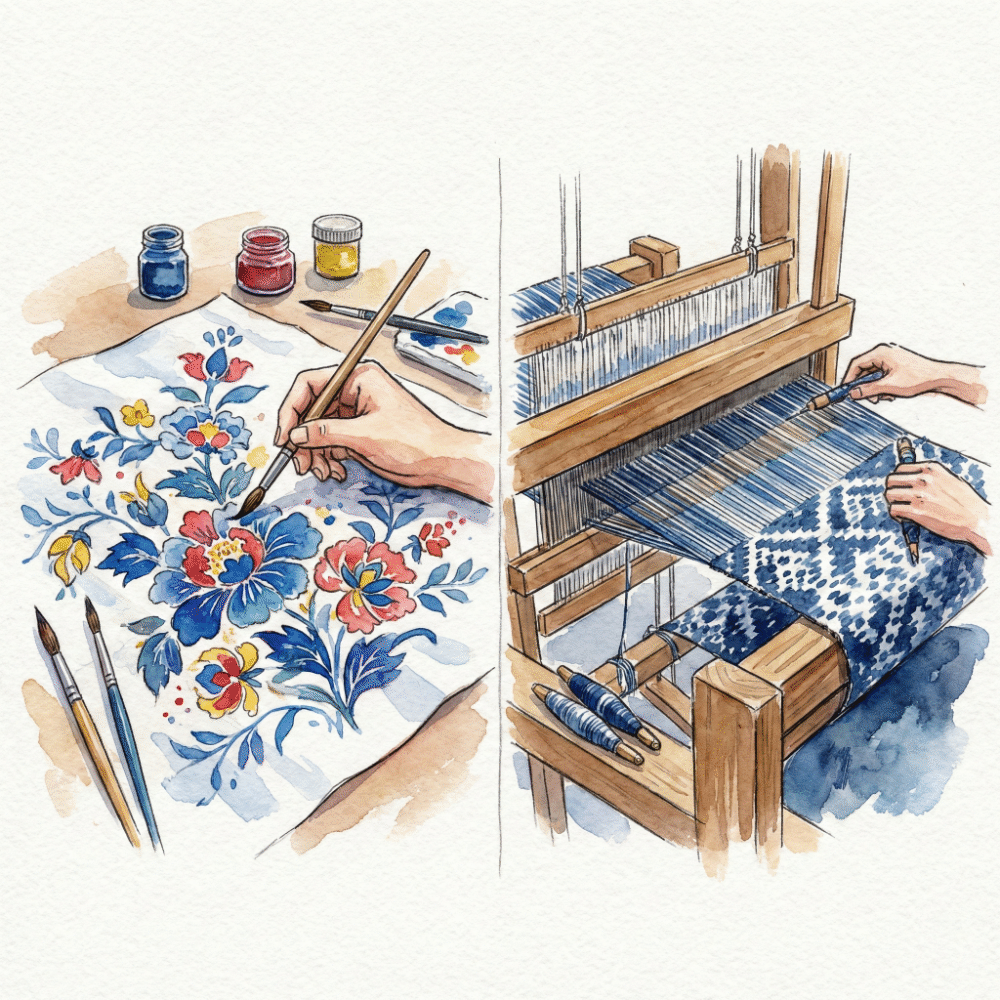
Japanese textiles divide into two fundamental categories: woven fabric (orimono) and dyed fabric (somemono) — and the formality rules between them are almost the opposite of what Westerners would expect.
Get this wrong and a genuinely expensive, beautiful piece can still look out of place.
The short rule: for formal occasions, choose post-dyed silk (like yuzen). For travel and everyday wear, choose pre-dyed woven fabric (like kasuri or tsumugi).
But beyond kimono, Japan's textiles are now making their way into sneakers, home interiors, and global fashion — there are more ways to engage with them than ever.
This guide maps the major Japanese textile traditions, explains the TPO rules, and shows you how to bring these fabrics into daily life — with or without a kimono.
Quick Reference: Japanese Textile Regions at a Glance
| Region | Material | Key Trait | Famous Products |
|---|---|---|---|
| Nishijin-ori (Kyoto) | Silk | Intricate jacquard weaving with gold and silver thread | Obi belts, formal kimono fabric, interior textiles |
| Arimatsu Shibori (Aichi) | Cotton / silk | Hand-tied resist dyeing with distinctive 3D texture | Yukata, accessories, scarves |
| Oshima Tsumugi (Kagoshima) | Silk (mud-dyed) | Light and durable; distinctive luster from mud-iron reaction | Tsumugi kimono, coat fabric |
| Kurume Kasuri (Fukuoka) | Cotton | Soft, washable everyday cloth; rustic splashed pattern | MONPE trousers, shirts, accessories |
1. The Core Rule — Woven vs. Dyed & the Japanese TPO System
When choosing a kimono or Japanese textile accessory, understanding the distinction between woven and dyed fabric is the single most important step.
The formality hierarchy is almost the reverse of what Western fashion intuition would suggest.
Why "Dyed" Ranks Higher Than "Woven"
| Type | How It's Made | Formality (TPO) |
|---|---|---|
| Dyed kimono (post-dyeing) |
Fabric is woven first as white cloth, then dyed with color and pattern. Examples: yuzen, komon |
Formal (higher rank) Weddings, ceremonies, parties. Also called "soft garments" (yawarakamono). |
| Woven kimono (pre-dyeing) |
Threads are dyed first, then woven into pattern. Examples: tsumugi, kasuri, denim |
Casual (lower rank) Shopping, theatre, dining out. Even expensive pieces are classified as "everyday." |
The beginner's shortcut:
Think of woven kimono — tsumugi, kasuri — as the Japanese equivalent of premium denim or tweed. No matter how expensive they are, you would not wear denim to a wedding. For formal occasions, the rule is dyed silk (yuzen, etc.).
Note for obi belts: the rule reverses — woven obi with gold and silver thread ranks higher than dyed obi.
2. Silk & Formal Wear — Nishijin and Kiryu Jacquard
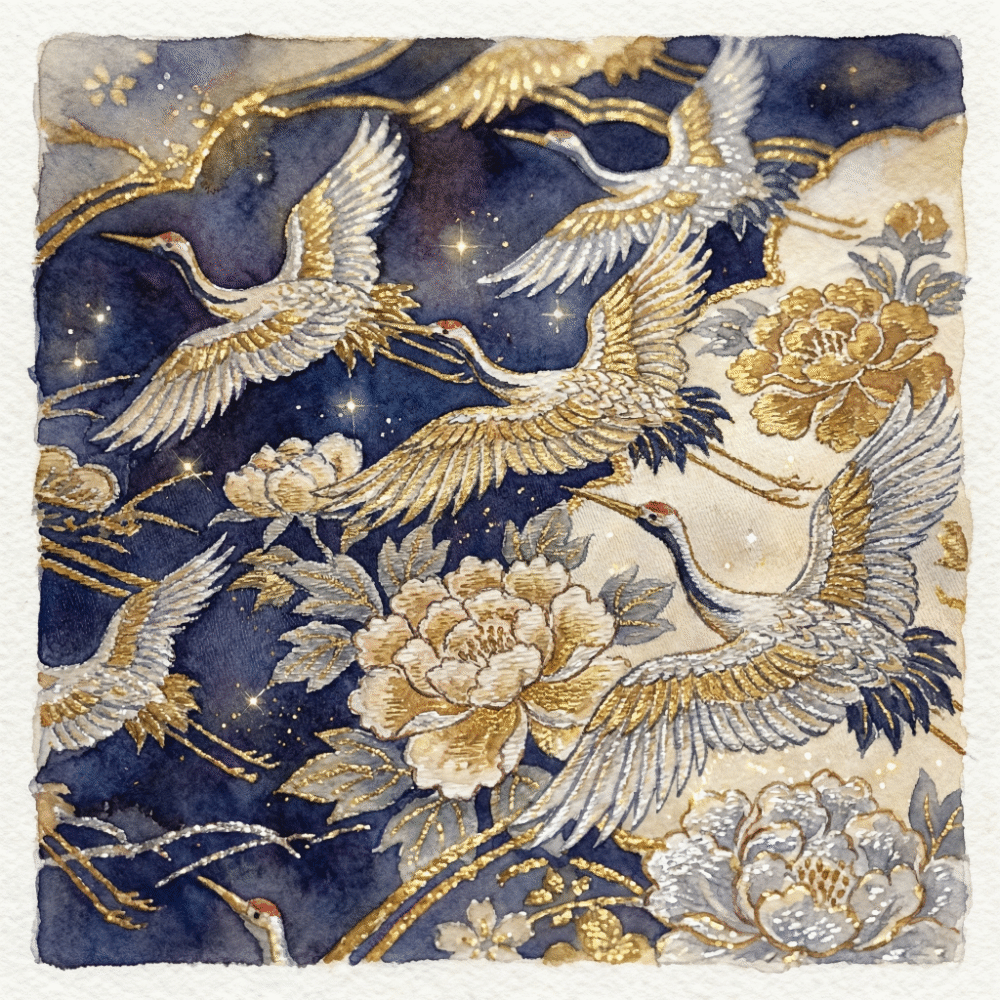
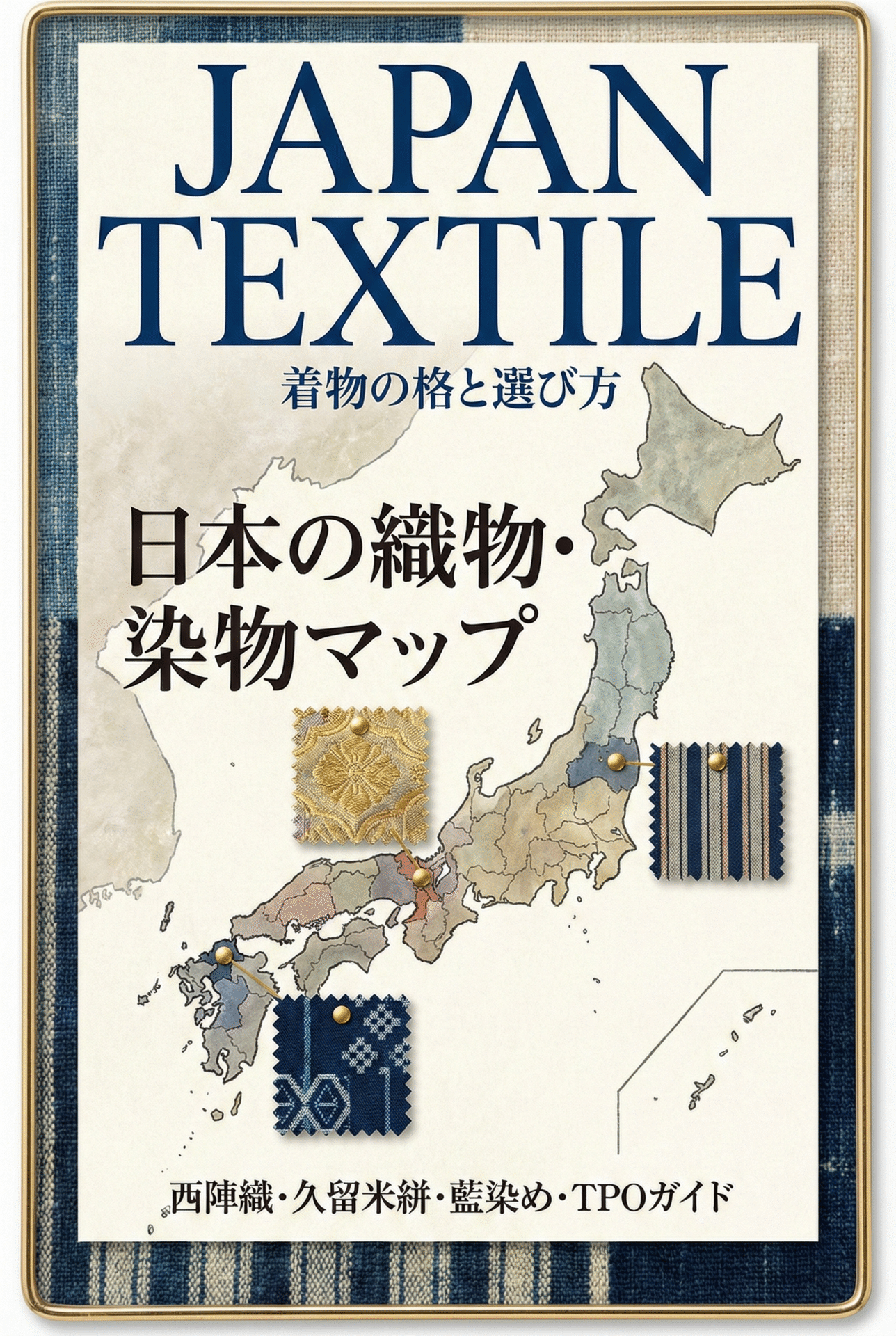
The pinnacle of Japanese weaving is Nishijin-ori (西陣織) from Kyoto — a pre-dyed patterned weave of extraordinary complexity, with over a thousand years of continuous production.
Nothing else in the world matches what these looms produce.
The Shimmer of Gold and Silver Thread
Nishijin-ori (Kyoto):
A small-lot, multi-variety weaving tradition producing many types of silk brocade — most famously, obi belts woven with real gold leaf hammered into threads (kinran). The technique is jacquard-based, allowing complex color patterns of extraordinary precision. A single Nishijin obi can involve hundreds of types of thread managed simultaneously on the loom.
Kiryu-ori (Gunma Prefecture):
Called "the Nishijin of the East," Kiryu has embraced the latest computerized jacquard technology to produce not just kimono fabric but commission weaving for Parisian fashion houses. The region is a bridge between tradition and industrial textile innovation.
When to use it:
A Nishijin obi worn with a formal kimono at a wedding or coming-of-age ceremony is the canonical use. For men, a Nishijin-woven necktie brings quiet distinction to any business meeting.
3. Cotton Casuals — Kurume Kasuri and Aizu Cotton
Silk requires specialist cleaning and careful handling. Cotton (momen) wovens, by contrast, can be washed at home, dry naturally, and only improve with use.
These evolved from Japan's working clothes — and they are the textile equivalent of well-worn denim.
Kurume Kasuri (Fukuoka) — MONPE Trousers
Japan's answer to denim — softer with every wash. These authentic MONPE trousers are woven from Kurume kasuri fabric, featuring the traditional resist-dyed splashed pattern. Originally a farm worker's garment, now reinterpreted as a relaxed everyday pant worn with both Western and Japanese tops.
- Origin
- Kurume, Fukuoka Prefecture — Made in Japan
- Material
- 100% cotton kasuri weave
- Formality
- Casual — sightseeing, travel, everyday wear
Aizu Cotton Casual — Japanese Samue Set
Woven thick against harsh winters — airy and full-bodied. This Japan-made cotton samue (traditional work shirt and trouser set) captures the spirit of Aizu Momen's practical cotton tradition: durable, breathable, and growing softer with every wash. Coordinates naturally with Western clothing.
- Origin
- Made in Japan, Kurume cotton
- Material
- 100% cotton, hand-dyed
- Formality
- Casual — home, travel, daily wear
4. Towel Technology — Imabari vs. Senshu and the Pile-Weave Secret
Towels are textiles too — specifically, pile weaves — and Japan's two dominant towel-producing regions have taken distinctly different approaches to the same problem: maximum absorbency.
The difference comes down to when the washing happens.
Pre-Bleached vs. Post-Bleached
- Imabari Towels (Ehime Prefecture) — pre-washed, pre-dyed:
Threads are washed and dyed before weaving. This allows complex jacquard patterns and a lofty, voluminous pile texture. The "5-second test" is Imabari's famous quality standard — a new towel dropped onto water must sink within 5 seconds. Imabari towels are the benchmark gift choice for quality-conscious Japanese consumers. - Senshu Towels (Osaka Prefecture) — post-bleached:
The towel is woven first, then washed and bleached at the very end of production. This removes every trace of sizing and oil from the weaving process, making Senshu towels extraordinarily absorbent straight from the packaging — no break-in period required. The utilitarian choice: grab it, use it hard, wash it, repeat.
5. Japan Blue — Awa Indigo Dyeing and Its Hidden Benefits
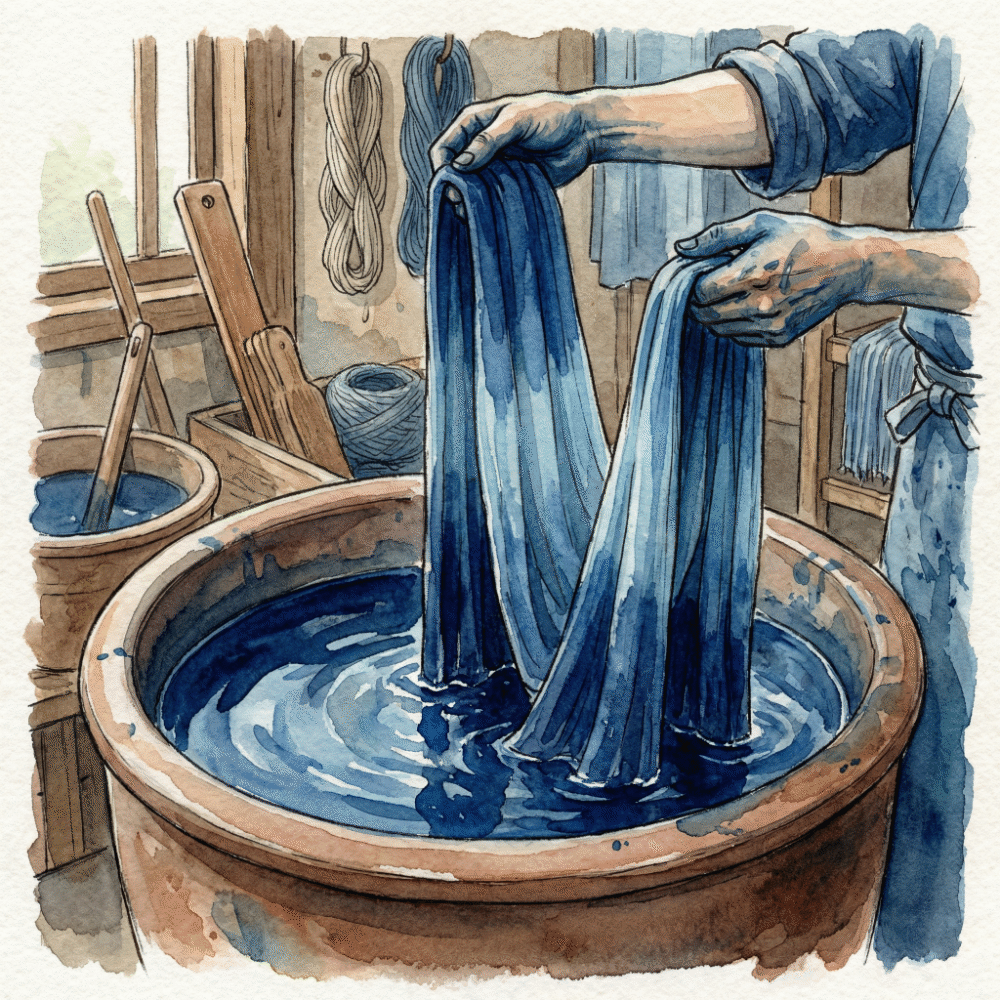
When foreign visitors arrived in Meiji-era Japan, they were struck by something unexpected: the deep, saturated blue worn by almost everyone in daily life. They called it "Japan Blue."
That color came from Tokushima Prefecture's Awa indigo (awa ai) — a natural dye made by fermenting Japanese indigo plants (tade-ai) into a concentrated dye paste called sukumo.
More Than a Color — The Practical Properties of Natural Indigo
Natural indigo dyeing carries real, measurable benefits that synthetic indigo (the kind used in standard blue denim) does not:
1. Antibacterial and deodorizing: Kendo practitioners' uniforms have been indigo-dyed for centuries — not only for tradition but because the dye actively suppresses odor and was historically believed to prevent infection in wounds.
2. Insect-repellent: Furoshiki wrapping cloths used to protect precious kimono were traditionally dyed with indigo to repel moths and textile pests.
3. UV protection: Natural indigo absorbs UV light effectively — making indigo-dyed parasols and scarves a genuinely functional accessory for summer sun protection.
Unlike synthetic indigo, natural awa indigo gradually fades toward a clear, sky-like blue as the dye is washed out over time — the color doesn't degrade, it evolves. This is called "growing the blue."
6. Mud Dyeing & Natural Dyes — Oshima Tsumugi and Living Color
Transferring the colors of plants and earth into cloth — producing complex, layered tones that no synthetic dye can replicate — is a form of respect for Japan's natural world.
The most extreme example is mud dyeing.
Tsumugi Silk — Haori Kimono Jacket
Experience the weight and drape of Japanese tsumugi fabric in wearable form. This lined haori kimono jacket by KYOETSU brings the characteristic nubby texture of tsumugi weave into a versatile outer layer — smart casual for theatre, dining, and cultural events.
- Style
- Haori (kimono jacket) — wears over Western or Japanese clothing
- Fabric
- Tsumugi-weave style, lined (awase)
- Formality
- Smart casual — theatre, reunion, cultural events
7. What to Wear When — A Beginner's Scene-by-Scene Guide
"What is actually appropriate here?"
Below is a practical reference table for the situations that beginners most often get wrong.
TPO Reference Table
| Occasion | Recommended Kimono / Fabric | Key Notes |
|---|---|---|
| Wedding / ceremony (formal) |
Visiting robe (hōmongi), understated formal (tsukesage) (dyed silk) |
Woven tsumugi is NOT appropriate here. Pair with a Nishijin-style fukuro obi with gold/silver weave. |
| Tea ceremony (semi-formal) |
Solid-color (iromoji), fine-pattern dye (Edo komon) (dyed silk) |
Understated patterns preferred. A single family crest (hitotsu-mon) added to the back is reassuring. |
| Theatre / reunion (smart casual) |
Oshima tsumugi, Yuki tsumugi (premium wovens) |
The first setting where woven kimono is genuinely appropriate. A chance to display refined personal taste. |
| Sightseeing / travel (casual) |
Cotton (Kurume kasuri), wool (washable materials) |
Washability is the priority — choose freely here. A half-width obi (hanhaba obi) keeps the look light. |
Seasonal layers:
October–May: lined kimono (awase) with full lining. June and September: unlined (hitoe). July–August: sheer summer weave (usumono).
Cotton and wool fall outside this system — they can be worn year-round (except midsummer) without restriction.
8. Stain Emergency — What to Do When You Spill
"I splashed soy sauce on myself at dinner—"
"Foundation got on the collar again."
When something spills on precious fabric, your immediate response matters far more than what you do at home later. Different materials require different approaches — take a breath and read the stain type first.
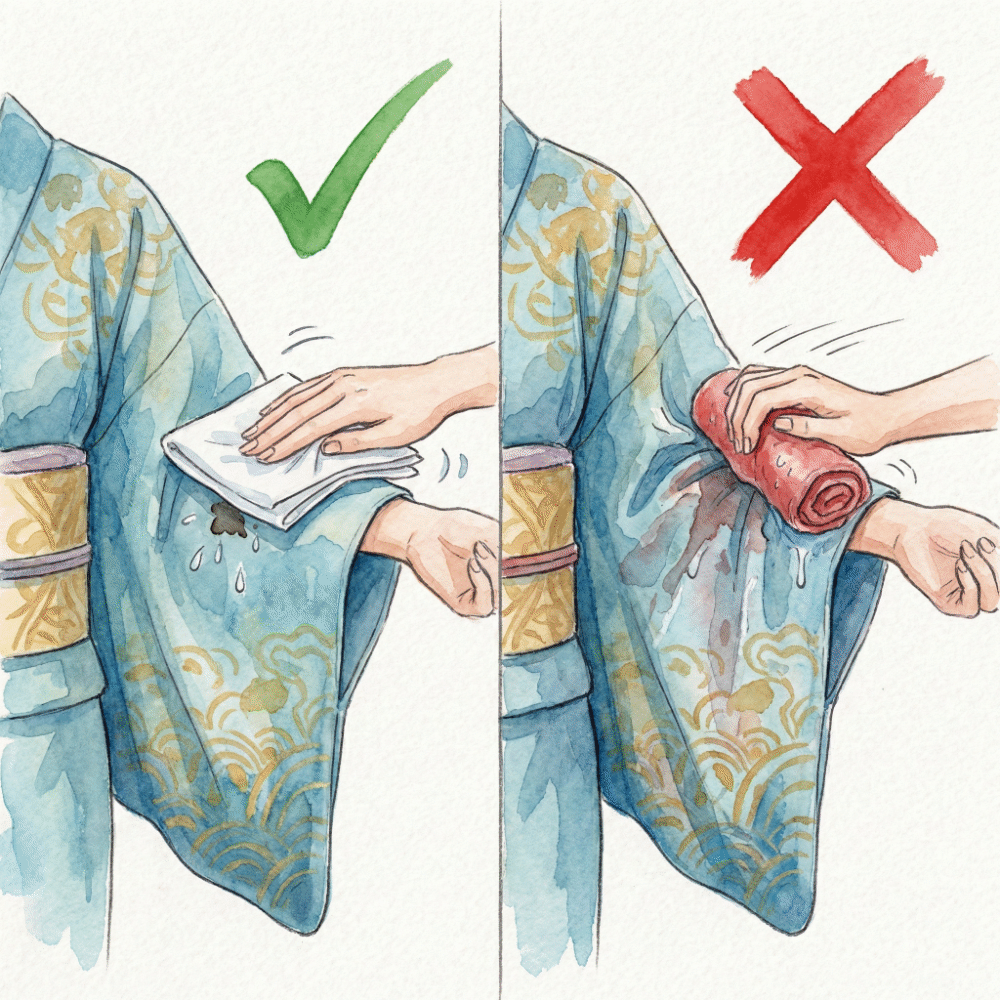
The Two Things You Must Never Do
Before anything else, avoid these:
✕ Scrubbing with a wet towel — this damages the fibers and drives the stain deeper into the weave.
✕ Applying heat (hairdryer, hot water) — heat sets the stain permanently.
Emergency First Aid by Stain Type
| Stain Type | First Response |
|---|---|
| Water-based (soy sauce, sake, tea) |
Blot — do not rub — with a dry handkerchief or tissue, pressing gently to absorb moisture. For cotton: a wrung-out damp cloth pressed (not rubbed) against the stain can follow. |
| Oil-based (dressing, lipstick) |
Do NOT add water — it will spread the oil. Lift the stain by blotting with a dry cloth, picking up as much as possible. At home: treat with benzine solvent, or take it to a specialist immediately. |
| Mud splatter |
Do nothing until it is completely dry. Attempting to wipe wet mud pushes it deeper. Once fully dry, brush away with a soft bristle brush — it comes off surprisingly cleanly. |
For silk kimono specifically: water causes silk to shrink and form ring marks. If anything spills on silk, do not attempt home treatment — bring it directly to a specialist dry-cleaner who handles kimono. The cost of early professional treatment is far lower than restorative repair.
Cotton and wool kimono can usually be handled with standard delicate-wash procedures at home.
9. Where to Shop — Trusted Japanese Textile Sources
"I want to touch the real thing before buying."
"I need someone to advise me in person."
Here are the most accessible and reliable sources — organized by what you're looking for.
Everyday & Casual — Modern takes on traditional cloth
Unaginonedoko (Fukuoka / online)
The brand that made MONPE a fashion item — Kurume kasuri for daily life.
Founded on the concept of "Japan's jeans," Unaginonedoko redesigned the traditional farm worker's MONPE trouser into a comfortable, stylish daily pant using Kurume kasuri fabric. They also sell patterns and fabric offcuts, making Japanese cloth accessible even to people who never intend to wear a kimono.
SOU·SOU (Kyoto / Aoyama / online)
Japanese tradition with the boldness of Marimekko — a genuinely new Japanese aesthetic.
SOU·SOU's mission is to create a living Japanese culture, not to preserve a museum. Their graphic textile designs use traditional Ise cotton and other Japanese fabrics but push the patterns into vivid, contemporary territory. Their kigoro (loose kimono-shaped top) and tabi shoes are a low-commitment entry point for anyone curious about Japanese dress.
Kimono Yamato (nationwide chain / online)
The most accessible starting point — mall locations, no pressure, modern options.
Yamato locations are found in shopping centers throughout Japan, making them easy to walk into without advance preparation. Their "THE YARD" sub-line offers refined modern kimono, and their washable cotton and polyester selections are ideal for beginners who want to try wearing before committing to silk.
Formal & Investment — Tsumugi and artist-made kimono
Ginza Motoji (Tokyo Ginza / online)
Where artisans' names are known — the aspirational specialist for serious kimono lovers.
Motoji operates Japan's first dedicated men's kimono boutique and a specialist Oshima tsumugi salon, buying directly from regional producers and individual artists. They even developed an original pure domestic silk thread called "Platinum Boy," reflecting an obsession with material integrity that is unique among Japanese kimono retailers.
Mitsukoshi / Isetan / Takashimaya (kimono floors)
"I can't face a specialist shop yet" — department stores offer the lowest-pressure high-quality option.
For occasions where you genuinely cannot make a mistake — a wedding guest outfit, a ceremony robe — major department stores offer the widest selection from reliably credentialed sources. High-pressure sales tactics are uncommon here, and beginner questions are handled with patience. Paradoxically, they are often the best environment for a nervous newcomer.
Secondhand — Try before you commit
Tansuya (nationwide / online)
Japan's largest recycled kimono chain — the best place to find Oshima tsumugi at accessible prices.
Good-condition secondhand kimono are available from a few thousand yen. Tansuya is the right choice if you want fabric for remixing and remakes — high-grade Oshima tsumugi at a fraction of original cost — or simply want a practice kimono for learning to dress yourself before investing in something precious.
10. Frequently Asked Questions
Can cotton kimono be machine-washed?
Yes — fold it, place it in a mesh laundry bag, and use the delicate cycle.
Kurume kasuri and Aizu momen are both machine-washable. Spin briefly (about 30 seconds to 1 minute), reshape while damp, and dry in shade — this minimizes wrinkles.
Silk kimono will shrink in a washing machine and must always go to a specialist cleaner.
Does natural indigo dye bleed?
Yes — especially in the early washes. Wash it separately until the color stabilizes.
This initial fading is called "the indigo settling" (ai ga kareru). Keep newly purchased indigo-dyed pieces away from white bags or obi belts during the settling period, as friction can transfer color.
After the early washes, the color continues its slow evolution toward a clearer, cooler blue — this is the process, not a defect.
How do I store kimono properly?
Guard against moisture and insects — everything else is secondary.
After wearing, hang the kimono on a kimono hanger (or a horizontal rod) for half a day to release humidity before folding and storing. Wrap in tatoshi paper (washi paper that absorbs moisture) and store in a paulownia wood chest (kiri-dansu) or a plastic container with silica gel packets. Wool and silk are both attractive to fabric pests — do not skip the moth deterrent.
Can old kimono be remade into Western clothing?
Yes — and Japanese textiles are unusually well-suited to it.
Traditional kimono are cut from long straight panels with almost no curved seams — unstitching one returns it to its original flat fabric lengths. These can then be cut into skirts, shirts, or jackets with minimal waste. Obi belts become table runners or upholstery. Kasuri kimono become wide-leg trousers. The straight-cut construction makes the math easy and the results very often beautiful.
What's the difference between kasuri and tsumugi?
Kasuri is a pattern technique; tsumugi is a yarn type — they often overlap.
Kasuri refers to the tie-and-dye resist method used to create blurred patterns in woven fabric — it describes the pattern, not the material.
Tsumugi refers to fabric woven from hand-reeled thread pulled from cocoon remnants, which is uneven in thickness and gives the cloth its distinctive nubby texture — it describes the yarn.
You can have kasuri-patterned tsumugi, kasuri-patterned cotton, or plain tsumugi with no kasuri pattern at all. Both are casual garments by definition.
I don't wear kimono. Can I still engage with Japanese textiles?
Absolutely — and it's increasingly easy to do so.
Kurume kasuri MONPE as everyday trousers. An indigo-dyed linen shirt. A Nishijin-woven pouch or small bag. A hand-dyed tenugui cotton cloth as a wall hanging or kitchen towel.
Japanese textile producers have worked hard to make their materials accessible in non-kimono formats — scarves, tote bags, upholstery fabric, stationery accessories. The craft is fully available without the traditional costume.
Final Thoughts: One Piece of Cloth, One Story
Japanese textiles are not just fabric. Each one carries the climate of a specific place, the material constraints that shaped a particular solution, and the accumulated judgment of craftspeople who refined a technique over generations.
A formal occasion calls for dyed silk — the back straightens, the posture changes.
A relaxed weekend in Kurume kasuri MONPE returns the body to ease.
You do not need a kimono to begin. A scarf, a bag, a tea towel — one piece that genuinely moves you is enough to start. Touch it, wash it, watch how it changes.
Japanese cloth is designed to be lived with, not displayed. Let it into daily life.
Japanese Leather Guide: Tochigi, Himeji & Cordovan Explained

Japanese Lacquerware (Urushi) Guide: Wajima, Yamanaka & How to Care