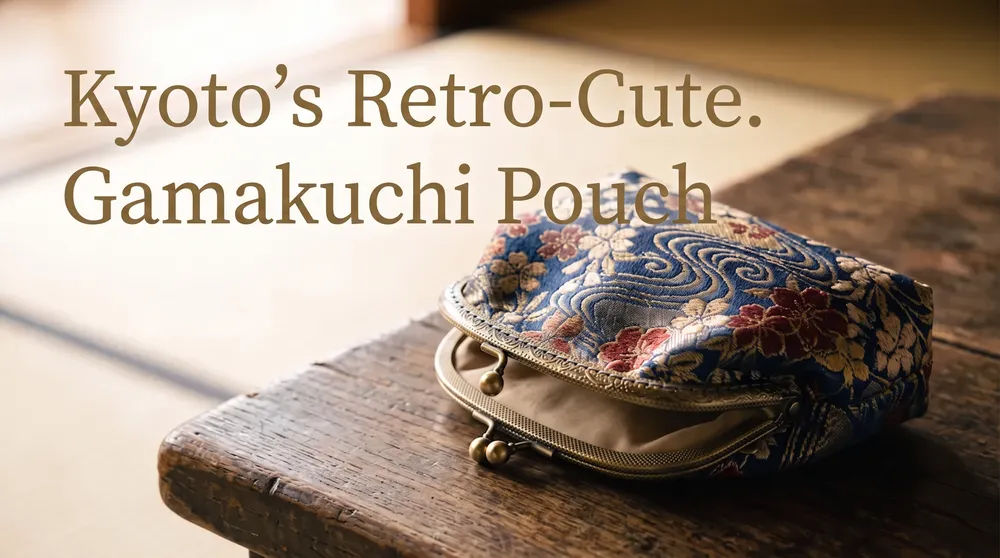
You already know this object. In English it is a kiss lock purse — the little
metal frame with two beads on top that snap together, the thing your grandmother kept coins in.
It is also not Japanese in origin. The frame purse developed in Europe between
the sixteenth and eighteenth centuries, and arrived in Japan from France during the Meiji era.
Only the name is Japanese: gama is toad and kuchi is mouth,
because an open frame gapes like one.
Then the West moved to zips, and Kyoto did not. That is the whole reason this
guide exists — the craft of fitting a frame to cloth by hand still has a home, and it is not the
one it started in.
Quick Reference: Frame vs Zip
| Gamaguchi | Zipped purse | |
|---|---|---|
| Opening | Gapes wide and stays open | A slot you hold apart |
| Finding a coin | See everything at once | Rummage |
| Closing | One hand, one snap | Two hands |
| Failure mode | Frame loosens over years | Zip jams or breaks |
| Capacity | Fixed by the frame | Stretches a little |
| The real argument is speed at a till. A frame purse opens fully with one hand and shows you every coin in it, which a zip cannot do. | ||
How a French Purse Became a Toad
The ancestor is a drawstring pouch worn on a chain at the waist, which is how Europeans carried small necessities in the seventeenth century. As metalworking and sewing improved, those cloth bags acquired metal frames and clasps, and the frame purse as we know it took shape somewhere between the sixteenth and eighteenth centuries.
It reached Japan in the Meiji era, imported from France, alongside a great deal of other Western material culture. It is routinely assumed to be a traditional Japanese accessory and it is not.
What Japan supplied was the name. Open the frame and the two halves gape apart
in a wide, shallow curve — which looks like a toad opening its mouth. Hence
gama + kuchi.
It became fashionable in the Taishō era, from 1912, as Western clothing spread
and more women entered paid work. A purse you could open one-handed while standing up
suited a life spent outside the house.
And the name turned out to be lucky
The Japanese word for frog or toad, kaeru, is a homophone for "to return". That produces two set phrases: buji ni kaeru — to come home safely — and okane ga kaeru, money comes back.
So a purse named after a toad is a purse that money returns to, and gamaguchi are given as good-luck gifts on that basis. It is a pun that only works in Japanese, applied to an object that arrived from France — which is a fairly complete summary of how things get naturalised.
Why Japanese — Kyoto Has Both Halves
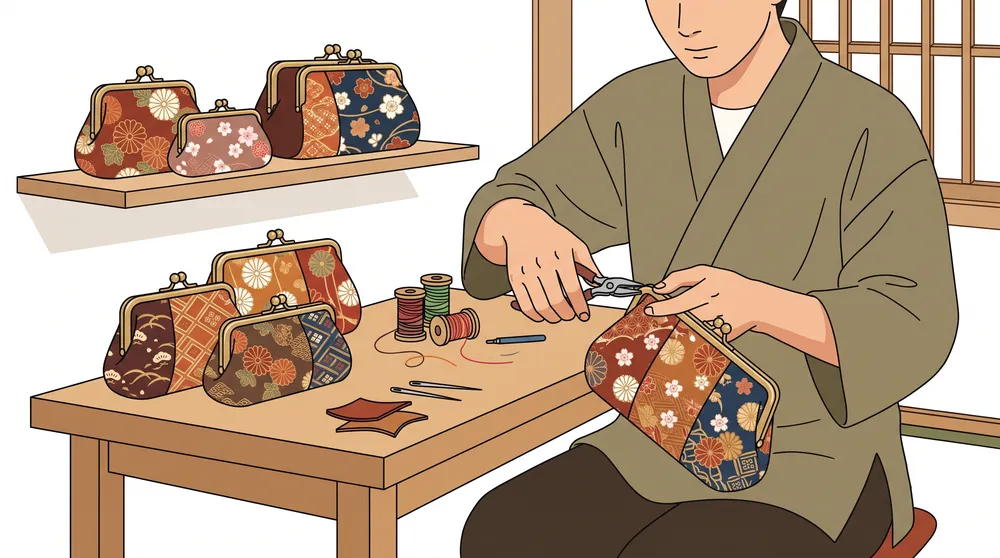
Everything that makes a gamaguchi good or bad happens where the cloth meets the frame. The fabric edge is packed into the channel of the metal frame and held there — traditionally with a cord pressed in behind it — and then the frame is closed onto it.
Done well, the join is invisible and permanent and the clasp snaps decisively.
Done badly — which is most cheap mass-produced ones — the frame is loose, the closure
feels vague, and the fabric works its way out at a corner within months.
You can test this in a shop in two seconds. Open and close it. A good one
resists slightly and then clicks; a bad one just squashes shut.
Kyoto's advantage is that it has both trades
Frame-fitting is a specialist skill, and Kyoto has a concentration of people who do it. That alone would make it a production centre.
But Kyoto is also where the cloth is — Nishijin brocade and chirimen silk crepe are both local industries with centuries behind them. Having the fabric weavers and the frame fitters in the same city is why the good gamaguchi come from there rather than from wherever the frames happen to be stamped.
It is the same logic as Tsubame-Sanjo's metalworking or Okayama's denim: the advantage is not one skill but two adjacent ones within a short drive of each other.
What It Is Actually Good At
These get bought abroad as decorative objects, which undersells them. There is a real functional case, and it is about the shape of the opening.
A frame purse opens into a wide oval and stays there. You are looking down into the entire contents at once, with both hands free. A zipped purse gives you a slot that closes itself the moment you stop holding it apart.
For coins this is decisive. Japan runs on coins, up to the ¥500 piece, and a purse you can see into is measurably faster at a till than one you have to rummage in.
Closing is one movement with one hand — press the frame and it snaps. No zip pull to find, nothing to catch on the lining.
The honest limitation: capacity is fixed by the frame. A zip has a little give;
a metal frame has none, and over-filling one is what eventually strains the join between cloth
and metal.
Buy a size up from what you think you need, and do not use a coin purse as a
general-purpose bag.
Sizes and Fabrics
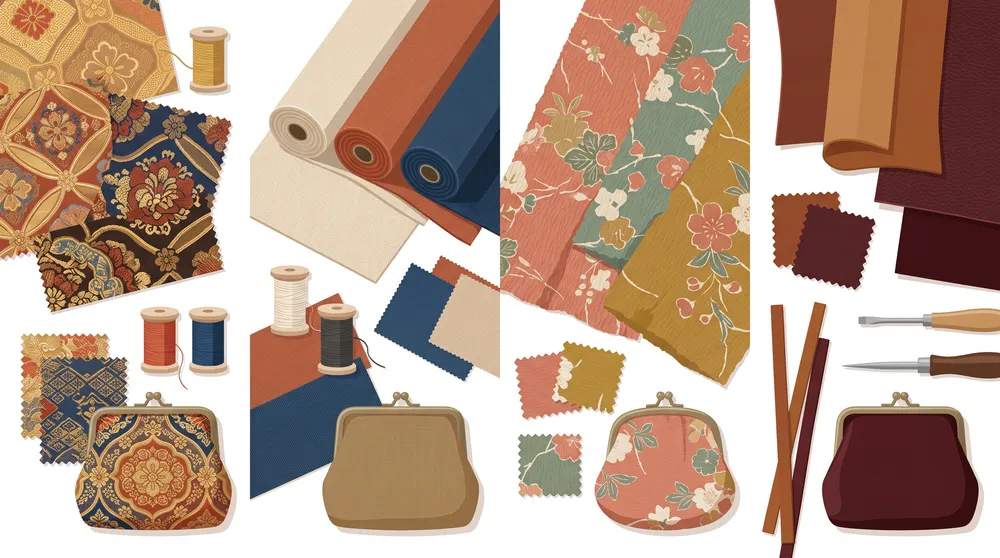
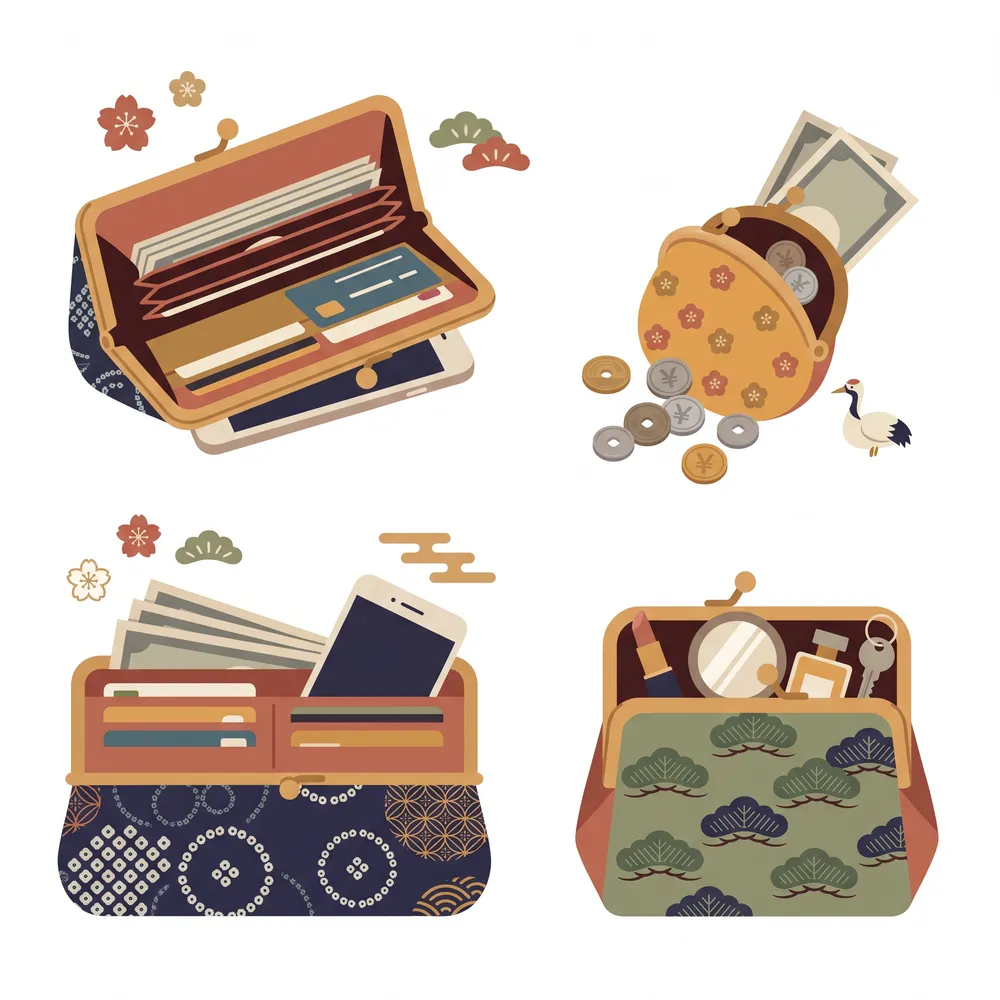
Three sizes cover almost everything:
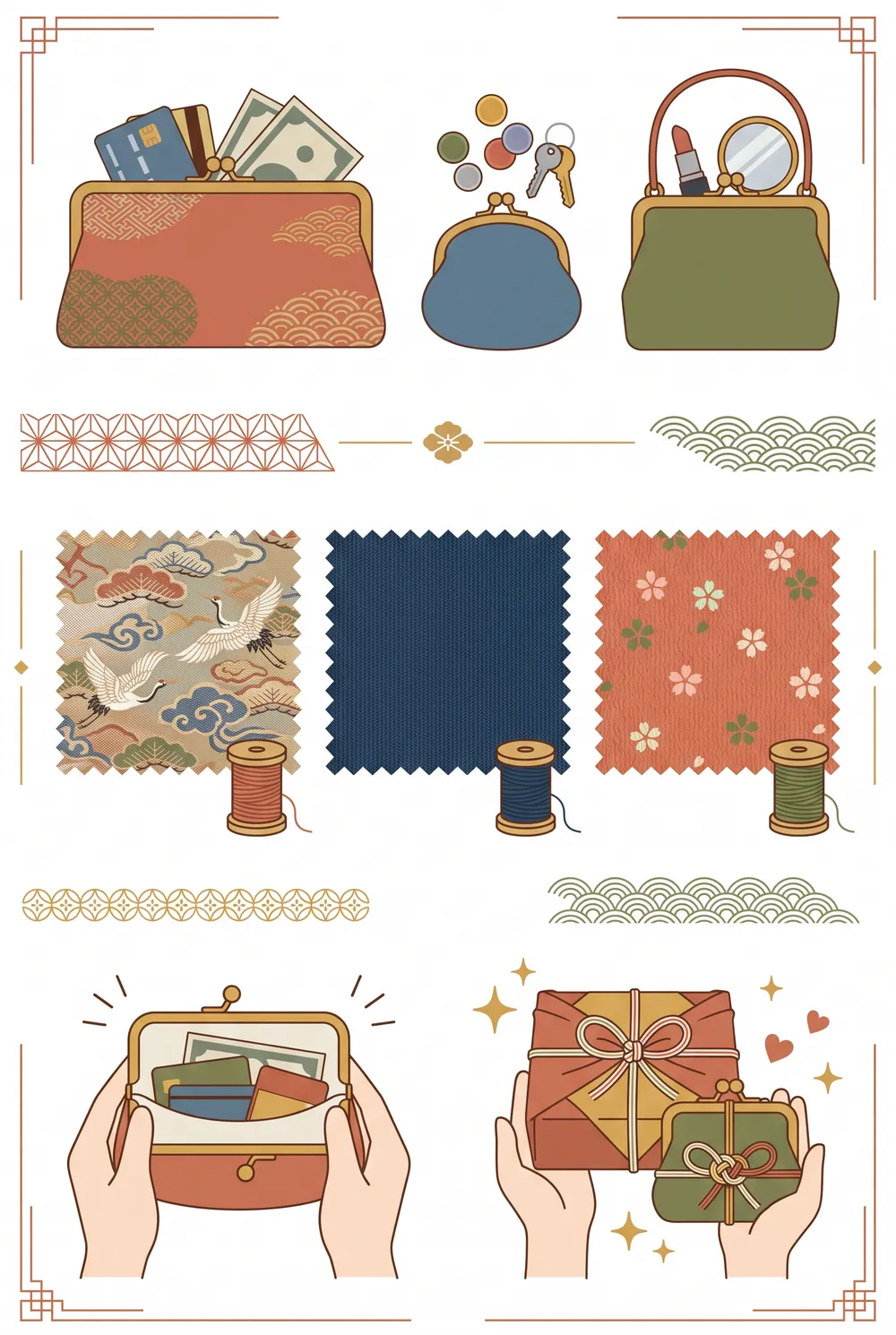
- Coin purse — palm-sized, the classic, and the cheapest way to find out whether you like the format.
- Long wallet — takes notes flat and cards in sleeves, with the frame across the top. The one that replaces your existing wallet.
- Pouch or mini bag — for cosmetics, cables, or as a small handbag. The frame makes it stand open on a table, which no zipped pouch does.
And three fabrics that behave differently:
- Nishijin brocade — woven pattern, formal, structured. The dressy one.
- Chirimen silk crepe — soft, matte, with a fine crinkled surface. The traditional one.
- Cotton canvas — hard-wearing, casual, and by far the most practical for daily use.
Many patterns are taken directly from kimono designs, which is why a gamaguchi
often looks like a piece of something larger. It usually is.
If you want one you will actually use every day, buy canvas. Silk crepe is
beautiful and marks; brocade is stiff and formal. Canvas survives a pocket.
What to Buy
⚠ A shipping problem worth knowing about
Kyoto's best-known gamaguchi specialist runs an English shop with prices in dollars
— and states that postal delivery to the United States, the Middle East and some other
regions is currently suspended. Much of their range was also showing as sold out when we
checked.
Read that precisely. If you are in Europe, the UK or Australia you may well be
able to order directly. If you are in the US you currently cannot, and need one
of the marketplaces below instead.
Kyoto-made, through a marketplace that ships
The Kyoto makers' pieces are carried by international craft marketplaces,
which is the reliable route while direct shipping is restricted. Patterns run from kimono
motifs to folkloric designs.
Start with a coin purse. It costs very little, it tells you whether you get
on with a frame closure, and it is the size the whole category is built around.
- Made
- Kyoto — design, dyeing and sewing in Japan
- Range
- Coin purse to shoulder bag
- Prices
- About $12 to $106
- Check
- That the clasp snaps rather than squashes
How to spot a bad one
- The clasp closes with no resistance. A good frame has a definite point where it takes over and pulls itself shut.
- You can see fabric edge inside the channel. It should be packed in and hidden.
- The two frame halves do not sit flush when closed — a gap at one end means the frame was crimped unevenly.
- The lining is glued rather than sewn. Glue lets go; stitching does not.
Care, and the Loose Frame
- Do not over-fill it. The frame does not stretch, and forcing it shut is what eventually works the fabric loose from the channel.
- Open it by the frame, not the fabric. Pushing the two beads apart is the intended movement; pulling the cloth apart stresses the join directly.
- Silk and chirimen: spot clean only. Water marks silk crepe permanently, and the frame cannot go anywhere near a washing machine regardless of fabric.
- Canvas can take a damp cloth, worked gently and dried away from direct heat.
- If the clasp goes slack, it can usually be adjusted. The frame is metal and a very careful, very small squeeze at the hinge ends with padded pliers often restores the snap.
- ⚠ Once, gently, and stop. Frames are thin and over-bending one cracks it — at which point the purse is finished, because the frame is the purse.
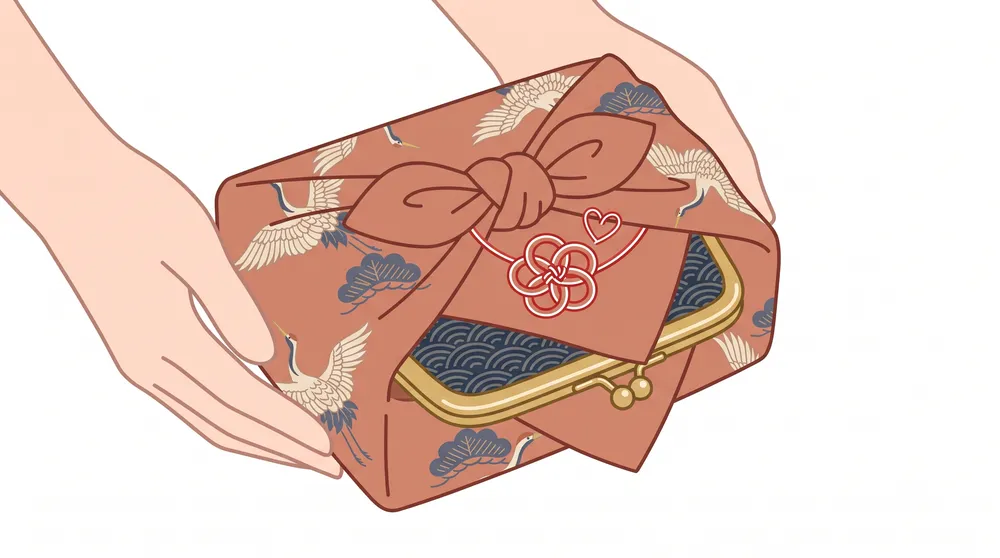
It makes an unusually easy gift. Small, light, unbreakable in the post, no sizing to get wrong, and it carries a piece of wordplay you can explain in one sentence: the toad brings the money back.
Frequently Asked Questions
Why is it called a toad's mouth?
Because that is what an open frame looks like — two halves gaping apart in a
wide shallow curve. Gama is toad, kuchi is mouth.
It also happens to be lucky: kaeru means both "frog" and "to return",
so a toad purse is one that money comes back to.
Is a gamaguchi actually Japanese?
The object is European; the name and the craft tradition are Japanese. Frame
purses developed in Europe and arrived in Japan from France in the Meiji era.
What is genuinely Japanese now is that they are still made properly — by hand,
by specialists, in a city that also weaves the cloth.
Is it practical, or just decorative?
Genuinely practical for coins. It opens into a wide oval and stays open, so you
see the whole contents at once and can close it one-handed with a snap.
The limitation is capacity — a metal frame does not give the way a zip does, so
buy slightly larger than you think.
Why are the good ones from Kyoto?
Because Kyoto has both halves of the job. Fitting fabric into a frame is a
specialist skill concentrated there, and Nishijin brocade and chirimen silk are local industries
as well.
Fabric and frame-fitting in the same city is what produces a consistently good
purse rather than a nice pattern in a bad frame.
The clasp has gone loose. Can I fix it?
Often, with a very small squeeze at the hinge ends using padded pliers. The
frame is soft metal and a fraction of a millimetre restores the snap.
Do it once, gently, and stop. Over-bending cracks the frame, and a cracked frame
cannot be repaired — it is the structural part of the purse.
Can I wash it?
No — the frame rules that out whatever the fabric is. Metal in a washing machine
damages both the machine and the purse, and soaking loosens the join.
Spot clean silk; a damp cloth is fine on canvas. Dry away from direct heat.
Final Thoughts: Kept by the Country That Borrowed It
Europe invented the frame purse, exported it, and then replaced it with a zip. Japan took delivery in the Meiji era, named it after a toad, noticed the pun about money coming back, and kept the craft going for a century and a half.
Buy a canvas coin purse first, and test the snap before anything else. A good frame resists and then pulls itself shut; a bad one just closes.
It is a small object with an unusually complete answer to "why Japanese". Because everyone else stopped.

Inden Wallet Guide: Japanese Deer Leather & Lacquer Craft
Japanese Wallets: The 7 Best Leather Brands, Compared