English has one phrase — "boar bristle" — for two materials that are not the same
animal, not the same thickness, and not suited to the same hair.
Japanese brush makers separate them. Buta-ke is pig bristle: finer, shorter,
softer. Inoshishi-ke is wild boar: thicker, longer, considerably stiffer — and
almost everything sold in the West as "boar bristle", Mason Pearson included, is the first
one.
That difference explains why a brush that transformed a friend's hair does nothing for yours. This
guide covers which bristle your hair actually wants, how Japanese brushes differ from the
English benchmark, and the care instruction most English articles get backwards.
Quick Reference: Which Bristle for Your Hair
| Bristle | Physically | Suits |
|---|---|---|
| Pig buta-ke 豚毛 |
~0.15–0.16mm, 2–5cm, solid, softer | Fine, thin or damaged hair. Sensitive scalps |
| Wild boar inoshishi-ke 猪毛 |
~0.20mm, up to 10cm, semi-hollow, much stiffer | Thick, coarse or abundant hair |
| Boar + nylon | Natural bristle with synthetic pins added for reach | The Western answer to thick hair. Different approach |
| Never wash a natural-bristle brush with water. This is the opposite of what most English guides say, and it is why brushes die early — see the care section. | ||
"Boar Bristle" Describes Two Different Animals
In the brush trade these are separate raw materials with measurably different properties.
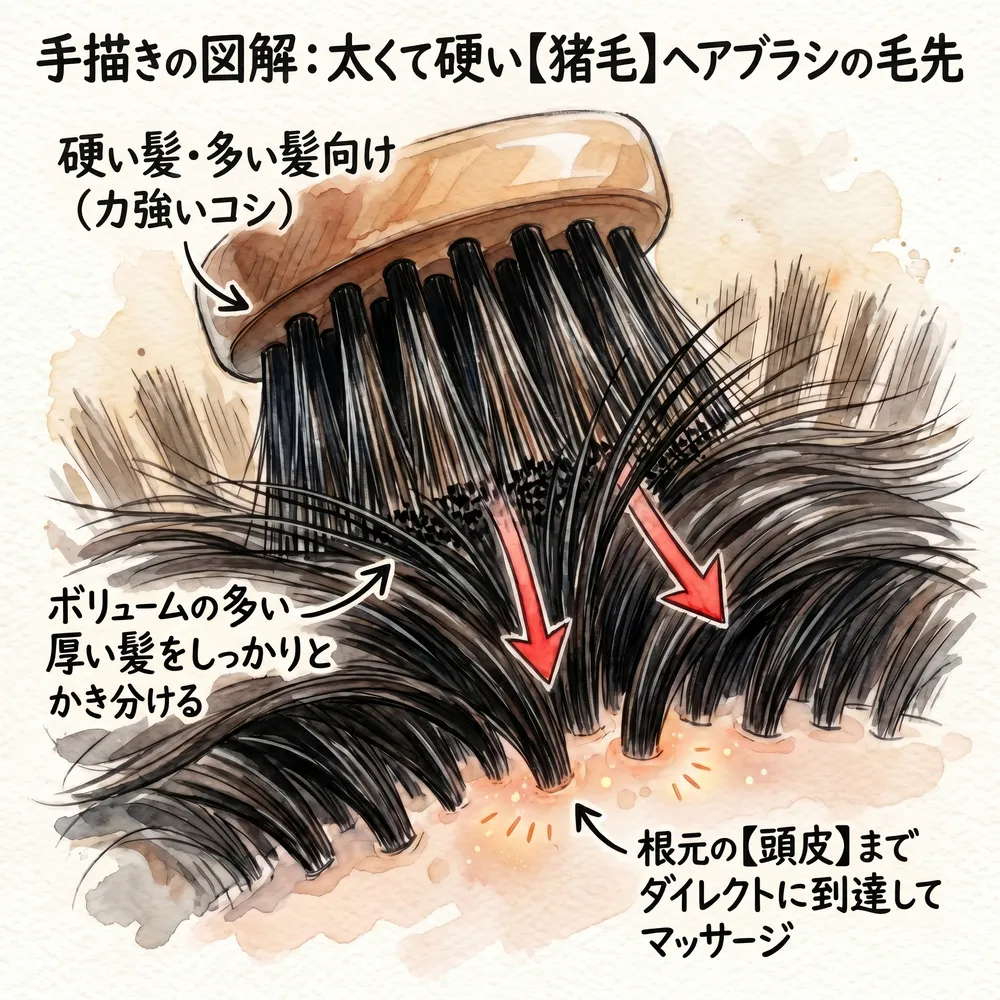
Wild boar bristle is roughly 0.20mm in diameter and can run to 10cm long; it
grows from a single follicle, is semi-hollow, and is notably harder and more elastic.
Pig bristle measures around 0.15–0.16mm and 2–5cm, grows from compound
follicles, and is solid rather than hollow — which makes it softer and considerably cheaper.
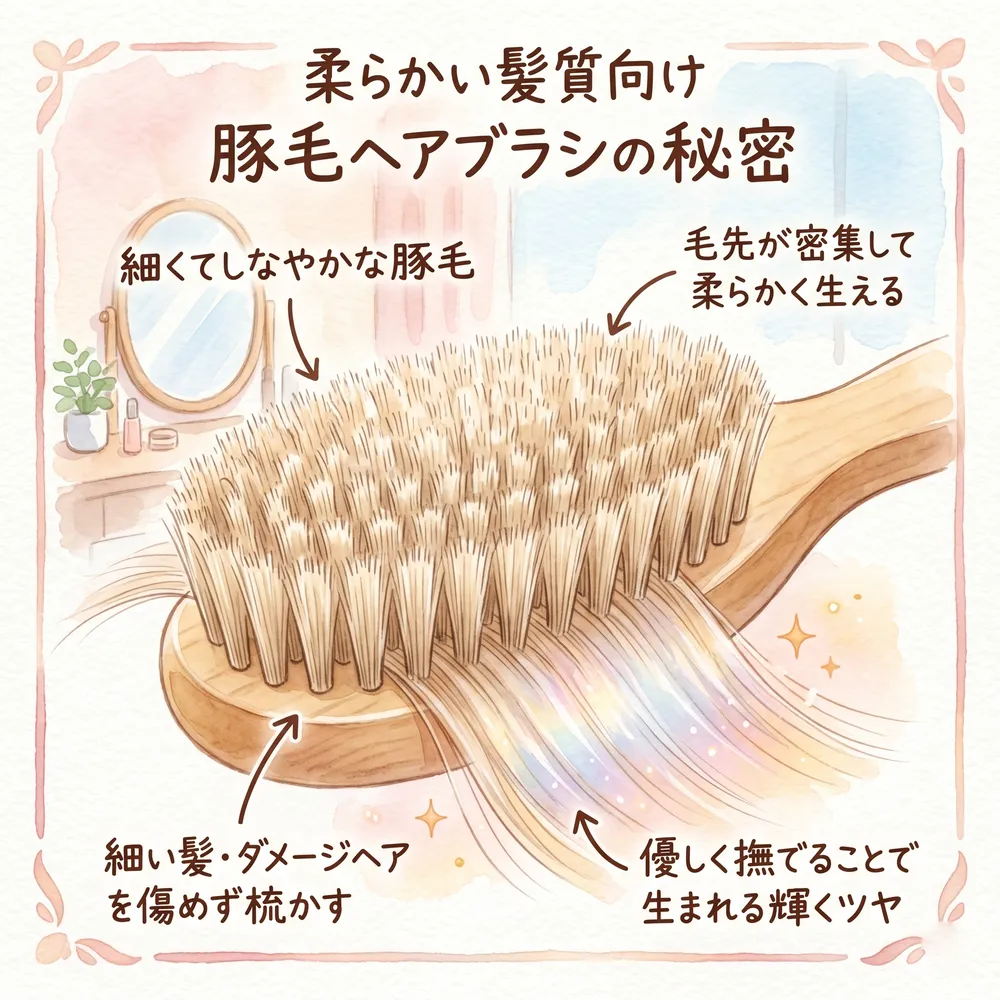
English collapses both into "boar bristle". In practice, brushes sold under that name in Western markets are made from pig bristle — true wild boar is scarcer and more expensive, and where extra stiffness is wanted the usual Western solution is to add nylon pins rather than to switch animal.
Why the distinction matters to you
A brush only works if the bristles reach the scalp and then survive the trip
back. Too soft for your hair and they buckle at the surface, doing nothing. Too stiff
for your hair and they scratch.
If you have thick hair and a soft natural brush has disappointed you, the
material was probably wrong rather than the idea. That is the case Japanese makers address with
genuine wild boar.
What the brush is actually doing
The mechanism is worth stating because it explains the care rules later.
- It moves sebum. Your scalp produces oil; the bristles carry it from root to tip, which is what produces shine. Plastic bristles slide over the surface and do not pick it up.
- It does not generate static. Natural protein bristles work on hair which is also protein. Plastic against hair builds a charge, which is the frizz.
- It smooths the cuticle. Repeated passes lay the scales down flat, and flat scales reflect light evenly — which is all "shine" means.
- It works the scalp. A stiff enough bristle reaching skin is a mild massage, which is a large part of why brushing feels good.
Why Japanese Brushes — Hand-Planted in Asakusa
Japan's brush industry sits largely in Asakusa, in the old craft district of Tokyo, and the workshops there have been at it for a long time — Kanaya Brush was founded in 1914 and began, as several of them did, making industrial and paint brushes before moving into hair.
Hand-planted versus machine-planted
Bristles are set into the base in bundles, and this can be done by machine or by hand. Hand-planting lets the maker vary bundle density and depth across the base — firmer where the brush needs to bite, softer at the edges — and set each bundle deep enough that it does not pull out.
The visible symptom of a cheap brush is shedding. Bundles work loose, the brush thins unevenly, and within two years it is a different tool from the one you bought. A hand-planted brush that is looked after is a decades-long object, which is the entire economic argument for paying more.
Shapes, briefly
Half-round (the classic paddle-ish shape) is the everyday brush and what you
should buy first.
Round brushes are for blow-drying and shaping, not daily brushing.
Narrow rectangular brushes suit short hair and men's styling.
Skip cushion-less wooden-base brushes if you have a sensitive scalp — the
rubber cushion is what lets bristles give way when they meet bone.
How They Compare With Mason Pearson
If you have researched natural-bristle brushes in English, you have met Mason Pearson — hand-made in England, around $200–$300, and the default benchmark. Ignoring it would make this article useless, so here it is straight.
| Mason Pearson | Japanese makers | |
|---|---|---|
| Made | England, hand-assembled | Japan, hand-planted |
| Answer to thick hair | Add nylon pins to the natural bristle | Use a stiffer natural bristle (wild boar) |
| Availability | Everywhere, including department stores | Specialist importers. Harder work |
| Price | $200–$300 | $60–$200 depending on maker and size |
Mason Pearson is not overpriced and Japanese brushes are not a cheap substitute. They are two solutions to the same problem. If you want an all-natural brush that still reaches through thick hair — rather than one that reaches through it with nylon — the Japanese wild boar option is the one that exists.
If your hair is fine and you can walk into a shop and buy a Mason Pearson today, that is a perfectly good answer and you should probably take it.
What to Buy
Availability is the honest weak point here. These brushes are not on Amazon the way Japanese knives and whetstones are — you are buying through specialist importers.
Kanaya Brush (かなや刷子) — the one that exports
Founded in Asakusa in 1914, and the Japanese brush maker with the most
reliable international presence. The range covers soft, medium and firm —
which in practice means pig bristle at the soft end and wild boar at the firm end, so
the choice you make here is the material choice from the first section.
Handles are typically turned hardwood; the classic models have been in the catalogue for
decades.
- Founded
- 1914, Asakusa, Tokyo
- Grades
- Soft (fine hair) / medium / firm (thick hair)
- Construction
- Hand-planted bristles, wooden handle
- Availability
- Japanese-goods specialists with international shipping. Not on Amazon.com
- Price range
- $70–$180
Perfect for: Anyone who wants an all-natural brush matched to their hair thickness rather than a one-size compromise.
Japanese natural-bristle brushes more generally
Several other Japanese makers — Ikemoto Brush, Asakusa Art Brush, Sanbi, VeSS
— produce excellent natural-bristle brushes at a range of prices, and some reach export
markets sporadically.
When shopping, the specification to look for is the bristle: whether it says
pig or boar, and whether the base is hand-planted. A listing that says only "natural bristle"
has told you nothing.
- Look for
- Bristle type stated (pig / boar), hand-planted base, rubber cushion
- Avoid
- "Natural bristle" with no further detail
- Shape
- Half-round for daily use. Round brushes are styling tools
- Price range
- $40–$150
Perfect for: A first natural brush at lower cost, or a second brush for travel.
Deliberately no shopping link here. A general search for "Japanese boar bristle brush" returns mostly the mass-produced brushes this article is warning you about — sending you there would contradict everything above. Use the specialist importers linked in the previous section, and check that the bristle type is stated before buying anything.
Buy the bristle cleaner at the same time
A brush cleaner — a small comb-like tool for raking lint and hair out from between the bundles — costs a few dollars and is the only correct way to clean these brushes. The next section explains why the obvious method is wrong.
Never Wash It With Water
Plenty of English brush-care advice says to wash your brush in soapy water. For a natural-bristle brush on a cushioned base, that advice will destroy it, and this is the single most valuable paragraph on this page.
- Natural bristle is protein. Soaking swells it, softens it, and strips the oils that give it spring. It never fully recovers.
- The cushion has an air hole. Water goes in through it and does not come out. What grows in there afterwards is exactly what you think.
- Wooden handles crack as trapped moisture leaves unevenly.
What to do instead
- Rake it out with a brush cleaner. Push the tool down between the bundles and lift — hair, lint and dust come out together. Once a week takes thirty seconds.
- Wipe the bristle tips with a cloth dampened with alcohol if there is oil build-up, then let it evaporate. Fast, and it does not soak in.
- Store it bristles-down or on its side, never bristles-up collecting dust.
- If it does get wet, shake it hard, blot it, and dry it bristles-down at room temperature. Never a hairdryer and never a radiator.
And do not brush wet hair with it
Wet hair stretches and snaps, and the brush gets soaked in the process — so this
one habit damages both. Use a wide-tooth comb or a purpose-made wet brush on wet hair, and save
the natural-bristle brush for dry.
Start at the ends and work upward. Starting at the roots drags every tangle in your hair into one
knot at the bottom.
Frequently Asked Questions
What is the difference between pig bristle and boar bristle?
They are different materials that English usually calls by one name. Wild boar
bristle is around 0.20mm thick and up to 10cm long, single-follicle and semi-hollow — harder and
more elastic. Pig bristle is roughly 0.15–0.16mm and 2–5cm, compound-follicle and solid, so it is
softer and cheaper.
Most brushes sold in the West as "boar bristle" are the softer material.
Which should I buy for my hair?
Softer pig bristle for fine, thin or damaged hair and sensitive scalps. Stiffer wild boar
for thick, coarse or abundant hair.
If you have thick hair and a natural brush has previously felt like it did nothing, the bristle
was almost certainly too soft to reach your scalp.
Can I wash it with water and soap?
No — this is the main way these brushes die. Water swells and softens the
bristle, strips its natural oils, and gets into the cushion through the air hole where it cannot
dry.
Rake it out with a brush cleaner instead, and wipe the tips with a little alcohol on a cloth if
they are oily.
Is my hair supposed to get greasy at first?
Often, yes, and it settles. The brush is doing exactly what it is meant to —
moving sebum from your scalp down the hair shaft. If your roots were oily and your ends dry, the
oil is now distributed and the roots look better while the lengths look worse.
Give it a couple of weeks. If it persists, you are brushing too much or too close to the scalp.
How is this different from a Mason Pearson?
Mostly in how each solves thick hair. Mason Pearson adds nylon pins to natural
bristle; Japanese makers use a stiffer natural bristle instead.
Mason Pearson is far easier to buy and costs more. Japanese brushes need an importer.
Neither is a substitute for the other — they are different designs.
How long should one last?
Decades, if it is hand-planted and you never wash it in water. The failure mode
on cheap brushes is bundles working loose and shedding, which hand-planting largely prevents.
Replace it when bristles are visibly thinning or splayed permanently — not on a schedule.
Final Thoughts: Match the Bristle, Then Leave It Dry
Most disappointment with natural-bristle brushes comes from one word doing the work of two. Soft bristle on thick hair never reaches the scalp, and no amount of brushing technique fixes a material mismatch.
Fine hair: soft, pig bristle. Thick hair: firm, wild boar. Hand-planted if you intend to keep it, and with a rubber cushion if your scalp objects to things.
Then the rule that outlives every specification: rake it, never wash it. A brush kept dry lasts decades. A brush washed in soapy water lasts until the cushion starts to smell.
Japanese Skincare: Sunscreen, Sake Lees, Rice Bran
Satsuma Boxwood Combs: Why They Cost What They Do