The beautiful hand-carved bamboo mimikaki you have seen in Japanese shops is a superb tool —
and it is probably the wrong one for your ears.
Earwax comes in two types, dry and wet, and which one you have is decided by a single gene.
Around 80–95% of people of East Asian descent have dry earwax. Among people of European or
African descent, it is 0–3%. The bamboo scoop was designed for dry, flaky wax. On wet wax
it tends to push rather than lift.
So if you are reading this in English, the odds are you want a titanium spiral, not
a bamboo spoon. This guide explains the difference, covers what is actually buyable outside Japan,
and deals honestly with the advice you have heard your whole life: don't put anything in your ear.
Quick Reference: Match the Tool to Your Earwax
| Your earwax | Who has it | Right tool | Wrong tool |
|---|---|---|---|
| Wet sticky, amber |
97–100% of people of European or African descent | Titanium spiral — the groove grips and lifts sticky wax | Bamboo scoop. It slides past and pushes wax deeper |
| Dry flaky, pale |
80–95% of people of East Asian descent | Bamboo scoop or titanium cup — lifts flakes off the wall | Spiral. There is nothing sticky for it to grip |
| Not sure | South Asian, Pacific, Central Asian, Indigenous American ancestry sits at 30–50% dry | A two-way titanium tool — spiral on one end, cup on the other | Committing to one shape before you know |
| Whichever you have: only the outer 1 cm. Wax is produced in the outer third of the canal and migrates outward on its own. Anything deeper than a centimetre is not cleaning — it is packing. | |||
"Nothing Smaller Than Your Elbow" — Let's Deal With That First
If you grew up in an English-speaking country, you were told never to put anything in your ear. That advice exists for a good reason, and we are not going to pretend otherwise.
The reason is the cotton swab. A swab is wider than the ear canal is deep in usable terms, and its soft tip compresses wax against the eardrum rather than removing it. Impacted earwax — a genuine medical problem causing hearing loss and pain — is frequently caused by the thing people use to prevent it.
An ear pick is a different instrument with a different failure mode. It is thin, it is rigid, and it removes material rather than compressing it. That makes it better at cleaning and worse at forgiving mistakes. A swab used badly packs wax. A pick used badly scratches the canal or, at the extreme, perforates the eardrum.
So here is the honest position. Your ears clean themselves — the canal migrates wax outward continuously, and most people never need to do anything. If you clean your ears anyway, which most people do, then the tool that removes wax is safer than the tool that packs it, provided you stay in the outer centimetre.
Do not use any of this if you have ear pain, discharge, sudden hearing loss, a perforated eardrum, grommets, or a history of ear surgery. That is a doctor's territory, and irrigation or microsuction is what you need.
Why Japanese Ear Picks?
Ear cleaning in Japan is not purely hygiene — it is a domestic ritual. Children
have their ears cleaned lying in a parent's lap, and the phrase hiza-makura (knee
pillow) describes it. Adults book it at salons. There are shops that do nothing else.
A culture that treats a small task as something to enjoy tends to make good tools for it. That
is the whole explanation for why Japan produces ear picks at a level nowhere else bothers with.

The metal picks come from Tsubame-Sanjo in Niigata — the same region behind Japanese cutlery and kitchen knives. Titanium is unpleasant to machine: hard, prone to galling, and it fights polishing. Getting it to a finish with no burr anywhere on an edge that will touch a mucous membrane is genuinely difficult, and that difficulty is what you are paying for.
The bamboo picks come from Shiga and Kyoto, carved individually with a small knife. The scoop is taken down below a millimetre while keeping enough spring in the shaft that it flexes instead of gouging. A machine cannot judge where that limit is on a given piece of bamboo.
Did you know: the fluffy end is not decoration
Many Japanese ear picks have a puff of feather or fur on the opposite end, called a
bonten. It is there to sweep out the loosened flakes the scoop has
lifted but not carried, and — more to the point — because the sensation is pleasant enough that
it turns the end of the job into the best part of it.
It is also the part people forget to clean. Wash it occasionally and let it dry fully.
Wet and Dry: The Gene That Decides Your Tool
Earwax type is controlled by a single change in a gene called ABCC11. There are two versions, and which you inherit determines whether your earwax is sticky and amber or dry and flaky. It is not diet, climate, or hygiene. It is one letter of DNA.
The distribution is dramatic:
- East Asian ancestry — 80–95% dry
- European or African ancestry — 0–3% dry, meaning almost everyone has wet
- South Asian, Pacific Islander, Central Asian, Indigenous American — 30–50% dry
This is why the advice in most English articles about Japanese ear picks is quietly wrong. They translate Japanese recommendations, and Japanese recommendations are written for the 80% of Japanese people with dry earwax.
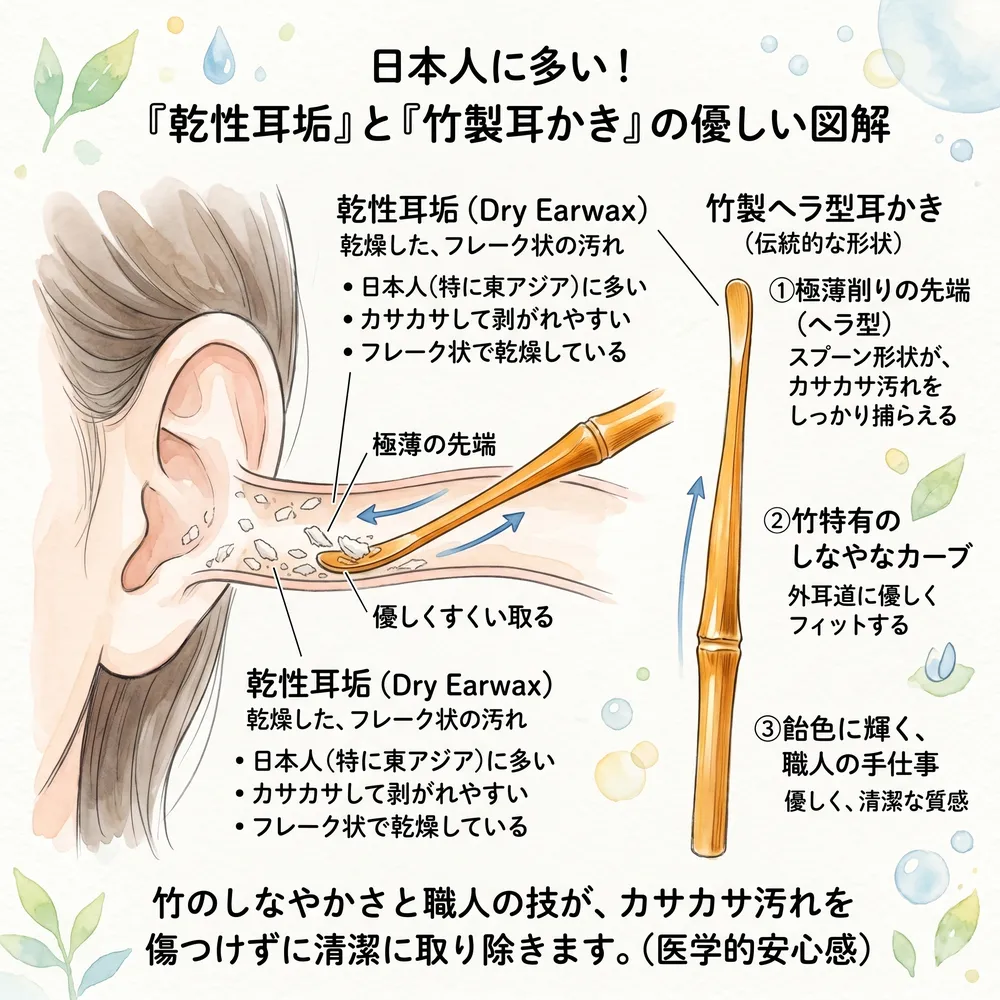
Dry earwax → scoop
Dry wax sits against the canal wall as pale flakes. A thin scoop — bamboo or a shallow titanium cup — slides underneath and lifts them away in one piece. This is what the classic bamboo mimikaki was designed to do, and at it, nothing is better.
Wet earwax → spiral
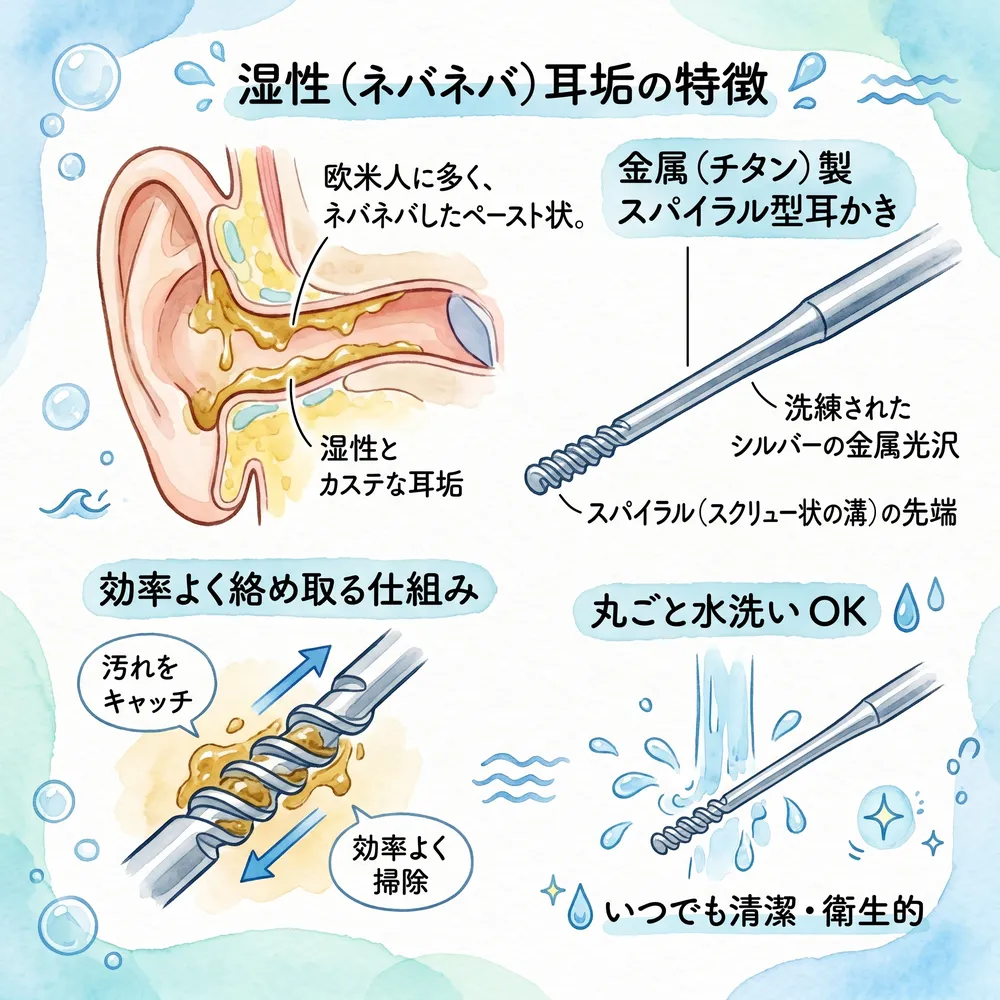
Wet wax is viscous. A flat scoop does not lift it — it slides underneath and shoves it
further in, which is exactly the outcome you are trying to avoid.
A spiral or screw tip works instead because the groove winds the wax onto itself and
pulls it out, the way a corkscrew works. It also grips on all sides, so you are not hunting for
the right angle.
Did you know: the same gene decides body odour
ABCC11 does not only control earwax. The same variant governs how much of the compound that
underarm bacteria turn into body odour your glands secrete — dry earwax comes with
markedly less body odour.
This is why the deodorant aisle in a Japanese supermarket is a fraction of the size of an American
one. It is not a cultural difference in washing. Most of the population simply produces less of
the raw material.
Japanese Ear Picks Worth Owning
Ordered by what most readers of this article will actually want. Availability outside Japan is noted honestly — several of the finest Japanese ear picks simply are not exported.
Green Bell Takumi no Waza Titanium Ear Pick — start here if your wax is wet
Green Bell's Takumi no Waza (craftsman's skill) line is the Japanese grooming range that actually reaches international shelves. The titanium picks are polished to a burr-free finish, will not corrode, and can be washed or sterilised without any consequence — which matters far more with sticky wax than dry.
- Material
- Titanium
- Shape
- Available as cup and as two-way spiral/cup
- Made in
- Japan
- Best for
- Wet earwax; anyone who wants to sterilise the tool
- Price range
- $10–$25
Perfect for: Almost every English-speaking reader. Get the two-way version if you are unsure of your type.
Green Bell Bamboo Mimikaki (3-pack) — the classic, if your wax is dry
Hand-carved smoked bamboo, the shape every Japanese household has in a drawer. The scoop is shaved thin enough to flex, so it follows the canal instead of scraping it. The flex is the whole point — bamboo gives way before your skin does.
- Material
- Smoked bamboo (susudake)
- Shape
- Scoop, with bonten puff
- Made in
- Japan
- Best for
- Dry earwax only
- Price range
- $10–$18 for three
Perfect for: Readers of East Asian descent, and anyone who has confirmed their wax is dry and flaky.
Bamboo cannot be sterilised the way titanium can. Keep it to one person, and replace it every year or two.
Not exported: the ones Japanese buyers rate highest
Three makers come up constantly in Japan and have no route to buy them abroad. Worth knowing about if you are visiting, or asking someone to bring one back.
- Takei
- A 200-year-old bamboo specialist in Shiga. Hand-carved ultra-fine picks, sold in paulownia boxes with name engraving. The gift standard
- Maruto Hasegawa EP-901
- Pure titanium, cup type, from the Tsubame-Sanjo maker better known for precision nippers
- Sanyu Medical
- A medical device manufacturer's take: brass handle for weight, with a flexible polyacetal screw tip instead of metal
Perfect for: Nobody outside Japan, unfortunately — which is exactly why they are worth mentioning.
No purchase link because there is no honest one. These are domestic-market items.
How to Use One Without Hurting Yourself
Once or twice a month, not daily
The temptation with a good pick is to use it constantly, because it feels good. Resist it. Earwax is doing a job — it is mildly acidic and antibacterial, it traps dust and insects, and it keeps the canal skin from drying out. Strip it daily and you get itching, which makes you clean more, which makes it worse.
The outer 1 cm. That is the whole rule
Wax is only produced in the outer third of the canal. Deeper in, there is nothing to remove — so anything you feel past a centimetre is wax you pushed there. Work the entrance and the wall you can see, and stop.
Never push against resistance
If something will not come out, leave it. Forcing a rigid tool against impacted wax is how eardrums get perforated. Softening drops over a few days, or a clinic, will deal with it in a way you cannot.
Wash titanium, dry bamboo
Titanium can go under hot water or alcohol without any consequence — do it, especially with wet wax. Bamboo cannot. Wipe it, let it dry fully, and do not share it. Bamboo is porous, so a shared bamboo pick moves more than wax between people.
Frequently Asked Questions
Are ear picks safe to use?
Safer than cotton swabs if you stay in the outer centimetre, and unsafe if you don't. A swab compresses wax inward; a pick removes it. But a pick is rigid, so mistakes cost more. Never push against resistance, and see a doctor rather than digging if you have pain, discharge or hearing loss.
What is the difference between wet and dry earwax?
A single gene, ABCC11, and it changes which tool works. Dry wax is pale and flaky and lifts off with a scoop. Wet wax is sticky and amber and needs a spiral to wind it out — a scoop just pushes it deeper. Around 80–95% of East Asians have dry; only 0–3% of people of European or African descent do.
Should I get bamboo or metal?
Wet earwax: titanium, spiral tip. Dry earwax: either. Beyond wax type, titanium can be sterilised and lasts forever, while bamboo is more forgiving because it flexes before it hurts. If you have wet wax, the beautiful bamboo one is the wrong purchase no matter how good it looks.
How often should I clean my ears?
Once or twice a month is plenty; medically, never is also fine. The canal migrates wax outward on its own. Frequent cleaning strips the protective layer and causes itching, which drives more cleaning — the loop that produces most of the problems people blame on wax.
Can I use one on my child?
Only the visible outer ear, and only with something that flexes. Children's canals are shorter, so the eardrum is closer than you think, and they move without warning. If you can see wax at the entrance, wipe it. If you cannot see it, leave it — a paediatrician can look properly with a light.
Where can I buy a genuine Japanese ear pick?
Green Bell is the brand that actually exports. Their titanium and bamboo picks are on Amazon in the US and elsewhere. The most admired Japanese makers — Takei's hand-carved bamboo, Maruto Hasegawa's titanium — are domestic-market only, so a visit or a favour from someone travelling is the only route.
Final Thoughts: Buy for Your Ears, Not for the Photograph
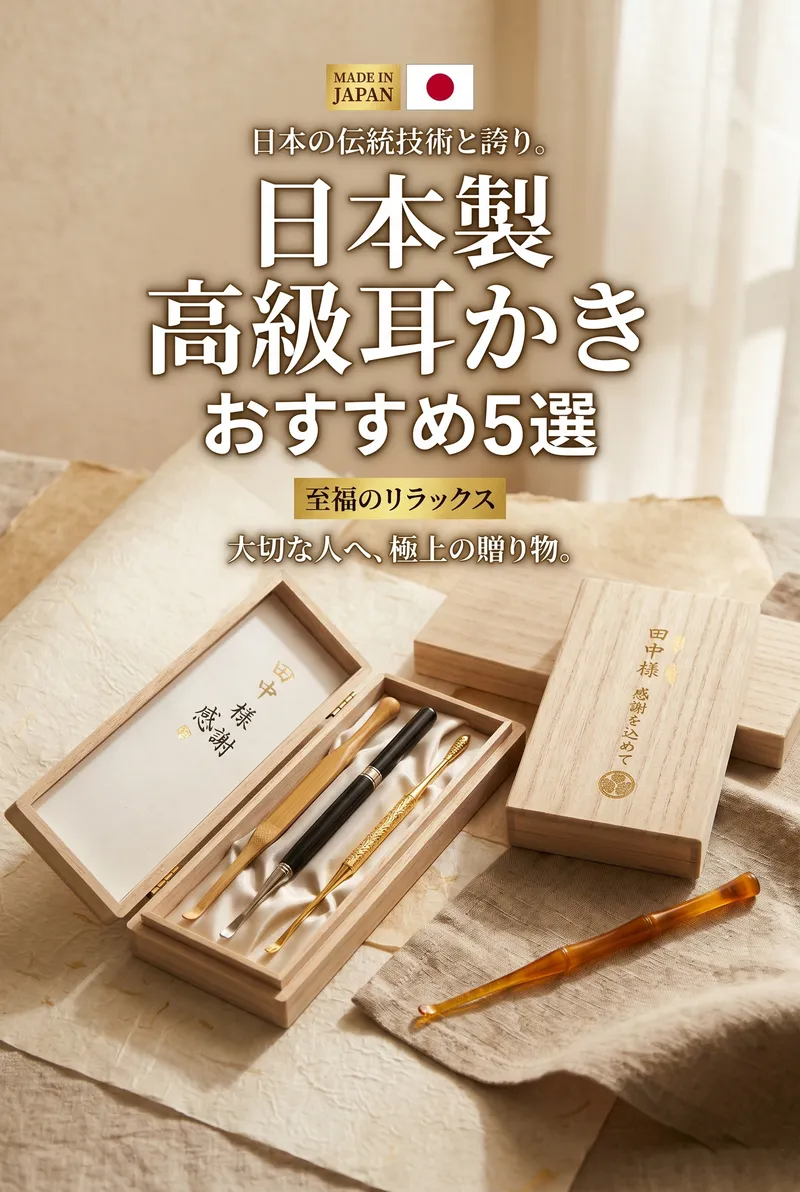
The hand-carved bamboo pick is the more beautiful object. It is also, for most people reading
this, the less useful one — and buying the beautiful wrong tool is how a good habit becomes a
frustrating one.
Check which kind of wax you have. Buy the shape that matches. Stay in the first centimetre and
do it twice a month, not twice a day.
Then the thing Japan actually figured out becomes available to you: that a small piece of daily
maintenance, done with a tool made properly, stops being a chore and turns into two minutes you
look forward to.

Japanese High-End Tweezers: Pain-Free Precision

Feather Safety Razors: The AS-D2 and What to Buy