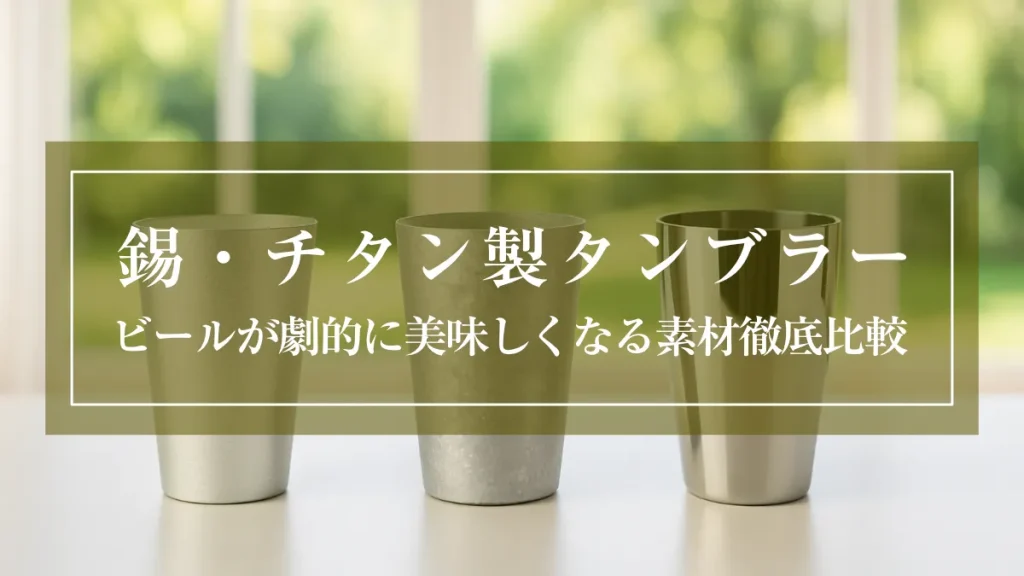
Cold beer tastes better when the vessel is as cold as the beer. Warm sake tastes better when it stays warm.
Japanese metal tumblers — crafted from tin and titanium — are engineered to deliver exactly that, with additional
properties that glass and ceramic can't offer: tin's ionic softening effect on alcohol, and
titanium's vacuum insulation that eliminates condensation entirely.
This guide compares both materials and ranks the six best Japanese brands — from centuries-old tin foundries to
precision titanium studios in Tsubame-Sanjo.
Quick Comparison: Tin vs Titanium Tumblers
| Factor | Tin (錫 / suzu) | Titanium (チタン) |
|---|---|---|
| Effect on taste | ◎ Ionic softening — reduces harshness, rounds the flavor | ○ Neutral — no taste transfer whatsoever |
| Cold retention | ○ Good (high thermal conductivity) | ◎ Exceptional (vacuum double-wall) |
| Weight | Moderate | Very light |
| Durability | Soft metal — handle carefully | ◎ Extremely durable |
| Allergy | Very low risk | ◎ Allergy-free (medical grade metal) |
| Price range | $60–$180 | $80–$250 |
| Top brands | NOUSAKU, Osaka Suzuki, Suzukou | HORIE, SUSgallery, Snow Peak |
Tin vs Titanium: The Full Breakdown
Why Tin Changes the Taste of Sake and Beer
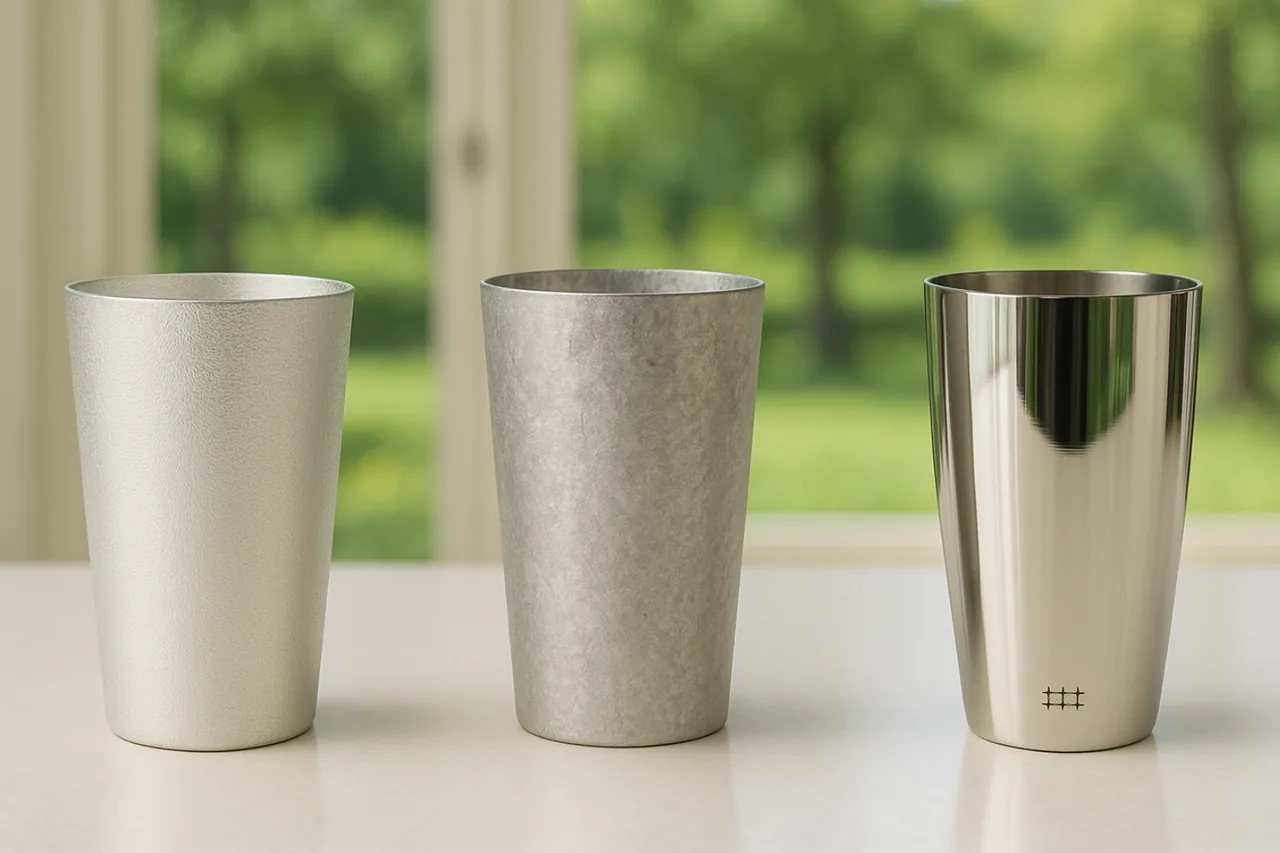
Tin has been used for sake vessels in Japan for centuries — and not just for aesthetics. Tin ions released into the
liquid interact with sulfur compounds that produce off-flavors and harshness. The result is a noticeable rounding of
the drink: bitterness softens, the finish becomes cleaner, and the overall character feels more polished.
Additionally, tin has exceptionally high thermal conductivity. Pour cold sake in, and the entire vessel becomes cold
within seconds — the chill is immediate and uniform, which intensifies the sensation of drinking cold sake in a way
that glass or ceramic can't match.
The tradeoff: tin is a soft metal. It can be dented if dropped or crushed. It requires hand-washing and no boiling
water (deforms above ~80°C).
Why Titanium Tumblers Eliminate Condensation
Titanium double-wall tumblers work on the same principle as vacuum flasks: the space between the inner and outer
walls is evacuated of air, creating thermal isolation. Cold drinks stay cold because the inner wall's temperature
never reaches the outer wall — so no condensation forms on the outside, and your table stays dry.
Titanium itself is an exceptional base material for this: lightweight (the same weight as aluminum),
corrosion-proof, and hypoallergenic. It's the metal used in surgical implants and aerospace components — and it
transfers none of its character to food or drink.
The tradeoff: vacuum double-wall tumblers insulate so well that the outside of the cup never gets cold — you lose
the tactile sensation of holding a cold vessel, which some people (especially sake drinkers) value as part of the
experience.
Best Tin Tumblers: 3 Japanese Brands
#1 NOUSAKU — Takaoka, Toyama
NOUSAKU was founded in 1916 in Takaoka, Toyama — a city with over 400 years of casting history. They are Japan's
most internationally recognized tin brand, exporting to over 30 countries and stocked at design stores
worldwide.
Their tin drinkware is 100% pure tin (not an alloy), cast using traditional sand-mold techniques and
hand-finished. The result is a vessel with a characteristic warm, silvery-white finish and satisfying weight.
NOUSAKU's beer cups (ビアカップ) are the most popular entry point: pour a cold lager and the cup becomes cold in
seconds, while the tin's ionic effect smooths out any bitterness. Their pair sake sets are the best-selling gift
item in the Japanese drinkware category.
- Material
- 100% pure tin (錫)
- Made in
- Takaoka, Toyama Prefecture
- Best for
- Beer, cold sake, gifting (wedding/retirement pair sets)
- Care
- Hand-wash only; no boiling water; no dishwasher
- Price range
- $60–$180 per piece; pair sets $120–$350
#2 Osaka Suzuki (大阪錫器) — Traditional Beer Tumbler
Osaka Suzuki is certified by Japan's Ministry of Economy as a Traditional Craft producer — one of the strictest
quality designations in Japanese manufacturing. Their tumblers are made by artisans continuing techniques passed
down through generations of Osaka metalworkers.
The defining feature of their beer tumbler is the nashiji (梨地) interior finish — a finely hammered
texture that covers the inside surface. This roughness produces more nucleation points for CO₂, which means the
foam head on beer is dramatically creamier and more stable than from a smooth-surface vessel.
If the quality of the foam head matters to you, Osaka Suzuki is the most purposefully engineered choice.
- Material
- 100% pure tin with nashiji hammer finish
- Made in
- Osaka (designated Traditional Craft)
- Best for
- Beer (lager, pilsner), gifting for beer enthusiasts
- Price range
- $80–$200 per piece
#3 Suzukou (錫光) — Sake Vessels from Asakusabashi, Tokyo
Suzukou operates out of Asakusabashi in Tokyo — a neighborhood with roots in Edo-era metalwork — and has been
making tin sake vessels since the Meiji period. While NOUSAKU is known for modern aesthetics, Suzukou leans into
the restrained, traditional character of Edo-style tinwork.
Their speciality is sake vessels: katakuchi (pouring bowls), guinomi (small cups), and tokkuri (sake carafes). The
tin's softening effect on sake is most pronounced in sake-specific vessels, where the ratio of liquid to surface
area is higher. A Suzukou guinomi is a particularly good gift for a serious sake drinker.
- Material
- 100% pure tin
- Made in
- Asakusabashi, Tokyo
- Best for
- Cold sake, traditional sake drinking ritual, serious sake enthusiasts
- Price range
- $60–$150 per piece
Best Titanium Tumblers: 3 Japanese Brands
#1 HORIE — Tsubame-Sanjo, Niigata
HORIE is the benchmark titanium tumbler brand in Japan, produced in Tsubame-Sanjo, Niigata — a region that has
supplied the world's finest metalware for over 400 years. HORIE holds the largest domestic market share in premium
titanium drinkware.
Their Titanes series uses a vacuum double-wall construction developed and refined in-house. The inner surface is
mirror-polished; the outer wall has a smooth matte or color-treated finish. HORIE pioneered color anodization of
titanium for drinkware — the iridescent purple, blue, and gold tones are achieved by controlling the thickness of
the titanium oxide film on the surface (no dye).
Cold drinks stay cold for hours. No condensation. Dishwasher-safe.
- Material
- Grade-1 pure titanium, vacuum double-wall
- Made in
- Tsubame-Sanjo, Niigata Prefecture
- Best for
- Beer, highball, whisky on the rocks, office use, outdoor use
- Care
- Dishwasher safe; no microwave
- Price range
- $80–$200 per piece
#2 SUSgallery — Titanes Series
SUSgallery produces some of the most design-forward titanium drinkware in Japan. Their Titanes line was served at
the 2010 APEC Summit — a level of institutional recognition that speaks to the product's quality and
presentation.
Where HORIE emphasizes color anodization, SUSgallery emphasizes surface finish: the exterior is typically a clean
matte that hides fingerprints and minor scratches, while the interior is high-polish for optical cleanliness. The
silhouette is more minimal and architectural than HORIE — closer to a sophisticated office object than a
traditional tumbler.
Particularly popular as corporate gifts and formal presentations.
- Material
- Pure titanium, vacuum double-wall
- Made in
- Japan (Niigata region)
- Best for
- Corporate gifts, design-conscious buyers, desk use
- Price range
- $100–$250 per piece
#3 Snow Peak — Single-Wall Titanium Mug
Snow Peak is headquartered in Sanjo, Niigata — the same metalworking heartland as HORIE. They are an outdoor brand
first, and their titanium mug is designed for camping and field use rather than desk or drinkware-focused use.
The Snow Peak titanium mug is single-wall (no vacuum insulation) — which means it gets cold or hot on the outside
matching the contents. It's direct-fire compatible (can be held over a flame or placed directly on a camp stove).
Ultralight. And because there's no coating or inner liner, the taste is completely pure titanium-neutral.
For outdoor sake, campfire whisky, or anyone who wants field-tested Japanese titanium at a lower price point, Snow
Peak is the answer.
- Material
- Pure titanium, single-wall
- Made in
- Japan
- Best for
- Camping, outdoor use, direct-fire heating, lightweight carry
- Price range
- $40–$80 per mug
Gifting Tips: Engraving, Care & What to Communicate
- Laser engraving: Both tin and titanium accept laser engraving on the base or exterior. NOUSAKU and HORIE offer name engraving services through their official shops. If ordering internationally, check the seller's engraving service or use a local engraver post-purchase.
- Tin's fragility — set expectations: When gifting tin, a brief note about its softness is considerate. Tin is not fragile like glass — it won't shatter — but it can dent if dropped or if heavy pressure is applied. Most recipients appreciate knowing this upfront rather than discovering it.
- Titanium's color: Anodized titanium colors (HORIE's gradient hues) shift appearance depending on lighting angle. If possible, reference the manufacturer's photos at multiple angles. Colors cannot be removed or changed — choose carefully for gift-giving.
- Match the material to the recipient's drink: Beer or highball drinker → titanium double-wall (HORIE). Sake enthusiast → tin vessel (NOUSAKU or Suzukou). Camper or outdoors person → Snow Peak single-wall. Two-brand household → one of each.
FAQ
Does a tin tumbler really make sake taste different?
Yes — and the effect is noticeable enough that side-by-side comparisons are commonly done at Japanese sake
tastings. Tin releases trace ions that neutralize sulfur compounds, which are responsible for the rough or harsh
edge some sakes and beers have.
The effect is most pronounced with sake and lager beer. With well-filtered spirits, the difference is subtler.
Most people describe it as: "the corners come off — it feels smoother and rounder without losing clarity."
Why doesn't a titanium double-wall tumbler get cold on the outside?
Because the vacuum between the inner and outer walls blocks thermal transfer almost completely. The outer wall has
no way to "feel" the temperature of the contents, so it stays at ambient room temperature regardless of what's
inside — and condensation only forms when a surface is colder than the dew point of the surrounding air.
This means the table stays dry, your hand doesn't get numb, and a napkin is never needed under the glass.
How easily does tin deform? Is it a problem in practice?
Tin is soft enough to bend with moderate hand pressure — softer than copper or silver. In practice, this
means:
— Don't squeeze the tumbler when washing
— Don't fill with boiling water (above ~80°C it softens further)
— Don't put it in the dishwasher
— Don't stack heavy items on top of it
With those habits, tin vessels typically last decades — traditional Japanese tin sake vessels are often passed
down as family heirlooms. The risk is not fragility in the sense of shattering; it's deformation from force.
Which is better for everyday use — tin or titanium?
Titanium for everyday use; tin for the special pour.
Titanium is dishwasher-safe, nearly indestructible, and works perfectly for beer, highball, or water at your desk.
Tin requires hand-washing and careful handling — but delivers a taste experience titanium can't replicate.
The ideal scenario for a serious drinker: titanium for daily convenience, tin for the good sake you want to savor.
Can metal tumblers go in the microwave?
Absolutely not. All metal — tin, titanium, stainless, copper — will arc (spark) in a microwave and can damage the
appliance or cause fire. This is a hard rule with no exceptions.
For warming drinks in a metal vessel, use a saucepan of hot water (place the tumbler in it for a few minutes).
Titanium's insulation is efficient enough that warmed sake in a titanium vessel stays warm for a long time without
reheating.
Which brand makes the best gift — NOUSAKU, HORIE, or SUSgallery?
It depends on the recipient and the occasion:
— NOUSAKU: best brand recognition internationally; gift-ready packaging; ideal for beer and sake
lovers; the pair sets are especially gifted for weddings and milestones.
— HORIE: best for someone who drinks highball or whisky on ice and values zero condensation;
color options add a personal touch.
— SUSgallery: best for corporate gifting, design-focused recipients, or anyone in a professional
context where visual restraint is valued.
Summary
- Want to change how sake and beer taste: tin — NOUSAKU (modern gift-oriented) or Suzukou (traditional, sake-focused)
- Want maximum cold retention without condensation: titanium double-wall — HORIE (color, premium) or SUSgallery (minimal, professional)
- Want a campfire-ready field mug: Snow Peak single-wall titanium
- Want the best gift for a beer drinker: NOUSAKU tin pair set or HORIE color titanium
Japanese Drinkware Materials: How Glass, Tin & Lacquer Change Your Drink
Edo Kiriko vs Satsuma Kiriko: Best Brands Ranked