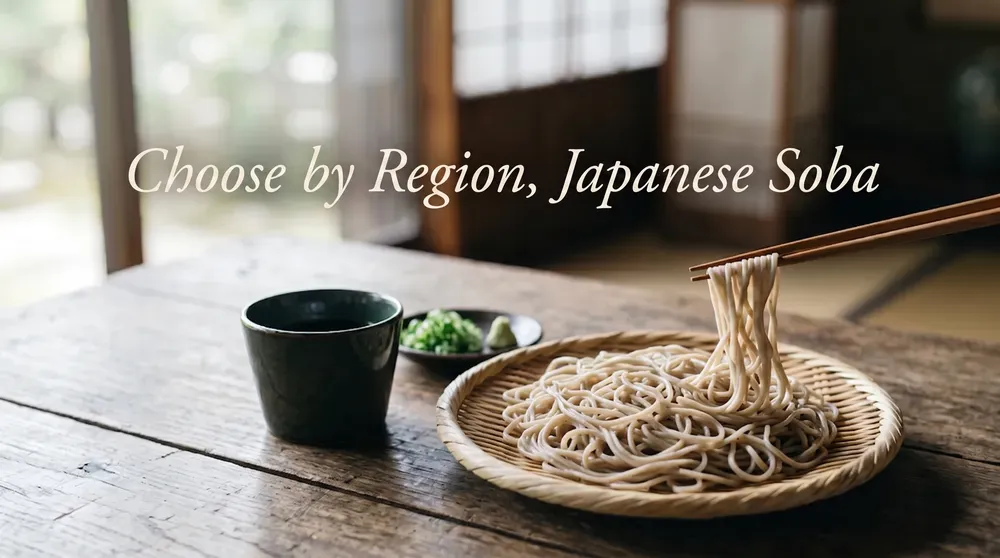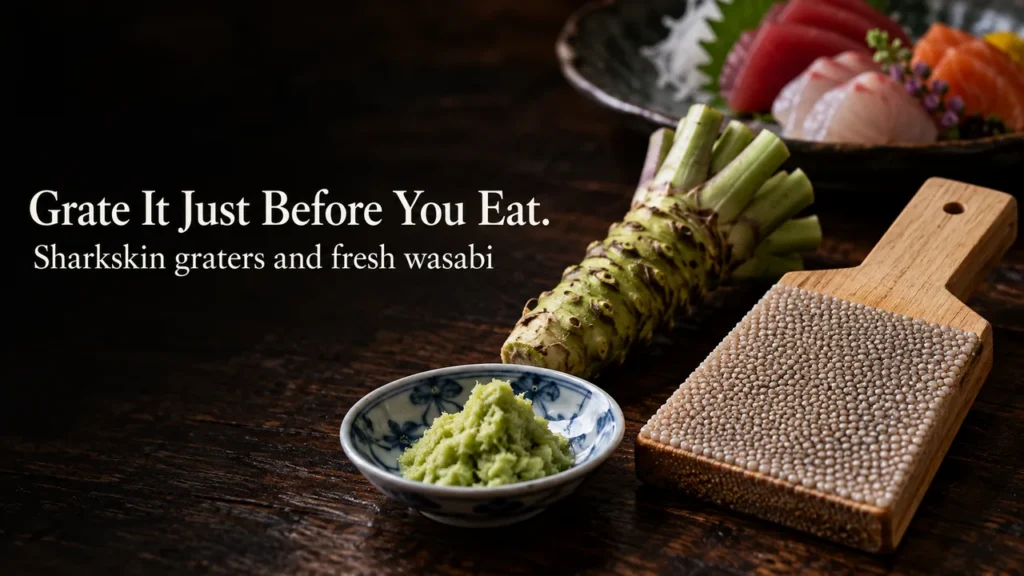
To taste fresh wasabi the way it's eaten in Japan, you need two things: one root, and a grater fine enough to turn it into a smooth paste.
You grate a little just before you eat. That small step is what lets you taste more than heat: the aroma, and a sweetness underneath. Sashimi, soba, grilled steak, a bowl of rice with bonito flakes. Once there's a root in the fridge, you start finding dishes for it.
This guide covers the graters made for that job in Japan, from a traditional sharkskin paddle you can order from abroad to a stainless board designed by a wasabi shop. It also covers the Shizuoka growers behind the root, and how to grate, eat, and store it so none goes to waste.
Quick Reference: Wasabi Graters at a Glance
| Chojiro sharkskin grater ▾ | Yamamoto Haganezame ▾ | |
|---|---|---|
| Grating surface | Real sharkskin on a Japanese cypress (hinoki) board | Etched stainless steel, a pattern of the characters "wa-sa-bi" |
| Made by | World Vision, finished by craftspeople | Yamamoto Foods, a Shizuoka wasabi shop, with a Japanese metalworking workshop |
| Care | Rinse, dry in the shade. No soaking, hot water, sun, or dishwasher | Dishwasher safe |
| From outside Japan | Official shop ships to the US, Canada, Europe, Australia and more | Sold through Japanese shops; no English page found |
| In common | Hold the root upright, press lightly, and grate in small circles | |
Already own a fine grater? Then all you need is a root. How to grate it ▾
1. Why Japanese: A Plant Native to Japan's Mountain Streams
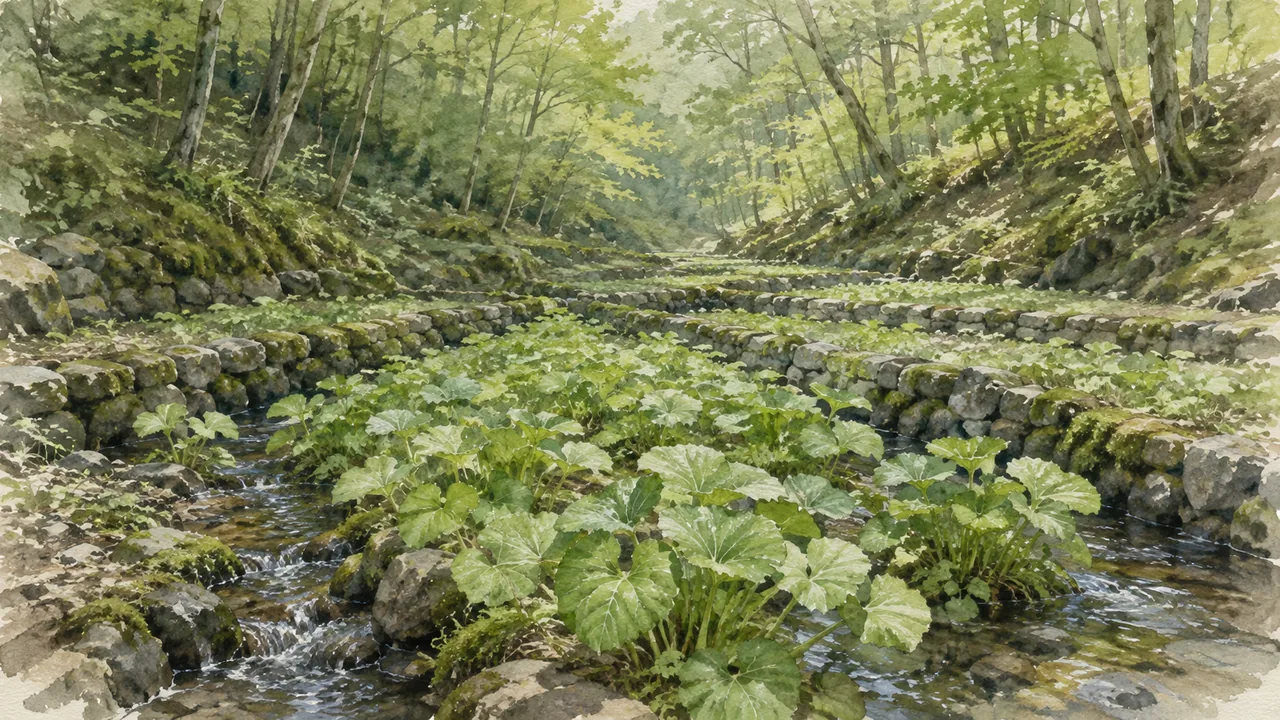
Wasabi is a Japanese plant, and Shizuoka is where it's farmed
Wasabi is native to Japan, and the part you grate is the knobbly green stem at the base of the plant, called the rhizome. In Shizuoka, growers have long used cold mountain water to farm it. In 2018 that way of growing, "Traditional Wasabi Cultivation in Shizuoka," was designated a Globally Important Agricultural Heritage System by the FAO.
The fields are built so water runs under the stones, too. In the tatami-ishi ("stacked-stone") style used in Shizuoka, large stones are laid at the bottom and smaller stones and gravel on top, so water flows not only across the surface but through the gaps beneath it. The field itself was engineered to make use of mountain water.
Marumasa Wasabi Farm: four generations in Utogi
Utogi is a hamlet about 600 metres up in the mountains of Shizuoka City. Marumasa Wasabi Farm, which describes Utogi as the birthplace of wasabi cultivation, has grown wasabi there across four generations of one family. From raising seedlings to growing, harvesting, and sorting, the work is done by looking and by hand, and the farm also develops its own varieties.
The clear water is what most people picture when they think of a wasabi region. But it's the farmers who keep shaping the place where wasabi can grow. With a root from Marumasa, you know which hillside it came from and whose hands raised it.
Yamamoto Foods: a wasabi shop since 1905 that designed its own grater
Yamamoto Foods, in Mishima, Shizuoka, has been a wasabi specialist since 1905. It sells fresh wasabi from Amagi on the Izu Peninsula and makes wasabi foods such as wasabi-zuke (wasabi stems pickled in sake lees). It didn't stop at selling the root: it set out to work out how people could grate it well at home, and developed a grater of its own, which appears in section 4.
Fresh roots from these growers are sold in Japan
Marumasa's medium root (about 40–60 g, or 1.4–2.1 oz) and Yamamoto's Amagi-grown wasabi are sold through Japanese online shops by chilled delivery. We didn't find international shipping for either. If you can buy a fresh root where you live, everything from section 3 onward applies.
2. What You Grate, and How Much to Buy
Grating is what makes the heat
A fresh root arrives whole, and the pleasure of it is grating only what you'll eat, each time. According to the Japan Wasabi Association, grating breaks the plant's cells, and that's what creates the pungency. So rather than grating a lot with force, you grate a little, slowly, right before sitting down. That's also the reason the grater matters.
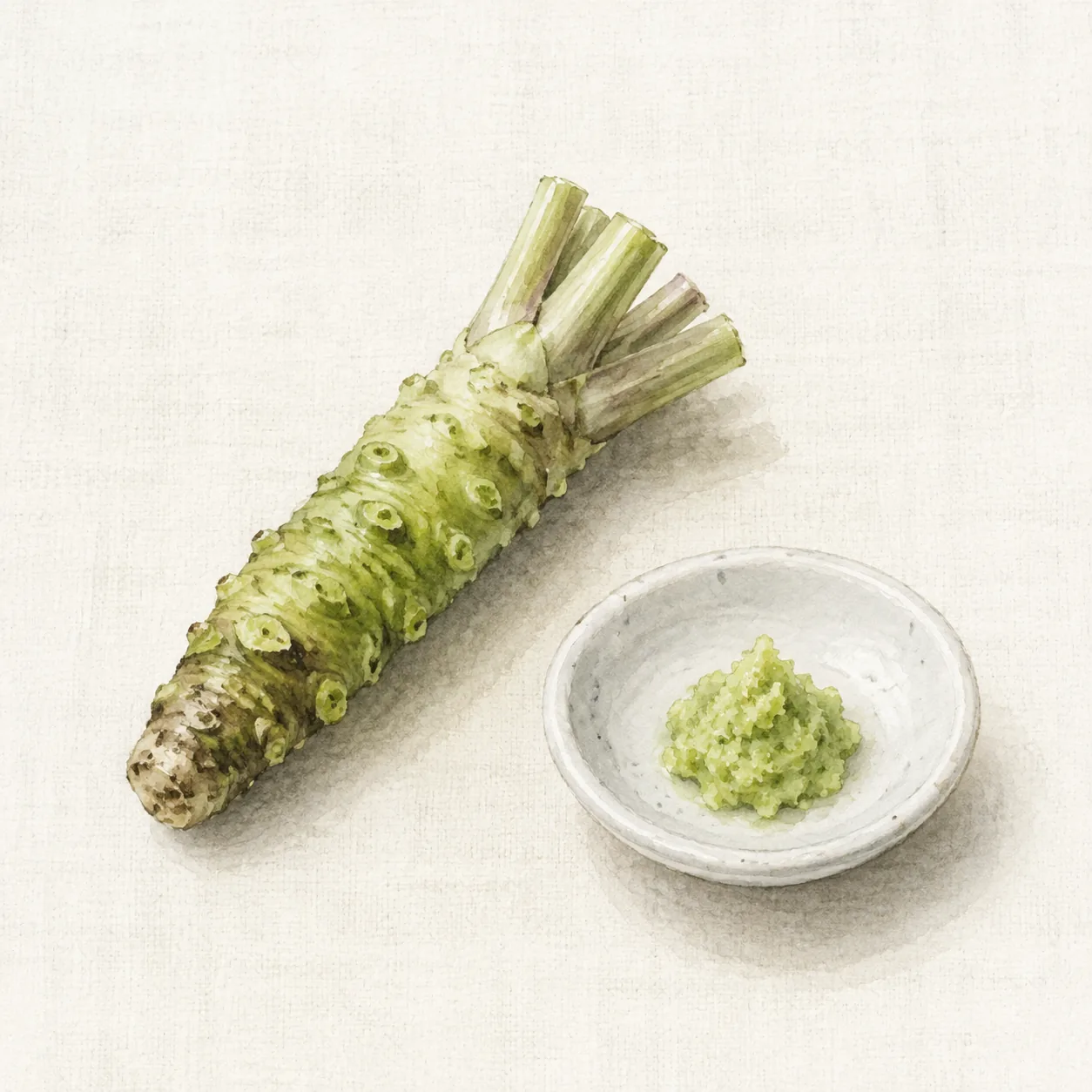
For a first time, start with one root
Fresh wasabi is sold anywhere from a single root to several. Roots around 40–60 g are a good place to start. It's hard to judge quantity by the number of people at the table, so buy a little first and find out which dishes you enjoy it with.
When comparing prices, look at the weight of the root and the total including chilled shipping. With small orders, shipping makes a big difference. Some sellers can't guarantee a delivery date for fresh produce, so if you're planning a particular meal, check the delivery terms before ordering.
3. The Sharkskin Grater: Chojiro, Medium Size
Fine roughness that grates a little at a time
The traditional tool is a wooden paddle covered in sharkskin (samegawa oroshi). The tiny bumps on the skin do the grating. Rather than shaving with a blade, you move the cut end of the root slowly over a rough surface.
World Vision, the maker of Chojiro, uses Japanese cypress (hinoki) and carefully selected real sharkskin, and each grater is finished by hand. Because the skin is natural, every one looks slightly different. If a wooden handle and a sharkskin face appeal to you, it's a tool you'll be glad to bring to the table.
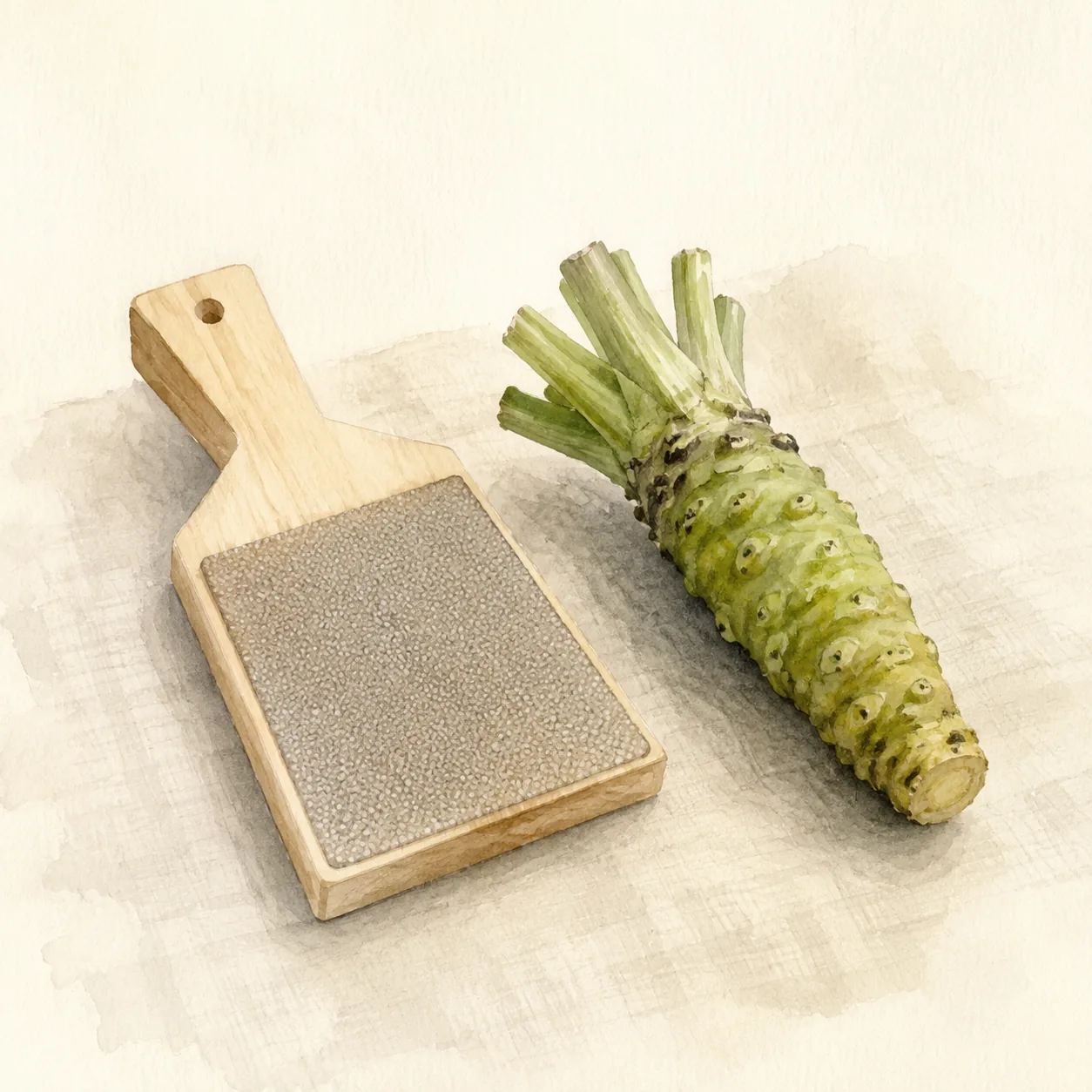
For home use, start with the medium
Chojiro comes in several sizes, and the maker recommends the medium for households. A smaller one stores more easily but leaves less surface to grate on. For a first grater, the medium gives you room to move the root in circles. It measures 6 × 5.6 × 11.3 cm (about 2.4 × 2.2 × 4.4 in).
After use, rinse it quickly and dry it in the shade. This is a tool for people who are happy to include that small step.
Chojiro sharkskin grater, medium — hinoki and real sharkskin
A household-size grater of Japanese cypress and sharkskin. The fine texture of the skin grates wasabi a little at a time, into a smooth, creamy paste. The maker also suggests it for green onion, carrot, and apple. Not dishwasher safe: rinse after each use and dry in the shade rather than leaving it in water.
On Amazon.com, the medium size comes as a gift set with a brush:
Chojiro Sharkskin Grater, Medium, with Brush (Gift Box)
Loading product details…
4. The Stainless Option: Yamamoto's Haganezame
A stainless grater designed by a wasabi shop
Alongside sharkskin, there's Haganezame ("steel shark"). Yamamoto Foods developed it with a small Japanese metalworking workshop: a stainless steel board whose surface, looked at closely, is covered in rows of the Japanese characters for wa-sa-bi. That fine pattern is the grating surface.
It's made by etching, a technique for working a metal surface in very fine detail. A wasabi shop's idea of grating wasabi finely, given shape by metalworking.
The regular Haganezame board is dishwasher safe. If you'd rather wash it with your everyday dishes, that ease is a reason to choose it. There's no need to decide whether it beats sharkskin. Pick the one you'll keep using.
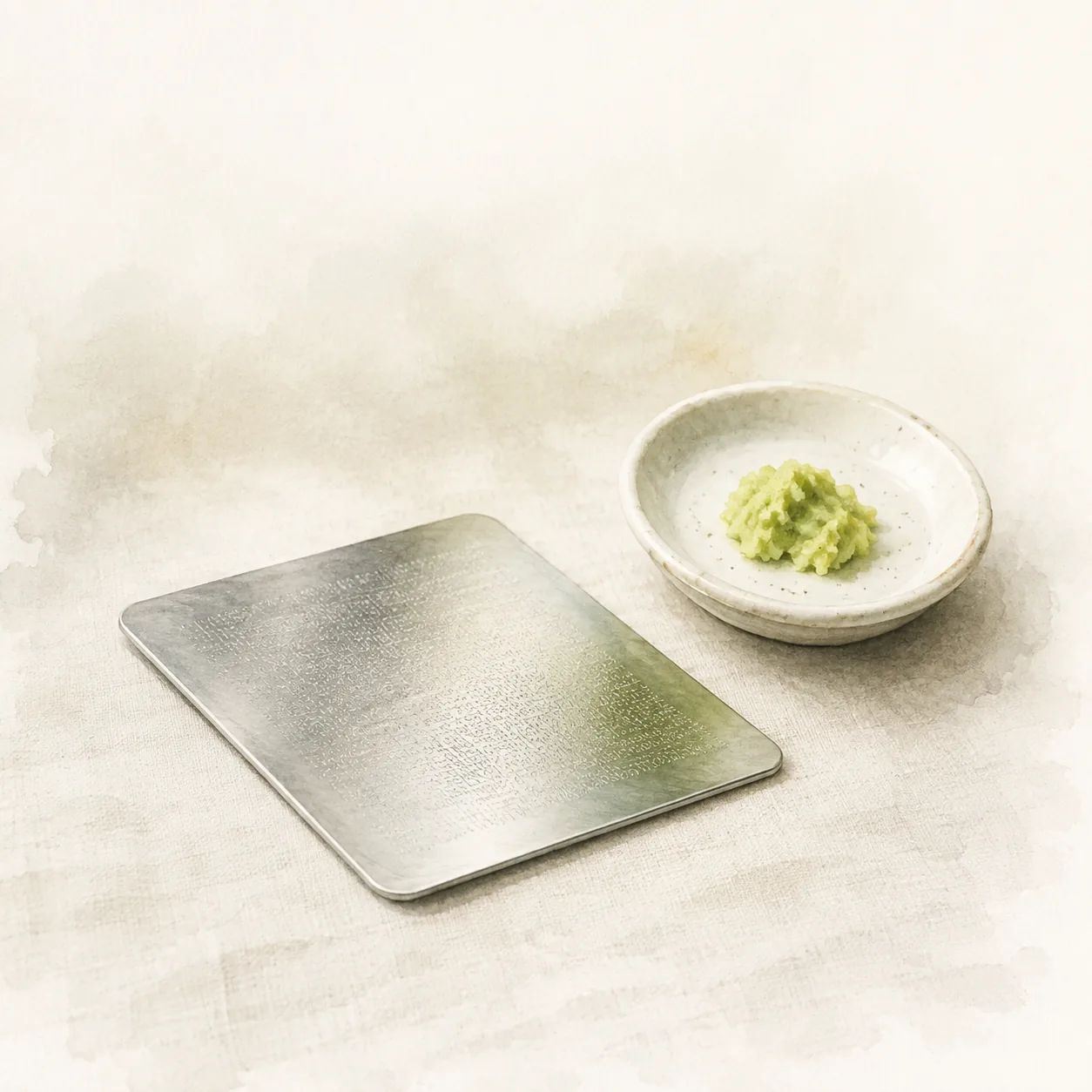
Yamamoto Foods Haganezame Regular — fine teeth, easy to wash
A fine grating surface in easy-care stainless steel, for anyone who wants to keep enjoying fresh wasabi. The current version, renewed in 2026, is sold as the board alone; the bamboo brush and scrubber are no longer included. In Japan it's also sold as a set with a root of Amagi-grown wasabi.
Yamamoto Foods Haganezame Regular Wasabi Grater
Loading product details…
5. How to Grate Fresh Wasabi, and What to Eat It With
Don't over-peel, and start from the stem end
Wash the root under water to remove any soil. Take off any remaining leaves and stems, and trim just the bumps that are hard to grate or any spots the dirt won't leave. There's no need to peel it all the way round.
Start grating from the thick end, where the leaves and stems were attached. Hold the root as upright as you can against the grater. Then, without pressing hard, move it slowly in small circles. Chojiro describes the motion as tracing the Japanese character の (no, a loop). When the paste turns fine and sticky, you're there.
The basics of grating and storage are also on the Japan Wasabi Association's guide (in Japanese).
"Grate wasabi with a smile"
There's a saying in Japan: wasabi wa waratte sure, "grate wasabi with a smile." Don't strain to do it all at once; go gently and slowly. Yamamoto Foods uses these words to pass on the knack. Even the first time you use a proper grater, take it easy and try a little at a time.
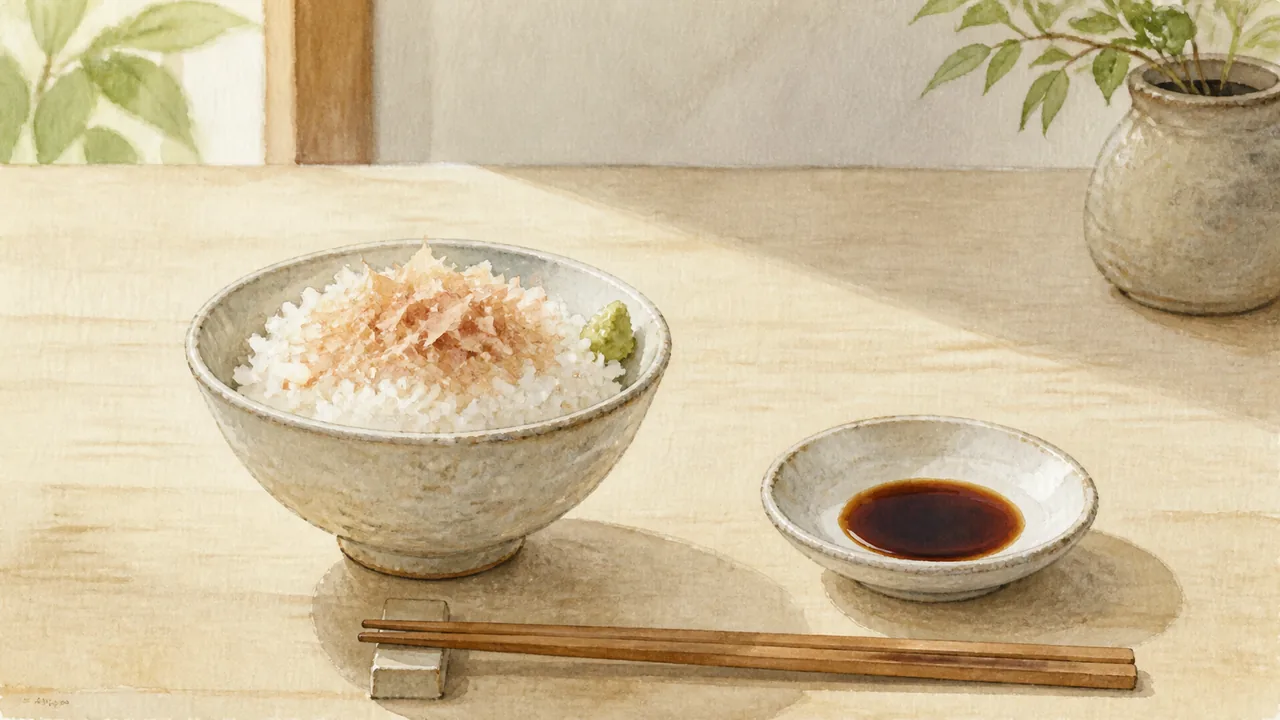
With sashimi or soba, a little at a time
The first thing to try is a small amount, freshly grated, placed on a slice of sashimi. Dip in soy sauce separately and you can adjust the wasabi for each piece. If you're not keen on heat, don't pile it on; find the amount you like.
With soba, one option is to put a dab on each mouthful before dipping it in the sauce. Stirring it into the sauce is fine too; there's no rule. Don't grate a lot in advance; use it bit by bit as you eat. That's all you need to begin.
The rest: wasabi rice bowls and grilled meat
Wasabi-don, a wasabi rice bowl, is easy to make at home: rice, a handful of bonito flakes, a little grated wasabi, and soy sauce to taste. With so few ingredients it's an easy way to use wasabi on any day. Mix it in a mouthful at a time so it doesn't get too hot.
It's also good with grilled beef or pork. Don't think of it as a sashimi-only ingredient; try adding a little to anything you'd eat with salt or soy sauce. Finding your favourite pairings while there's a root in the fridge makes the next one something to look forward to.
6. Storing Leftover Wasabi, and Caring for the Grater
Keep the root from drying out, in the fridge
If you don't use the whole root, wrap it in a damp paper towel, then in cling film or a storage bag so it doesn't dry out, and keep it in the fridge. Change the paper for a clean one as you go. If the seller gives storage instructions or a use-by date, follow those first.
How long a fresh root keeps depends on its condition. Don't stock up expecting it to last; order with the idea of using it while it's still fragrant. That makes the quantity easier to decide.
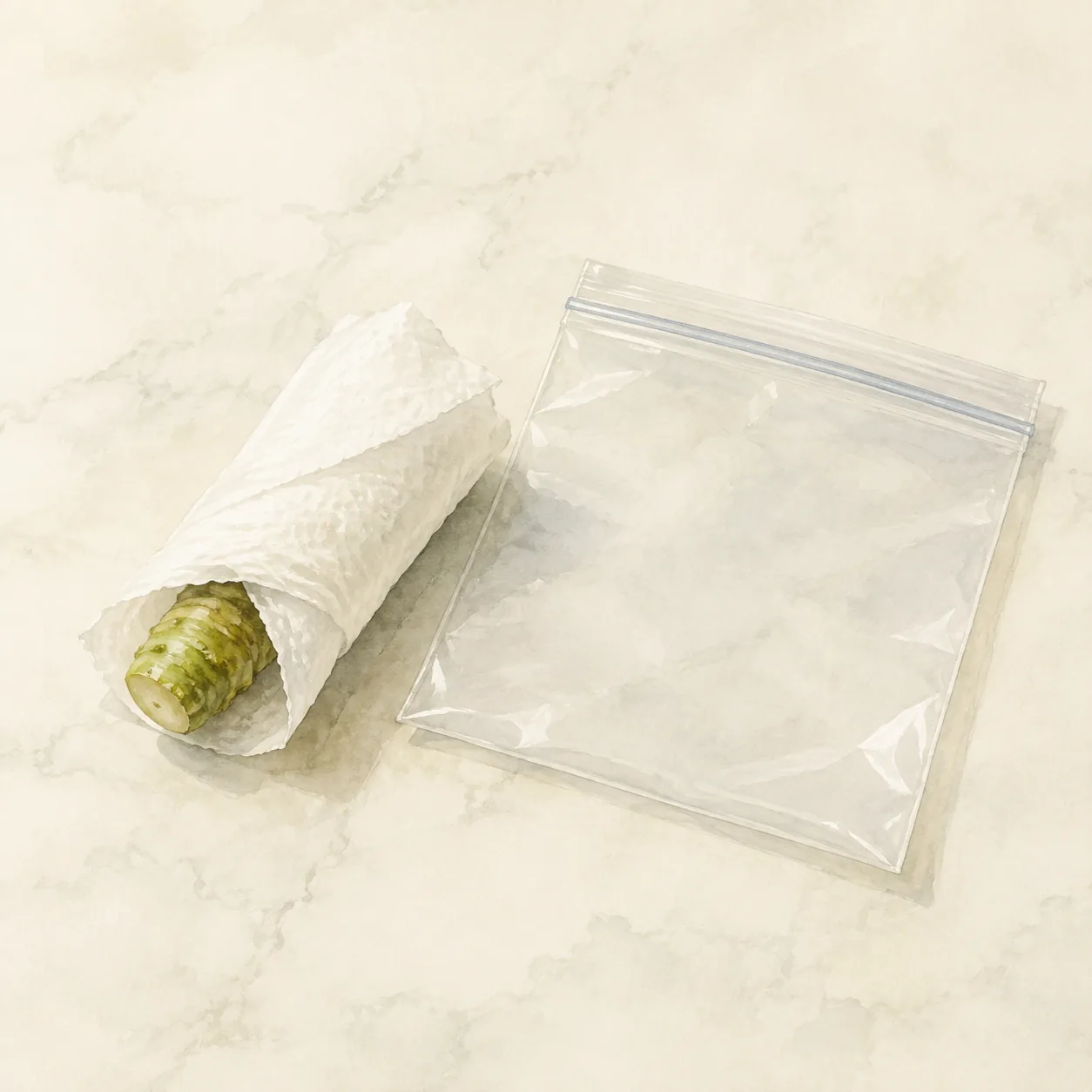
What you can't finish, freeze in small portions
It freezes, too. Yamamoto Foods recommends spreading grated wasabi thinly on cling film and wrapping it. Divide it into small amounts and you can take out just what you need for a dish. The aroma and texture won't be the same as freshly grated, but it's a useful way to keep what you'd otherwise waste.
Never soak sharkskin; rinse and dry it in the shade
Rinse the Chojiro grater after use and dry it in a shady, airy spot. Avoid soaking, hot water, and the dishwasher. The maker also advises against drying it in direct sun to speed things up, and warns that if the board stays damp for long, or is used many times a day without drying, the skin can loosen and the wood can crack or warp. Let it rest and dry now and then.
The Haganezame Regular, on the other hand, can go in the dishwasher. Each tool has its own care, so follow its instructions. Put away clean, it's ready the next time you buy a root.
7. Buying From Outside Japan
Chojiro's official shop has English pages and ships overseas, listing the US, Canada, European countries, China, Singapore, Thailand, South Korea, Taiwan, Hong Kong, Australia and New Zealand among its destinations. Payment is in Japanese yen; prices shown in other currencies are estimates. Shipping is charged by region, and the shop notes that personal orders are usually duty-free but that customs occasionally charge duties or fees, which it can't collect in advance.
We didn't find an English page or international shipping for Yamamoto Foods' Haganezame, or for the fresh wasabi from Marumasa and Yamamoto, which is shipped chilled within Japan. We will add listings you can buy from abroad here as we confirm them, one product at a time.
8. Frequently Asked Questions
Do I need a sharkskin grater for fresh wasabi?
Not necessarily. Any grater fine enough to turn wasabi into a smooth paste will work. This guide covers Chojiro's sharkskin grater and Yamamoto's stainless Haganezame. You can try the grater you already have first, then choose a dedicated one.
Should I peel fresh wasabi?
No need to peel the whole root. Wash it well, remove any leaves and stems, and trim only the bumps that are hard to grate or spots where dirt remains. If the seller includes preparation instructions, check those too.
Which end of the root do I grate from?
The thick end, where the leaves and stems were. Hold the cut end upright against the grater and, without pressing hard, move it slowly in small circles.
Can I buy Chojiro from outside Japan?
Yes. Chojiro's official shop ships overseas, including the US, Canada, Europe, Australia and New Zealand. Payment is in yen, and customs may occasionally charge duties or fees on delivery.
Can fresh wasabi be frozen?
Yes. Grate it, wrap it thinly, and divide it into small portions. The aroma and texture change compared with freshly grated, so treat it as a way to keep what you can't finish while it's chilled.
What else can I eat fresh wasabi with, besides sashimi?
Soba, grilled meat, and rice topped with bonito flakes. For a wasabi rice bowl, put bonito flakes and a little wasabi on rice and add soy sauce. Don't mix in a lot at once; adjust the heat a mouthful at a time.
Final Thoughts: One Root, Grated at the Table
A root grown in Shizuoka's mountain water, and a tool made just to grate it. Wasabi is a plant native to Japan, and Shizuoka's way of farming it is recognised as world agricultural heritage.
For the grater, there's Chojiro's hinoki-and-sharkskin paddle, which you can order from abroad, and Yamamoto Foods' stainless Haganezame, which goes in the dishwasher. With either one, you start the same way: a little at a time, just before you eat.
On a sashimi night, or on a day you're just putting bonito flakes on rice, grate a little before you sit down and add it to what's on the table.
Japanese Graters: Copper & Tsubame-Sanjo Steel for Fluffy Daikon