White Rose
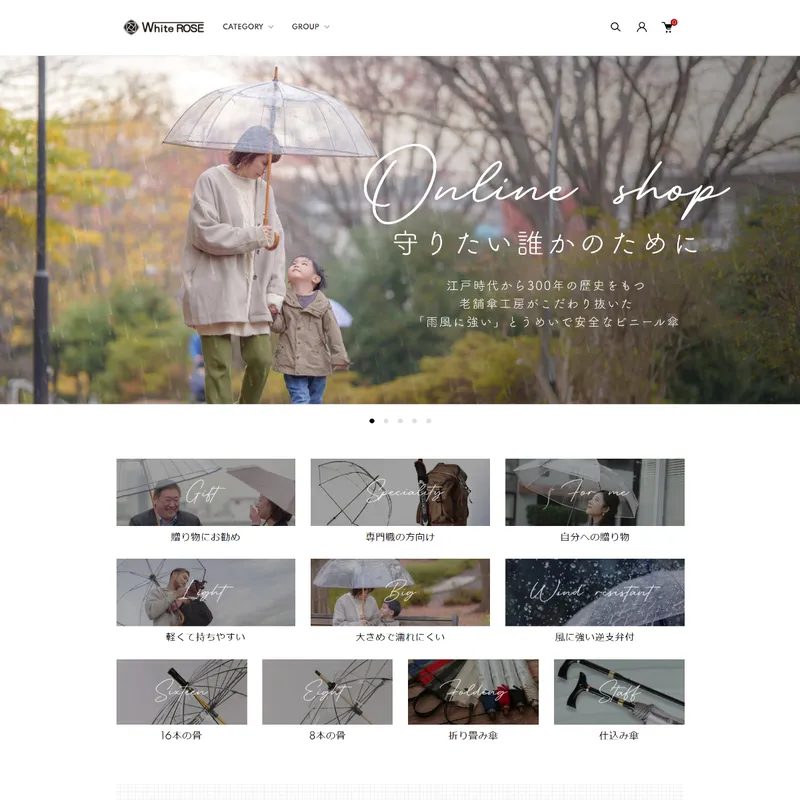
Clear canopies, clearer streets on rainy days.
Based in Kotobuki, Taito-ku (Tokyo), White Rose has built its identity around clear umbrellas designed for safer visibility. Some models use polyolefin multi-layer film, balancing transparency with waterproof performance. The patented "reverse valve" mechanism lets wind escape from inside the canopy, helping reduce turning inside out while keeping rain out. Another key idea is longevity: umbrellas made to be repaired and used for years, not treated as disposables.
Why We Love It
For a first pick, start with a portable folding model in the Amemachi line, or the lightweight long umbrella Kateel Piccoro. If you want more coverage, the 16-rib Kateel 16 Sakura offers a wide diameter, while the extra-large Terra Bozen suits days when you need maximum canopy space. It's also fun to compare natural-wood handles and shafts across models. Many items come with a storage bag, handy right after the rain. For long-term use, having repair consultations available adds peace of mind.
PROFILE About the Company / Workshop
WHITE ROSE CO., LTD. operates from Kotobuki, Taito-ku in Tokyo, with both an office and a store, and also maintains its own factory (White Rose Asahi Factory). The business traces its origins to Kyoho 6 and was incorporated on February 9, 1953. Using materials such as EVA and vinyl, it applies high-frequency welding and sewing to make rain gear and household items.
One signature model, Kateel 16 Sakura, features a 16-rib frame with an operating diameter of about 108 cm. It uses a birch shaft, a natural sakura-wood handle, and a polyolefin multi-layer film canopy. The patented reverse-valve mechanism is included as well, aiming to keep visibility clear while easing wind-related stress.
The lineup ranges from compact long umbrellas like Kateel Piccoro (about 84 cm diameter) to folding umbrellas in the Amemachi series, and even extra-large options such as Terra Bozen (140 cm diameter). You can choose by opening style (manual or jump), size, and handle materials — each model has a clear role.
Longevity is part of the brand's "eco" thinking: repairable umbrellas meant to be used longer. The company also references a wind-speed durability test at 15 m/s conducted with support from the Japan Culture Goods Safety Testing Institute. The Kotobuki store functions as a place to visit and consult, keeping the relationship with users close.
Visibility-first, with a fully clear canopy
White Rose positions a clear umbrella as a tool for safer walking in bad weather. Selected models use polyolefin multi-layer film, keeping the view open while staying waterproof. Clear vision matters when streets get dark and crowded.
Patented "reverse valve" to release wind pressure
The patented reverse-valve structure creates a path for wind to escape from inside the canopy. It is designed to reduce inversion in strong gusts, while still preventing rain leakage. You'll find it across many core models.
Materials tuned for everyday comfort
The cover material is described as less sticky when wet, and stable from 70°C down to -20°C. Frames often use fiberglass ribs to flex and shed wind. It's a practical approach that shows up in the feel of daily use.
Made to be repaired and kept
A key message is longevity: umbrellas that can be repaired, encouraging careful use rather than quick disposal. With a store in Taito-ku and its own factory (White Rose Asahi Factory), the brand builds support into the way it makes things.