KOMETUYA (Rice-Fed Eggs)
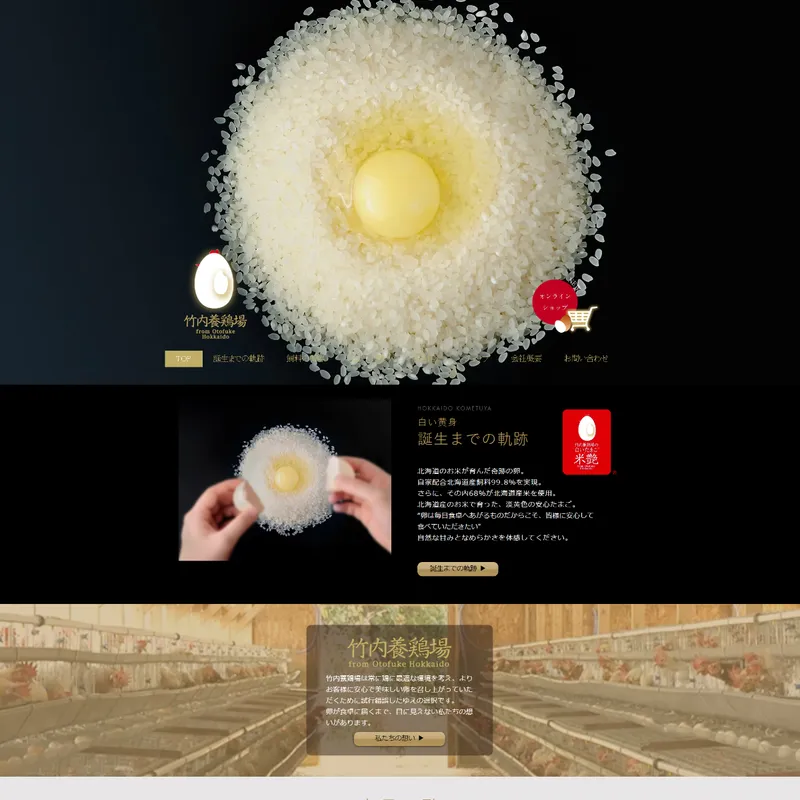
Founded in 1955 in Otofuke, Hokkaido, Takeuchi Poultry Farm built the KOMETUYA line around a clear idea: eggs should reflect what hens are truly fed. The farm formulates feed from raw ingredients and keeps the blend at 99.8% Hokkaido-sourced. With Hokkaido rice (including rice from Higashikawa) as the main component, KOMETUYA eggs can show a pale lemon-yellow yolk when raw and turn white when cooked — an unmistakable signature created by the feed itself, not added pigments.
Why We Love It
The biggest surprise of KOMETUYA is the "white yolk" when made into a fried egg or boiled egg. Beyond the visual impact, the soft sweetness from rice and the richness from Kushiro fish meal coexist — so even with a soft-boiled egg, the "outline of flavor" comes through clearly. Including the design of being limited to young hens within 350 days, this is an egg that hits home for people who want to straightforwardly upgrade what they eat every day.

PROFILE About the Company / Workshop
Takeuchi Poultry Farm began in 1955 and has remained rooted in Otofuke, Hokkaido. Because eggs are a daily staple, the team emphasizes transparency in ingredients, husbandry, and shipment — details that directly shape both safety and taste.
The farm blends feed from scratch, purchasing raw materials and adjusting the mix as needed. Their preference for Hokkaido-sourced ingredients is also connected to how they view imported staple crops: GMO varieties and post-harvest pesticide practices can be difficult to evaluate over long-term exposure, so they choose to center production on ingredients from Hokkaido, where GMO cultivation is regulated by local ordinance.
KOMETUYA is defined by its rice-based feed. By avoiding pigment additives, the eggs naturally show a pale lemon-yellow yolk when raw and can turn white after cooking. The look on the plate becomes a direct reflection of the ingredient choice, not a cosmetic adjustment.
For husbandry, the farm chooses a cage system to prioritize hygiene: droppings fall below the cages so hens do not contact them, and the hens consume only the provided feed and water. This approach also supports stable management through Hokkaido's severe winters and helps maintain high laying rates without placing extra stress on the birds.
At the same time, the poultry houses are curtain-style open barns. Curtains are adjusted multiple times a day to match weather and temperature, balancing airflow and protection. The farm also uses an all-in/all-out method: after about 13 months of rearing, birds are moved out together, the house is washed and disinfected, and then left empty for at least a month to keep conditions clean.
The operation links back to the local community through circular practices — rice husks are used as bedding material, and all manure is utilized as compost by local farmers. Chicks are introduced at 105 days after completing a vaccination program with a specialized grower, and the farm states it does not administer antibiotics thereafter.
Eggs are brushed rather than washed to protect the natural cuticle layer, collected on the morning of shipment, and dispatched the same day. Alongside the rice-forward KOMETUYA, the farm also offers TAMATUYA, which uses Hokkaido corn (18%) for a naturally yellow yolk without coloring agents, and YUMETAMAGO, a Co-op Sapporo private brand egg made under the same production philosophy.
99.8% Hokkaido-sourced feed, blended in-house
Instead of buying pre-mixed feed, the farm procures each ingredient and blends it on site. This allows the ratio to be adjusted in real time based on season and the hens' condition — one of the foundations of consistent quality.
A rice-forward recipe with traceable ingredients
The overall feed ratio is led by Hokkaido rice at 68% (including rice grown in Higashikawa). It also includes fish meal from the Kushiro port (15%) made from fish such as saury, sardine, and herring processed on the same day, plus Hokkaido fresh rice bran (8.8%) and sterilized, crushed scallop shells from Lake Saroma (8.0%).
KOMETUYA: gentle sweetness and a rich finish
Because the feed contains no pigment sources, the yolk appears a clear lemon yellow when raw and turns white after heating. The farm describes the flavor as softly sweet with a smooth, fine texture, while generous use of Kushiro fish meal adds depth and richness.
Brand eggs limited to young hens (within 350 days)
To highlight the signature balance of sweetness and richness, KOMETUYA is limited to eggs laid by young hens within 350 days. The egg white is noted for rising firmly, giving the egg a dense, energetic character.
LINKS Official Links / Social Media
- Online Shop https://www.kometuya.jp/shop
- Contact Form https://www.kometuya.jp/contact
- How KOMETUYA Was Born https://www.kometuya.jp/history
- Feed (Ingredients and Ratios) https://www.kometuya.jp/feed
- Our Philosophy (Husbandry and Hygiene) https://www.kometuya.jp/message
- Products (KOMETUYA / TAMATUYA / YUMETAMAGO) https://www.kometuya.jp/egg
- Gift Orders https://www.kometuya.jp/gift
- Subscription https://www.kometuya.jp/subscription
- Company Profile https://www.kometuya.jp/information